Eight Years of Turbulence in Web3 Phones: From 'Geek Toy' to Xiaomi's 'Factory Standard'

marsbitPublicado em 2025-12-11Última atualização em 2025-12-11

Resumo

Web3 Smartphones: An 8-Year Evolution from 'Geek Toy' to Xiaomi's 'Standard Feature' On December 10th, high-performance blockchain Sei announced a partnership with Xiaomi, the world's third-largest smartphone manufacturer. The Sei Foundation will develop a next-gen crypto wallet and DApp discovery platform, which will be pre-installed on Xiaomi's new smartphones for global markets (excluding mainland China and the US). Utilizing MPC technology, the collaboration aims to allow users to log in directly via Google or Xiaomi accounts, eliminating intimidating seed phrases. A pilot stablecoin payment system is also slated for 2026, enabling purchases at Xiaomi's retail stores with tokens like USDC. The journey of Web3 phones began around 2018 with devices like Sirin Labs' Finney and HTC's Exodus 1, which focused on "hardware sovereignty" and extreme security, often featuring physical safeguards or trusted execution environments (TEE). These early attempts, including niche projects like Pundi X's communication-focused BOB phone and Electroneum's low-cost "cloud mining" M1, were commercially unsuccessful due to high costs and poor user experience, remaining confined to tech enthusiasts. Mainstream manufacturers like Samsung cautiously entered the space around 2019, integrating features like the Samsung Blockchain Keystore into flagship models. A notable early example was the "KlaytnPhone" edition of the Galaxy Note 10, which included free KLAY, prefiguring the later "airdrop" mod...

On December 10th, the high-performance public chain Sei announced a partnership with Xiaomi, the world's third-largest smartphone manufacturer. The Sei Foundation will develop a new generation of crypto wallets and a decentralized application (DApp) discovery platform, which will be pre-installed directly on Xiaomi's new smartphones targeting the global market (excluding Mainland China and the United States).

The two parties plan to utilize Multi-Party Computation (MPC) technology, allowing users to log into the wallet directly via their Google or Xiaomi accounts, eliminating the intimidating 'seed phrases' for average users. They also plan to pilot a stablecoin payment system in regions like Hong Kong and the European Union in the second quarter of 2026, enabling users to directly use tokens like USDC to purchase electronics at Xiaomi's over 20,000 offline retail stores.


Retrospective: The Seven-Year Evolution of Web3 Phones


First-Generation Attempts (2018–2020): Hardcore Security and Wild Imagination
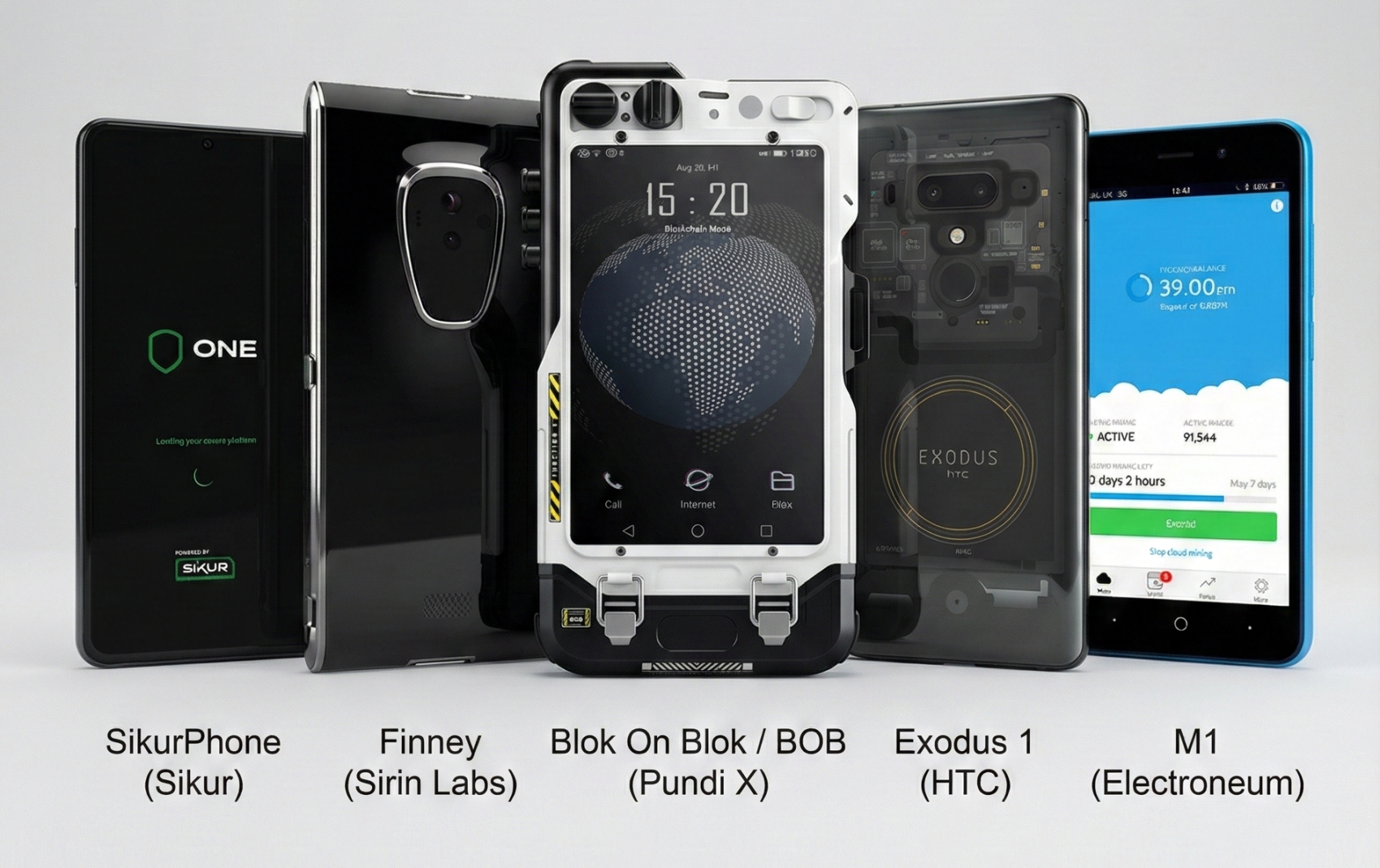

Image source: Internet, compiled by AI


Around 2018, alongside the first major crypto market bull run, the first batch of 'blockchain phones' was born. The representatives of this era were Sirin Labs' Finney and HTC's Exodus 1, whose design philosophies were 'hardware sovereignty' and 'ultimate security'.


Taking Sirin Labs' Finney as an example, this phone featured a unique slide-out 'security screen' that used physical isolation specifically for displaying transaction details and entering passwords, ensuring funds remained safe even if the main system was compromised. HTC, in collaboration with Binance, developed the Exodus 1, introducing the 'Zion Vault', which utilized the phone chip's Trusted Execution Environment (TEE) to store private keys.


Besides Sirin and HTC, another device worth mentioning is the SikurPhone, which represented an attempt at a 'closed system' at the time. Launched by a Brazilian security company, the SikurPhone focused on being 'hacker-proof' and having a built-in cold wallet. Its extreme approach was running the highly closed SikurOS, which did not allow users to install third-party applications themselves (requiring manufacturer evaluation), thereby reducing the attack surface.


Beyond secure storage, entrepreneurs of the time had even more cyberpunk imaginations. Pundi X launched the Blok On Blok (BOB) phone, attempting to solve the problem of decentralized communication. This modular phone allowed users to switch between 'Android mode' and 'blockchain mode', claiming to enable calls and data transmission over a decentralized network without going through mobile carriers.


During this phase, Electroneum released the M1 phone priced at just $80. It targeted developing countries, allowing users to perform 'cloud mining' on the phone to earn tokens for paying phone bills. Although it didn't gain traction at the time due to poor user experience, it was actually the precursor to the later 'phone-as-a-miner' and JamboPhone models.


However, these devices ultimately could not escape commercial failure. The Finney was priced as high as $999 and had dismal sales, while Pundi X's decentralized communication failed to take off due to a lack of user base. The technological features of the time overly emphasized turning the phone into a 'cold wallet' or 'full node', which posed too high a barrier for ordinary users, resulting in products that only circulated within geek circles.


Mainstream Manufacturers Testing the Waters (2019–2022): Cautious Exploration


Image source: Internet, compiled by AI


Seeing the attempts of early startups, mainstream phone manufacturers began testing the waters in a more cautious manner. Samsung integrated the Samsung Blockchain Keystore into its Galaxy S10 series, theoretically giving tens of millions of flagship phone users a hardware-level encrypted wallet.


It is worth noting that Samsung actually laid the groundwork for 'buy a phone, get tokens' as early as 2019. In its 'KlaytnPhone' special edition of the Galaxy Note 10, Samsung partnered with the Korean internet giant Kakao to randomly include 2,000 KLAY tokens. This can be seen as the earliest雏形 (prototype) of the later successful Solana Saga model, although it was confined to the Korean market at the time and did not cause a global sensation.


This period also saw attempts targeting specific niche markets. For example, Vertu launched the Metavertu, priced at tens of thousands of dollars, promoting 'dual-system' switching and luxury services, aiming to attract crypto tycoons. HTC also pivoted to launch the Desire 22 Pro, focusing on the metaverse concept.


Although the involvement of major manufacturers brought better hardware experiences, the limitations of this stage were still evident: Web3 functions were often hidden in deep menus or used merely as marketing gimmicks, failing to fundamentally change user habits.


Besides the 'hardware wallet' attempts by big manufacturers (Samsung) and 'luxury gimmicks' (Vertu), this stage also saw a lightweight path of 'software-defined membership' with the Nothing Phone. Nothing Phone partnered with Polygon to establish a decentralized membership loyalty program through the 'Black Dot' NFT.


The New Wave (2023–2025): Ecosystem Binding and Infrastructure-ization
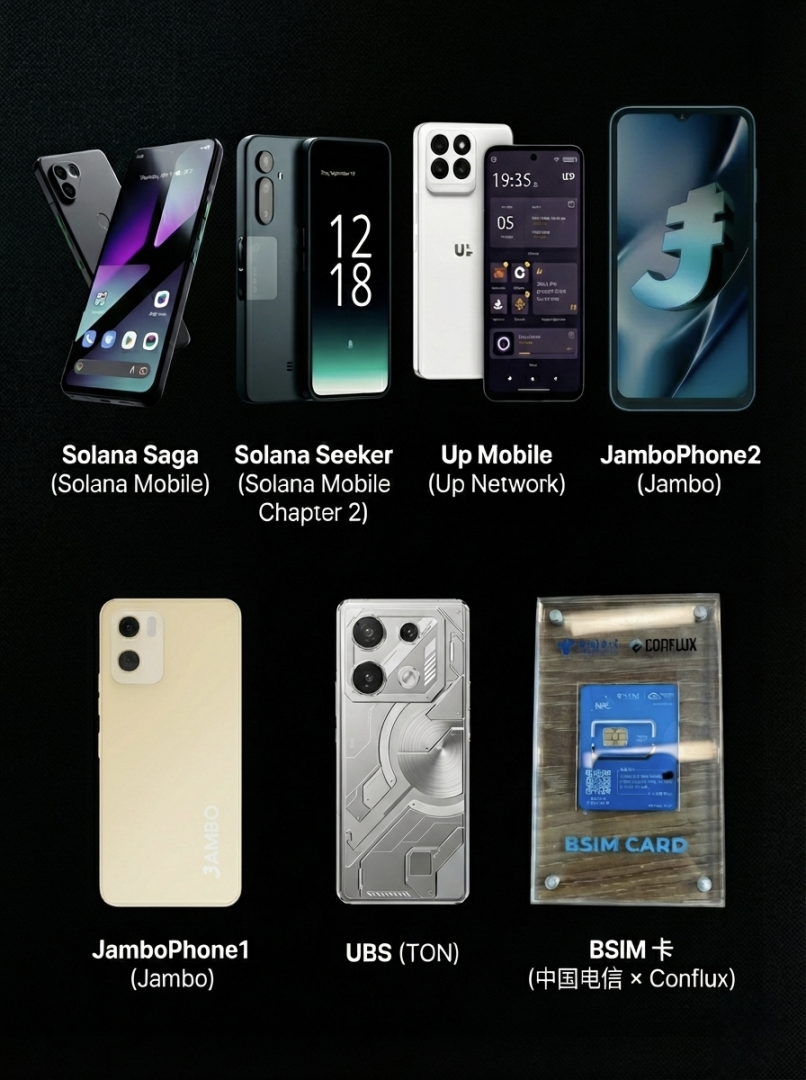

Image source: Internet, compiled by AI


Entering 2023, the Web3 phone market was completely activated by the Solana Saga, ushering in a new era of 'ecosystem binding' and 'token incentives'. The Solana Saga initially had stagnant sales due to poor cost-performance, but after the value of the included BONK token airdrop exceeded the phone's price, it sold out instantly, earning the nickname 'dividend phone'.


The subsequent Solana Seeker (Chapter 2) continued this airdrop logic, using 'Soulbound Tokens' (SBT) to prevent scalping and introducing the TEEPIN architecture to support decentralized infrastructure networks.


Meanwhile, ecosystem competition intensified. The TON ecosystem launched the Universal Basic Smartphone (UBS), also priced at $99, directly challenging the JamboPhone. The TON phone leverages Telegram's massive user base, focusing on 'data dividends', allowing users not only to earn money by completing tasks but also to profit from selling their own data. Binance Labs-incubated Coral Phone also joined the fray, aiming to build a dedicated hardware entry point for the BNB Chain ecosystem, focusing on multi-chain aggregation and AI functions.


In the low-end market, the JamboPhone entered the arena with an ultra-low price of $99, serving as an entry point for 'super apps' and attracting users in Africa and Southeast Asia through a 'Learn to Earn' model. New players like Up Mobile also began to get a piece of the pie by combining AI and Move language technology. Jambo has already launched its second-generation product. While maintaining the $99 price, it upgraded the RAM to 12GB (although the processor remains entry-level), which is already capable of handling more Web3 tasks and 'super app' demands in emerging markets.


The BSIM card launched by China Telecom and Conflux showcased another path: a SIM card with a built-in high-performance security chip. Users simply need to replace their SIM card to transform any ordinary Android phone into a higher-security Web3 device. This 'Trojan Horse' strategy provides a new approach for large-scale adoption in compliant markets.


Trends: Shifts in Five Directions


Looking at the development over these eight years, we can clearly see five key shifts happening with Web3 phones.


Hardware capabilities and security architectures are upgrading. Early security relied mainly on software or simple TEE isolation, whereas now, technology is evolving towards more complex directions. Solana Seeker introduced the TEEPIN (Trusted Execution Environment Platform Infrastructure Network) architecture, enabling the phone to act as a trusted node participating in DePIN network construction. The BSIM card launched by China Telecom and Conflux integrates private key generation and storage directly into the SIM card, achieving telecom-grade hardware security. The collaboration between Xiaomi and Sei employs MPC technology, allowing users to log in with one click via their Google account, enabling secure management without seed phrases.


Ecosystem binding has become standard. Today's Web3 phones are not just generic crypto devices but entry points to specific public chain ecosystems. Saga is bound to Solana, Up Mobile is bound to Movement Labs, while JamboPhone, based on Aptos, further aggregates the Solana and Tether payment ecosystems, becoming a super app entry point for emerging markets. The phone has become a channel for public chains to distribute applications and retain users.


Airdrops or incentives dominate user growth. The motivation for users to buy Web3 phones has shifted from 'secure storage' to 'obtaining收益 (returns/profits)'. Saga's success proved that hardware can be used as a 'loss-leading' tool, compensating users with subsequent token airdrops or other incentives. This economic model of 'phone-as-a-miner' or 'phone-as-a-golden-shovel' has become the strongest driving force in the current market.


Application scenarios take precedence over technical concepts. Early products were obsessed with geeky functions like 'running a full node', while the current focus has shifted to practical applications. The core of the Xiaomi-Sei collaboration is stablecoin payments, and JamboPhone focuses on流量变现 (monetizing traffic) through built-in apps. Solving real payment and application distribution problems is more attractive than pure technological stacking.


Channel and scale effects are beginning to show. Selling 20,000 Solana Saga units was considered a huge success, but it's a drop in the bucket compared to Xiaomi's annual shipment volume of 168 million units. When a major manufacturer like Xiaomi starts pre-installing wallets via system updates, the growth scale of Web3 users will leap from 'ten-thousands' to 'hundreds of millions'. This scale effect is unmatched by any vertical crypto phone manufacturer.


Conclusion: Tearing Down the Walls, Integrating into the Mainstream


Throughout this eight-year evolution, we attempted to build expensive, closed Web3 phones as secure fortresses. But reality has proven that the real 'wall' hindering Web3 adoption is not security, but the complexity of seed phrases and the fragmented user experience.


Truly valuable Web3 phones will eventually no longer need to label themselves as 'Web3 phones'. They should be like today's 5G phones; you don't need to understand the underlying communication protocols, you just enjoy the high-speed experience they bring.


Solana Mobile proved that breaking through driven by利益 (interest/profit) is feasible, while SEI's partnership with Xiaomi is attempting to prove that integration driven by experience is the long-term solution. In this evolution from 'hardcore toy' to 'mass tool', whoever lowers the technical barrier of Web3 the most, whoever彻底推倒 (completely tears down) this cognitive wall, will hold the ticket to the next hundred-million user base.


Perguntas relacionadas

QWhat is the significance of the recent partnership between Sei and Xiaomi in the Web3 phone market?

AThe partnership signifies a major shift towards mainstream adoption, as Sei will develop a next-gen crypto wallet and DApp discovery platform pre-installed on Xiaomi's global smartphones (excluding China and the US). It leverages MPC technology for seamless login via Google or Xiaomi accounts, eliminating seed phrases, and plans to pilot a stablecoin payment system (e.g., USDC) in Xiaomi's retail stores by 2026.

QHow did the early Web3 phones (2018-2020) differ from the current generation in terms of focus and user experience?

AEarly Web3 phones like Sirin Finney and HTC Exodus 1 focused on 'hardware sovereignty' and 'extreme security' through features like physical isolation screens and trusted execution environments (TEE). They were expensive, complex, and targeted at tech-savvy users, whereas current models prioritize user incentives (e.g., airdrops), practical applications (e.g., payments), and seamless integration, lowering barriers for mainstream users.

QWhat role did Solana Saga play in revitalizing the Web3 phone market in 2023?

ASolana Saga activated the market by introducing an 'ecosystem binding' and 'token incentive' model. Initially slow-selling, it gained massive popularity when the included BONK token airdrop exceeded the phone's price, making it a 'dividend phone.' This success demonstrated that hardware could be used as a loss-leading tool for user acquisition through future airdrops and rewards.

QWhat are the five key shifts in Web3 phone development highlighted in the article?

AThe five shifts are: 1) Upgraded hardware security (e.g., TEEPIN, MPC, BSIM cards); 2) Ecosystem binding (phones as entry points for specific chains like Solana or Aptos); 3) Airdrop/incentive-driven user growth; 4) Focus on practical applications (e.g., payments) over technical concepts; 5) Emergence of scale and channel effects, with major manufacturers like Xiaomi enabling billion-user reach.

QHow does the BSIM card developed by China Telecom and Conflux represent an alternative approach to Web3 phone integration?

AThe BSIM card is a 'Trojan horse' strategy that embeds a high-performance security chip into a SIM card. By simply replacing the SIM, any standard Android phone can be transformed into a Web3 device with enhanced security for private key storage and management, offering a compliant and scalable solution for mass adoption without requiring specialized hardware.

Leituras Relacionadas

KOL's Perspective: Why Is SOL Set to Rise from This Point?

**Summary: Why SOL is Positioned for Growth at This Level** The article argues that SOL is poised for an upward move from its current price point, citing several key factors. Primarily, SOL has just broken out of a 4-month consolidation phase. This breakout signals a return of risk appetite to the broader crypto market, as SOL is seen as a key indicator of overall crypto health. The token's ownership has reportedly shifted from short-term traders and tourists to long-term accumulators, leading to low volume. Any meaningful increase in trading activity could thus trigger significant upward momentum. Fundamental strengths include strong institutional adoption, integration with DeFi and RWAs (Real-World Assets), and the potential benefits from the Clarity Act. Despite its high volatility—having dropped 70% from its all-time high but still up 12x from its bear market low—SOL is highlighted as one of the few tokens from the last cycle to reach new highs. It boasts a robust ecosystem of applications, users, and protocols. Future catalysts include the expected influx of AI developers following the Miami Accelerate conference, which focused on AI on Solana. Furthermore, Solana is positioned as the premier chain for memecoin activity, a trend expected to continue and drive network usage and fees. The article concludes that recent price action reflects a healthy transfer to long-term holders, setting the stage for growth.

marsbitHá 13m

KOL's Perspective: Why Is SOL Set to Rise from This Point?

marsbitHá 13m

Those Pre-Bitcoin PoW Protocols Have Recently Been Reimplemented

This article details a recent surge in replicating pre-Bitcoin Proof-of-Work (PoW) protocols, specifically focusing on Hal Finney's 2004 RPOW (Reusable Proofs of Work). Within five days in May 2026, multiple independent builders in the Bitcoin/cypherpunk community launched projects inspired by this early electronic cash proposal. The initiative began with Fred Krueger's `rpow2.com`, a centralized but auditable system that replaced RPOW's original IBM 4758 hardware with Ed25519 signatures. Initially a faithful replica, it later adopted Bitcoin-like features (21M supply cap, difficulty adjustment) and a controversial 5.24% founder allocation. This sparked rapid forks, including `rpow4.com` which incorporated full Bitcoin parameters, a prediction market (`rpowmarket.com`), and a DEX (`rpow2swap.com`). Concurrently, Mike In Space created a prototype of Wei Dai's 1998 b-money proposal (`b-money.replit.app`), pushing the historical exploration even further back. The article contrasts these centralized, server-dependent experiments with Bitcoin's core innovation of decentralized, trustless consensus. It also highlights a parallel development: the `HASH` project on Ethereum, which uses smart contract hooks to enable a purely fair-launch, browser-mineable PoW token with 0% allocations to team or VCs. The collective activity is framed as a meme-driven, educational exploration of cypherpunk history rather than a serious financial movement, with all projects heavily disclaiming any investment value.

marsbitHá 17m

Those Pre-Bitcoin PoW Protocols Have Recently Been Reimplemented

marsbitHá 17m

South Korean Exchanges 'Battle' Regulators, Challenging the Boundaries of Enforcement and Legislation

South Korea's cryptocurrency industry is engaged in a rare, direct confrontation with regulators. The Financial Intelligence Unit (FIU), the primary anti-money laundering (AML) watchdog, has recently imposed heavy penalties on major exchanges like Upbit and Bithumb for alleged violations involving unregistered overseas VASPs and AML procedures. However, exchanges are now actively challenging these actions in court and through industry associations. In a significant shift, the Seoul Administrative Court ruled in favor of Upbit's operator, Dunamu, overturning part of an FIU-ordered business suspension. The court found the FIU's penalty criteria and justification insufficiently clear. Similarly, the court suspended the enforcement of a six-month business suspension against Bithumb pending a final ruling, citing potential irreversible harm to the exchange. Beyond legal battles, the industry is contesting proposed legislative amendments. The Digital Asset eXchange Alliance (DAXA) strongly opposes a draft rule that would mandate Suspicious Transaction Reports (STRs) for all crypto transfers over 10 million KRW (~$6,800). DAXA argues this "poison pill" clause violates legal principles and would overwhelm the STR system, increasing reports from 63,000 to an estimated 5.45 million annually for major exchanges, thereby crippling effective AML monitoring. This conflict highlights a structural tension in South Korea's crypto governance: comprehensive digital asset laws are still developing, while regulators rely heavily on AML enforcement. The industry's move from passive compliance to active legal and legislative challenges signifies a new phase, pressing for clearer rules and more proportionate enforcement. While short-term disputes may intensify, this clash could ultimately lead to a more mature and sustainable regulatory framework for South Korea's vibrant crypto market.

marsbitHá 1h

South Korean Exchanges 'Battle' Regulators, Challenging the Boundaries of Enforcement and Legislation

marsbitHá 1h

After 50x Storage Surge, Justin Sun Always Looks to the Next Decade

Sun Yuchen, known for his controversial stunts like a $30 million lunch with Warren Buffett (canceled due to a kidney stone) and eating a $6.2 million duct-taped banana, is often overshadowed by a significant fact: his decade-long track record of spotting major investment trends. In 2016, he famously advised young people to invest in Bitcoin, Nvidia, Tesla, and Tencent instead of buying property. A hypothetical $20,000 investment in Nvidia and Tesla from that list would now be worth over 50 million RMB. His latest major call was on November 6, 2025, predicting a "50x storage opportunity" tied to the AI boom, which materialized with Sandisk's stock surging nearly 50-fold by 2026. Looking ahead, Sun now focuses on the next frontier: Physical AI. He identifies four key areas: 1. **Embodied AI/Robotics**: He sees this reaching its "iPhone moment," with companies like UBTech and Galaxy General leading in commercialization. 2. **Drones**: Viewed as the first commercially viable form of Physical AI, revolutionizing sectors from warfare (e.g., AeroVironment's Switchblade) to logistics. 3. **Spatial Computing**: Beyond VR, it's about AI understanding physical space, a foundational technology for robotics and autonomous systems, exemplified by Apple's Vision Pro. 4. **Space Exploration**: After a 2025 suborbital flight with Blue Origin, Sun advocates for space as the ultimate frontier, discussing blockchain's potential role in space asset management and data transactions. His investment philosophy involves betting on entire, inevitable trends rather than single companies. For robotics, he sees Tesla (the body/manufacturer) and Nvidia (the brain/AI platform) as complementary plays. In defense drones, he highlights companies making tanks obsolete (AeroVironment) and those augmenting fighter jets (Kratos). For space, he participated in Blue Origin's flight and anticipates SpaceX's potential IPO to redefine the sector's valuation. Sun Yuchen's vision frames the next two decades not as a revolution in information flow (like the internet), but in the fundamental operation of the physical world through AI-powered robots, autonomous systems, and spatial intelligence, ultimately extending human and AI activity into space. While many still focus on conventional assets, he continues to look toward the next technological horizon.

marsbitHá 2h

After 50x Storage Surge, Justin Sun Always Looks to the Next Decade

marsbitHá 2h

Trading

Spot
Futuros

Artigos em Destaque

O que é $S$

Compreender o SPERO: Uma Visão Abrangente Introdução ao SPERO À medida que o panorama da inovação continua a evoluir, o surgimento de tecnologias web3 e projetos de criptomoeda desempenha um papel fundamental na formação do futuro digital. Um projeto que tem atraído atenção neste campo dinâmico é o SPERO, denotado como SPERO,$$s$. Este artigo tem como objetivo reunir e apresentar informações detalhadas sobre o SPERO, para ajudar entusiastas e investidores a compreender as suas bases, objetivos e inovações nos domínios web3 e cripto. O que é o SPERO,$$s$? O SPERO,$$s$ é um projeto único dentro do espaço cripto que procura aproveitar os princípios da descentralização e da tecnologia blockchain para criar um ecossistema que promove o envolvimento, a utilidade e a inclusão financeira. O projeto é concebido para facilitar interações peer-to-peer de novas maneiras, proporcionando aos utilizadores soluções e serviços financeiros inovadores. No seu núcleo, o SPERO,$$s$ visa capacitar indivíduos ao fornecer ferramentas e plataformas que melhoram a experiência do utilizador no espaço das criptomoedas. Isso inclui a possibilidade de métodos de transação mais flexíveis, a promoção de iniciativas impulsionadas pela comunidade e a criação de caminhos para oportunidades financeiras através de aplicações descentralizadas (dApps). A visão subjacente do SPERO,$$s$ gira em torno da inclusão, visando fechar lacunas dentro das finanças tradicionais enquanto aproveita os benefícios da tecnologia blockchain. Quem é o Criador do SPERO,$$s$? A identidade do criador do SPERO,$$s$ permanece algo obscura, uma vez que existem recursos publicamente disponíveis limitados que fornecem informações detalhadas sobre o(s) seu(s) fundador(es). Esta falta de transparência pode resultar do compromisso do projeto com a descentralização—uma ética que muitos projetos web3 partilham, priorizando contribuições coletivas em vez de reconhecimento individual. Ao centrar as discussões em torno da comunidade e dos seus objetivos coletivos, o SPERO,$$s$ incorpora a essência do empoderamento sem destacar indivíduos específicos. Assim, compreender a ética e a missão do SPERO é mais importante do que identificar um criador singular. Quem são os Investidores do SPERO,$$s$? O SPERO,$$s$ é apoiado por uma diversidade de investidores que vão desde capitalistas de risco a investidores-anjo dedicados a promover a inovação no setor cripto. O foco desses investidores geralmente alinha-se com a missão do SPERO—priorizando projetos que prometem avanço tecnológico social, inclusão financeira e governança descentralizada. Essas fundações de investidores estão tipicamente interessadas em projetos que não apenas oferecem produtos inovadores, mas que também contribuem positivamente para a comunidade blockchain e os seus ecossistemas. O apoio desses investidores reforça o SPERO,$$s$ como um concorrente notável no domínio em rápida evolução dos projetos cripto. Como Funciona o SPERO,$$s$? O SPERO,$$s$ emprega uma estrutura multifacetada que o distingue de projetos de criptomoeda convencionais. Aqui estão algumas das características-chave que sublinham a sua singularidade e inovação: Governança Descentralizada: O SPERO,$$s$ integra modelos de governança descentralizada, capacitando os utilizadores a participar ativamente nos processos de tomada de decisão sobre o futuro do projeto. Esta abordagem promove um sentido de propriedade e responsabilidade entre os membros da comunidade. Utilidade do Token: O SPERO,$$s$ utiliza o seu próprio token de criptomoeda, concebido para servir várias funções dentro do ecossistema. Esses tokens permitem transações, recompensas e a facilitação de serviços oferecidos na plataforma, melhorando o envolvimento e a utilidade gerais. Arquitetura em Camadas: A arquitetura técnica do SPERO,$$s$ suporta modularidade e escalabilidade, permitindo a integração contínua de funcionalidades e aplicações adicionais à medida que o projeto evolui. Esta adaptabilidade é fundamental para manter a relevância no panorama cripto em constante mudança. Envolvimento da Comunidade: O projeto enfatiza iniciativas impulsionadas pela comunidade, empregando mecanismos que incentivam a colaboração e o feedback. Ao nutrir uma comunidade forte, o SPERO,$$s$ pode melhor atender às necessidades dos utilizadores e adaptar-se às tendências do mercado. Foco na Inclusão: Ao oferecer taxas de transação baixas e interfaces amigáveis, o SPERO,$$s$ visa atrair uma base de utilizadores diversificada, incluindo indivíduos que anteriormente podem não ter participado no espaço cripto. Este compromisso com a inclusão alinha-se com a sua missão abrangente de empoderamento através da acessibilidade. Cronologia do SPERO,$$s$ Compreender a história de um projeto fornece insights cruciais sobre a sua trajetória de desenvolvimento e marcos. Abaixo está uma cronologia sugerida que mapeia eventos significativos na evolução do SPERO,$$s$: Fase de Conceituação e Ideação: As ideias iniciais que formam a base do SPERO,$$s$ foram concebidas, alinhando-se de perto com os princípios de descentralização e foco na comunidade dentro da indústria blockchain. Lançamento do Whitepaper do Projeto: Após a fase conceitual, um whitepaper abrangente detalhando a visão, os objetivos e a infraestrutura tecnológica do SPERO,$$s$ foi lançado para atrair o interesse e o feedback da comunidade. Construção da Comunidade e Primeiros Envolvimentos: Esforços ativos de divulgação foram feitos para construir uma comunidade de primeiros adotantes e investidores potenciais, facilitando discussões em torno dos objetivos do projeto e angariando apoio. Evento de Geração de Tokens: O SPERO,$$s$ realizou um evento de geração de tokens (TGE) para distribuir os seus tokens nativos a apoiantes iniciais e estabelecer liquidez inicial dentro do ecossistema. Lançamento da dApp Inicial: A primeira aplicação descentralizada (dApp) associada ao SPERO,$$s$ foi lançada, permitindo que os utilizadores interagissem com as funcionalidades principais da plataforma. Desenvolvimento Contínuo e Parcerias: Atualizações e melhorias contínuas nas ofertas do projeto, incluindo parcerias estratégicas com outros players no espaço blockchain, moldaram o SPERO,$$s$ em um jogador competitivo e em evolução no mercado cripto. Conclusão O SPERO,$$s$ é um testemunho do potencial do web3 e das criptomoedas para revolucionar os sistemas financeiros e capacitar indivíduos. Com um compromisso com a governança descentralizada, o envolvimento da comunidade e funcionalidades inovadoras, abre caminho para um panorama financeiro mais inclusivo. Como em qualquer investimento no espaço cripto em rápida evolução, potenciais investidores e utilizadores são incentivados a pesquisar minuciosamente e a envolver-se de forma ponderada com os desenvolvimentos em curso dentro do SPERO,$$s$. O projeto demonstra o espírito inovador da indústria cripto, convidando a uma exploração mais aprofundada das suas inúmeras possibilidades. Embora a jornada do SPERO,$$s$ ainda esteja a desenrolar-se, os seus princípios fundamentais podem, de facto, influenciar o futuro de como interagimos com a tecnologia, as finanças e uns com os outros em ecossistemas digitais interconectados.

69 Visualizações TotaisPublicado em {updateTime}Atualizado em 2024.12.17

O que é $S$

O que é AGENT S

Agent S: O Futuro da Interação Autónoma no Web3 Introdução No panorama em constante evolução do Web3 e das criptomoedas, as inovações estão constantemente a redefinir a forma como os indivíduos interagem com plataformas digitais. Um projeto pioneiro, o Agent S, promete revolucionar a interação humano-computador através do seu framework aberto e agente. Ao abrir caminho para interações autónomas, o Agent S visa simplificar tarefas complexas, oferecendo aplicações transformadoras em inteligência artificial (IA). Esta exploração detalhada irá aprofundar-se nas complexidades do projeto, nas suas características únicas e nas implicações para o domínio das criptomoedas. O que é o Agent S? O Agent S é um framework aberto e agente, especificamente concebido para abordar três desafios fundamentais na automação de tarefas computacionais: Aquisição de Conhecimento Específico de Domínio: O framework aprende inteligentemente a partir de várias fontes de conhecimento externas e experiências internas. Esta abordagem dupla capacita-o a construir um rico repositório de conhecimento específico de domínio, melhorando o seu desempenho na execução de tarefas. Planeamento ao Longo de Longos Horizontes de Tarefas: O Agent S emprega planeamento hierárquico aumentado por experiência, uma abordagem estratégica que facilita a decomposição e execução eficientes de tarefas intrincadas. Esta característica melhora significativamente a sua capacidade de gerir múltiplas subtarefas de forma eficiente e eficaz. Gestão de Interfaces Dinâmicas e Não Uniformes: O projeto introduz a Interface Agente-Computador (ACI), uma solução inovadora que melhora a interação entre agentes e utilizadores. Utilizando Modelos de Linguagem Multimodais de Grande Escala (MLLMs), o Agent S pode navegar e manipular diversas interfaces gráficas de utilizador de forma fluida. Através destas características pioneiras, o Agent S fornece um framework robusto que aborda as complexidades envolvidas na automação da interação humana com máquinas, preparando o terreno para uma infinidade de aplicações em IA e além. Quem é o Criador do Agent S? Embora o conceito de Agent S seja fundamentalmente inovador, informações específicas sobre o seu criador permanecem elusivas. O criador é atualmente desconhecido, o que destaca ou o estágio nascente do projeto ou a escolha estratégica de manter os membros fundadores em anonimato. Independentemente da anonimidade, o foco permanece nas capacidades e no potencial do framework. Quem são os Investidores do Agent S? Como o Agent S é relativamente novo no ecossistema criptográfico, informações detalhadas sobre os seus investidores e financiadores não estão explicitamente documentadas. A falta de informações disponíveis publicamente sobre as fundações de investimento ou organizações que apoiam o projeto levanta questões sobre a sua estrutura de financiamento e roteiro de desenvolvimento. Compreender o apoio é crucial para avaliar a sustentabilidade do projeto e o seu impacto potencial no mercado. Como Funciona o Agent S? No núcleo do Agent S reside uma tecnologia de ponta que lhe permite funcionar eficazmente em diversos ambientes. O seu modelo operacional é construído em torno de várias características-chave: Interação Humano-Computador Semelhante: O framework oferece planeamento avançado em IA, esforçando-se para tornar as interações com computadores mais intuitivas. Ao imitar o comportamento humano na execução de tarefas, promete elevar as experiências dos utilizadores. Memória Narrativa: Utilizada para aproveitar experiências de alto nível, o Agent S utiliza memória narrativa para acompanhar os históricos de tarefas, melhorando assim os seus processos de tomada de decisão. Memória Episódica: Esta característica fornece aos utilizadores orientações passo a passo, permitindo que o framework ofereça suporte contextual à medida que as tarefas se desenrolam. Suporte para OpenACI: Com a capacidade de funcionar localmente, o Agent S permite que os utilizadores mantenham o controlo sobre as suas interações e fluxos de trabalho, alinhando-se com a ética descentralizada do Web3. Fácil Integração com APIs Externas: A sua versatilidade e compatibilidade com várias plataformas de IA garantem que o Agent S possa integrar-se perfeitamente em ecossistemas tecnológicos existentes, tornando-o uma escolha apelativa para desenvolvedores e organizações. Estas funcionalidades contribuem coletivamente para a posição única do Agent S no espaço cripto, à medida que automatiza tarefas complexas e em múltiplos passos com mínima intervenção humana. À medida que o projeto evolui, as suas potenciais aplicações no Web3 podem redefinir a forma como as interações digitais se desenrolam. Cronologia do Agent S O desenvolvimento e os marcos do Agent S podem ser encapsulados numa cronologia que destaca os seus eventos significativos: 27 de Setembro de 2024: O conceito de Agent S foi lançado num artigo de pesquisa abrangente intitulado “Um Framework Agente Aberto que Usa Computadores como um Humano”, mostrando a base para o projeto. 10 de Outubro de 2024: O artigo de pesquisa foi disponibilizado publicamente no arXiv, oferecendo uma exploração aprofundada do framework e da sua avaliação de desempenho com base no benchmark OSWorld. 12 de Outubro de 2024: Uma apresentação em vídeo foi lançada, proporcionando uma visão visual das capacidades e características do Agent S, envolvendo ainda mais potenciais utilizadores e investidores. Estes marcos na cronologia não apenas ilustram o progresso do Agent S, mas também indicam o seu compromisso com a transparência e o envolvimento da comunidade. Pontos-Chave Sobre o Agent S À medida que o framework Agent S continua a evoluir, várias características-chave destacam-se, sublinhando a sua natureza inovadora e potencial: Framework Inovador: Concebido para proporcionar um uso intuitivo de computadores semelhante à interação humana, o Agent S traz uma abordagem nova à automação de tarefas. Interação Autónoma: A capacidade de interagir autonomamente com computadores através de GUI significa um avanço em direção a soluções computacionais mais inteligentes e eficientes. Automação de Tarefas Complexas: Com a sua metodologia robusta, pode automatizar tarefas complexas e em múltiplos passos, tornando os processos mais rápidos e menos propensos a erros. Melhoria Contínua: Os mecanismos de aprendizagem permitem que o Agent S melhore a partir de experiências passadas, aprimorando continuamente o seu desempenho e eficácia. Versatilidade: A sua adaptabilidade em diferentes ambientes operacionais, como OSWorld e WindowsAgentArena, garante que pode servir uma ampla gama de aplicações. À medida que o Agent S se posiciona no panorama do Web3 e das criptomoedas, o seu potencial para melhorar as capacidades de interação e automatizar processos significa um avanço significativo nas tecnologias de IA. Através do seu framework inovador, o Agent S exemplifica o futuro das interações digitais, prometendo uma experiência mais fluida e eficiente para os utilizadores em diversas indústrias. Conclusão O Agent S representa um ousado avanço na união da IA e do Web3, com a capacidade de redefinir a forma como interagimos com a tecnologia. Embora ainda esteja nas suas fases iniciais, as possibilidades para a sua aplicação são vastas e cativantes. Através do seu framework abrangente que aborda desafios críticos, o Agent S visa trazer interações autónomas para o primeiro plano da experiência digital. À medida que avançamos mais profundamente nos domínios das criptomoedas e da descentralização, projetos como o Agent S desempenharão, sem dúvida, um papel crucial na formação do futuro da tecnologia e da colaboração humano-computador.

623 Visualizações TotaisPublicado em {updateTime}Atualizado em 2025.01.14

O que é AGENT S

Como comprar S

Bem-vindo à HTX.com!Tornámos a compra de Sonic (S) simples e conveniente.Segue o nosso guia passo a passo para iniciar a tua jornada no mundo das criptos.Passo 1: cria a tua conta HTXUtiliza o teu e-mail ou número de telefone para te inscreveres numa conta gratuita na HTX.Desfruta de um processo de inscrição sem complicações e desbloqueia todas as funcionalidades.Obter a minha contaPasso 2: vai para Comprar Cripto e escolhe o teu método de pagamentoCartão de crédito/débito: usa o teu visa ou mastercard para comprar Sonic (S) instantaneamente.Saldo: usa os fundos da tua conta HTX para transacionar sem problemas.Terceiros: adicionamos métodos de pagamento populares, como Google Pay e Apple Pay, para aumentar a conveniência.P2P: transaciona diretamente com outros utilizadores na HTX.Mercado de balcão (OTC): oferecemos serviços personalizados e taxas de câmbio competitivas para os traders.Passo 3: armazena teu Sonic (S)Depois de comprar o teu Sonic (S), armazena-o na tua conta HTX.Alternativamente, podes enviá-lo para outro lugar através de transferência blockchain ou usá-lo para transacionar outras criptomoedas.Passo 4: transaciona Sonic (S)Transaciona facilmente Sonic (S) no mercado à vista da HTX.Acede simplesmente à tua conta, seleciona o teu par de trading, executa as tuas transações e monitoriza em tempo real.Oferecemos uma experiência de fácil utilização tanto para principiantes como para traders experientes.

1.2k Visualizações TotaisPublicado em {updateTime}Atualizado em 2025.03.21

Como comprar S

Discussões

Bem-vindo à Comunidade HTX. Aqui, pode manter-se informado sobre os mais recentes desenvolvimentos da plataforma e obter acesso a análises profissionais de mercado. As opiniões dos utilizadores sobre o preço de S (S) são apresentadas abaixo.

活动图片













