Doubao and Qwen Will Discontinue Agent Functionality on July 15

marsbitPublicado em 2026-07-05Última atualização em 2026-07-05

Resumo

On July 4th, Doubao and Tongyi Qianwen announced the impending shutdown of their user-created "AI Agent" features. Doubao confirmed its agent feature will be taken offline on July 15, directing users to ByteDance's CatBox app for similar needs. On the same day, Tongyi Qianwen notified users, specifying that personalized interactive agents and user-built agent functions will cease on July 10, with all agent features and services completely deactivated by July 15. After this date, access to agent configurations and historical chat records will be lost. This adjustment impacts core user scenarios like role-playing, personal assistants, and vertical tool agents. The shutdown date coincides with the official implementation of China's "Interim Measures for the Administration of Artificial Intelligence Human-like Interactive Services" on July 15. The new regulations impose strict rules on "human-like emotional interaction services," requiring platforms to implement measures like anti-addiction systems, minor verification, and content moderation. This move is widely seen as a proactive step by the platforms to align with regulatory timelines and mitigate compliance risks. Additionally, commercial challenges are a key driver. Analysis suggests that casual, human-like chat agents generate high-frequency, low-value interactions, leading to high computational costs with poor monetization. As the AI application market shifts from user growth to proving value, sustaining such "high-cost...

On July 4, Doubao and Tongyi Qwen announced the upcoming discontinuation of their agent functionality.

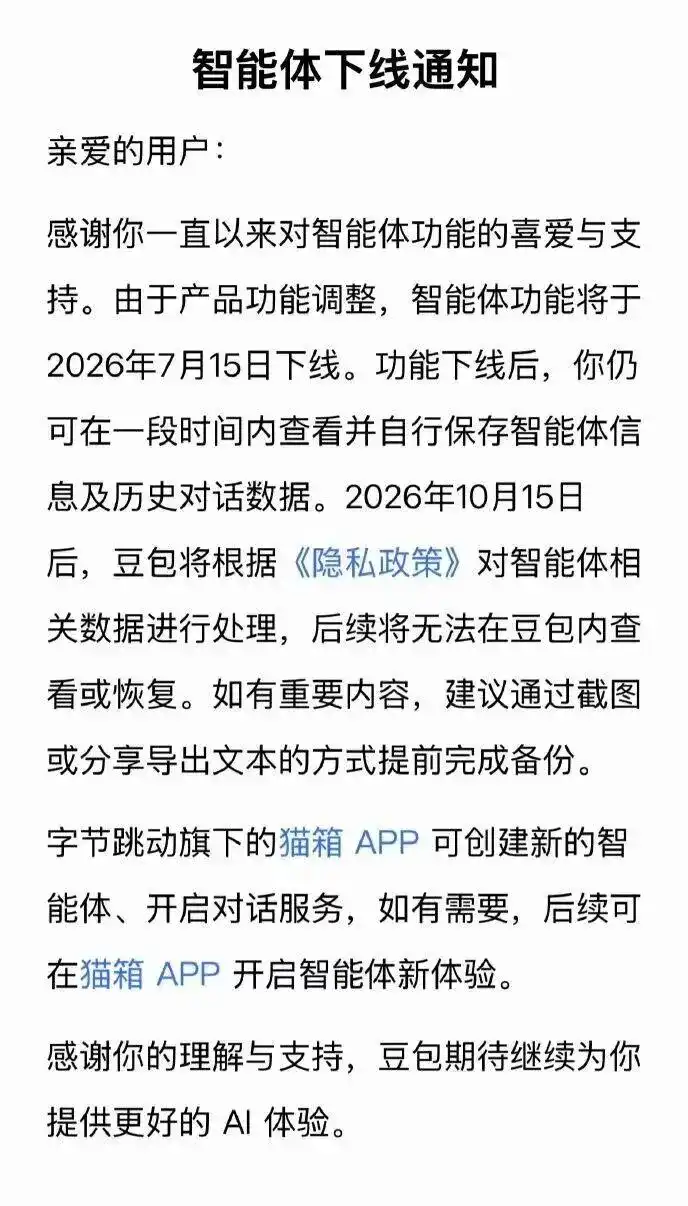
Doubao issued the "Notice on Discontinuation of Doubao Agent Functionality," confirming that the agent functionality will be discontinued on July 15, and will redirect users to ByteDance's Mao Xiang App to meet related needs.
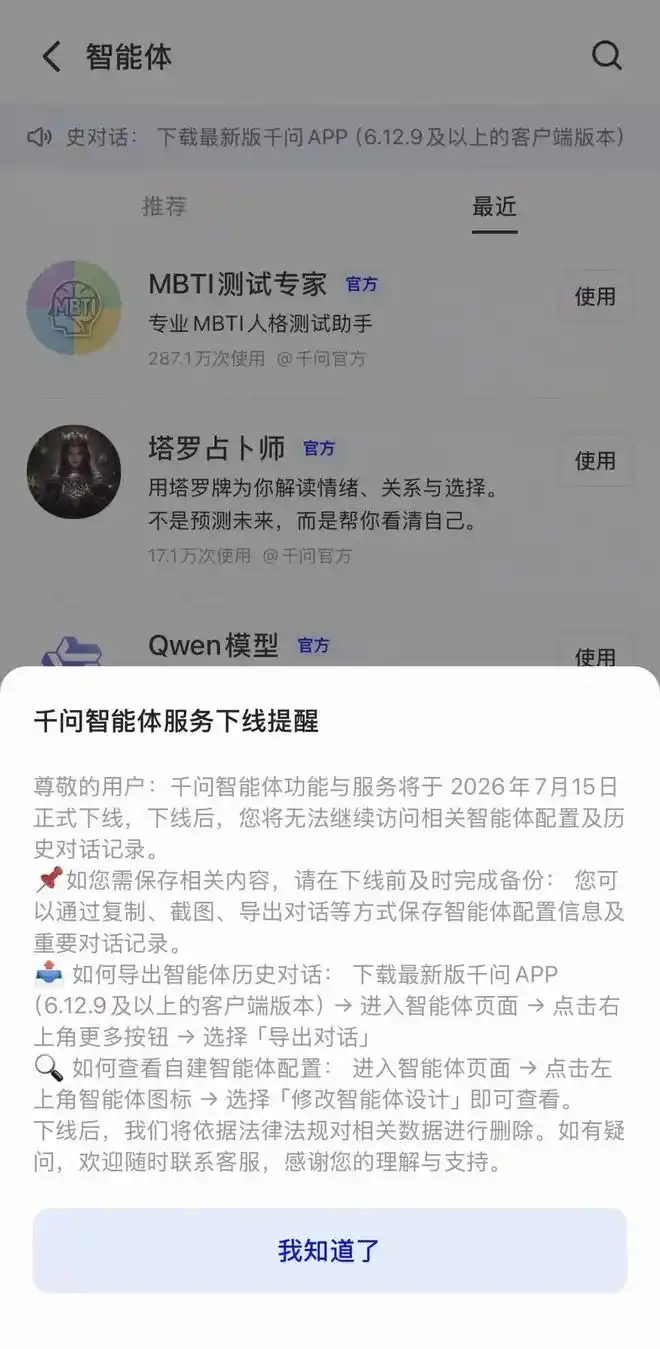
On the same day, Tongyi Qwen pushed a discontinuation reminder to users, stating that personified interaction agents and user-created agent functionality will be discontinued on July 10, and that after the complete discontinuation of Qwen agent functionality and services on July 15, users will no longer be able to access related agent configurations and historical conversation records.
This adjustment affects the most core personalized usage scenarios for C-end users of AI platforms — including role-playing, exclusive assistants, and vertical tool-type agents.

For Doubao and Qwen, user-created agents were previously a key means to gather C-end users and accumulate UGC content. The comprehensive discontinuation of this functionality signifies a directional shift in the platforms' traffic strategies.

New Regulations Force Action, Discontinuation Date Not a Coincidence

The discontinuation date chosen by Doubao and Qwen, July 15, coincides with the official implementation date of the "Interim Measures for the Administration of AI Personified Interaction Services."

These measures strictly regulate "personified emotional interaction services," requiring platforms to implement mechanisms to prevent addiction, verify the identities of minors, conduct content reviews, and fulfill other primary responsibilities.

Regulatory rectification actions have already begun. On June 26, the Cyberspace Administration of Shanghai Municipal Committee announced the results of the first phase of the "Clear and Bright: Rectifying Irregularities in AI Applications" special campaign, having removed over 14,000 non-compliant agents. Among them, agents from Xuanyu (MiniMax) involving functions like "one-click undressing" and soccer betting/gambling were key targets of the crackdown.

Currently, the Cyberspace Administration of Shanghai Municipal Committee has completed regulatory briefings for nearly a hundred key platforms, urging enterprises to fulfill their compliance obligations.

Against this backdrop, Doubao and Qwen proactively aligning with the regulatory timeline, choosing to complete the functionality discontinuation on the day the new regulations take effect, is widely interpreted by the industry as a proactive move to mitigate compliance risks in advance and fulfill platform responsibilities.

User Transition Arrangements and Data Processing Timeline

Both platforms have provided a transition window for existing users to save their data.

For Doubao, after the functionality is discontinued, users will still be able to view and manually save their agent information and historical conversation data for a period of time; after October 15, Doubao will process the relevant data according to its privacy policy, at which point the data will no longer be viewable or recoverable.

Doubao recommends users back up their data in advance by taking screenshots or exporting text, and migrate agent creation and conversation functionality to the Mao Xiang App.

Tongyi Qwen similarly advises users to save important content before the discontinuation by copying, taking screenshots, or exporting conversations. After discontinuation, access to related agent configuration information and historical conversation records will no longer be possible.

As leading platforms successively scale back their C-end agent layouts, the competitive logic of the AI application market is undergoing a fundamental shift.

Compliance capabilities and sustainable business models will replace user scale and feature richness as the core dimensions of platform competition in the next phase.

High Consumption, Low Efficiency, Business Logic Also Unsustainable

In addition to regulatory pressure, difficulties in commercial monetization are also an intrinsic motive driving this adjustment.

Analysis suggests that personified chit-chat and niche role-playing agents typically generate scattered, high-frequency, lightweight conversation calls, resulting in high computing power consumption and low per-unit commercial value, representing a typical "high consumption, low efficiency" business model.

In the phase where AI applications are shifting from "land grabbing" to "value verification," while such UGC agents may bring short-term traffic and user engagement metrics, they are difficult to convert into direct commercial revenue. Their economic rationale for continued existence is being questioned.

Tongyi Qwen's pivot to the B-end has already shown signs. On June 3, Qwen officially announced the comprehensive opening of Agent and Skill access permissions to third-party enterprises and developers across all industries. Leading brands like Luckin Coffee, KFC, Mixue Ice Cream & Tea, and China Eastern Airlines have already initiated service testing.

This strategic shift indicates that platforms are concentrating resources from low-value C-end UGC ecosystems towards high-value B-end enterprise service scenarios.


Criptomoedas em alta

Perguntas relacionadas

QAccording to the article, on what date are Doubao and Tongyi Qianwen scheduled to take their 'Intelligent Agent' functions offline?

ABoth platforms have scheduled the full shutdown of their Intelligent Agent functions for July 15.

QWhat is the main regulatory reason mentioned for the shutdown of the Intelligent Agent functions?

AThe shutdown coincides with the formal implementation on July 15 of the 'Interim Measures for the Management of Artificial Intelligence Anthropomorphic Interaction Services', which strictly regulates services involving simulated human emotional interaction.

QWhat alternative platform does Doubao recommend for users who wish to continue using Intelligent Agent features?

ADoubao is directing users to migrate their Intelligent Agent creation and conversation functions to the ByteDance-owned app, Cat Box (猫箱 App).

QBeyond regulatory pressure, what internal business challenge contributed to the decision to shut down these C-end Intelligent Agent functions?

AThe article cites commercialization difficulties, describing these UGC agents (especially for casual chat and niche roles) as 'high-consumption, low-efficiency'—they require significant computing power but generate little direct revenue, making them economically unsustainable.

QHow is Tongyi Qianwen's strategic focus shifting according to the article?

ATongyi Qianwen is shifting its resources from low-value C-end UGC ecosystems towards high-value B-end enterprise service scenarios, having opened its Agent and Skill access to third-party businesses and developers.

Leituras Relacionadas

Institutions Have Already Bought the Dip: Is Bitcoin at $70,000 the Start of a Bull Run or a Local Top?

Institutional Investors Piled into Bitcoin Ahead of Rally: Is $70K a New Bull Market Start or Local Top? Bitcoin surged past $70,000 following pro-crypto remarks from former U.S. President Donald Trump on August 20. However, institutional investors had been accumulating exposure in Q2 2026, even as the price fell. 13F filings reveal that while total Bitcoin ETF holdings declined, institutional holdings increased by 7.5%, reaching a record 44.2% share of ETF assets. Key institutional moves include Jane Street increasing its Bitcoin ETF and MicroStrategy (MSTR) exposure by over $800 million, BlackRock adding ~$290 million in Bitcoin-related holdings (MSTR, its own IBIT ETF, and ASST), and JPMorgan boosting its IBIT position by $85.6 million. UBS significantly increased its call option exposure on IBIT. Notably, Paul Tudor Jones's fund reversed a multi-quarter selling trend to add IBIT shares. Market opinions are divided post-rally. The "bear market over" camp includes F2Pool's co-founder declaring the bear market ended, Strive's CEO citing a favorable macro backdrop for Bitcoin, and Standard Chartered targeting $100,000 by year-end. Conversely, the "not yet bottomed" camp includes CZ stating the super cycle hasn't arrived, CryptoQuant analysts warning of elevated retail demand often preceding local tops, and analysis from VanEck and Glassnode suggesting on-chain data shows a prolonged "capitulation phase" is still unfolding, indicating current price strength may be a relief rally rather than a definitive trend reversal.

Odaily星球日报Há 12m

Institutions Have Already Bought the Dip: Is Bitcoin at $70,000 the Start of a Bull Run or a Local Top?

Odaily星球日报Há 12m

Viewpoint: A $4 Billion Buyback Can Fix Liquidity, But Not U.S. Fiscal Health

On August 19, the U.S. Treasury announced it would increase its maximum single-operation buyback size for long-term bonds from $2 billion to at least $4 billion, aiming to improve market liquidity. This move initially led to a pullback in long-term yields, such as the 30-year Treasury yield which had recently hit a 2007 high near 5.34%, sparking talk of potential "Treasury support." However, an opposing perspective argues this is merely a temporary fix. While buybacks can enhance trading conditions for older, less-liquid bonds, they do not address the underlying fiscal pressures. The Treasury's actions are a form of debt management, not monetary stimulus like QE; the funds used for buybacks ultimately come from cash balances or new borrowing. They do not reduce the government's overall financing needs. The core issue is growing fiscal supply. With the federal deficit reaching a record $432 billion in July 2026 and cumulative deficits already surpassing the prior fiscal year's total, the market faces a massive wave of new debt issuance. The recent surge in long-term yields may reflect a repricing of this persistent fiscal risk and the associated term premium, rather than just a liquidity shortage. Furthermore, demand-side challenges loom. Foreign holdings of U.S. Treasuries have recently declined, and if official demand weakens, the market will rely more on price-sensitive private investors, potentially requiring higher yields to clear future auctions. In essence, the Treasury can use buybacks to soothe market "trading problems," but it cannot buy away the nation's "fiscal problem." The key factors to watch will be the appetite at long-term bond auctions, the trajectory of the fiscal deficit, and whether higher yields can sustainably attract buyers. Without improvement in these areas, the yield relief provided by the $4 billion buyback expansion is likely just a short-term buffer.

marsbitHá 21m

Viewpoint: A $4 Billion Buyback Can Fix Liquidity, But Not U.S. Fiscal Health

marsbitHá 21m

Trading

Spot

Artigos em Destaque

Como comprar 4

Bem-vindo à HTX.com!Tornámos a compra de 4 (4) simples e conveniente.Segue o nosso guia passo a passo para iniciar a tua jornada no mundo das criptos.Passo 1: cria a tua conta HTXUtiliza o teu e-mail ou número de telefone para te inscreveres numa conta gratuita na HTX.Desfruta de um processo de inscrição sem complicações e desbloqueia todas as funcionalidades.Obter a minha contaPasso 2: vai para Comprar Cripto e escolhe o teu método de pagamentoCartão de crédito/débito: usa o teu visa ou mastercard para comprar 4 (4) instantaneamente.Saldo: usa os fundos da tua conta HTX para transacionar sem problemas.Terceiros: adicionamos métodos de pagamento populares, como Google Pay e Apple Pay, para aumentar a conveniência.P2P: transaciona diretamente com outros utilizadores na HTX.Mercado de balcão (OTC): oferecemos serviços personalizados e taxas de câmbio competitivas para os traders.Passo 3: armazena teu 4 (4)Depois de comprar o teu 4 (4), armazena-o na tua conta HTX.Alternativamente, podes enviá-lo para outro lugar através de transferência blockchain ou usá-lo para transacionar outras criptomoedas.Passo 4: transaciona 4 (4)Transaciona facilmente 4 (4) no mercado à vista da HTX.Acede simplesmente à tua conta, seleciona o teu par de trading, executa as tuas transações e monitoriza em tempo real.Oferecemos uma experiência de fácil utilização tanto para principiantes como para traders experientes.

809 Visualizações TotaisPublicado em {updateTime}Atualizado em 2026.06.02

Como comprar 4

Discussões

Bem-vindo à Comunidade HTX. Aqui, pode manter-se informado sobre os mais recentes desenvolvimentos da plataforma e obter acesso a análises profissionais de mercado. As opiniões dos utilizadores sobre o preço de 4 (4) são apresentadas abaixo.

活动图片