Original | Odaily Planet Daily (@OdailyChina)
Author | Golem (@web3_golem)

Bull is back, hurry up. On August 20, Beijing time, in the early morning, favorable comments from Trump during a White House gathering of cryptocurrency industry executives propelled Bitcoin to break through $70,000, with a 24-hour surge exceeding 10% (related reading:What Did Trump Say on the Night Cryptocurrencies Soared?). The return of the "Crypto President" signals the impending end of Bitcoin's dreary period. Starting today, many retail investors are also likely to shift more attention and capital from the AI stock market back to the crypto market.
However, traditional financial institutions and asset management giants, always "one step ahead," had already completed their Bitcoin accumulation and positioning before the Trump-induced bullish sentiment arrived. According to 13F quarterly reports disclosed by major institutions, in Q2 2026, while Bitcoin fell by 14%, institutional holdings increased by 7.5%. This indicates that institutions were steadily expanding their holdings before the market began to recover.
Who are these institutions quietly increasing their Bitcoin exposure? Will we see Bitcoin below $65,000 again, and has the bear market bottom been established? Odaily Planet Daily will, in this article, tally the institutions that disclosed increased Bitcoin exposure in their 13F filings, as well as institutions' views on Bitcoin's subsequent price action.
Institutions Increasing Bitcoin Exposure
The primary avenues for institutions to increase Bitcoin exposure are through Bitcoin spot ETFs and stocks of Bitcoin treasury companies.
Institutional Bitcoin ETF Holdings Increased by 7.5% in Q2 2026
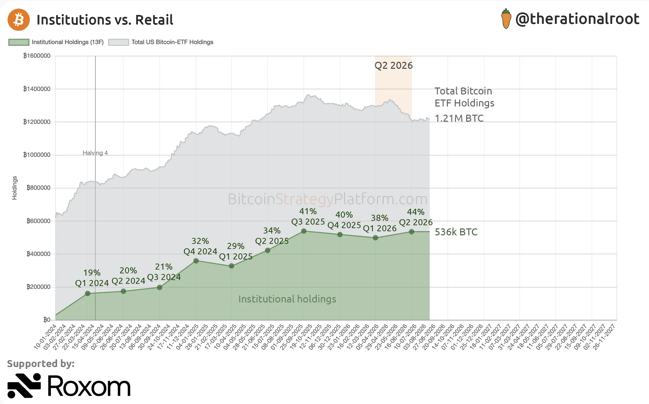
First, looking at the overall data, according to statistics by Bitcoin analyst Root, in Q2 2026, total ETF holdings decreased from 1,297,010 BTC to 1,211,322 BTC, a 6.6% decline. However, institutional holdings increased from 498,389 BTC to 535,723 BTC, a 7.5% growth. The proportion of institutional holdings rose from 38.4% to 44.2%, reaching a record high. This indicates that during the unfavorable crypto market conditions, retail investors significantly reduced their Bitcoin ETF positions, while institutions were accumulating positions at the bottom.
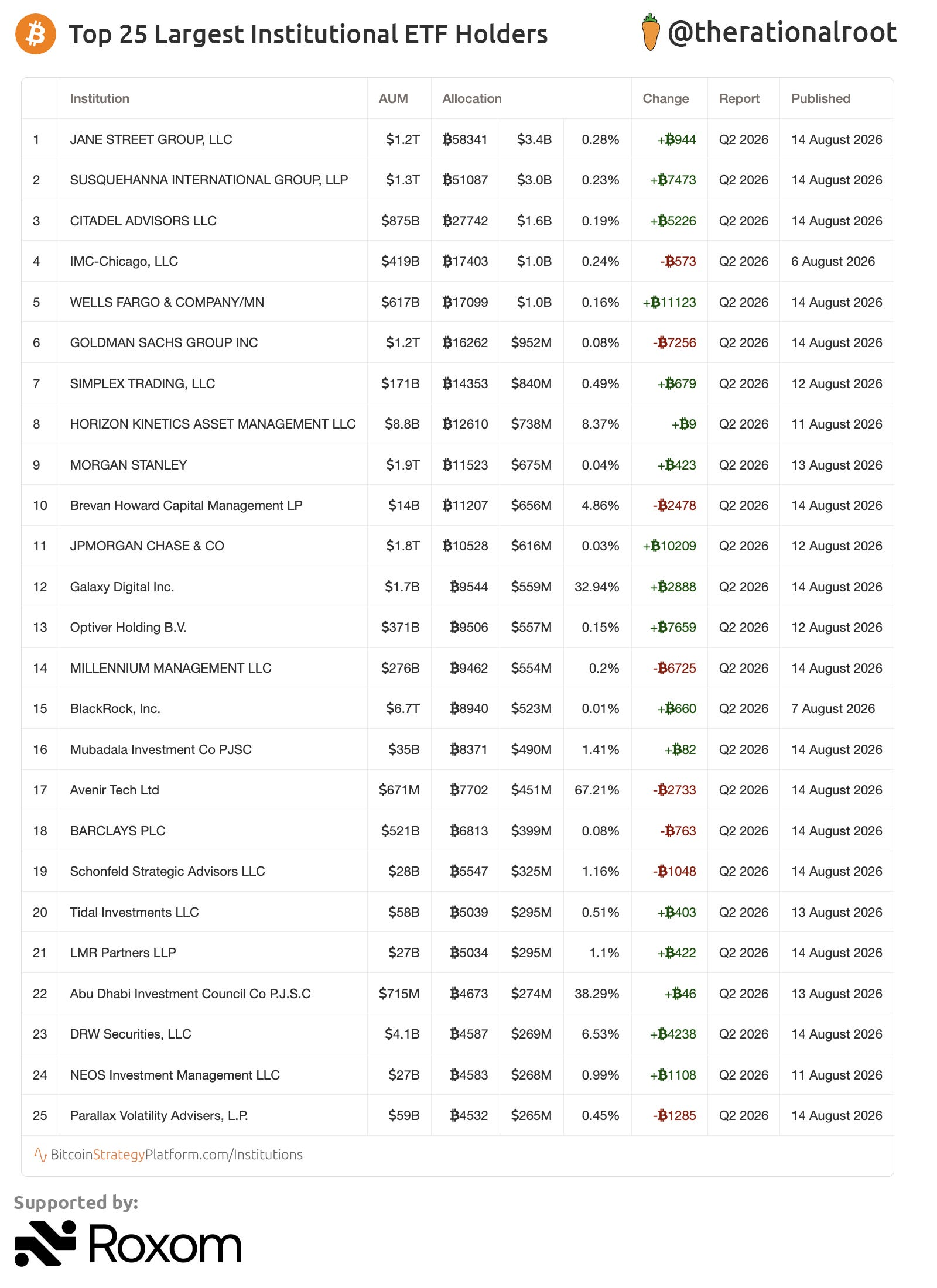
However, not all institutions increased their Bitcoin ETF holdings; the increases were concentrated mainly among leading institutions. According to statistics, overall, the number of institutions holding Bitcoin decreased from about 2,000 in Q1 to nearly 1,900 in Q2, a drop of about 6.8%. Yet, among the top 25 institutional holders of Bitcoin ETFs, 17 increased their holdings in Q2.
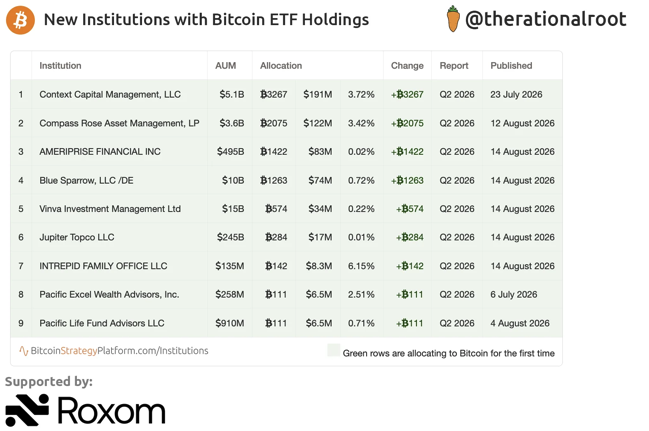
This shows that for the majority of institutions, holding Bitcoin firmly during a bear market is also quite challenging. Even so, according to Root's statistics, in Q2 2026, there were still 9 institutions that allocated over 100 Bitcoin in value for the first time.
Below, Odaily Planet Daily will profile some leading institutions that disclosed increased Bitcoin exposure in their 13F filings.
Jane Street: Bitcoin ETF Exposure Increased by Approximately $600 Million; MSTR Holdings Increased by Over $200 Million
As of June 30, Jane Street disclosed a total Bitcoin spot ETF value of approximately $990 million, of which BlackRock's Bitcoin ETF IBIT amounted to $828 million, about 24.9 million shares. In Q1 2026, Jane Street disclosed total Bitcoin spot ETF holdings of only $225 million, about 5.9 million shares. Compared to Q1, Jane Street's Bitcoin ETF exposure increased by approximately $600 million in Q2.
Additionally, Jane Street significantly increased its holdings of Strategy (MSTR) shares, from 209,833 shares (worth approximately $26.2 million) in Q1 to 2,677,622 shares (worth approximately $232.76 million) in Q2, an increase of about 2,467,789 shares, a rise of about 1,176%, valued at over $200 million.
In summary, in Q2 2026, Jane Street increased its Bitcoin exposure by over $800 million.
However, it is important to note that Jane Street's situation differs from that of typical asset management institutions. 13F filings only disclose common stock long positions (excluding options, short positions, etc.). As a typical quantitative trading/market-making institution, Jane Street may hold short positions in Bitcoin ETFs and MSTR, so the actual Bitcoin exposure may deviate. Even though its long positions cannot be simply interpreted as long-term directional bets, the scale is still quite remarkable.
BlackRock: Bitcoin Exposure Increased by Approximately $290 Million in Q2
In Q2, BlackRock increased its investment in three Bitcoin-related assets: Strategy (MSTR), IBIT, and Strive (ASST).
BlackRock raised its MSTR holdings from about 17.75 million shares to 19,394,284 shares (worth $1.69 billion) in Q2, an increase of 1,640,399 shares (worth approximately $238 million), a quarter-on-quarter growth of 9.24%. (Odaily Planet Daily Note: BlackRock's statistics differ from Jane Street's; this article primarily uses data disclosed in 13F filings.)
Secondly, BlackRock also increased its holdings of its own Bitcoin spot ETF, IBIT. IBIT holdings increased by 1,024,742 shares (worth approximately $41.7 million), with total holdings at the end of Q2 being 15,034,046 shares, worth approximately $500 million. Finally, BlackRock also increased its holdings of the Bitcoin treasury company Strive (ASST) stock. ASST holdings increased by 1,636,854 shares (worth approximately $17.86 million), a rise of 45.1%. Total holdings at the end of Q2 were 5.266 million shares, worth $57.5 million. Strive currently holds over 20,000 Bitcoin.
In summary, BlackRock's Bitcoin exposure increased by approximately $290 million in Q2.
JPMorgan Chase: Increased IBIT Holdings by $85.6 Million
JPMorgan Chase primarily increased its holdings of BlackRock's Bitcoin spot ETF IBIT in Q2. IBIT holdings increased by 2,104,944 shares (worth approximately $85.6 million), a rise of 25.35%, growing from 8,302,691 shares in Q1 to 10,407,635 shares. Total holdings were worth approximately $356 million.
UBS Group: IBIT Call Option Exposure Grew 24-Fold in Q2
In Q2, UBS Group's direct shareholding of IBIT also grew by 12%, reaching 407,890 shares (worth approximately $13.6 million). The increase in direct holdings was relatively moderate. Although still below the level at the end of 2025 (about 540,000 shares), being higher than the Q1 2026 level (364,000 shares) indicates an increasing preference for Bitcoin allocation.
Compared to direct holdings, UBS Group's IBIT call option exposure surged 24-fold in Q2, skyrocketing from about 80,000 shares to 1.95 million shares. Meanwhile, put option exposure decreased by about 53%, from approximately 303,000 shares to about 143,000 shares.
This already shows a clear bullish inclination from UBS Group (increasing buying rights, decreasing selling rights). However, 13F filings do not disclose strike prices, expiration dates, or actual costs, and the holdings may include client business, market-making, or hedging activities, so they may not entirely represent proprietary directional bets.
Wall Street Legendary Hedge Fund ManagerPaul Tudor Jones: Ends the Trend of Continuous IBIT Reduction Since 2025
Tudor Investment, the hedge fund firm of Wall Street legendary hedge fund manager Paul Tudor Jones, also increased its IBIT holdings in Q2 2026. Total holdings at the end of Q2 were 688,529 shares (worth $22.9 million). This holding increased by 109,446 shares (worth approximately $4.45 million) compared to the 579,083 shares reported in the previous quarter, an 18.9% increase.
Although the absolute amount of the increase is small, this ends the trend of continuous IBIT reduction by Paul Tudor Jones since 2025, possibly indicating an optimistic and watchful stance towards Bitcoin's subsequent trend. At its peak at the end of 2024, Tudor Investment held over 8 million shares of IBIT worth approximately $427 million. Current holdings are still about 91% below that peak.
Harvard University Endowment Fund: Halts Reduction of Bitcoin Spot ETF
The 13F filing submitted by the Harvard University Endowment Fund shows that as of the end of Q2, its holdings of the Bitcoin spot ETF IBIT remained unchanged at 3,044,612 shares, with a market value of approximately $101.4 million at the end of Q2.
The Harvard University Endowment Fund had been reducing its IBIT holdings for two consecutive quarters prior. The peak in Q3 2025 was about 6.81 million shares (worth approximately $443 million). It reduced holdings by 21% in Q4 2025, and by another approximately 43% in Q1 2026, bringing it to the current level. Although it did not increase Bitcoin exposure this time, halting the previous two consecutive quarters of reduction can still be interpreted as an optimistic and watchful stance.
What Do Institutions Think: Has Bitcoin Bottomed?
Current institutional views on Bitcoin's subsequent price action can be broadly categorized into "the bear market has ended" and "the bottom has not been reached yet."
The Bear Market Has Ended Camp
With Bitcoin breaking through the $70,000 mark today, Wang Chun, co-founder of Bitcoin mining pool F2Pool, quoted his own tweet from January 28, 2023, saying "I miss the bear market" on platform X, stating, "The bear market has ended."

Compared to Wang Chun's "succinctness," Strive CEO Matt Cole's argument is more comprehensive. He believes Bitcoin is facing a historically favorable upward environment because the US Dollar Index has been in a structural downtrend and may currently be approaching a more substantial downward phase. Therefore, the next 5 to 7 years could become one of the most favorable macro environments in Bitcoin's history. Matt Cole also stated that Bitcoin's current price is at a historically low level, and Strive is willing to take risks and continue buying Bitcoin at this point.
Standard Chartered is bullish on Bitcoin hitting $100,000 by year-end. Geoff Kendrick, Head of Digital Assets Research at Standard Chartered Bank, stated that as the US Treasury expands liquidity support for the long-term Treasury market, Bitcoin could rise to $100,000 before the end of 2026. He mentioned that Bitcoin's current key technical resistance level is $65,500. If the price breaks through this level, it might indicate that the low point of this market cycle has been formed.
The latest report from 10x Research also points out that after months of narrow-range fluctuations, Bitcoin has welcomed a breakout. It stated that its most favored strategy this month is to buy call options with a strike price of $70,000. This option was as low as about $300 on August 5, dropped to $30 three days ago, then surged to a high of $1,600, and is currently trading around $1,300.
10x Research also stated that a better trading strategy is a call spread with September expiry and strike prices of $70,000/$80,000. This structure is more bullish while also retaining some flexibility.
Bitcoin Has Not Bottomed Yet Camp
Even though Bitcoin has broken through $70,000, there are still cautious institutions that believe Bitcoin has not bottomed yet.
CZ stated at the SALT conference held in Jackson Hole, Wyoming, USA, that the Bitcoin "super cycle" has not yet materialized and we are still in the bear market phase, with the market still adhering to a relatively strict four-year cycle pattern. However, CZ acknowledged that the current environment is the most favorable in his 12 years in the industry.
CryptoQuant analyst Darkfost believes that current Bitcoin retail demand is close to its highest level in the past two years. Historical data shows a clear correlation between growth in retail demand and local tops in Bitcoin's price. Therefore, Darkfost believes this may reflect "impatience" among retail investors, who need to become more sensitive to Bitcoin's volatility. Greeks.live researcher Adam also comforted investors who missed this Bitcoin surge, stating that after Bitcoin broke $70,000, the implied volatility is still 32%. With ample seller liquidity currently, there are still many trading opportunities for buyers.
The latest report from crypto asset management firm VanEck shows that while Bitcoin is currently showing "capitulation signals" similar to the end of historical bear markets, data indicates the market bottom has not been fully confirmed. It stated that of the 12 Bitcoin market capitulation indicators it tracks, 8 have entered extreme territory. These indicators mainly measure market stress factors such as Bitcoin price retracement, miner profitability, and the proportion of holders at a loss.
However, historical performance does not show that these signals mean a short-term bottom has formed. VanEck data shows that when historically 8 to 12 indicators were triggered simultaneously, Bitcoin's average return over the next 90 days was about 12.8%, and about 32% over 180 days, both below Bitcoin's long-term average (90-day: 15.2%, 180-day: 36.3%). Relevant signals only showed relative advantages within a one-year cycle, thus cannot guide long-cycle operations.
Glassnode also believes that Bitcoin's on-chain structure is still in a "capitulation phase." The cost basis for Bitcoin short-term holders has dropped to about $68,500, below the true market average of about $75,800. Meanwhile, the peak relative unrealized loss in this cycle is about 25%, significantly lower than the over 60% levels seen in previous cycle capitulation phases. This means the degree of loss in this market cycle is relatively shallow but more widely distributed, possibly requiring more time to complete the shakeout.
Glassnode emphasizes that any current price rebound should be viewed more as a local bounce rather than a fundamental shift in market trends.