Don't Lose Heart in Crypto, Be a Pragmatic Optimist

marsbitPublicado em 2025-12-11Última atualização em 2025-12-11

Resumo

Nic Carter, co-founder of Castle Island Ventures, responds to Ken Chan’s pessimistic essay “I Wasted 8 Years of My Life in Crypto” by arguing for a pragmatic and optimistic outlook on the crypto industry. While acknowledging that Chan’s critique—that crypto has devolved into a massive speculative casino rather than a decentralized financial system—contains truth, Carter contends that the industry still holds meaningful purpose. Carter identifies five core visions driving crypto: restoring sound money (e.g., Bitcoin as a global monetary asset), encoding business logic via smart contracts, making digital property real (e.g., NFTs and Web3), improving capital market efficiency, and expanding global financial inclusion. He admits that many early idealistic expectations—such as hyperbitcoinization or revolutionary digital ownership—have not materialized, and that much of the current activity involves speculation, memecoins, and gambling. However, Carter advocates for “pragmatic optimism.” He argues that speculative excess and financial nihilism are unfortunate but inevitable byproducts of building permissionless, open financial infrastructure. The key is to focus on the real, albeit gradual, progress: Bitcoin’s adoption, functional stablecoins, decentralized exchanges, and improved financial access in developing regions—without succumbing to either utopian fantasies or cynical despair.

Author: Nic Carter, Co-founder of Castle Island Ventures

Compiled by: Felix, PANews

Ken Chan, co-founder of Aevo, recently published an article stating that he wasted 8 years of his life in the crypto industry. Ken Chan believes that the crypto industry has deviated from its original intention of "decentralized finance" and has evolved into the largest and most widely participated speculative and gambling system in human history. This pessimistic view has sparked heated discussions in the crypto community. Nic Carter, co-founder of Castle Island Ventures, also published an article to participate in the discussion. The full text is as follows.

No one can serve two masters: for either he will hate the one and love the other, or he will be devoted to the one and despise the other. You cannot serve God and mammon (Note: the personification of wealth in religious legends). —Matthew

Ken Chang recently published an article titled "I Wasted 8 Years of My Life in Cryptocurrency," lamenting that the industry seems inherently characterized by capital consumption and financial nihilism.

People in the crypto circle love to mock such "rage quit" articles, gleefully recalling how historical figures like Mike Hearn and Jeff Garzik made grand exits back in the day, and then smugly pointing out how much Bitcoin has risen since they left.

But Ken's article is mostly correct. He said:

"Cryptocurrency claimed to decentralize the financial system, and I fully believed it at first, but the reality is, it's just a super speculative and gambling system, essentially just a mirror of the current economy. The truth hit me like a damn truck: I wasn't building a new financial system at all, I built a casino. A casino that refuses to admit it's a casino, yet it's the largest, 24/7, multi-player casino ever created by our generation."

Ken points out that VCs burned tens of billions of dollars supporting countless new L1s, and we clearly don't need that many. This is indeed correct, although he slightly distorts the incentive model (VCs are just conduits for capital). He also decries the proliferation of perpetual contracts, spot DEXs, prediction markets, and meme coin launch platforms. Admittedly, while you can defend these concepts on an abstract level (except for meme coin launch platforms, which are utterly indefensible), it's undeniable that they proliferate simply because the market has incentives and VCs are willing to invest.

Ken says he entered the crypto space full of idealism. Everyone should be very familiar with this: he had Randian libertarian leanings. But instead of practicing libertarianism, he built a casino. Specifically, he is best known for his involvement in developing Ribbon Finance, a protocol that allows users to deposit assets into vaults and earn yield by systematically selling options.

I don't want to be too harsh personally, but that's the fact. If it were me, I would also engage in some deep reflection. As the conflict between principle and practice became increasingly unbearable, Ken ultimately pessimistically realized: cryptocurrency is a casino, not a revolution.

When reading Ken's article, what struck me most was how it reminded me of Mike Hearn's famous exit宣言 almost 10 years ago. Hearn wrote:

Why did Bitcoin fail? It's because the community failed. What was supposed to be a new decentralized currency, without 'systemically important institutions' and 'too big to fail' entities, has become something worse: a system entirely controlled by a handful of people. Worse still, the network is on the verge of technical collapse. The mechanisms that were supposed to prevent this outcome have failed, so there's little reason left to believe Bitcoin can be any better than the existing financial system.

The details differ, but the argument is the same. Bitcoin/cryptocurrency was supposed to be one thing (decentralized, cypherpunk practice), but it turned into another (casino, centralized). Both Hearn and Chang believe: it ultimately isn't any better than the existing financial system.

Their arguments boil down to one sentence: cryptocurrency started out meaning one thing, but then it became something else. So we are stuck in a debate about the "teleology" of cryptocurrency—what is its purpose?

The Five Purposes of Cryptocurrency

In my personal view, there are roughly five camps, and they are not entirely mutually exclusive. For example, I most identify with the first and fifth, but I also have some sympathy for the others. However, I am not a die-hard adherent to any single one, not even the most hardcore Bitcoin camp.

1. Restoring Sound Money

This was the shared dream of the early majority of Bitcoin supporters, though not all agree. The idea is that over time, Bitcoin will pose a competitive threat to the monetary privileges of many countries, potentially even replacing their currencies, returning to an arrangement similar to a new gold standard. People in this group often believe everything else happening in crypto is a distracting scam riding Bitcoin's coattails. Bitcoin has made limited progress at the sovereign level, but it's quite an achievement to become a significant monetary asset in just 15 years. Bitcoiners holding this view are always in a state of intertwined disillusionment and hope, anticipating Bitcoin's full adoption is just around the corner.

2. Encoding Business Logic into Smart Contracts

This is the view most promoted by Vitalik Buterin and Ethereum supporters: since money can be digitized, so can various transactions and contracts be written as code, making the world more efficient and fair. This was initially heresy to Bitcoin proponents. But it has succeeded in some narrow areas, especially contracts easily expressed mathematically, like derivatives.

3. Making Digital Property "Real"

I think this is the best summary of the "Web3" or "Read Write Own" idea: digital property should be as real as physical property. The idea itself has value, but its implementation (NFTs, Web3 social) has either gone completely astray or is too ahead of its time. Despite billions poured into it, few defend it today. But I still think the idea has merit. Most problems on the internet today stem from not truly owning your own web space and not having real control over who you interact with or who sees your content. I believe we will eventually reclaim control over our online assets, and this will likely involve blockchains. It's just that the time for this idea hasn't matured yet.

4. Making Capital Markets More Efficient

This is the least ideological of the five. You'd be hard-pressed to find many people truly particularly interested in securities settlement, COBOL, SWIFT, or bank wire windows. But this实实在在 supports a large part of the crypto industry's value. The core idea is: the Western financial system is built on outdated technology that is extremely difficult to update due to path dependency (you can't just tear down and rebuild core infrastructure handling trillions in daily settlements). This update must come from outside the system and adopt a completely new architecture. The value here is mainly体现在 in efficiency gains and possible consumer surplus, so it's not particularly exciting.

5. Expanding Financial Accessibility Globally

Finally, there are the compassionate ones who see cryptocurrency as an inclusive technology, enabling people in less developed countries to use low-cost financial infrastructure for the first time: allowing them to self-custody crypto assets or stablecoins, buy tokenized stocks or money market funds, get a card based on a crypto wallet or exchange account, and be treated as equals on the financial internet. This is a very real phenomenon and provides motivation for many idealists whose enthusiasm is waning to keep going.

Pragmatic Optimism

So who is right? The idealists, or the cynics? Or some unknown third answer?

I could go on at length about how bubbles always accompany major technological changes, how bubbles actually facilitate useful infrastructure construction, and why cryptocurrency is especially filled with speculation because it is inherently a financial technology, but this is mostly just self-consolation.

The real answer is: maintaining pragmatic optimism is the correct attitude. Whenever you feel extremely pessimistic about the "crypto casino," hold firmly to this attitude. Speculation, mania, and predation should be understood as inevitable, unpleasant externalities in the process of building useful infrastructure. It does bring very real negative effects, which I don't want to downplay. The normalization of meme coins, mindless gambling, and financial nihilism among young people is depressing and socially harmful. But this is an inevitable side effect of building permissionless capital markets. This situation wouldn't happen without blockchains. You just have to accept this as a negative consequence of how blockchains operate. You don't have to participate in it.

To summarize here, cryptocurrency has its purposes, and it's completely fine to be idealistic about it. There is a force激励着成千上万的人 to dedicate their careers to this industry.

It's just that this purpose might not be as exciting as you imagined.

The world will most likely not experience "hyperbitcoinization." NFTs haven't revolutionized digital ownership. Capital markets are moving on-chain, but progress is slow. Not much has been truly tokenized besides the dollar. No authoritarian regime has been overthrown by ordinary people carrying crypto wallets. Smart contracts mostly only involve derivatives, nothing else. The applications that currently have true product-market fit are limited to Bitcoin, stablecoins, decentralized exchanges, and prediction markets. And, most of the value created will likely be captured by large companies or returned to consumers in the form of efficiency gains and cost savings.

So the real challenge is: maintaining a down-to-earth, reality-based optimism, rather than indulging in blind fantasy. If you believe in a Randian libertarian utopia, the gap between expectation and reality will eventually break you. As for the casino-like mechanisms, unrestrained token issuance, and疯狂投机行为, they should be seen as unpleasant flaws of the industry, yet difficult to eradicate. If you believe that the costs brought by introducing blockchains to the world outweigh the benefits, you have every reason to be disappointed. But in my personal view, the situation is actually better than ever. We have more evidence than ever that we are on the right path. Just don't forget the original intention.

Related reading: Nihilism and Vicious Cycles, Why Should We Oppose Over-Financialization?

Criptomoedas em alta

Perguntas relacionadas

QWhat are the five main purposes of cryptocurrency as outlined by Nic Carter in the article?

AThe five main purposes are: 1. Restoring sound money, 2. Encoding business logic into smart contracts, 3. Making digital property 'real', 4. Making capital markets more efficient, and 5. Expanding financial accessibility globally.

QAccording to the author, what is the 'pragmatic optimism' one should adopt towards the crypto industry?

APragmatic optimism is the attitude of acknowledging that speculation, manias, and predation are inevitable and unpleasant externalities in the process of building useful infrastructure. One should remain grounded in realistic possibilities rather than blind fantasies, accepting the negative side effects as part of how blockchains operate without necessarily participating in them.

QWhat was the core complaint in Ken Chan's article 'I Wasted 8 Years of My Life in Cryptocurrency'?

AKen Chan's core complaint was that the crypto industry has deviated from its original purpose of 'decentralized finance' and has become the largest, most widely participated speculative and gambling system in human history, essentially building a casino that refuses to admit it is one.

QHow does the author, Nic Carter, respond to the criticism that crypto is just a casino?

ANic Carter acknowledges that much of the criticism is valid and that the industry is indeed filled with speculation. However, he argues that this is an inevitable byproduct of building permissionless capital markets and that one should focus on the useful infrastructure being built, adopting a stance of pragmatic optimism.

QWhat historical example does the author use to parallel Ken Chan's disillusionment with crypto?

AThe author draws a parallel to Mike Hearn's famous exit declaration from roughly 10 years ago, where Hearn similarly argued that Bitcoin had failed because the community failed, and it had become a system controlled by a few people rather than a new decentralized currency.

Leituras Relacionadas

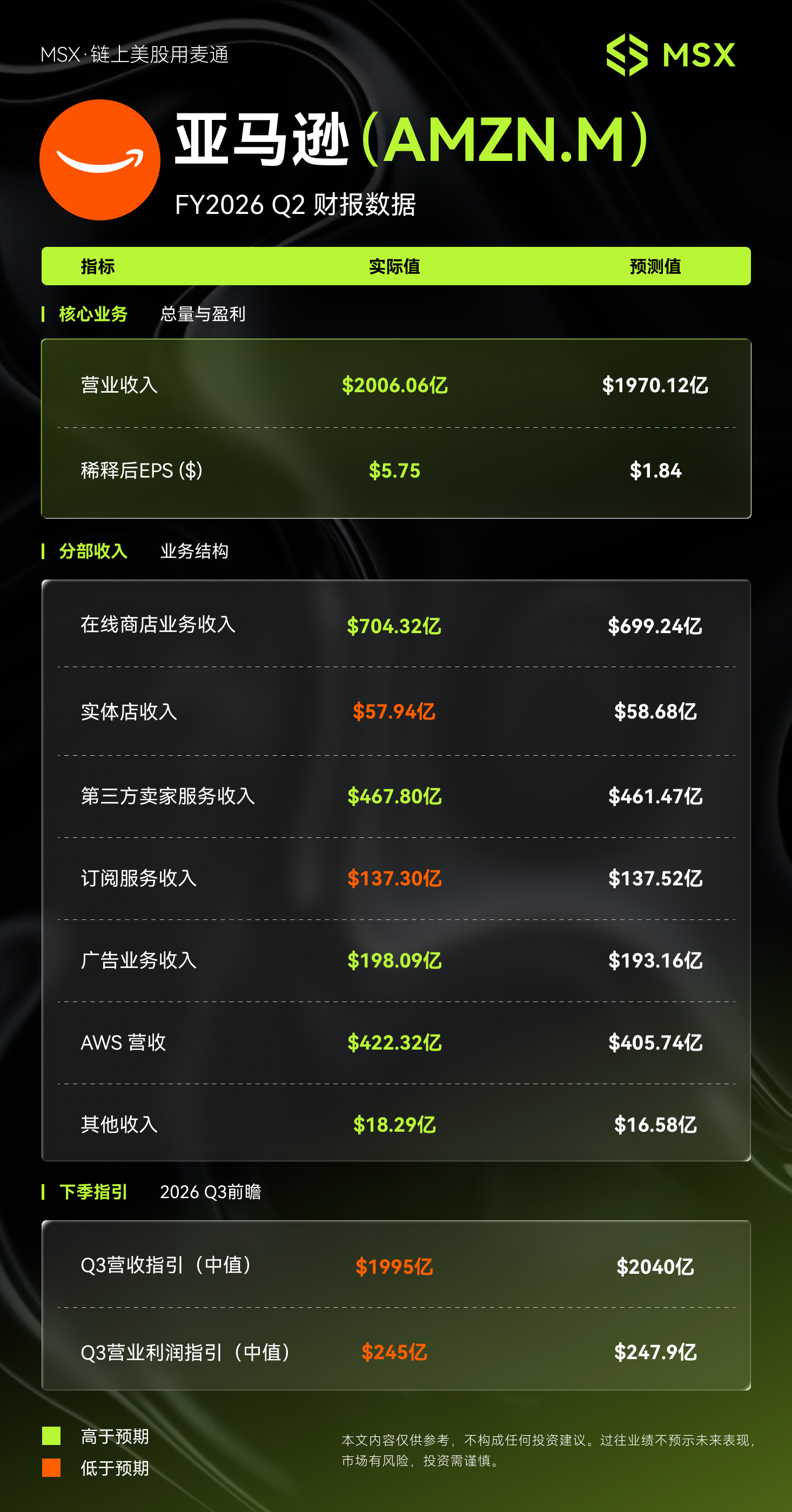
MSX US Stock Daily Insight: Amazon 2026 Q2 Earnings: AWS Records Fastest Growth in Five Years

**MSX Daily US Stock Observation: Amazon's Q2 2026 Earnings: AWS Achieves Fastest Growth in Five Years** Amazon's latest quarterly results exceeded expectations, driven by a strong performance from its cloud computing unit. The company reported revenue of $200.66 billion, surpassing estimates of approximately $197 billion. The key highlight was Amazon Web Services (AWS), which generated $42.232 billion in revenue, surging 37% year-over-year. This marked the segment's fastest growth pace in 18 quarters, indicating robust demand for cloud services. Reported Earnings Per Share (EPS) of $5.75 significantly exceeded the $1.84 forecast. However, this figure included a substantial one-time, non-operating gain of $53.4 billion, primarily from the revaluation of Amazon's investment in AI company Anthropic. Excluding this item, core operating profit was $27.461 billion, a strong increase of 43% compared to the same period last year. Despite the positive results, Amazon provided guidance for the upcoming third quarter that fell short of market expectations. The company's revenue guidance midpoint is $199.5 billion, below the consensus estimate of around $204 billion. Operating profit guidance of $24.5 billion also slightly missed expectations of approximately $247.9 billion. Furthermore, Amazon raised its forecast for full-year capital expenditures to $220 billion, citing rising memory chip costs, which weighed on investor sentiment regarding future profitability. In summary, Amazon's quarter showcased accelerating momentum in its core AWS business. The underlying operational profit growth remains solid. However, cautious forward guidance and increased investment spending present key areas for monitoring in the coming quarters, as the market assesses whether the current growth phase will translate into sustained profit margin expansion.

Odaily星球日报Há 9m

MSX US Stock Daily Insight: Amazon 2026 Q2 Earnings: AWS Records Fastest Growth in Five Years

Odaily星球日报Há 9m

Cyclical Stock or Growth Stock? Coinbase's Q2 Earnings Report Reveals 'Valuation Disagreement'

Coinbase's Q2 2026 financial results revealed a mixed performance, reigniting debate over whether the company should be valued as a cyclical stock tied to crypto markets or a growth stock with future potential. Total revenue missed expectations at $1.22 billion, down 19% year-over-year. Transaction revenue fell to $599 million, with retail crypto spot trading revenue dropping 30% to $452 million, back to 2023 levels. The company reported a net loss of $359 million, marking its third consecutive quarterly loss. Despite CEO Brian Armstrong's positive commentary on metrics like a 10.3% overall crypto trading market share and 106% growth in prediction markets, the market reacted negatively, with shares dropping over 5% after-hours. A key issue is the decline in core retail trading. While Coinbase touted record market share, this figure includes derivatives and new products. Its traditional crypto spot trading share is likely shrinking. New ventures like prediction markets, while growing, contributed less than $30 million, insufficient to offset the core revenue decline. The valuation debate hinges on perspective. As a cyclical stock, Coinbase remains deeply tied to the crypto bear market, with user attrition and competitive pressures justifying a lower valuation. The company's strategy appears focused on surviving until the next bull cycle. Viewed as a growth stock, however, Coinbase shows promising diversification. Subscription and service revenue reached $555 million, nearly matching transaction revenue. Stablecoin revenue, its second-largest source at $292 million, remains strong through its partnership with Circle. Critically, Coinbase is positioning itself as a leader in the emerging on-chain "agent economy." Over 90% of agent-based stablecoin transactions occur on its Base network, which it believes could handle trillions in future agent transactions. The recent acquisition of Deribit also aims to boost its international derivatives offering. In summary, Coinbase's present struggles are clear, but its future hinges on whether its investments in revenue diversification, stablecoins, and the agent economy can ultimately transform its business model and justify a growth premium.

Odaily星球日报Há 29m

Cyclical Stock or Growth Stock? Coinbase's Q2 Earnings Report Reveals 'Valuation Disagreement'

Odaily星球日报Há 29m

Global Market Share Survey: Japanese Firms Lead in Semiconductor Materials

Global Market Share Survey: Japanese Firms Lead in Semiconductor Materials According to the 2025 "Major Goods and Services Market Share Survey" by Nikkei, Japanese companies maintain strong positions in semiconductor-related materials. In silicon wafers, Shin-Etsu Chemical ranks first with a 26.3% share, followed by SUMCO at 17.8%. Together, they hold 44.1% of the market, widening their lead over competitors from Taiwan, Germany, and South Korea. In photoresists, Tokyo Ohka Kogyo, JSR, and Shin-Etsu Chemical occupy the top three spots, with a combined share of 60.5%. Despite their strength in materials, Japanese firms have a weaker presence in core semiconductor segments like DRAM and NAND flash memory, where South Korean and U.S. companies dominate. For instance, SK Hynix and Samsung lead in DRAM, while China’s CXMT doubled its share to 6% in 2025. The semiconductor market is projected to grow rapidly, with WSTS forecasting a 90% increase to $1.5112 trillion by 2026. Major players like Samsung, SK Hynix, and Micron are making massive investments to expand capacity. To maintain their edge in materials, Japanese companies must similarly commit to large-scale, risk-taking investments. In contrast, Japan’s automotive sector shows stagnation. Toyota remains the global leader but with only a slight share increase to 12.3%, while Japanese brands are absent from the top five in the EV market. In shipbuilding, Imabari Shipbuilding rose to third place globally with a 7.2% share, benefiting from large container ship deliveries. However, Chinese and South Korean firms dominate the sector, holding the top two positions. Japan aims to revitalize its shipbuilding industry through government and corporate efforts, targeting a near doubling of output by 2035. Addressing labor shortages and adopting advanced technologies like physical AI will be critical for competitiveness.

marsbitHá 54m

Global Market Share Survey: Japanese Firms Lead in Semiconductor Materials

marsbitHá 54m

Trading

Spot

Artigos em Destaque

Como comprar O

Bem-vindo à HTX.com!Tornámos a compra de O1 exchange (O) simples e conveniente.Segue o nosso guia passo a passo para iniciar a tua jornada no mundo das criptos.Passo 1: cria a tua conta HTXUtiliza o teu e-mail ou número de telefone para te inscreveres numa conta gratuita na HTX.Desfruta de um processo de inscrição sem complicações e desbloqueia todas as funcionalidades.Obter a minha contaPasso 2: vai para Comprar Cripto e escolhe o teu método de pagamentoCartão de crédito/débito: usa o teu visa ou mastercard para comprar O1 exchange (O) instantaneamente.Saldo: usa os fundos da tua conta HTX para transacionar sem problemas.Terceiros: adicionamos métodos de pagamento populares, como Google Pay e Apple Pay, para aumentar a conveniência.P2P: transaciona diretamente com outros utilizadores na HTX.Mercado de balcão (OTC): oferecemos serviços personalizados e taxas de câmbio competitivas para os traders.Passo 3: armazena teu O1 exchange (O)Depois de comprar o teu O1 exchange (O), armazena-o na tua conta HTX.Alternativamente, podes enviá-lo para outro lugar através de transferência blockchain ou usá-lo para transacionar outras criptomoedas.Passo 4: transaciona O1 exchange (O)Transaciona facilmente O1 exchange (O) no mercado à vista da HTX.Acede simplesmente à tua conta, seleciona o teu par de trading, executa as tuas transações e monitoriza em tempo real.Oferecemos uma experiência de fácil utilização tanto para principiantes como para traders experientes.

314 Visualizações TotaisPublicado em {updateTime}Atualizado em 2026.06.29

Como comprar O

Como comprar PROS

Bem-vindo à HTX.com!Tornámos a compra de Pharos (PROS) simples e conveniente.Segue o nosso guia passo a passo para iniciar a tua jornada no mundo das criptos.Passo 1: cria a tua conta HTXUtiliza o teu e-mail ou número de telefone para te inscreveres numa conta gratuita na HTX.Desfruta de um processo de inscrição sem complicações e desbloqueia todas as funcionalidades.Obter a minha contaPasso 2: vai para Comprar Cripto e escolhe o teu método de pagamentoCartão de crédito/débito: usa o teu visa ou mastercard para comprar Pharos (PROS) instantaneamente.Saldo: usa os fundos da tua conta HTX para transacionar sem problemas.Terceiros: adicionamos métodos de pagamento populares, como Google Pay e Apple Pay, para aumentar a conveniência.P2P: transaciona diretamente com outros utilizadores na HTX.Mercado de balcão (OTC): oferecemos serviços personalizados e taxas de câmbio competitivas para os traders.Passo 3: armazena teu Pharos (PROS)Depois de comprar o teu Pharos (PROS), armazena-o na tua conta HTX.Alternativamente, podes enviá-lo para outro lugar através de transferência blockchain ou usá-lo para transacionar outras criptomoedas.Passo 4: transaciona Pharos (PROS)Transaciona facilmente Pharos (PROS) no mercado à vista da HTX.Acede simplesmente à tua conta, seleciona o teu par de trading, executa as tuas transações e monitoriza em tempo real.Oferecemos uma experiência de fácil utilização tanto para principiantes como para traders experientes.

307 Visualizações TotaisPublicado em {updateTime}Atualizado em 2026.06.29

Como comprar PROS

O que é VERONA

I. Introdução ao Projeto VERONA é uma blockchain construída para todos, em todo o lado, através da abstração da cadeia. Utilizando a sua camada de Abstração Generalizada, a VERONA distingue-se por integrar funcionalidades complexas de blockchain, como contas, assinaturas e interoperabilidade, diretamente ao nível do protocolo. Esta abordagem permite a interação com aplicações de blockchain sem a necessidade de compreender as tecnologias subjacentes.1) Informação Básica Nome: VERONA (VERONA)III. Links Relacionados Link do site oficial: https://xion.burnt.com/ Whitepaper: https://xion.burnt.com/whitepaper.pdf Exploradores: https://explorer.burnt.com/ Mídias Sociais: https://x.com/burnt_xion Nota: A introdução ao projeto provém dos materiais publicados ou fornecidos pela equipa oficial do projeto, que é apenas para referência e não constitui aconselhamento de investimento. A HTX não se responsabiliza por quaisquer perdas diretas ou indiretas resultantes.

979 Visualizações TotaisPublicado em {updateTime}Atualizado em 2026.06.22

O que é VERONA

Discussões

Bem-vindo à Comunidade HTX. Aqui, pode manter-se informado sobre os mais recentes desenvolvimentos da plataforma e obter acesso a análises profissionais de mercado. As opiniões dos utilizadores sobre o preço de A (A) são apresentadas abaixo.

活动图片