Dogecoin nears $0.088 support – But THESE signals hint at downside

ambcryptoPublicado em 2026-03-23Última atualização em 2026-03-23

Resumo

Dogecoin (DOGE) is nearing a critical support level at $0.088, with recent on-chain activity showing increased transfers and transactions, yet failing to boost its price. This is attributed to a distribution phase, where whale inflows into exchanges have created selling pressure. Market sentiment remains bearish due to global tensions, affecting both crypto and stock markets. Bitcoin's drop below $70,000 has added to the downward pressure. Technical indicators like the RSI at 35 confirm bearish momentum, though the CMF suggests slightly easing outflows. A cluster of long liquidations between $0.084 and $0.088 could drive prices lower, potentially testing $0.086. A break below this level would weaken bullish prospects, while a hold could set the stage for a recovery.

Dogecoin [DOGE] witnessed an increase in onchain activity recently. It was reported that both the Daily Transfer Volume and the Transaction Count numbers were elevated, but failed to translate into any notable price gains.

This was likely because DOGE was going through a distribution phase.

AMBCrypto reported that whale flows into exchanges translated into immediate sell pressure. This pushed prices further toward the month-long range lows at $0.0887.

What can happen at the Dogecoin range lows?

Generally, one would expect a bullish reaction at the lows of a range.

At the same time, the market sentiment was once more in extreme despair. Worries of escalation in the US-Iran conflict and a worsening energy crisis have already sent Asian stock markets reeling.

Bitcoin [BTC] faced profit-taking pressure and has slumped below the $70k psychological support. In these settings, Dogecoin bulls will have a tough time sparking a price rally.
Source: DOGE/USDT on TradingView

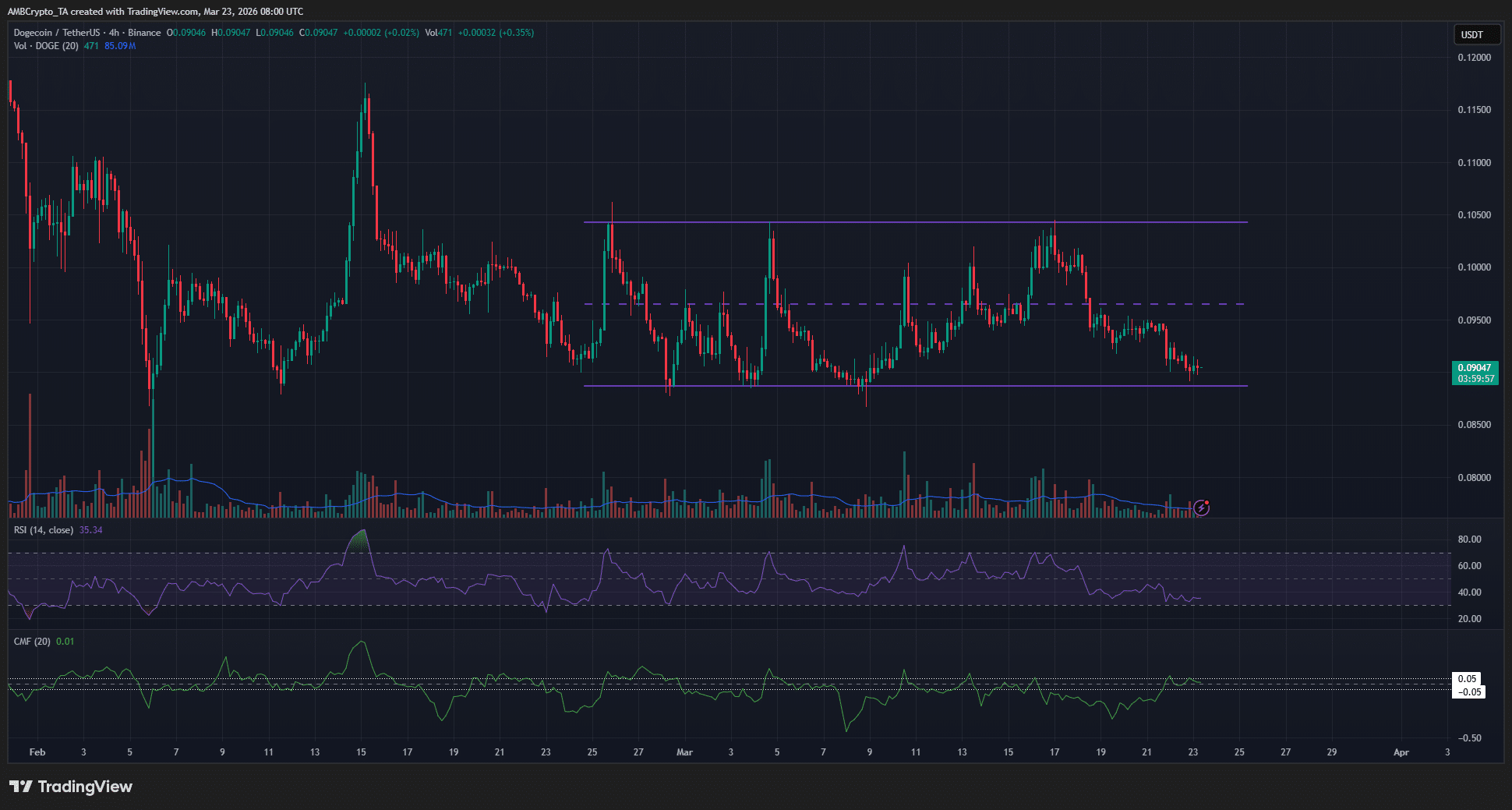
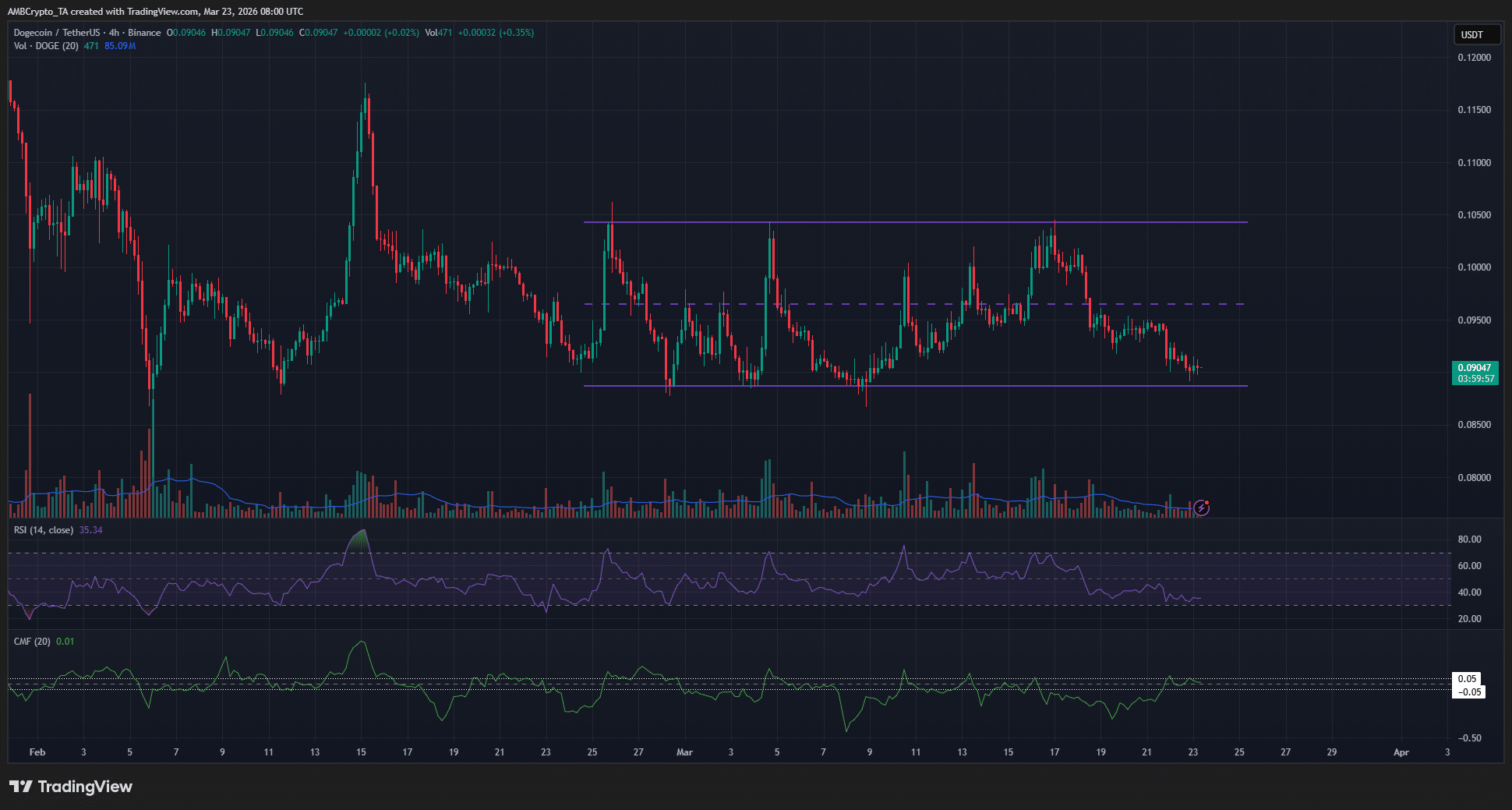
The range extended from $0.0887 to $0.104, with the mid-point at $0.0965. The $0.088 area has had added importance as a support level since the first week of February.

The RSI on the 4-hour chart was at 35, indicating bearish momentum was prevalent.

On the other hand, the CMF was at +0.01. It had climbed higher within the past week to signal easing capital outflows as the price approached a key local support.

It is unclear if this is enough for the bulls to initiate a move toward the range highs. It would depend on Bitcoin and the crypto market sentiment, which also hinges on the global investor sentiment.

Traders’ call to action- Brace for a sweep of the local lows
Source: CoinGlass

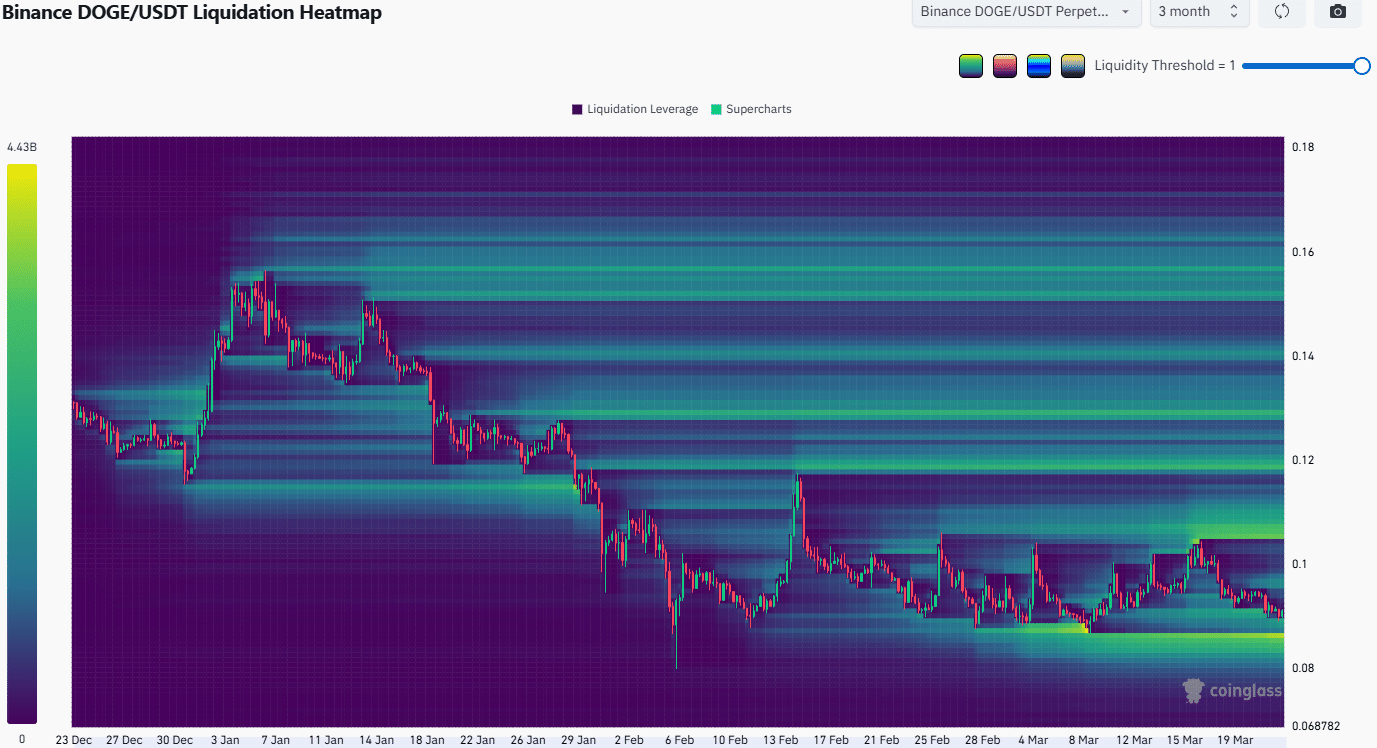
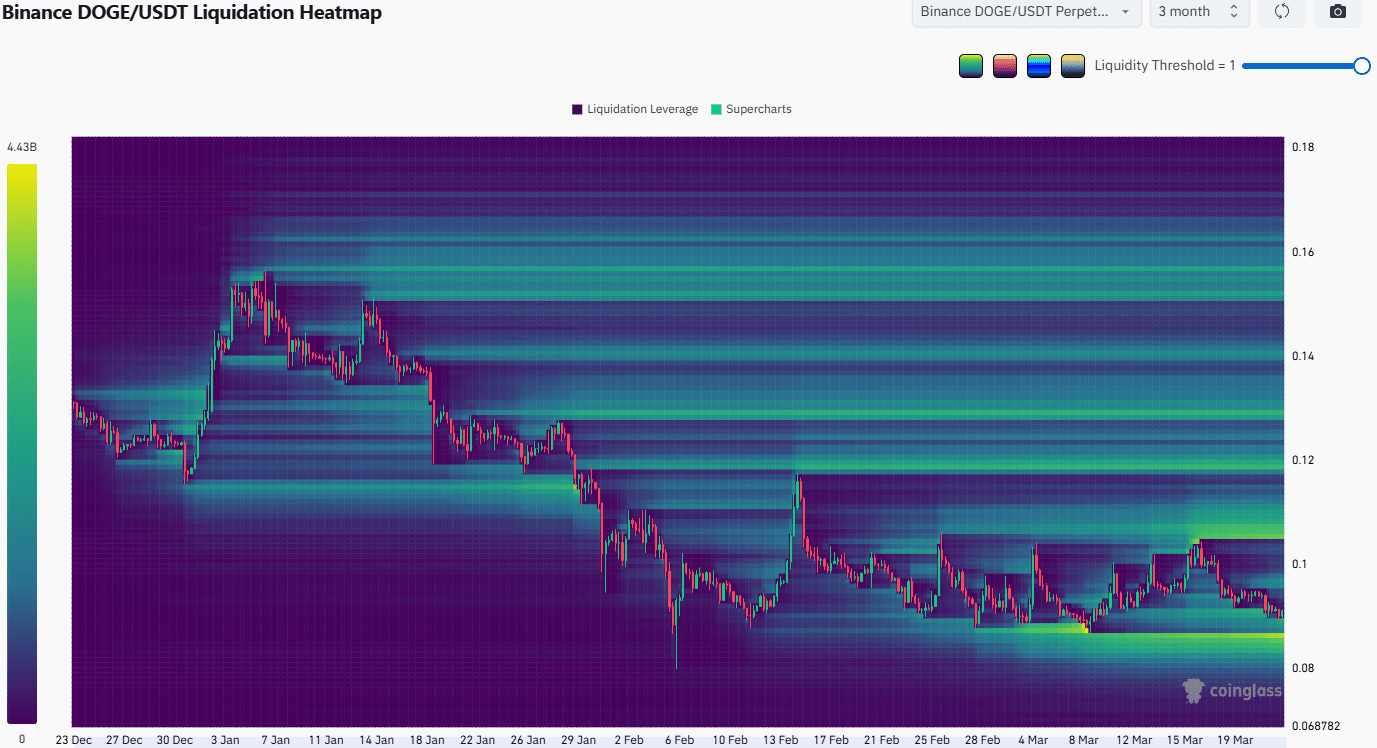
The 3-month Liquidation Heatmap showed that the $0.084-$0.088 was a nearby cluster of long liquidations. They have built up over the past three weeks and could pull prices lower.

Such a liquidity sweep, combined with the range lows as support, could give DOGE a platform for recovery. On the other hand, a slide below $0.086 would make the bulls’ position more tenuous.


Final Summary

  • Dogecoin swiftly approached a key local support as the crypto and stock markets experienced extreme fear.
  • The combination of the month-long range lows and a cluster of long liquidations could see DOGE prices pushed to $0.086 soon.


Perguntas relacionadas

QWhat key support level is Dogecoin approaching according to the article?

ADogecoin is approaching the key support level at $0.0887, which is the month-long range low.

QWhat two on-chain metrics increased for DOGE but failed to result in price gains?

AThe Daily Transfer Volume and the Transaction Count numbers increased but failed to translate into any notable price gains.

QWhat does the RSI value of 35 on the 4-hour chart indicate about Dogecoin's momentum?

AThe RSI value of 35 indicates that bearish momentum was prevalent.

QAccording to the liquidation heatmap, what price zone is a cluster of long liquidations that could pull prices lower?

AThe $0.084-$0.088 zone is a nearby cluster of long liquidations that could pull prices lower.

QWhat two broader market conditions are mentioned as reasons why Dogecoin bulls will have a tough time sparking a rally?

AWorries of escalation in the US-Iran conflict and a worsening energy crisis, which have sent Asian stock markets reeling, and Bitcoin facing profit-taking pressure and slumping below the $70k support.

Leituras Relacionadas

a16z: AI's 'Amnesia', Can Continuous Learning Cure It?

The article "a16z: AI's 'Amnesia' – Can Continual Learning Cure It?" explores the limitations of current large language models (LLMs), which, like the protagonist in the film *Memento*, are trapped in a perpetual present—unable to form new memories after training. While methods like in-context learning (ICL), retrieval-augmented generation (RAG), and external scaffolding (e.g., chat history, prompts) provide temporary solutions, they fail to enable true internalization of new knowledge. The authors argue that compression—the core of learning during training—is halted at deployment, preventing models from generalizing, discovering novel solutions (e.g., mathematical proofs), or handling adversarial scenarios. The piece introduces *continual learning* as a critical research direction to address this, categorizing approaches into three paths: 1. **Context**: Scaling external memory via longer context windows, multi-agent systems, and smarter retrieval. 2. **Modules**: Using pluggable adapters or external memory layers for specialization without full retraining. 3. **Weights**: Enabling parameter updates through sparse training, test-time training, meta-learning, distillation, and reinforcement learning from feedback. Challenges include catastrophic forgetting, safety risks, and auditability, but overcoming these could unlock models that learn iteratively from experience. The conclusion emphasizes that while context-based methods are effective, true breakthroughs require models to compress new information into weights post-deployment, moving from mere retrieval to genuine learning.

marsbitHá 1h

a16z: AI's 'Amnesia', Can Continuous Learning Cure It?

marsbitHá 1h

Can a Hair Dryer Earn $34,000? Deciphering the Reflexivity Paradox in Prediction Markets

An individual manipulated a weather sensor at Paris Charles de Gaulle Airport with a portable heat source, causing a Polymarket weather market to settle at 22°C and earning $34,000. This incident highlights a fundamental issue in prediction markets: when a market aims to reflect reality, it also incentivizes participants to influence that reality. Prediction markets operate on two layers: platform rules (what outcome counts as a win) and data sources (what actually happened). While most focus on rules, the real vulnerability lies in the data source. If reality is recorded through a specific source, influencing that source directly affects market settlement. The article categorizes markets by their vulnerability: 1. **Single-point physical data sources** (e.g., weather stations): Easily manipulated through physical interference. 2. **Insider information markets** (e.g., MrBeast video details): Insiders like team members use non-public information to trade. Kalshi fined a剪辑师 $20,000 for insider trading. 3. **Actor-manipulated markets** (e.g., Andrew Tate’s tweet counts): The subject of the market can control the outcome. Evidence suggests Tate’sociated accounts coordinated to profit. 4. **Individual-action markets** (e.g., WNBA disruptions): A single person can execute an event to profit from their pre-placed bets. Kalshi and Polymarket handle these issues differently. Kalshi enforces strict KYC, publicly penalizes insider trading, and reports to regulators. Polymarket, with its anonymous wallet-based system, has historically been more permissive, arguing that insider information improves market accuracy. However, it cooperated with authorities in the "Van Dyke case," where a user traded on classified government information. The core paradox is reflexivity: prediction markets are designed to discover truth, but their financial incentives can distort reality. The more valuable a prediction becomes, the more likely participants are to influence the event itself. The market ceases to be a mirror of reality and instead shapes it.

marsbitHá 2h

Can a Hair Dryer Earn $34,000? Deciphering the Reflexivity Paradox in Prediction Markets

marsbitHá 2h

Trading

Spot
Futuros
活动图片