Dogecoin at a crossroads: Will DOGE breakout to $0.1 or see another pullback?

ambcryptoPublicado em 2026-03-31Última atualização em 2026-03-31

Resumo

Amid a broader memecoin recovery, Dogecoin (DOGE) successfully defended the $0.09 support level, rising 1.86% to trade at $0.092, backed by over $1 billion in trading volume. Spot market activity showed strength, as outflows exceeded inflows, reducing available supply and potentially supporting further gains. However, the futures market remained bearish, with significant long liquidations and reduced open interest, reflecting trader caution. Technical indicators like the Stochastic RSI show a bullish crossover but remain in oversold territory, indicating lingering selling pressure. DOGE faces a critical juncture: if spot demand prevails, it could target $0.106; otherwise, it may retest $0.086 or even $0.080.

Amid extended market weakness, memecoin signaled market recovery, making slight gains across the board. With memecoins showing slight upside momentum, Dogecoin [DOGE] successfully defended $0.09 and then jumped to $0.093 before retracing slightly.

At press time, DOGE traded at $0.092, after slightly rising by 1.86% on the daily charts. This price uptick was backed by a 7% increase in trading volume, which exceeded $1 billion, reflecting market momentum.

Dogecoin: Spot buyers defend key levels

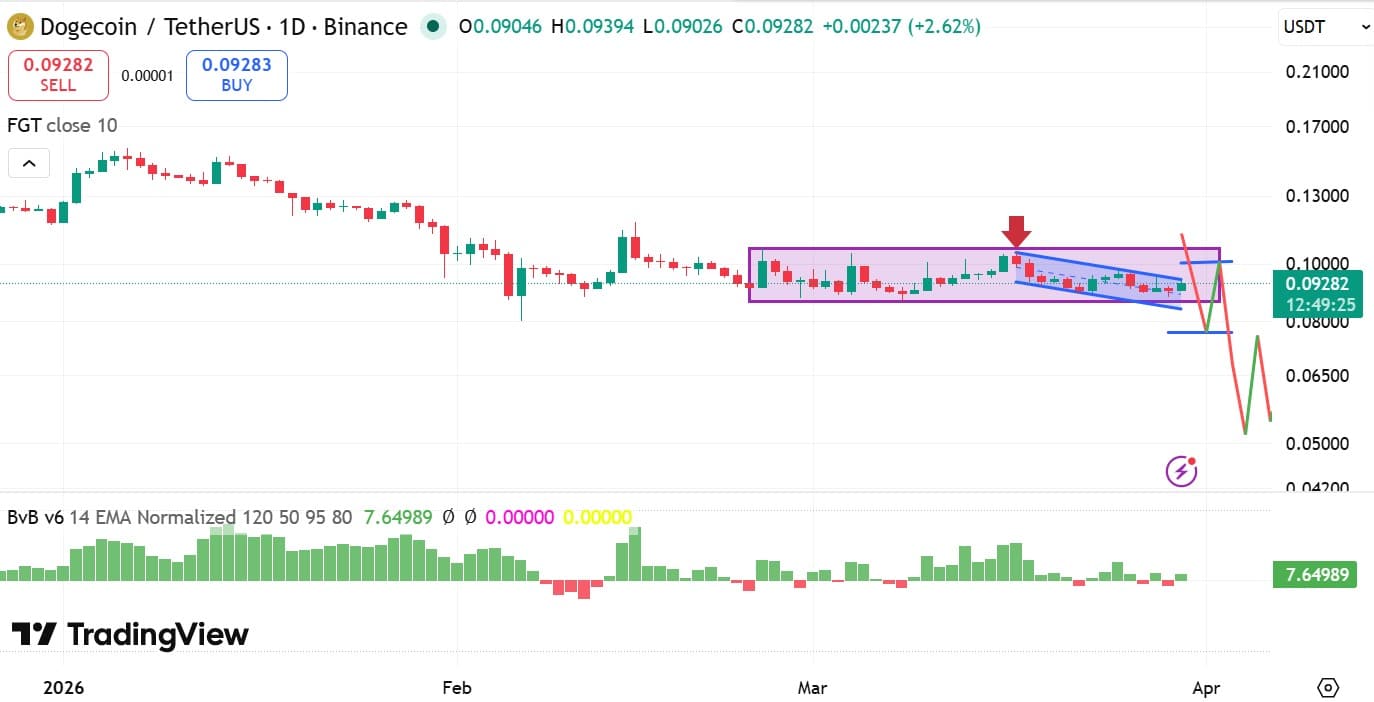
Dogecoin bulls have attempted to defend and flip $0.09 support over the past few days, with no success. As the market signaled a recovery, bulls jumped in with strength and successfully achieved their goal.
Source: TradingView

In fact, the Bulls vs. Bears indicator turned positive again, rising to 6.8 after falling into the negative zone. A rebound here suggested that buyers stepped in and displaced bears.

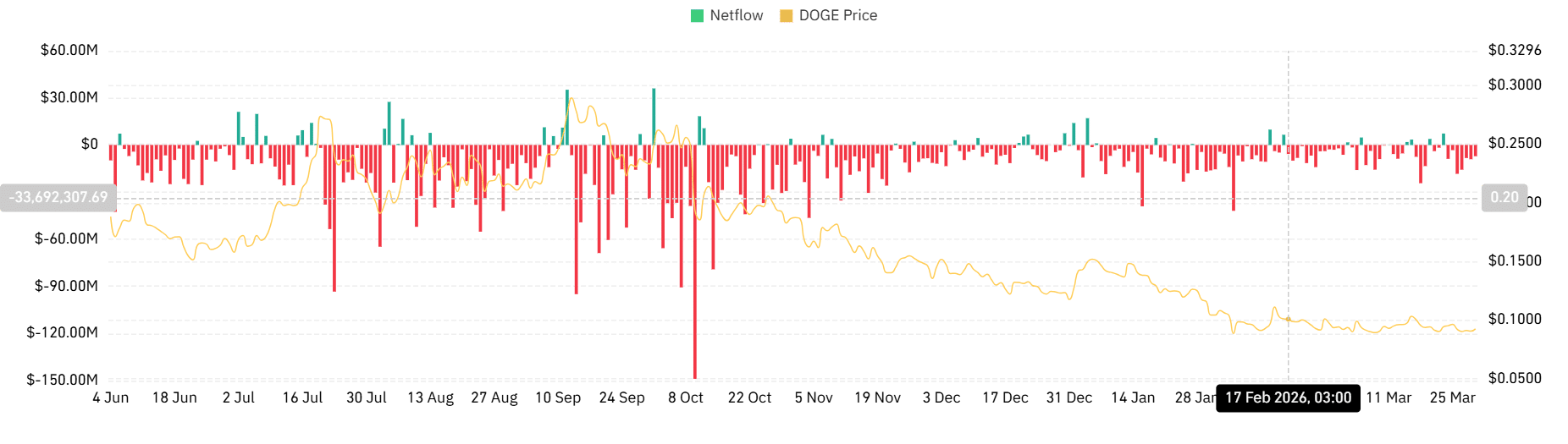
According to CoinGlass data, DOGE recorded $82.79 million in Spot outflows compared to $68.64 million in inflows. As a result, the memecoin’s Spot Netflow dropped 148% to -$14.25 million.
Source: CoinGlass

Notably, when outflows outpace inflows, it suggests that exchanges recorded more withdrawal orders than deposit orders.

Such a setup on exchanges reduces the supply available for immediate sale, effectively increasing scarcity and creating perfect conditions to accelerate upside momentum.

Futures remain overly bearish

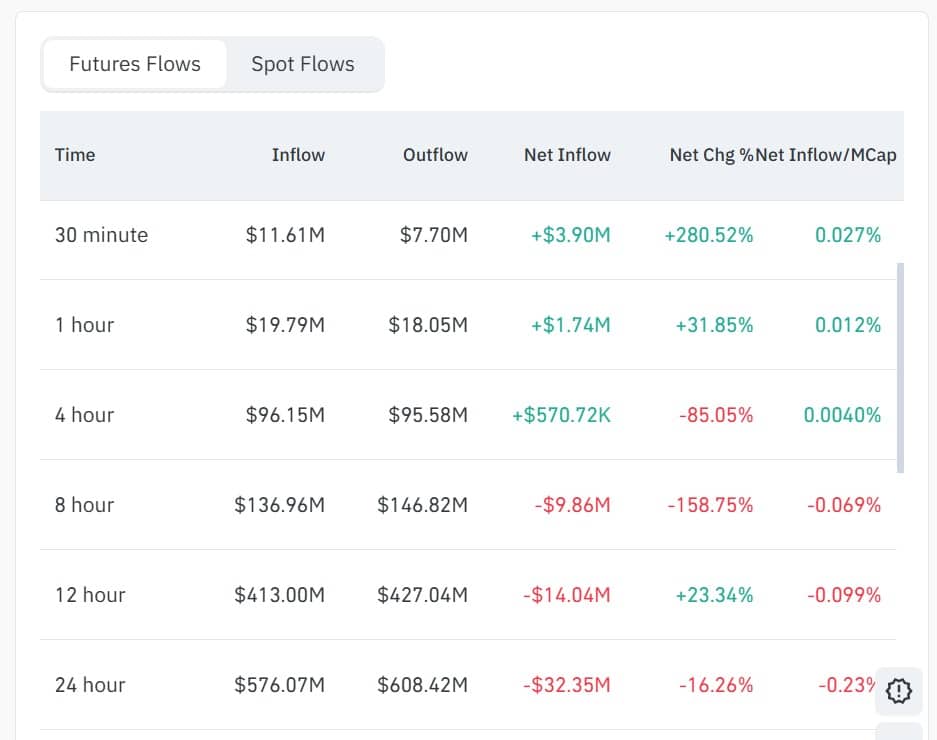
Although significant capital has flowed into the Spot market, derivatives market participants have continued to reduce their exposure.

While DOGE showed slight upside momentum, traders have avoided piling in, especially on the long side. This is due to increased long-position liquidations.

According to CoinGlass data, over $2.8 million in longs were liquidated. This liquidation rate amplified investors’ fear of taking more long positions.
Source: CoinGlass

As such, massive capital flowed into the Futures market, with over $608.4 million in outflows. This suggests that most participants closed their positions, indicating reduced risk appetite.

Such market conditions have left the Dogecoin market weakened and exposed to potentially more losses on its price charts.

What’s next for DOGE?

Dogecoin is currently at a crossroads, with the Spot market showing greater determination to pull the market out of a slump, while Futures remain bearish. These two conflicting forces expose DOGE to the fate of whichever side manages to overwhelm the other.

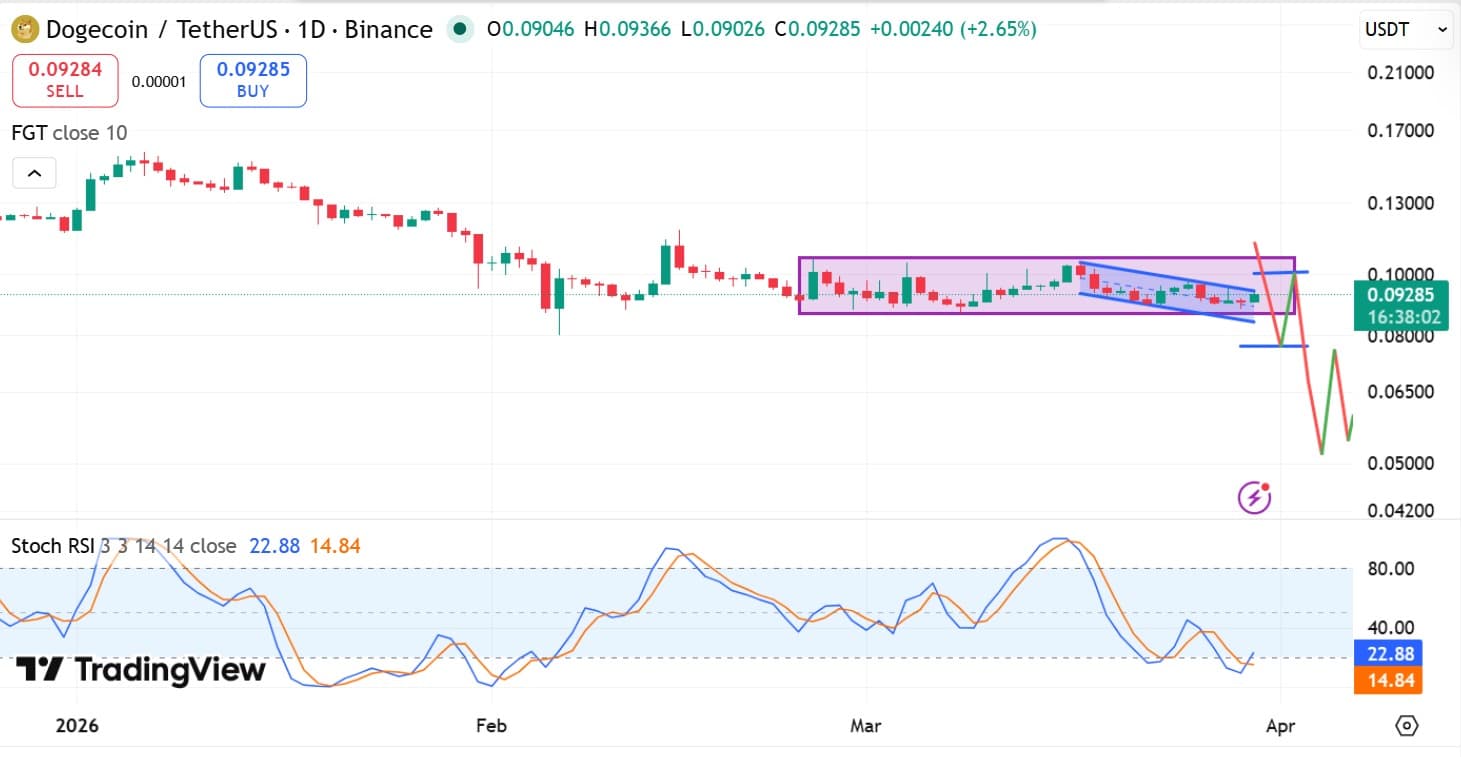
Looking at the Stochastic RSI, the momentum made a bullish crossover, rising from 7 to 23, reflecting increased buying pressure. Despite this crossover, the momentum index remains firmly stuck in oversold territory, signaling the presence of sellers.
Source: TradingView

Even more worrying for memecoin prospects, the future Grand Trend suggested another slip. Based on the future model, DOGE could drop below $0.09 again, falling to $0.086, with $0.080 as critical support.

However, if Spot demand outweighs Futures selling, Dogecoin could hold above $0.09 and target $0.106 resistance.


Final Summary

  • DOGE rose slightly, flipping $0.09, touching a high of $0.093, before retracing to $0.092.
  • Dogecoin saw fresh capital inflows into the Spot market, but Futures remained bearish, posing a risk of pullback.

Perguntas relacionadas

QWhat was Dogecoin's price and daily percentage change at the time the article was written?

AAt press time, DOGE traded at $0.092, after slightly rising by 1.86% on the daily charts.

QWhat key support level did Dogecoin bulls successfully defend and flip?

ADogecoin bulls successfully defended and flipped the $0.09 support level.

QAccording to the article, what does it suggest when exchange outflows outpace inflows for an asset like DOGE?

AWhen outflows outpace inflows, it suggests that exchanges recorded more withdrawal orders than deposit orders. This reduces the supply available for immediate sale, increasing scarcity and creating conditions for upside momentum.

QWhy are traders in the derivatives market hesitant to take long positions on DOGE?

ATraders have avoided piling into long positions due to increased long-position liquidations, with over $2.8 million in longs being liquidated, which amplified investors' fear.

QWhat are the two potential price targets for DOGE mentioned in the article, based on conflicting market forces?

AIf Futures selling pressure outweighs spot demand, DOGE could drop to $0.086, with $0.080 as critical support. However, if Spot demand outweighs Futures selling, Dogecoin could hold above $0.09 and target the $0.106 resistance level.

Leituras Relacionadas

No Sales Team, $20 Million in Revenue: How Did AI Employee Viktor Win Over 30,000 Companies?

The AI employee Viktor, developed by a team with DeepMind background, has achieved $20 million in annual revenue without a traditional sales team, serving over 30,000 companies. Its core innovation lies in positioning itself as a "Tier 3 AI Coworker" capable of "end-to-end execution and delivery of results," moving beyond the "draft and wait for human completion" model of typical AI assistants. Users can simply mention Viktor in Slack or Microsoft Teams using natural language commands, and it autonomously performs tasks like pulling sales data from a CRM, generating reports, or even cross-tool operations like creating board meeting PPTs by aggregating data from six different sources. Key to its growth is a pure Product-Led Growth (PLG) model, eliminating complex implementation cycles and per-seat licensing. Instead, it charges based on task credits or consumption, lowering the trial barrier with a $100 free credit offer and no credit card required. This enabled viral, bottom-up adoption within organizations. Viktor's interaction paradigm removes the barrier of prompt engineering, allowing non-technical employees to delegate complex workflows seamlessly. It also features proactive, automated task execution (e.g., overnight bookkeeping, scheduled reports) based on triggers, effectively embedding AI as an automated "process layer" within business operations. However, its expansion into Microsoft Teams—a platform with 320 million users—highlights challenges. Large enterprises require stringent IT compliance, security reviews (e.g., SOC 2), and governance, potentially hindering the frictionless, user-driven adoption that succeeded in Slack. Additionally, the "black box" nature of its autonomous decision-making raises concerns about operational risks, data integrity, and the need for robust audit logs and permission controls. Balancing efficiency gains with security and trust remains a critical hurdle for Viktor and similar AI agents aiming to become core enterprise infrastructure.

marsbitHá 2h

No Sales Team, $20 Million in Revenue: How Did AI Employee Viktor Win Over 30,000 Companies?

marsbitHá 2h

Trading

Spot
Futuros
活动图片