DOGE Year-End Review: Did Musk's Hundred-Day Reform Work?

marsbitPublicado em 2025-12-31Última atualização em 2025-12-31

Resumo

DOGE Year-End Review: Did Musk's 100-Day Reform Work? The DOGE (Department of Government Efficiency) initiative, led by Elon Musk and Vivek Ramaswamy, aimed to cut bureaucratic waste, reduce regulations, and save $2 trillion to balance the federal budget. Despite ambitious goals, Musk resigned after just 130 days, and DOGE was dissolved by November—10 months into an 18-month plan. DOGE achieved a 9% reduction in federal employees (271,000 jobs cut) and claimed $21.4–25 billion in savings through contract terminations and program closures. However, total federal spending increased from $6.75–7.135 trillion in 2024 to $7.01–7.6 trillion in 2025, a 4–6% rise. Mandatory spending (e.g., Social Security, Medicare) and interest on debt—unaffected by administrative cuts—drove this growth. Independent analyses suggested actual savings were as low as $3 billion, with potential future tax losses from weakened IRS enforcement offsetting gains. Post-Musk, DOGE’s influence waned, and service disruptions emerged. The reform highlighted the fundamental mismatch between corporate efficiency models and government operations, where statutory spending and systemic inertia limit top-down restructuring. The experiment underscored that government cannot be run like a business, as efficiency must balance fairness, stability, and public trust.

Federal employees were successfully reduced by 271,000, a decrease of 9%, setting the largest peacetime layoff record. However, at the same time, total federal expenditures did not decrease but instead increased, soaring from $6.75-7.135 trillion in 2024 to $7.01-7.6 trillion, a net increase of $248-480 billion. This phenomenon of "losing weight but gaining mass" is the core contradiction of the DOGE (Department of Government Efficiency) reform.
This "external advisor" agency, initially led by Elon Musk and Vivek Ramaswamy, promised to use commercial means to dismantle government bureaucracy, cut redundant regulations, reduce wasteful spending, and ultimately save $2 trillion to balance the federal budget. This ambitious plan was expected to last until July 2026, giving them 18 months to transform the government. However, reality proved far harsher than expected: Musk resigned hastily in May, serving only a 130-day term as a special government employee; by November, DOGE quietly dissolved, a full 8 months before the original term was set to end.

This was not an unfinished reform, but a complete abandonment. From launch to disappearance, DOGE's actual lifespan was only about 10 months. When the savings target was clearly unattainable, legal challenges ensued, and disputes with Trump became public, Musk chose to return to his business empire, leaving behind a crumbling agency and a host of unanswered questions. This rapid fall from ambition to disillusionment exposed not only missteps in reform strategy but also the essential, difficult-to-cross chasm between corporate logic and government operations.

I. The Grand Vision vs. The Harsh Reality: A Complete Divergence

DOGE's reform vision was full of Silicon Valley-style idealism. They planned to use lean management principles to terminate hundreds of billions of dollars in inefficient contracts, close redundant facilities, reduce the federal workforce from about 3.015 million to a leaner size, and replace some bureaucratic functions with AI and automation tools. This methodology has proven successful time and again in the business world—why couldn't it be used to transform the government?
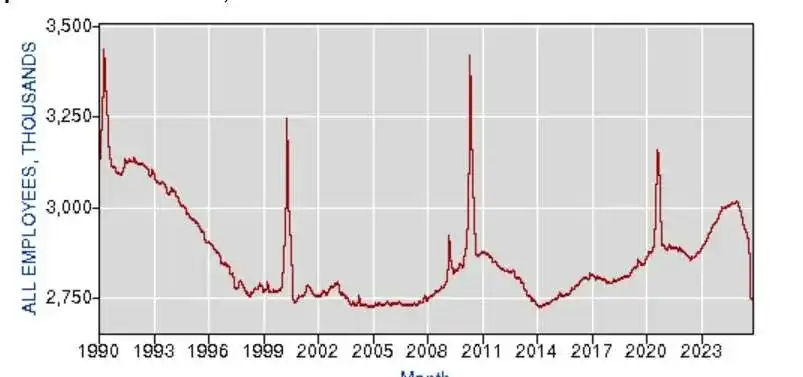
Chart: Federal Employee Count Since 1990

In January 2025, Musk joined DOGE as a special government employee, with a term set for 130 days. In Silicon Valley, 130 days is enough to launch a product prototype, complete a round of financing, or even turn around a startup's fate. In the initial months, DOGE demonstrated dazzling execution. From January to November, federal employees decreased from 3.015 million to 2.744 million, a net reduction of 271,000 positions. This was not only the largest peacetime federal layoff since WWII, but the speed of execution was also staggering. Specific actions included terminating a $290 million refugee facility contract at the Department of Health and Human Services, $190 million in IT redundancy spending at the Treasury Department, and closing hundreds of inefficient agencies and programs, cumulatively undertaking over 29,000 reduction actions. DOGE claimed these measures saved approximately $21.4-25 billion, primarily concentrated in non-defense federal mandatory spending, which decreased by 22.4% year-on-year.
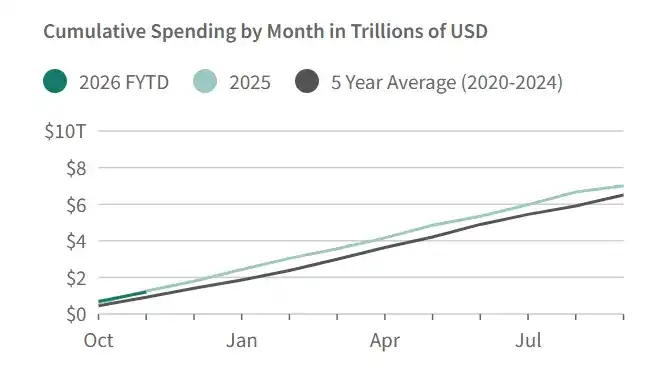
Chart: Cumulative Federal Government Expenditure

But the data on the spending side told a completely different story. Overall federal expenditure rose from about $6.75-7.135 trillion in 2024 to about $7.01-7.6 trillion in 2025, an increase of 4%-6%. Spending in just the first 11 months reached $7.6 trillion, $248 billion more than the same period the previous year. More ironically, some independent analyses suggested that DOGE's claimed savings figures might be severely inflated, with verifiable savings potentially only in the tens of billions, even as low as $3 billion. Due to the weakening of IRS enforcement capabilities, this could lead to at least $350 billion in lost tax revenue over the next decade, making the net effect of the so-called "savings" close to zero or even negative.

Resistance from reality soon became apparent. Federal spending continued to climb; mandatory spending like Social Security, Medicare, and interest on the national debt was completely unaffected by administrative layoffs. By May, multiple pressures converged. Musk's relationship with Trump began to deteriorate, with public disputes between the two. Legal challenges followed, questioning DOGE's authority and procedural legality. Tesla's business was also calling him back—stock price fluctuations, production issues, market competition, all requiring the CEO's attention. Most crucially, the $2 trillion savings target was clearly an impossible mission; staying on a project doomed to fail held no benefit for Musk's personal brand. As soon as his 130-day term ended, Musk announced his return to private enterprise. He did not apply for an extension, did not ask for more resources, but chose a clean break. This decision itself was the loudest admission: transforming the government with business methods was far more difficult than he had thought.

II. The Struggles of the Headless Horseman: Decline from May to November
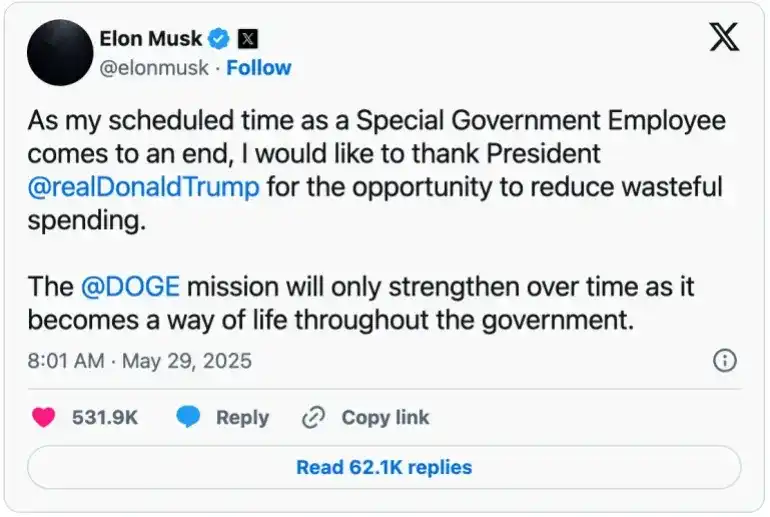
After Musk's departure, DOGE tried to prove it could continue. The White House signaled that the "DOGE spirit" would be integrated into the government's daily operations, becoming part of the "government lifestyle." Some former DOGE employees were embedded in various federal agencies to continue pushing layoffs and cost cuts. Ramaswamy was still nominally leading the agency, trying to maintain the reform momentum.

But DOGE without Musk was like a rocket without an engine; inertia could only last so long. Without the star founder's halo, the agency's attention rapidly declined. Without Musk's direct communication channel with Trump, DOGE's influence within the government was greatly diminished. More importantly, the limitations of the reform became increasingly apparent—those large expenditure items that truly required Congressional legislation to change were utterly beyond DOGE's reach.

During this period, DOGE's achievements became harder to define. Although some layoff actions continued, spending data kept rising. Reports of service disruptions began to increase. Social Security applications were delayed, regulatory gaps appeared, and key positions were left unfilled due to over-cutting. Criticism grew louder: in the name of optimizing efficiency, DOGE was undermining the government's basic operational capacity. Legal challenges also accumulated, questioning whether many of DOGE's actions exceeded executive authority.

By November, several authoritative media outlets began reporting a fact: DOGE had quietly disbanded. Reuters, TIME, CNN, Newsweek, and others used terms like "disbanded," "quietly shut down," and "no longer exists" to describe the agency's fate. There was no formal dissolution announcement, no press conference; DOGE simply vanished from public view. Its charter, originally meant to last until July 2026, was terminated early, with many functions transferred to the Office of Personnel Management or other常规 agencies.

This silent end perhaps speaks volumes more than any failure. Not even a decent farewell, because admitting failure itself was an embarrassment. DOGE went from a revolutionary agency promising to change the government to a brief interlude everyone wanted to forget as quickly as possible.

III. The Underlying Logic of "Reducing Staff Without Saving Money"

1. The Impenetrable Wall of Mandatory Spending
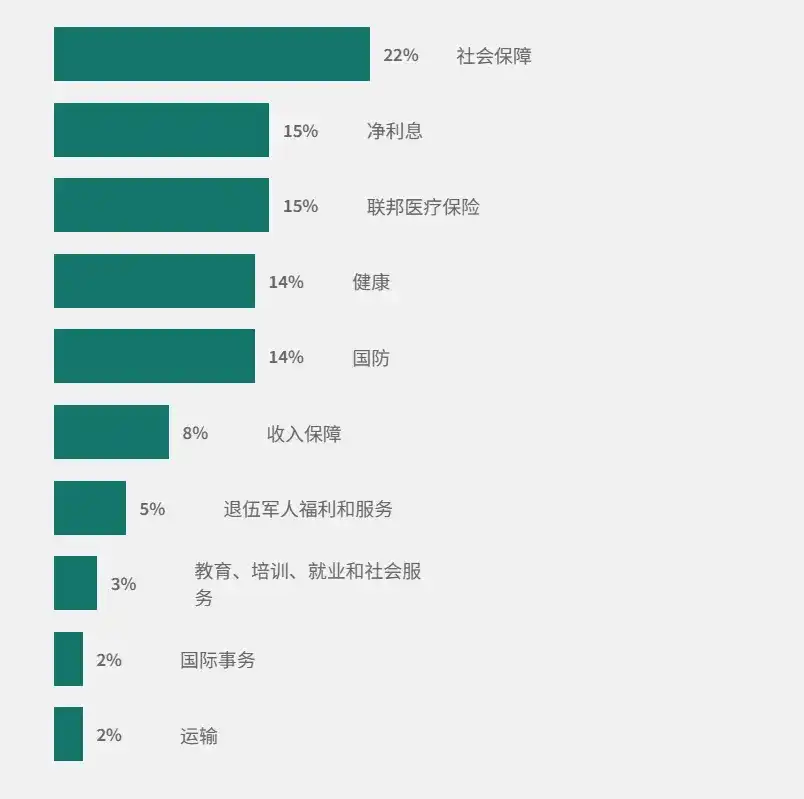
The most fundamental difference between the government fiscal system and a corporation is that over 70% of federal spending is on mandatory programs. These expenditures grow automatically as mandated by law, influenced by demographics, economic cycles, and interest rate fluctuations, completely unaffected by administrative layoffs. The 2025 data clearly shows this rigidity: benefit spending like Social Security and Medicare increased by about $168 billion, driven mainly by an aging population and inflation adjustments; national debt interest costs soared by $71 billion, with the debt scale already expanded to $36-38.3 trillion, making interest expenditure even exceed the defense budget, becoming the federal government's largest single expense.

These rigid expenditures directly offset all of DOGE's savings efforts. No matter how many administrative staff were cut, Social Security payments still had to be made according to statutory formulas, Medicare subsidies still had to be paid based on enrollment, and national debt interest had to be paid on time to maintain national credit. As an executive agency, DOGE could not unilaterally modify benefit programs authorized by Congress, meaning the effort was confined to the "periphery" from the start, unable to touch the "core" of expenditures.

At a deeper level, this rigidity stems from constitutional and legislative frameworks. The government is not a profit-seeking enterprise but a public institution承担ing the function of a social safety net. When a 65-year-old applies for Social Security, the government cannot refuse payment for "cost optimization." This is the essential difference between government and business, and the fundamental reason corporate thinking hit a wall here.

2. The "Offsetting" of Inter-Departmental Spending

DOGE did achieve some results in the discretionary spending area. They terminated 5,200 projects and hundreds of billions of dollars in contracts in departments like Health and Human Services, Education, and the Agency for International Development, saving about $37 billion. But these savings were quickly吞噬ed by growth in other departments. Defense spending increased due to geopolitical tensions, infrastructure investment膨胀ed due to the Trump administration's priorities, and the spillover effects of mandatory spending further pushed up the overall budget.

The result was "local slimming, global expansion." This is similar to the "savings transfer" phenomenon common in corporate mergers and acquisitions—costs cut in one department often reappear in another form elsewhere. But the government lacks the flexible adjustment mechanisms of a company and cannot reconfigure resources as quickly. The 2025 spending growth also included emergency response (increased natural disaster funds) and inflation adjustments (CPI rose about 3%-4%), these external factors further amplified the "offsetting" effect.

Specific data shows that DOGE's savings accounted for only 0.3%-0.5% of total spending, far insufficient to reverse the overall trend. In 2025, mandatory spending increased by $221 billion, discretionary spending increased by $80 billion, and net interest costs increased by $71 billion. When you save a few billion in one pocket but pull out hundreds of billions from three others, the so-called "efficiency improvement" becomes a numbers game.

3. The Cost Inertia and Transition Friction of Agency Operations

Layoffs are never a zero-cost operation, especially in the government system. Implementing the DOGE reform itself generated huge expenses: severance pay, paid leave, rehiring costs after wrongful termination, totaling an estimated $135 billion. This figure already far exceeds many of the "savings" projects claimed by DOGE. More hidden costs came from productivity losses and service disruptions.

The operation of government agencies highly relies on institutional memory and human networks. When large numbers of experienced employees left, Social Security applications began to delay, regulatory gaps appeared, and policy implementation efficiency actually decreased. Although AI and automation were held in high hopes, these tools are far from mature enough to completely replace human judgment. Algorithmic governance might be efficient, but it also brings new problems like data privacy leaks and algorithmic bias. In the process of transitioning from a "public service apparatus" to a "data-driven terminal," the government is losing something difficult to quantify but crucial—legitimacy, social cohesion, and public trust.

A more practical problem is the increase in overtime pay for remaining employees and rising contract outsourcing costs. The government outsourced work previously done internally to private contractors, often at a higher price. In the long run, large-scale brain drain could create a "knowledge gap," affecting policy continuity and professional capacity accumulation.

Conclusion: Who Lost? Reflecting on the Cost and Boundaries of Reform

In this collision of ideals and reality, who ultimately lost? Perhaps first the idealistic reformers, who underestimated the complexity of government operations and mistakenly thought business logic could be directly transplanted into the public sector. Taxpayers might benefit from partial savings in the short term, but face the risk of service cuts and quality decline in the long run. Beneficiaries of public services, especially groups relying on Social Security and Medicare, might suffer from service disruptions and reduced efficiency.

The deeper loser might be the entire system's sustainability and democratic legitimacy. When the government is "optimized" like a business, those values that cannot be measured by numbers—fairness, stability, social cohesion—are quietly being eroded. Opinion polls showed DOGE's approval rating hovering around 40%, reflecting public recognition of efficiency gains coexisting with concerns about service disruptions.

But this collision was not entirely meaningless. If DOGE can push Congress to take action and truly touch core issues like welfare reform and debt control, it could still become a historical turning point. The key is to recognize that the government is not a business; efficiency needs to be balanced with fairness, sustainability, and democratic principles. A business can sacrifice everything for profit, but the government must保留 the last line of defense for society's most vulnerable groups. This is the most important lesson corporate thinking needs to learn, and the most profound insight left to us by this激烈 collision.

Data for this report was compiled and edited by WolfDAO. Please contact us if you have any questions for updates;

Author: Nikka / WolfDAO ( X : @10xWolfdao )

Perguntas relacionadas

QWhat was the main contradiction in the DOGE reform efforts as described in the article?

AThe main contradiction was that while the DOGE successfully reduced the federal workforce by 271,000 employees (a 9% cut), the total federal spending actually increased by $248-480 billion, from $6.75-7.135 trillion to $7.01-7.6 trillion. This 'slimming down but gaining weight' phenomenon highlighted the core failure of the reform.

QWhy did Elon Musk leave the DOGE after only 130 days?

AElon Musk left due to multiple converging pressures: a deteriorating relationship with Trump, mounting legal challenges questioning DOGE's authority, the need to return to his business empire (Tesla) to address stock volatility and production issues, and the realization that the $2 trillion savings goal was an impossible task that could damage his personal brand.

QWhat happened to the DOGE after Elon Musk's departure?

AAfter Musk left, the DOGE attempted to continue but quickly lost influence and momentum. It was described as losing its engine. It was eventually quietly disbanded in November, about 10 months after its start and 8 months before its original end date, with many of its functions transferred to other agencies like the Office of Personnel Management.

QAccording to the article, what are the fundamental reasons why corporate logic failed within the government?

ACorporate logic failed due to three fundamental reasons: 1) The 'impregnable wall' of mandatory spending (over 70% of the budget) on programs like Social Security and Medicare, which is required by law and unaffected by administrative cuts. 2) The 'see-saw effect' of spending, where savings in one department were swallowed by increases in others like defense and infrastructure. 3) The high cost inertia and transition friction of the reforms themselves, including severance pay, productivity loss, and the inability of AI to fully replace human judgment.

QWhat were some of the hidden costs and negative consequences of the DOGE's workforce reductions?

AHidden costs included an estimated $135 billion in implementation costs (severance, paid leave, rehiring after wrongful termination). Negative consequences included service disruptions (delays in Social Security applications), regulatory vacuums, loss of institutional memory, increased overtime pay for remaining staff, higher costs from outsourcing to contractors, and a long-term 'knowledge gap' affecting policy continuity.

Leituras Relacionadas

Trading

Spot
Futuros

Artigos em Destaque

O que é POO DOGE

Poo Doge: Um Jogador Inovador no Espaço Cripto Introdução No panorama em rápida evolução das criptomoedas e da tecnologia blockchain, novos projetos surgem continuamente para capturar a atenção de investidores e entusiastas da tecnologia. Um desses projetos é o Poo Doge ($POO DOGE), lançado em 2022 como uma oferta única dentro do ecossistema Web3. Operando na plataforma Dogechain, o Poo Doge conquistou um nicho como uma ferramenta descentralizada que visa melhorar a forma como os usuários gerem os seus ativos digitais. Este artigo explora os aspectos centrais do Poo Doge, analisando os seus objetivos, funcionalidade, criadores e as características únicas que o distinguem num mercado saturado. O que é Poo Doge? O Poo Doge é uma criptomoeda descentralizada concebida especificamente para o ecossistema Dogechain. Utilizando a Máquina Virtual Ethereum (EVM), funciona como um rastreador de portefólios versátil e fácil de usar. O objetivo principal deste projeto é proporcionar aos usuários a capacidade de monitorizar e gerir múltiplos tokens de forma eficaz dentro da estrutura Dogechain. Como uma moeda descentralizada, o Poo Doge distingue-se pelo seu foco na segurança e simplicidade na gestão de ativos. Os usuários podem acompanhar os seus investimentos e gerir portefólios de tokens sem as complexidades frequentemente associadas às plataformas cripto tradicionais. Esta abordagem centrada no usuário na gestão de ativos é sem igual, particularmente no contexto único do Dogechain, que proporciona um ambiente leve e orientado para a comunidade. Quem é o Criador do Poo Doge? A informação relativa aos indivíduos específicos ou equipa responsáveis pela criação do Poo Doge não é divulgada. Numa indústria onde a transparência é frequentemente considerada um valor fundamental, a falta de detalhes públicos sobre o criador pode levantar questões entre potenciais usuários e investidores. No entanto, esta anonimidade não diminui os objetivos do projeto e o impacto previsto no espaço Web3. Quem são os Investidores do Poo Doge? Neste momento, não existe informação pública disponível sobre investidores específicos ou organizações de investimento que apoiem o projeto Poo Doge. Esta ausência pode sugerir que o projeto é auto-financiado ou que ainda não atraiu a atenção de entidades de investimento maiores, tipicamente associadas a iniciativas cripto mais extensas. Embora a falta de apoio identificável possa ser vista com ceticismo, não é incomum que projetos emergentes, especialmente aqueles focados em tecnologia descentralizada, operem inicialmente sem apoio institucional notável. À medida que o Poo Doge continua a desenvolver-se e a expandir a sua base de usuários, uma maior integração com potenciais investidores pode ocorrer. Como Funciona o Poo Doge? O Poo Doge opera com base nos princípios da descentralização, aproveitando a Dogechain (EVM) para fornecer uma solução definitiva de rastreamento de portefólios. Aqui estão os aspectos-chave de como o projeto funciona: Plataforma Descentralizada Sendo construído sobre uma estrutura descentralizada, o Poo Doge é concebido para eliminar pontos centrais de falha, que muitas vezes representam um risco nos sistemas bancários e financeiros tradicionais. Esta descentralização não só melhora a segurança, mas também promove a transparência, uma vez que todas as transações são verificáveis na blockchain. Rastreio de Portefólios A característica distintiva do Poo Doge é o seu papel como rastreador de portefólios, o primeiro do seu tipo na blockchain original de meme coin do Dogechain. Esta abordagem inovadora permite que os usuários gerenciem eficientemente os seus investimentos em vários tokens. Os usuários podem obter insights sobre as suas posses, volatilidade e desempenho histórico, permitindo decisões de investimento mais informadas. Compatibilidade com EVM O Poo Doge tira partido da Máquina Virtual Ethereum, permitindo uma integração e interoperabilidade sem costuras com outras blockchains compatíveis com EVM. Esta capacidade técnica é crucial no ecossistema cripto interconectado, permitindo que o Poo Doge ofereça funcionalidades melhoradas, facilite transações cross-chain e atraia uma base de usuários mais ampla. Linha do Tempo do Poo Doge Para melhor compreender a evolução do Poo Doge no panorama das criptomoedas, aqui está uma breve linha do tempo destacando marcos significativos na sua história: 2022: O Poo Doge ($POO DOGE) foi oficialmente lançado, fazendo a sua entrada no mercado de criptomoedas. Desenvolvimento em 2022: O projeto concentrou-se em construir e otimizar as suas operações dentro do ambiente Dogechain, focando na sua função principal como rastreador de portefólios. Suprimento de Tokens: Um suprimento total de 1.000.000.000.000 tokens foi estabelecido, embora se note que nenhum token está alegadamente em circulação neste momento, sugerindo que o projeto ainda pode estar na sua fase inicial de desenvolvimento. Características Únicas O Poo Doge destaca-se de outros projetos de várias maneiras importantes: Vantagem do Primeiro Chegador: Como o primeiro rastreador de portefólios no Dogechain, o Poo Doge ocupa um espaço único que pode atrair primeiros adotantes e melhorar a sua posição no mercado. Focado no Usuário: O projeto enfatiza a simplicidade e a facilidade de uso, garantindo que mesmo aqueles que podem não ter um amplo conhecimento em blockchain conseguem gerir eficazmente os seus ativos digitais. Descentralizado e Seguro: Ao operar dentro de uma estrutura descentralizada, os usuários podem desfrutar de uma segurança aumentada e da confiança de que os seus portefólios estão protegidos contra possíveis hacks que podem afetar plataformas centralizadas. Abordagem Orientada pela Comunidade: A dependência do Poo Doge em relação ao envolvimento e feedback da comunidade é fundamental no seu desenvolvimento, podendo resultar num produto que se alinha mais estreitamente com as necessidades dos usuários. Conclusão O Poo Doge ($POO DOGE) representa um desenvolvimento fascinante no panorama Web3 e das criptomoedas. Embora existam lacunas notáveis na informação pública disponível sobre os seus criadores e investidores, a abordagem inovadora do projeto em relação às finanças descentralizadas e à gestão de ativos detém uma promissora consideração. Com o seu foco na experiência do usuário e o conceito pioneiro de um rastreador de portefólios no Dogechain, o Poo Doge está preparado para atrair atenção à medida que continua a evoluir. À medida que o panorama das criptomoedas cresce e amadurece, iniciativas como o Poo Doge sublinham a transição contínua em direção à descentralização e ao empoderamento do usuário nas finanças, abrindo caminho para uma nova era de gestão de ativos digitais.

327 Visualizações TotaisPublicado em {updateTime}Atualizado em 2024.12.03

O que é POO DOGE

Como comprar DOGE

Bem-vindo à HTX.com!Tornámos a compra de Dogecoin (DOGE) simples e conveniente.Segue o nosso guia passo a passo para iniciar a tua jornada no mundo das criptos.Passo 1: cria a tua conta HTXUtiliza o teu e-mail ou número de telefone para te inscreveres numa conta gratuita na HTX.Desfruta de um processo de inscrição sem complicações e desbloqueia todas as funcionalidades.Obter a minha contaPasso 2: vai para Comprar Cripto e escolhe o teu método de pagamentoCartão de crédito/débito: usa o teu visa ou mastercard para comprar Dogecoin (DOGE) instantaneamente.Saldo: usa os fundos da tua conta HTX para transacionar sem problemas.Terceiros: adicionamos métodos de pagamento populares, como Google Pay e Apple Pay, para aumentar a conveniência.P2P: transaciona diretamente com outros utilizadores na HTX.Mercado de balcão (OTC): oferecemos serviços personalizados e taxas de câmbio competitivas para os traders.Passo 3: armazena teu Dogecoin (DOGE)Depois de comprar o teu Dogecoin (DOGE), armazena-o na tua conta HTX.Alternativamente, podes enviá-lo para outro lugar através de transferência blockchain ou usá-lo para transacionar outras criptomoedas.Passo 4: transaciona Dogecoin (DOGE)Transaciona facilmente Dogecoin (DOGE) no mercado à vista da HTX.Acede simplesmente à tua conta, seleciona o teu par de trading, executa as tuas transações e monitoriza em tempo real.Oferecemos uma experiência de fácil utilização tanto para principiantes como para traders experientes.

1.4k Visualizações TotaisPublicado em {updateTime}Atualizado em 2025.03.21

Como comprar DOGE

O que é DOGE M

Doge Matrix ($doge m): A Nova Raça de Criptomoeda Orientada pela Comunidade Introdução No panorama em constante evolução das criptomoedas, novos projetos surgem constantemente, cada um visando captar o interesse de investidores e entusiastas. Um dos mais recentes entrantes neste domínio é o Doge Matrix, representado pelo símbolo de ticker $doge m. Este projeto atraiu atenção graças às suas raízes na popular cultura de memes em torno do Dogecoin, estabelecendo o seu lugar dentro do espaço web3. Este artigo visa fornecer uma análise abrangente do Doge Matrix, cobrindo a sua visão geral, criador, investidores, funcionalidade, cronologia e aspetos notáveis. O que é o Doge Matrix ($doge m)? O Doge Matrix é um projeto de criptomoeda orientado pela comunidade que aparentemente se baseia no apelo generalizado do Dogecoin, uma moeda digital conhecida pelo seu mascote Shiba Inu e pelas suas origens em memes. Embora os objetivos gerais do Doge Matrix não estejam extensivamente definidos, caracteriza-se por um compromisso em aproveitar o envolvimento e o apoio da comunidade. Ao contrário das criptomoedas tradicionais que muitas vezes enfatizam a utilidade ou o valor intrínseco através de tecnologias subjacentes, o Doge Matrix posiciona-se dentro de um espaço que abraça o fenómeno cultural das criptomoedas, apelando particularmente àqueles que se identificam com a ética dos ativos baseados em memes. Aproveitando as forças da comunidade Dogecoin, o Doge Matrix opera como parte de um ecossistema mais amplo, convidando à participação e ao envolvimento de utilizadores que partilham um interesse pela criptomoeda e pelo espaço digital. Quem é o Criador do Doge Matrix ($doge m)? A identidade do criador do Doge Matrix permanece desconhecida. Esta falta de transparência não é uma ocorrência incomum no espaço das criptomoedas, onde alguns projetos são lançados sem revelar as identidades dos seus fundadores. A ausência de informação sobre a equipa fundadora pode levantar questões entre potenciais investidores sobre a responsabilidade e a direção do projeto. Quem são os Investidores do Doge Matrix ($doge m)? Atualmente, não há informações disponíveis publicamente que detalhem os investidores ou as fundações de investimento que apoiam o Doge Matrix. O projeto parece depender principalmente do apoio da comunidade em vez de investimento institucional. Este modelo alinha-se com a natureza orientada pela comunidade da iniciativa, promovendo um ambiente onde a direção do projeto é moldada pelos seus participantes em vez de ser ditada por um pequeno grupo de financiadores. Como Funciona o Doge Matrix ($doge m)? Os detalhes sobre os mecanismos operacionais do Doge Matrix são um tanto vagos, refletindo uma tendência mais ampla de projetos no espaço das moedas meme, onde funcionalidades inovadoras nem sempre são claramente articuladas. No entanto, o Doge Matrix parece ser projetado para aproveitar o ecossistema existente de criptomoedas, incentivando a participação dos utilizadores enquanto se liga às referências culturais familiares associadas ao Dogecoin. As suas características potencialmente únicas derivam das interações da comunidade em vez de avanços tecnológicos, enfatizando experiências partilhadas e colaboração entre os detentores de tokens. Embora as inovações exatas não tenham sido explicitamente delineadas, o projeto parece criar um espaço onde os membros da comunidade podem interagir, partilhar ideias e impulsionar o potencial do projeto para a frente. Cronologia do Doge Matrix ($doge m) Refletir sobre a cronologia do projeto revela eventos notáveis que definiram a sua jornada até agora: 25 de Novembro de 2024: O Doge Matrix alcançou o seu valor máximo histórico, marcando um marco significativo na sua história inicial. 1 de Janeiro de 2025: Por outro lado, o Doge Matrix atingiu o seu valor mínimo histórico, ilustrando a volatilidade frequentemente associada às criptomoedas, especialmente nas fases iniciais do ciclo de vida de um projeto. Em Curso: O projeto continua a ser ativamente negociado e apoiado pela sua comunidade, embora marcos ou objetivos futuros específicos ainda não tenham sido divulgados. Pontos Chave Sobre o Doge Matrix ($doge m) Foco na Comunidade No coração do Doge Matrix está um compromisso com o envolvimento da comunidade. O projeto prospera na premissa de colaboração e objetivos partilhados entre os seus membros, enfatizando a importância do esforço coletivo. Ao contrário de projetos centralizados que muitas vezes têm uma estrutura de liderança definida, o Doge Matrix apresenta atualmente uma abordagem mais fluida à governança, onde a voz de cada membro da comunidade importa. Volatilidade O mercado de criptomoedas é notório pela sua volatilidade, e o Doge Matrix não é exceção. A sua história de preços reflete flutuações significativas entre valores altos e baixos, o que é típico de muitas novas criptomoedas, mas sublinha os riscos associados ao investimento em tokens emergentes. Falta de Informação Detalhada Uma das características mais marcantes do Doge Matrix é a escassez de informação detalhada sobre os seus fundamentos tecnológicos e mecanismos operacionais. Esta ambiguidade exige que potenciais investidores realizem uma diligência prévia minuciosa antes de se envolverem com o projeto. Conclusão Em resumo, o Doge Matrix ($doge m) ilustra uma nova onda de projetos de criptomoeda que dependem fortemente do envolvimento da comunidade e da relevância cultural. Embora falte em certos pormenores—como liderança clara, objetivos definidos e funcionalidade detalhada—o projeto conseguiu gerar interesse dentro da comunidade cripto, aproveitando o apelo estabelecido da cultura de memes. Como em qualquer investimento no espaço das criptomoedas, compreender os riscos inerentes e realizar uma pesquisa abrangente é essencial para potenciais participantes. O Doge Matrix serve como um lembrete da natureza dinâmica, por vezes imprevisível, da indústria cripto, marcada por uma evolução constante e entusiasmo por iniciativas orientadas pela comunidade.

428 Visualizações TotaisPublicado em {updateTime}Atualizado em 2025.02.03

O que é DOGE M

Discussões

Bem-vindo à Comunidade HTX. Aqui, pode manter-se informado sobre os mais recentes desenvolvimentos da plataforma e obter acesso a análises profissionais de mercado. As opiniões dos utilizadores sobre o preço de DOGE (DOGE) são apresentadas abaixo.

活动图片














