Distinguishing Types of Drawdowns Is More Important Than Blindly Buying the Dip

marsbitPublicado em 2026-02-15Última atualização em 2026-02-15

Resumo

Distinguishing between types of drawdowns is more important than blindly buying the dip. Academic finance categorizes risk into systemic (market-wide, unavoidable) and idiosyncratic (company-specific). Similarly, drawdowns can be market-driven (systemic, like the 2008 crisis) or company-specific (idiosyncratic, like the recent AI-driven selloff in software stocks). Using FactSet (FDS) as an example, the article illustrates that a systemic drawdown, such as in 2008/09, was a test of the market's durability, not FactSet's economic moat. In these cases, investors can leverage a behavioral advantage—patience and a long-term view—as history shows markets tend to recover. Conversely, the current 2025/26 drawdown in software stocks is largely idiosyncratic, driven by specific fears that AI could disrupt industry pricing power and erode moats. To capitalize on such a drawdown, an investor needs an analytical advantage: a more accurate vision of the company's future a decade from now than the market's pessimistic price implies. This requires understanding why informed sellers are wrong, a fine line between conviction and arrogance. The key takeaway is not to apply a blunt behavioral solution (like simply buying the dip) to a problem that requires nuanced, fundamental analysis.

Original Author: Todd Wenning

Original Compilation: Deep Tide TechFlow

Guide: Academic finance theory categorizes risk into systematic risk and idiosyncratic risk. Similarly, stock drawdowns can also be divided into two types: market-driven systematic drawdowns (such as the 2008 financial crisis) and company-specific idiosyncratic drawdowns (such as the current software stock crash driven by AI concerns).

Using FactSet as an example, Todd Wenning points out: during a systematic drawdown, you can leverage a behavioral advantage (patiently waiting for the market to recover); but during an idiosyncratic drawdown, you need an analytical advantage—having a more accurate vision of what the company will look like in ten years than the market does.

Amid the current AI impact on software stocks, investors must distinguish: is this a temporary market panic, or is the moat truly crumbling?

class="ql-align-justify">Do not use a blunt behavioral solution to solve a problem that requires nuanced analysis.

Full Text Below:

Academic finance theory posits two types of risk: systematic and idiosyncratic.

  • Systematic risk is unavoidable market risk. It cannot be eliminated through diversification, and it is the only type of risk for which you are compensated.
  • On the other hand, idiosyncratic risk is company-specific risk. Because you can cheaply purchase a diversified portfolio of uncorrelated businesses, you are not compensated for taking on this risk.

We can debate Modern Portfolio Theory another day, but the systematic-idiosyncratic framework is helpful for understanding different types of drawdowns (the percentage decline from peak to trough of an investment) and how we, as investors, should evaluate opportunities.

From the moment we picked up our first value investing book, we were taught to take advantage of a despondent Mr. Market when stocks are sold off. If we remain calm while he loses his senses, we will prove ourselves to be stoic value investors.

But not all drawdowns are the same. Some are market-driven (systematic), while others are company-specific (idiosyncratic). Before you make a move, you need to know which type you're looking at.
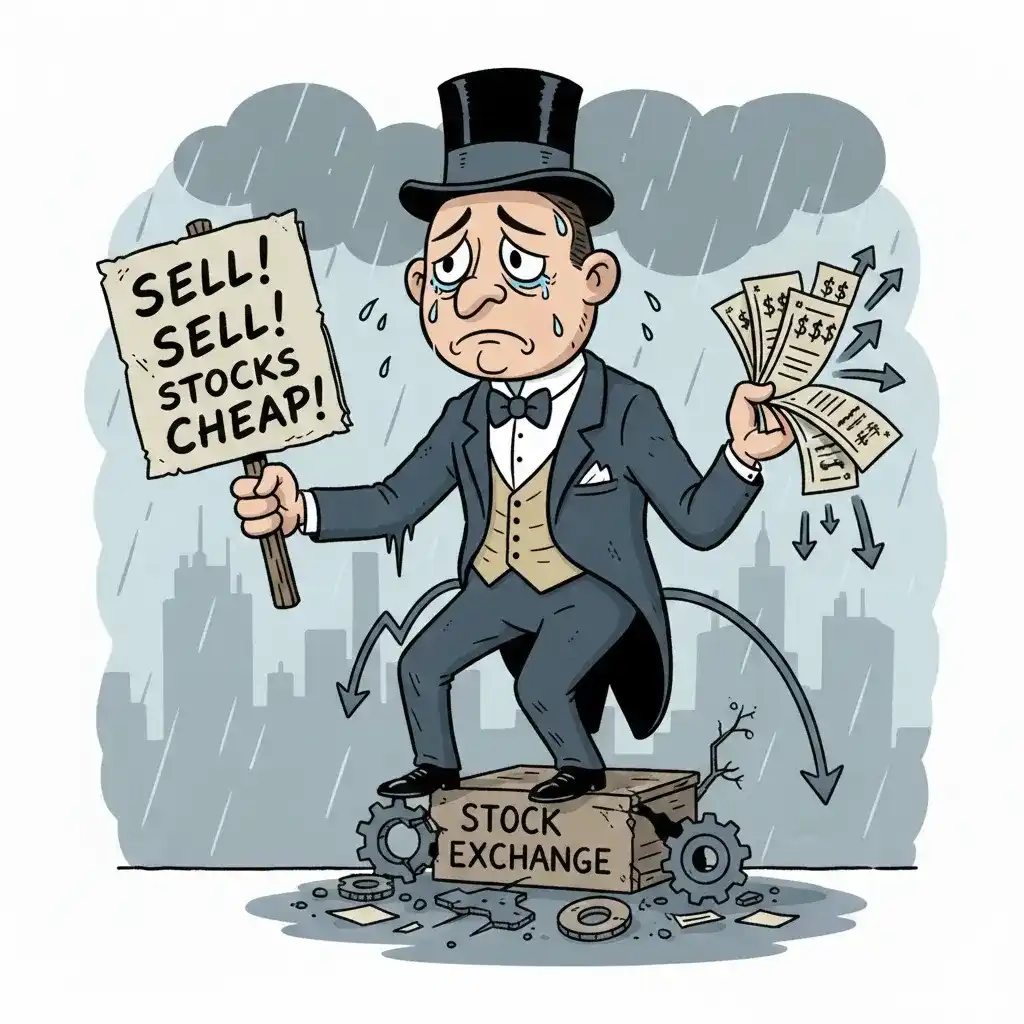
Generated by Gemini

The recent sell-off in software stocks due to AI concerns illustrates this point. Let's look at the 20-year history of drawdowns between FactSet (FDS, blue) and the S&P 500 (measured via the SPY ETF, orange).
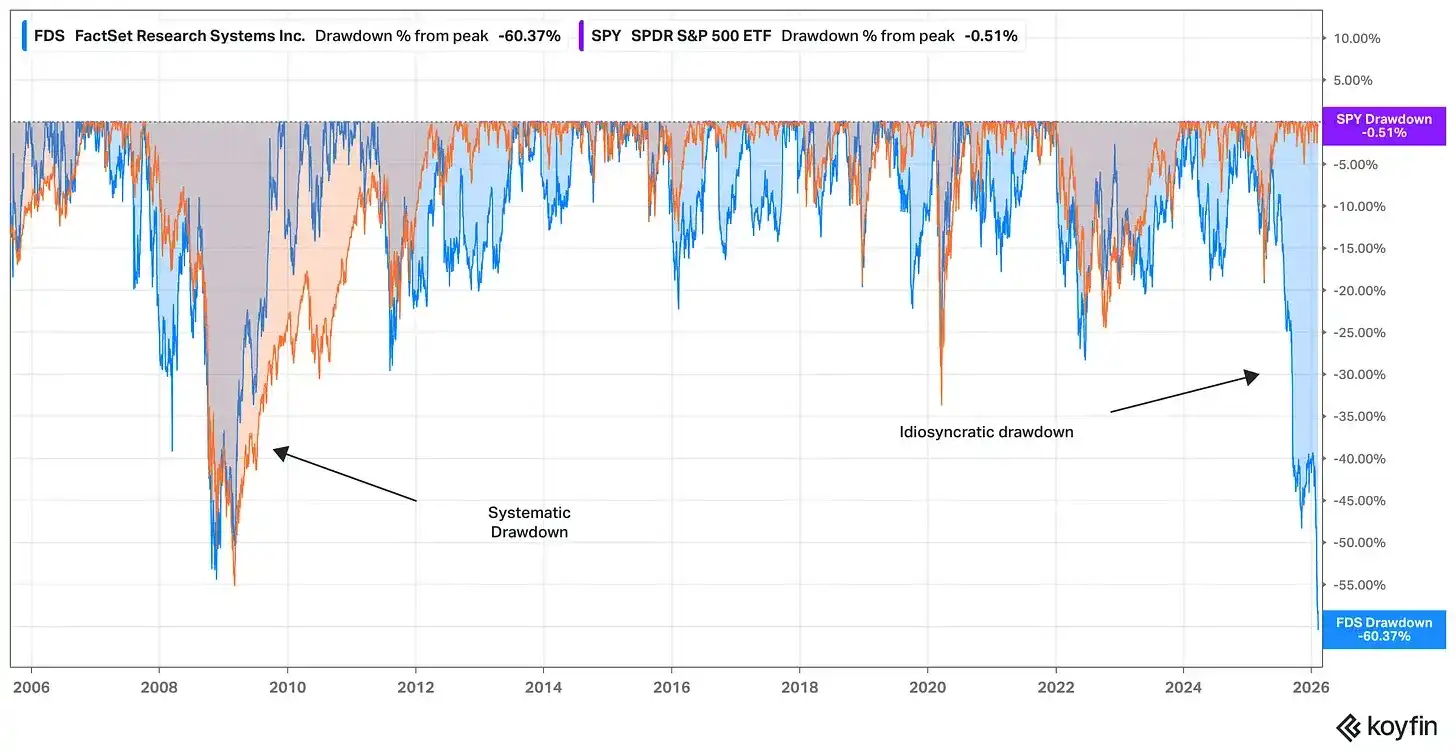
Source: Koyfin, as of February 12, 2026

FactSet's drawdown during the financial crisis was primarily systematic. In 2008/09, the entire market was worried about the durability of the financial system, and FactSet could not be immune to these concerns, especially since it sells products to financial professionals.

At that time, the stock's drawdown had less to do with FactSet's economic moat and more about whether FactSet's moat would matter if the financial system collapsed.

The 2025/26 FactSet drawdown is the opposite case. Here, the concerns are almost entirely focused on FactSet's moat and growth runway, alongside broader fears about accelerating AI capabilities disrupting pricing power in the software industry.

In a systematic drawdown, you can more reasonably make a time arbitrage bet. History shows that markets tend to rebound, and companies with intact moats may emerge even stronger than before, so if you are willing and able to remain patient while others panic, you can leverage a strong stomach to exploit a behavioral advantage.

Photo by Walker Fenton on Unsplash

However, in an idiosyncratic drawdown, the market is telling you that something is wrong with the business itself. Specifically, it suggests increasing uncertainty about the business's terminal value.

Therefore, if you hope to take advantage of an idiosyncratic drawdown, you need to possess an analytical advantage in addition to a behavioral one.

To succeed, you need to have a more accurate vision of what the company will look like in ten years than the current market price implies.

Even if you know a company well, this is not easy to do. Stocks don't typically fall 50% relative to the market for no reason. A lot of once-steadfast holders—even investors you might respect for their deep research—had to capitulate for this to happen.

If you are going to step in as a buyer during an idiosyncratic drawdown, you need to have an answer for why these otherwise informed and thoughtful investors were wrong to sell and why your vision is correct.

There's a fine line between conviction and arrogance.

Whether you are holding a stock in a drawdown or looking to initiate a new position in one, it's important that you understand what type of bet you are making.

Idiosyncratic drawdowns can tempt value investors to start looking for opportunities. Before you take the plunge, make sure you aren't using a blunt behavioral solution to solve a problem that requires nuanced analysis.

Stay patient, stay focused.

Todd

Perguntas relacionadas

QAccording to the article, what are the two main types of risk in academic financial theory?

ASystematic risk and idiosyncratic risk.

QWhat is the key difference in the type of advantage an investor needs to exploit a systematic drawdown versus an idiosyncratic one?

AAn investor can exploit a systematic drawdown with a behavioral advantage (patience), but to exploit an idiosyncratic drawdown, they need an analytical advantage (a more accurate vision of the company's future).

QUsing the example from the article, what was the primary cause of FactSet's drawdown during the 2008/09 financial crisis?

AFactSet's drawdown during the 2008/09 crisis was primarily systematic, driven by market-wide fears about the durability of the financial system.

QWhat does the article suggest is the market implying about a business during an idiosyncratic drawdown?

ADuring an idiosyncratic drawdown, the market is implying that there is a problem with the business itself and that its terminal value is becoming increasingly uncertain.

QWhat is the 'fine line' the article warns investors about when considering a purchase during an idiosyncratic drawdown?

AThe fine line is between conviction and arrogance. An investor must be able to explain why the sellers were wrong and their own vision is correct, without being overconfident.

Leituras Relacionadas

Day 6 of the rsETH Incident: DeFi United Secures Approximately $100 Million in Intentional Commitments, but a $50 Million Gap Remains

On April 18, Kelp DAO’s rsETH LayerZero bridge was exploited, resulting in the unauthorized minting of 116.5k rsETH (approx. $292M). The attacker borrowed around $190M on Aave V3. The Arbitrum Security Council froze 30,766 ETH linked to the incident. DeFi United, a cross-protocol rescue initiative led by Awe, was formed to cover a total shortfall of 112.2k rsETH ($258M). As of April 24, several protocols have pledged around $100M in support, though most commitments are still under DAO voting or discussion. Key pledges include: - Golem: 1,000 ETH ($2.3M) - Aave founder Stani Kulechov: 5,000 ETH ($11.5M) - EtherFi: up to 5,000 ETH ($11.5M) - Lido: up to 2,500 stETH ($5.75M), contingent on full coverage - Mantle: proposed a $69M loan to Aave DAO under specific terms The remaining shortfall is estimated at $50M. Aave’s treasury and safety module (~$236M combined) can cover the worst-case bad debt scenario ($230M). Three potential loss distribution paths were outlined by DefiLlama’s 0xngmi: 1. Uniform 18.5% haircut for all rsETH holders: Aave bad debt ~$216M 2. Only protect Mainnet, abandon L2: bad debt up to $341M 3. Repay only pre-attack holders: technically difficult, ~$91M net loss KelpDAO has not yet announced a specific plan. The success of DeFi United depends heavily on KelpDAO’s final decision on loss allocation.

marsbitHá 29m

Day 6 of the rsETH Incident: DeFi United Secures Approximately $100 Million in Intentional Commitments, but a $50 Million Gap Remains

marsbitHá 29m

Kicked Out of PayPal, Musk Aims for a Comeback in the Crypto Market

Elon Musk's X (formerly Twitter) has launched its "Smart Cashtags" feature, generating approximately $1 billion in trading volume within days of its April 2026 pilot launch. The feature allows users to click on stock or crypto tickers (or even full Solana token contract addresses) in posts to view real-time price charts and discussions without leaving the app. Initially available to iPhone users in the US and Canada, with a partnership in Canada enabling direct trading via the Wealthsimple app. This move is part of Musk's broader "Everything App" vision, spearheaded by the upcoming X Money platform. Analysts, such as Mizuho's Dan Dolev, see this as a potential disruptor to the US payments market, even prompting a downgrade of PayPal's stock. X Money's beta offers services like 6% APY on deposits, cashback, and P2P transfers, with speculation it may later incorporate crypto trading and stablecoin settlements for faster transactions. However, the ambitious plan faces significant regulatory scrutiny. Senator Elizabeth Warren has questioned the sustainability of the high 6% yield and raised concerns over X's banking partner, Cross River Bank, which has a history of regulatory violations. Additional risks involve the "GENIUS Act," which may create loopholes for stablecoin issuance without full FDIC insurance coverage, potentially leaving users unprotected. The integration of social trading on a platform with over 500 million users could inject new liquidity and retail interest into the crypto market. Yet, it also amplifies risks like herd mentality and the blurring of lines between entertainment and financial speculation. Musk's return to finance, after his ouster from PayPal, hinges on balancing innovation with regulatory compliance.

marsbitHá 2h

Kicked Out of PayPal, Musk Aims for a Comeback in the Crypto Market

marsbitHá 2h

Trading

Spot
Futuros
活动图片





