David Hoffman: Ethereum in the New World Order

marsbitPublicado em 2026-01-26Última atualização em 2026-01-26

Resumo

David Hoffman, founder of Bankless, reflects on the 2026 Davos Forum, where crypto leaders gathered amidst a significant shift in global order. U.S. Secretary Howard declared "globalization has failed," while Canada’s Minister Mark noted the "fracturing, not transformation" of the rules-based international system. Hoffman argues that the post-WWII order, upheld by fragile institutions like the UN, is collapsing as the U.S. abandons multilateralism under Trump’s "America First" policy, reverting to a might-makes-right reality. In this fragmented landscape, Hoffman sees decentralized crypto protocols like Bitcoin and Ethereum as emerging higher-order structures that can unify a divided world. They don’t replace nation-states but provide a neutral, rules-based coordination layer for global cooperation. Bitcoin enforces accountability through its decentralized, algorithmic "if-then" logic, while Ethereum’s Turing-complete smart contracts extend this principle further. Despite current crypto market pessimism, Hoffman believes these protocols could deliver the rules-based order that traditional institutions failed to sustain—potentially making Ethereum the unexpected foundation for a new global system.

Author: David Hoffman, Founder of Bankless

Compiled by: Hu Tao, ChainCatcher

This year's Davos Forum was truly spectacular.

It brought together many heavyweight figures from the cryptocurrency industry, including Brian Armstrong, Jeremy Allaire, CZ, and Larry Fink.

Although cryptocurrency was a focal point of this forum, what truly captured attention was the Trump administration's clear statement regarding a phased shift in the global order.

Two significant speeches at the Davos Forum highlighted this point. U.S. Secretary of Commerce Howard delivered a speech titled "Globalization Has Failed," while Canadian Prime Minister Mark responded by saying, "The rules-based international order is experiencing a rupture, not a transformation."

Rules-Based International Order vs. Law of the Jungle

Since World War II, the international community has maintained a certain degree of order and cooperation. Although the United Nations has relatively little power, it is highly respected in the decision-making of various countries and plays a pivotal role.

"International law" once truly existed, but mainly because we all believed in it. We collectively赋予 it meaning.

The Trump administration decided to puncture this shared illusion.

Trump believes that this "rules-based international order" exists only because the United States allows it to exist. As the most powerful nation with the strongest military force, this means that we are the ones who truly构建 this "rules-based international order," and Trump's "America First" philosophy means he no longer wants to play nice with the rest of the world.

According to Trump, as elaborated in Lutnick's speech, this model does not serve the best interests of the United States, so we are now taking a different path.
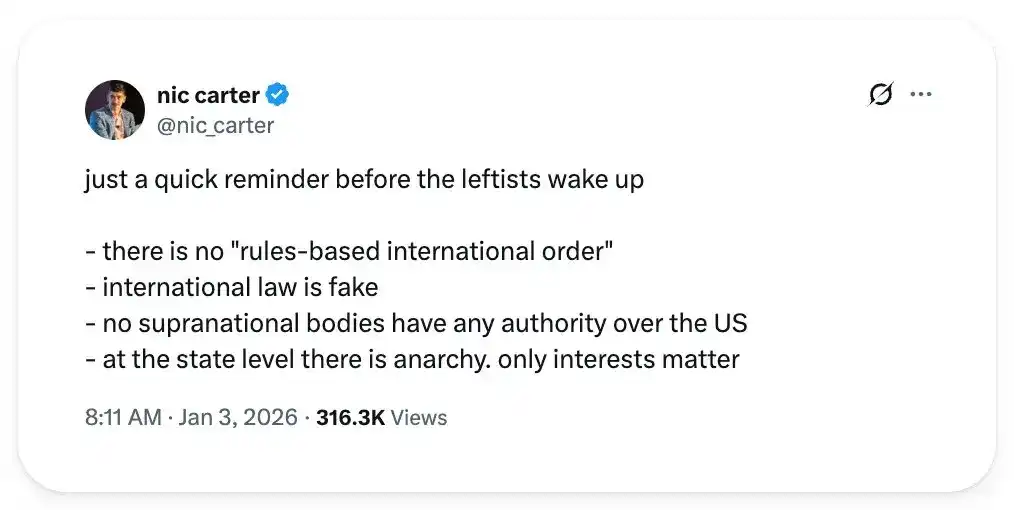
Nic Carter is right—the state is the highest level of organization that humanity has created. Before the nation-state, religion and monarchy were the highest levels of organizational structure that humans could create, and before that were feudal systems and tribes.

We attempted to build higher-level organizational structures through "common agreements" with institutions like the United Nations, but these agreements ultimately proved very fragile and had minimal impact on the world.

Therefore, our current situation is this: by 2026, the United States has abandoned the attempt to build a higher-level unified organizational structure and claims that we are better off going it alone.

It is worth mentioning that "pariah states" like Russia and Iran have恰恰 thrived by relying on a weak international order. They have always adhered to the law of the strong and exploited the weaknesses of the "rules-based international order" to expand their power, committing human rights violations that the United Nations merely condemns.

Although it is regrettable to see the attempts at global cooperation ultimately fail, at least we can finally be frank in pointing out that countries like Russia never truly followed these rules.

Bitcoin, Ethereum, and Decentralized Crypto Protocols

Decentralized crypto protocols are powerful and autonomous "higher-level organizational structures" that failed to materialize from the "rules-based international order" paradigm.

Trump's分裂 of the unified international community is precisely the situation that Ethereum aims to balance.

When the unified world falls apart and degenerates into regional powers, Ethereum reunites it in cyberspace.

These protocols do not enforce laws or protect their members. They do not replace nation-states. However, they are a ubiquitous, autonomous coordination layer for the people of the world to unite.

The conversation between Brian Armstrong and the Governor of the Bank of France exemplifies this power. The central bank governor made the mistake that all central bank governors make: misunderstanding and underestimating Bitcoin. Brian corrected him, pointing out that "Bitcoin has no issuer—it is a decentralized protocol...", and then he went on to elaborate on Bitcoin's most important role in unifying the world: "...[Bitcoin] is actually the most effective accountability mechanism for deficit spending."

No, we cannot establish a "rules-based international order" through voluntary coordination and cooperation among nations. But can we obtain a "rules-based international order" from a decentralized, cryptography-based internet protocol?

Bitcoin operates on "if...then..." statements. In my opinion, that sounds like a "rules-based international order." Doesn't Ethereum extend the same principle to Turing-complete smart contracts?

Despite the current atmosphere of despair and negativity in the cryptocurrency industry, I still firmly believe that we are far from tapping the potential of smart contracts.

So, perhaps we won't get a "rules-based international order" from the United Nations.

Perhaps we will get it from an unexpected place.

Perhaps we will get it from Ethereum.

Perguntas relacionadas

QWhat is the main argument David Hoffman makes about the role of Ethereum in the context of a failing international order?

ADavid Hoffman argues that as the unified global order fragments into regional powers, Ethereum serves as a decentralized, autonomous coordination layer in cyberspace that can unify the world by providing a 'rules-based international order' through its cryptographic protocols and smart contracts, unlike the failed attempts of institutions like the UN.

QAccording to the article, how did the Trump administration's stance impact the 'rules-based international order'?

AThe Trump administration rejected the 'rules-based international order' by claiming it only existed because the U.S. allowed it, and with its 'America First' policy, it no longer wanted to cooperate under this framework, effectively puncturing the collective illusion of global cooperation and international law.

QWhat example does the article provide to illustrate the power of decentralized crypto protocols like Bitcoin in holding governments accountable?

AThe article cites Brian Armstrong's conversation with the French Central Bank governor, where Armstrong corrected the governor's misunderstanding by stating that Bitcoin is a decentralized protocol without an issuer and serves as 'the most effective accountability mechanism for deficit spending,' enforcing rules through its 'if-then' operational logic.

QWhy does the author believe that decentralized crypto protocols are superior to traditional international institutions like the UN?

AThe author believes decentralized crypto protocols are superior because they are robust, autonomous higher-level organizational structures that exist ubiquitously in cyberspace, enforcing rules through code and cryptography, whereas traditional institutions like the UN rely on fragile voluntary coordination and have minimal real-world impact.

QWhat historical context does the article provide about the evolution of human organizational structures before nation-states?

AThe article references Nic Carter's view that nation-states are the highest form of organization humans have created, preceded by religions and monarchies, and before that, feudal systems and tribes, highlighting the failed attempts to create higher-level structures through agreements like the UN.

Leituras Relacionadas

When Doing Cryptocurrency Payment, the First Thing is Licenses, What is the Second?

When launching a crypto payment business, obtaining the necessary licenses is the crucial first step. However, the second, and arguably more critical, step is designing a comprehensive operational framework that forms a coherent business loop. This loop must be clearly understood and executable by all stakeholders: banks, payment partners, exchanges, on-chain analytics providers, regulators, and your internal team. Many projects mistakenly believe a single license permits all operations. Licenses merely grant entry; they don't define how the specific business functions. The real challenge lies in detailing every aspect of the workflow. This involves clarifying the customer base, the flow of fiat and crypto assets, the settlement process, and establishing clear lines of responsibility for risks like AML compliance, sanctions screening, chargebacks, and regulatory inquiries. A robust framework must answer seven core questions: Who are the clients and merchants? Who collects fiat and crypto? Who handles conversion and custody? And who is ultimately accountable for compliance and risk management? Projects often fail not from a lack of licensing, but during due diligence when they cannot convincingly explain these operational details. Therefore, beyond securing licenses, the priority must be constructing a closed-loop system. This system ensures the business model is transparent, risks are managed, responsibilities are delineated, contracts are aligned, and the entire process is comprehensible to partners and regulators. The true competitive edge in crypto payments lies not in acquiring a license quickly, but in integrating licensing, banking, compliance, and operations into a sustainable and executable whole.

marsbitHá 20m

When Doing Cryptocurrency Payment, the First Thing is Licenses, What is the Second?

marsbitHá 20m

Arthur Hayes Analysis: AI Bubble Nears Burst, Crypto Market Faces Short-Term Pressure

Arthur Hayes argues that the current AI market is a bubble poised to burst, which will exert downward pressure on the crypto market in the near term. The core trigger is rising oil prices due to the US-Iran conflict and a blockade of the Strait of Hormuz. Higher energy costs directly increase the operational expenses of AI data centers, squeezing profit margins for companies like Google, Anthropic, and OpenAI. Hayes predicts that persistent inflation from high oil prices will force Trump, in a bid to win the November election, to turn public sentiment against the AI industry. He may propose regulations and taxes on data centers and AI companies to appeal to voters concerned about costs and job displacement. Such political rhetoric could shatter market confidence. Furthermore, the market is unlikely to healthily absorb the massive concurrent IPOs of SpaceX, Anthropic, and OpenAI, which together seek valuations in the trillions. The combination of soaring energy costs, overwhelming equity supply, and negative political pressure will puncture the AI bubble. Hayes notes that nearly all new USD liquidity since 2022 has flowed into AI, leaving crypto like Bitcoin behind. When the AI bubble bursts, liquidity will contract sharply, pulling down all risk assets, including cryptocurrencies. In response, Hayes's fund, Maelstrom, has sold all AI-related stocks and non-core cryptocurrencies. It maintains core positions in Bitcoin and Ethereum while increasing exposure to energy sector equities, betting on rising oil and gas prices. He expects Bitcoin to bottom after the AI-led market decline, before rallying again with future monetary easing.

Foresight NewsHá 34m

Arthur Hayes Analysis: AI Bubble Nears Burst, Crypto Market Faces Short-Term Pressure

Foresight NewsHá 34m

To C, To B, and the Next Big Thing Called To A

After To C and To B, the Next Wave is To A: Serving AI Agents In a recent quarterly earnings call, Meituan's Wang Xing introduced a new concept: To A (To Agent), signifying that future business services will increasingly target AI Agents as primary clients, not just consumers or merchants. This shift implies that internet giants must now consider how to make their services more appealing for AI Agents to recommend, fundamentally altering traditional distribution logic. This "To A era" is prompting an unusual trend of alliances among major tech companies. Unlike previous competitive battles, firms like Meituan, Tencent, JD.com, Huawei, OPPO, and OpenAI are rapidly forming partnerships. The reason is strategic: as AI Agents become the primary user interface, handling tasks from a single command (e.g., "Book a Japanese restaurant for tomorrow"), the risk for platforms is being bypassed entirely. Companies are positioning themselves within this new value chain. Three primary strategies are emerging: 1. **Super-Entry Points + Service Providers:** Platforms like Tencent's Yuanbao, WeChat, and ChatGPT aim to be the first-stop Agent, integrating various services (food delivery, shopping, travel) from partners like Meituan and JD.com. 2. **Apps as Callable Services:** Companies like Meituan, JD.com, and Uber are ensuring their core services remain accessible and callable by external Agents, shifting from front-end apps to back-end capabilities. 3. **System-Level Agent Entry Points:** Smartphone makers (Huawei, Honor, OPPO) are leveraging their OS-level AI assistants to control the initial user command, redistributing it to relevant service apps. While alliances offer mutual benefit—entry points gain service capabilities, and service providers gain traffic—inherent conflicts of interest exist. A dominant Agent platform could eventually attempt to connect directly with suppliers (restaurants, hotels), bypassing current aggregators like Meituan or Ctrip. Other unresolved challenges include the potential for Agent recommendations to become a new form of paid ranking and unclear accountability for faulty recommendations. The current rush to form alliances is a defensive move by service providers to secure their position before the landscape solidifies. In this To A-driven restructuring, the greatest risk is not losing the race but failing to hear the starting gun.

marsbitHá 43m

To C, To B, and the Next Big Thing Called To A

marsbitHá 43m

The More Lifelike the Robot, the More Terrifying? Unveiling the 'Uncanny Valley Effect' in the Era of Humanoid Robots

As humanoid robots become increasingly lifelike, they confront a significant psychological barrier known as the "Uncanny Valley Effect," a concept proposed by Japanese roboticist Masahiro Mori in 1970. This phenomenon describes a dip in human comfort and acceptance when robots appear almost, but not perfectly, human. Minor imperfections in facial expressions, eye movements, or skin texture trigger a subconscious sense of unease, as the brain detects something trying, yet failing, to mimic a person. Examples range from the controversial human-like robot Sophia to animated characters in films like *The Polar Express*. The effect poses a key design challenge for robotics companies. Some, like Boston Dynamics, avoid it entirely by creating highly capable but visibly mechanical robots. Others, like Hanson Robotics, push for greater human likeness despite the risk. For consumer robots, especially in homes, most manufacturers opt for stylized or clearly mechanical designs to ensure broader acceptance. While the Uncanny Valley remains a powerful force, its impact may diminish over time through technological advancements that achieve near-perfect realism or through generational familiarity as people grow accustomed to interacting with humanoid machines. Ultimately, navigating this psychological frontier requires as much understanding of human perception as of robotics technology itself.

marsbitHá 43m

The More Lifelike the Robot, the More Terrifying? Unveiling the 'Uncanny Valley Effect' in the Era of Humanoid Robots

marsbitHá 43m

Trading

Spot
Futuros

Artigos em Destaque

Como comprar ORDER

Bem-vindo à HTX.com!Tornámos a compra de Orderly (ORDER) simples e conveniente.Segue o nosso guia passo a passo para iniciar a tua jornada no mundo das criptos.Passo 1: cria a tua conta HTXUtiliza o teu e-mail ou número de telefone para te inscreveres numa conta gratuita na HTX.Desfruta de um processo de inscrição sem complicações e desbloqueia todas as funcionalidades.Obter a minha contaPasso 2: vai para Comprar Cripto e escolhe o teu método de pagamentoCartão de crédito/débito: usa o teu visa ou mastercard para comprar Orderly (ORDER) instantaneamente.Saldo: usa os fundos da tua conta HTX para transacionar sem problemas.Terceiros: adicionamos métodos de pagamento populares, como Google Pay e Apple Pay, para aumentar a conveniência.P2P: transaciona diretamente com outros utilizadores na HTX.Mercado de balcão (OTC): oferecemos serviços personalizados e taxas de câmbio competitivas para os traders.Passo 3: armazena teu Orderly (ORDER)Depois de comprar o teu Orderly (ORDER), armazena-o na tua conta HTX.Alternativamente, podes enviá-lo para outro lugar através de transferência blockchain ou usá-lo para transacionar outras criptomoedas.Passo 4: transaciona Orderly (ORDER)Transaciona facilmente Orderly (ORDER) no mercado à vista da HTX.Acede simplesmente à tua conta, seleciona o teu par de trading, executa as tuas transações e monitoriza em tempo real.Oferecemos uma experiência de fácil utilização tanto para principiantes como para traders experientes.

256 Visualizações TotaisPublicado em {updateTime}Atualizado em 2026.06.02

Como comprar ORDER

Discussões

Bem-vindo à Comunidade HTX. Aqui, pode manter-se informado sobre os mais recentes desenvolvimentos da plataforma e obter acesso a análises profissionais de mercado. As opiniões dos utilizadores sobre o preço de ORDER (ORDER) são apresentadas abaixo.

活动图片