Currency and Stock Barometer丨Strategy Invested $204 Million to Purchase 3,015 Bitcoins Last Week; US-Listed Company GD Culture Board Approved Sale of 7,500 Bitcoins Last Week (March 3)

marsbitPublicado em 2026-03-03Última atualização em 2026-03-03

Resumo

Crypto Market Weekly Roundup: Strategy Invests $204M in Bitcoin, GD Culture to Sell Holdings Last week saw significant activity among crypto treasury companies amid ongoing market volatility. Strategy (formerly MicroStrategy) led Bitcoin acquisitions, purchasing 3,015 BTC for $204.1 million—a 412.8% increase from the previous week—bringing its total holdings to 720,737 BTC. In contrast, NASDAQ-listed GD Culture approved the sale of its entire 7,500 BTC reserve to fund a stock repurchase plan, reflecting the financial pressure some firms face. Meanwhile, Ethereum treasury company FG Nexus sold 7,550 ETH (worth $14.06 million), accumulating an unrealized loss of approximately $82.8 million. ETHZilla rebranded to Forum Markets and pivoted to RWA tokenization, while Bitmine added 50,928 ETH ($98.53 million) to its holdings. Other notable updates include American Bitcoin reporting over 6,000 BTC in reserves and $185.2 million in annual revenue, and Solana treasury firm DeFi Development making a strategic investment in stablecoin protocol Apyx. Global public companies (excluding miners) now hold 981,150 BTC, accounting for 4.9% of the circulating supply. Market analysts suggest a potential consolidation trend among crypto treasury companies in 2026, especially for those trading below net asset value.

Editor's Note: Last weekend, the Iran-Israel conflict suddenly escalated into a local hot war, causing turbulent changes in the global economic situation, and the crypto market was not spared from the impact. After experiencing sharp fluctuations following the outbreak of the war, US stocks rose against the trend, and the prices of many cryptocurrency concept stocks also saw a sharp increase, with Circle (CRCL), which far exceeded earnings expectations, BTC treasury bellwether concept stock Strategy (MSTR), and RWA track leading listed company Figure (FIGR) performing particularly well. Furthermore, thanks to a series of developments in the AI field and the emergence of new concepts and products like OpenClaw, crypto mining companies transitioning into AI computing power or HPC high-performance computing data centers have seen relative price stability and are worth long-term attention.

The following is a summary of last week's currency and stock market information compiled by Odaily Planet Daily, all US stock data comes frommsx.com.
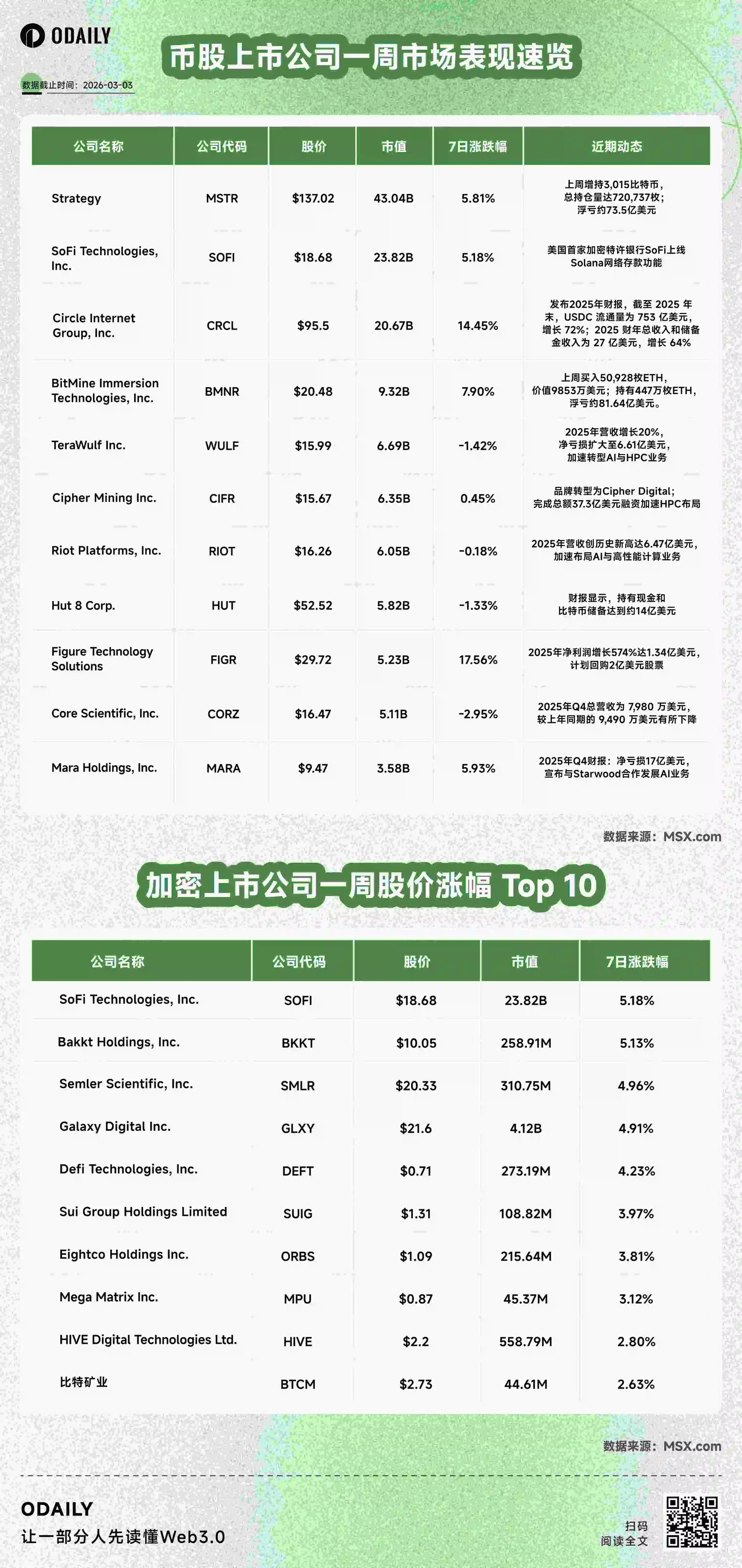
Crypto Concept Stock Sharp Review: Selling Coins to Survive VS M&A Boom?

BTCS Executive: Crypto Treasury Companies May See Consolidation Wave in 2026

BTCS Chief Strategy Officer Wojciech Kaszycki stated that against the backdrop of a continued market downturn, crypto treasury companies may see a consolidation trend in 2026. He pointed out that currently, some companies' stock prices are below the Net Asset Value (NAV) of their held crypto assets, trading at a discount.

Kaszycki believes that companies with actual operational businesses (such as blockchain validator services or public/private credit products) are more capable of acquiring enterprises that only hold crypto assets but lack operating income due to their cash flow. Additionally, he mentioned the tokenization of real-world assets (RWA), particularly the on-chain conversion of public and private credit assets, which may grow significantly within the next 24 months and could become a potential revenue source for treasury companies. He also mentioned that the world's largest Bitcoin treasury company, Strategy, provides investors with credit-like and fixed-income tools, citing this as a key argument for inclusion in the MSCI index system.

Selling Coins to Survive, The Reluctant Choice of BTC and ETH Treasury Listed Companies

Previously, ETH treasury company ETHZilla was forced to sell coins to survive, recently renaming itself to Forum Markets and transitioning to an RWA digital asset platform. Influenced by this news, its stock price once surged by 17%.

Recently, ETH treasury company FG Nexus sold over 7,500 ETH again. Moreover, some BTC treasury companies are not as financially strong as companies like Strategy and Metaplanet, forcing them to take measures to cope with the continuously falling crypto market. For example, the board of US-listed company GD Culture has authorized the approval to sell, exchange, or dispose of its current reserve of 7,500 bitcoins, aiming to provide funding for a share repurchase plan announced on February 18, 2026.

However, some listed companies are still persevering. For instance, Bitcoin treasury company EmperyDigital, after receiving shareholder proposals to sell coins, maintained its decision not to immediately liquidate all Bitcoin assets at this stage.

For treasury companies in the crypto bear market, choosing the right time to sell is undoubtedly a difficult dilemma.

Weekly Update on Currency and Stock Listed Company Dynamics

Representative BTC Treasury Listed Companies

Last week, global listed companies had a net purchase of $208.79 million worth of BTC. Strategy invested $204 million to purchase 3,015 bitcoins, a 412.8% increase in purchase amount compared to the previous week.

According to SoSoValue data, as of 8:30 AM Eastern Time on March 2, 2026, the total net purchase of Bitcoin configured by global listed companies (excluding mining companies) last week was $208.79 million, a 348% increase compared to the previous week.

Strategy (formerly MicroStrategy) announced on March 2 an investment of $204.10 million (a 412.8% increase compared to last week's purchase amount) to acquire 3,015 bitcoins at a price of $67,700, bringing the total holdings to 720,737 bitcoins.

Japanese listed company Metaplanet did not purchase Bitcoin last week, marking the seventh consecutive week without a purchase.

Additionally, 2 other companies purchased Bitcoin last week. Japanese food brand DayDayCook announced on February 25 an investment of $4.22 million to purchase 50 bitcoins at a price of $84,468, bringing total holdings to 2,118 bitcoins; Brazilian Bitcoin company OrangeBTC announced on March 2 an investment of $470,000 to purchase 0.7 bitcoins at a price of $67,438.14, bringing total holdings to 3,723 bitcoins.

As of press time, the total Bitcoin holdings of the global listed companies (excluding mining companies) included in the statistics amounted to 981,150 bitcoins, a 0.31% increase from last week. The current market value is approximately $64.26 billion, accounting for 4.9% of Bitcoin's circulating market capitalization.

American Bitcoin Earnings Report: Bitcoin Reserves Exceed 6,000, Full Year 2025 Revenue Surpasses $180 Million

Trump family-supported Nasdaq-listed Bitcoin mining company American Bitcoin released its 2025 earnings report, disclosing that the company's Bitcoin reserves have exceeded 6,000. 2025 was its first year as an independent listed company, with full-year operations and capital execution performance meeting the established strategy. The company adopted a dual-track model of "scaled mining + ATM fundraising" to accelerate strategic reserve accumulation. Full-year revenue for 2025 reached $185.2 million, with deployed computing power of approximately 25 EH/s and ownership of about 78,000 ASIC miners.

US-Listed Company GD Culture Board Approves Sale of 7,500 Bitcoins

Nasdaq-listed company GD Culture announced that its board has authorized the approval to sell, exchange, or dispose of its current reserve of 7,500 bitcoins, aiming to provide funding for a share repurchase plan announced on February 18, 2026. It is reported that these Bitcoin sales will be conducted in multiple tranches, flexibly executed by management based on the best interests of the company and its shareholders. Proceeds from the sale of Bitcoin will be used to repurchase the company's common stock and cover related expenses, including brokerage commissions, handling fees, and taxes.

Bitcoin Treasury Company EmperyDigital: Will Not Immediately Liquidate All Bitcoin Assets at This Stage

In response to a major shareholder's proposal to sell all Bitcoin and return cash to shareholders, Nasdaq-listed Bitcoin treasury company EmperyDigital issued a statement responding that the board and management have evaluated the relevant proposal and believe that liquidating all Bitcoin assets is not in the best interests of all shareholders, therefore the plan will not be executed at this stage.

The statement also stated that although the company's stock price is below net asset value, it has implemented a stock repurchase plan. Regarding the allegations made by shareholder Tice P. Brown, the company stated that his remarks are untrue and claimed that ATG Capital has not communicated with the company's directors or executives.

Representative ETH Treasury Listed Companies

Bitmine Bought 50,928 ETH Last Week, Valued at $98.53 Million

According to Onchain Lens monitoring, Bitmine (@BitMNR) bought 50,928 ETH last week, valued at $98.53 million. Currently, Bitmine's total holdings are 4,473,587 ETH, valued at $8.66 billion, of which 3,040,483 ETH valued at $5.88 billion are in a staked state.

Ethereum Treasury Company ETHZilla Renames to Forum Markets and Transitions to RWA Digital Asset Platform

Nasdaq-listed Ethereum treasury company ETHZilla announced its official renaming to Forum Markets and its transition to a digital asset platform. Its stock ticker will also be adjusted to "FRMM" upon Nasdaq approval, but the CUSIP number will remain unchanged. Shareholders need not take any action regarding this change. After the transformation, the company will strategically upgrade to build an institutional-grade real-world asset (RWA) tokenization digital asset platform and explore the launch of tokenized investment products across multiple asset classes.

Intchains Group Discloses ETH Holdings Reach 9,070, Has Cumulatively Staked 2,600 ETH to Date

Nasdaq-listed company Intchains Group released an update on its ETH holdings, disclosing that as of February 23, its treasury ETH holdings reached 9070, with a total investment of $23.70 million and an average purchase price of $2611.1. To date, it has cumulatively staked 2,600 ETH, of which 1,000 ETH are staked on the FalconX platform and 1,600 ETH are staked on the Goldshell staking platform it acquired last year for $1.3 million.

Ethereum Treasury Company FG Nexus Sells Another 7550 ETH, Currently Still Holds 30094 ETH with Cumulative Floating Loss of Approximately $82.8 Million

According to Lookonchain monitoring, Ethereum treasury company FG Nexus sold another 7550 ETH, valued at approximately $14.06 million.

Data shows that FG Nexus bought 50,770 ETH at an average price of approximately $3860 between August and September 2025, with a total cost of approximately $196 million; and announced on October 22, 2025, its intention to sell real estate to continue accumulating ETH. But less than a month later, it began reducing its ETH holdings, cumulatively selling 21,025 ETH at an average price of approximately $2649, cashing out approximately $55.70 million.

Currently, FG Nexus still holds 30,094 ETH, valued at approximately $57.50 million, with a cumulative paper loss of approximately $82.80 million.

Representative SOL Treasury Listed Companies

Nasdaq-Listed Solana Treasury Company DeFi Development Makes Strategic Investment in Stablecoin Protocol Apyx

Nasdaq-listed Solana treasury company DeFi Development announced a strategic investment in stablecoin protocol Apyx. The specific investment amount has not been disclosed. The aim is to establish an early layout in the emerging Dividend Backed Stablecoin (DBS) category. The Apyx model can convert dividend flows into on-chain yields, providing scarce yield opportunities for the over $300 billion stablecoin market, while aligning with the trend of digital asset treasury companies prioritizing the accumulation of digital assets.

Representative Altcoin Treasury Listed Companies

Tron Inc Discloses Increase of 176,081 TRX Tokens, Total Holdings Exceed 684 Million

On March 1, Nasdaq-listed TRX treasury company Tron Inc. disclosed that it had purchased an additional 176,081 TRX tokens at an average price of $0.28. Its TRX treasury total holdings have now exceeded 684 million.

SUI Group Earnings Report: SUI Holdings Break 108 Million and Completion of 8.8% Repurchase of Issued Common Shares

Nasdaq-listed SUI treasury company Sui Group Holdings released its full-year 2025 operational performance report, disclosing a Q4 net loss of $221.8 million. As of February 23, its SUI token holdings increased to 108,368,594, and these tokens have been almost entirely staked; with daily earnings of approximately 5000 SUI. The company also disclosed that it has completed the repurchase of 7,801,042 common shares under the previously approved $50 million stock repurchase plan, accounting for 8.80% of the issued common shares.

Criptomoedas em alta

Perguntas relacionadas

QHow much did Strategy invest in Bitcoin last week and how many coins did they acquire?

AStrategy invested $204 million to acquire 3,015 Bitcoin last week.

QWhich Nasdaq-listed company's board approved the disposal of 7,500 Bitcoin?

AThe board of GD Culture, a Nasdaq-listed company, approved the disposal of 7,500 Bitcoin.

QWhat was the total net purchase amount of Bitcoin by global public companies (excluding mining firms) last week?

AThe total net purchase of Bitcoin by global public companies (excluding mining firms) was $208.79 million last week.

QWhich Ethereum treasury company sold 7,550 ETH and is facing significant unrealized losses?

AFG Nexus, an Ethereum treasury company, sold 7,550 ETH and is facing cumulative unrealized losses of approximately $82.8 million.

QWhat major strategic shift did the company formerly known as ETHZilla announce?

AThe company formerly known as ETHZilla announced a rebranding to Forum Markets and a strategic shift to become a digital asset platform focused on institutional-grade real-world asset (RWA) tokenization.

Leituras Relacionadas

Two Legends Lost in Three Days: Is Google's AI Talent Dam Cracking?

In three days, Google lost two AI legends. On June 18, Noam Shazeer, co-author of the seminal "Attention is All You Need" paper and Gemini co-lead, left for OpenAI. Just 48 hours later, John Jumper, 2024 Nobel laureate and AlphaFold lead, departed DeepMind for Anthropic. This follows Andrej Karpathy joining Anthropic in May. These moves highlight a structural trend: top AI talent is concentrating at mission-driven, pre-IPO firms like OpenAI and Anthropic, while Google becomes a primary source. The exodus stems from a core mission mismatch. Google's ad-centric model often subordinates AI research to product and revenue goals, creating friction for pioneers like Shazeer, who returned in 2024 only to leave again. In contrast, OpenAI and Anthropic offer singular focus on pushing AI boundaries, whether towards AGI or safety-aligned models, which deeply appeals to top researchers like Jumper. Financial incentives amplify the pull. With both OpenAI and Anthropic nearing IPO, employees stand to gain immensely from equity, an upside Google's mature stock cannot match. Furthermore, the 2023 merger of Google Brain and DeepMind, intended to consolidate strength, has instead created cultural tension and slowed the path from research to product, as evidenced by Gemini's pace. This talent redistribution is reshaping the AI landscape. While Google retains vast data and compute resources, its true crisis is the quiet, continuous loss of the people who define the field's future. The real moat in AI is not infrastructure, but the concentration of brilliant minds—a battle Google is currently losing.

marsbitHá 33m

Two Legends Lost in Three Days: Is Google's AI Talent Dam Cracking?

marsbitHá 33m

Behind the AI Report Card, Lies a Chinese 'Exam Setter'

Beyond the familiar performance charts like MMLU-Pro and MMMU, which major AI models strive to ace, stands a key "examiner": Chinese-Canadian researcher Wenhu Chen. An assistant professor at the University of Waterloo and founder of TIGERLab, Chen addresses the crucial need for more rigorous AI evaluation. As models like GPT-4 began scoring near-perfect results on older benchmarks like MMLU, it became difficult to distinguish their true capabilities. In response, Chen introduced MMLU-Pro in 2024, featuring harder, more reasoning-focused questions with more answer choices, successfully reintroducing meaningful performance gaps. His work extends to multi-modal evaluation with MMMU and its enhanced version, MMMU-Pro. These benchmarks test a model's ability to understand and reason with complex information from images, charts, and text across diverse academic subjects, exposing the significant challenges even top models face in genuine comprehension. Chen's background in complex QA, table reasoning, and his experience at Google DeepMind on projects like Gemini inform his approach. He understands that effective benchmarks must anticipate how models might "cheat" by memorizing data or avoiding visual analysis. His lab also actively researches video understanding and generation models (e.g., UniVideo, Vamba), ensuring his evaluation work is grounded in practical model-building challenges. Now at Meta's Super Intelligence Lab, Chen continues his focus on multi-modal data and evaluation, representing the deep yet often unseen contributions of Chinese talent in shaping the fundamental tools of the AI industry.

marsbitHá 44m

Behind the AI Report Card, Lies a Chinese 'Exam Setter'

marsbitHá 44m

Alliance Co-founder's Letter to Entrepreneurs: Written at the Moment Cursor Sold for $600 Billion

Alliance Co-founder's Letter to Entrepreneurs: On Cursor's $60 Billion Sale Many aspiring founders see massive exits like Cursor's $60B sale and wonder why they can't achieve the same, often concluding opportunities are exhausted. But great companies aren't built in obvious, crowded spaces. Cursor, like Stripe, Figma, and Shopify before it, started with a non-consensus belief about the future. Before ChatGPT, they believed AI would transform knowledge work. They focused on a genuinely exciting domain, became their own customer, and obsessed over power users. Their journey involved years of "glass-chewing" effort before the market was ready. The pattern is consistent: identify a long-term technological shift, find a missed entry point, and execute for years before the trend becomes obvious. First-generation products (PayPal, Adobe, Amazon) prove a market exists. Second-generation winners (Stripe, Figma, Shopify) rebuild that market around new insights, technology, or changing customer behaviors. Founders must identify their phase in the cycle. Early entrants like Coinbase or Cursor focus on making new technology usable for power users. Later entrants find the "yin" to the established "yang"—the blind spots incumbents miss as they grow distant from individual users. The key is deep market immersion. Use every product in your space. Talk to users. Build an audience. Stop looking for ideas and start *seeing* them everywhere. Then, choose one. The idea must offer a 10x improvement or solve a "hair-on-fire" pain point—something severe enough that users are already crafting workarounds. When building, avoid feature bloat. Ask: why would someone switch? Great startups rarely force new behaviors; they improve familiar workflows with drastically lower friction (e.g., Cursor forked VS Code instead of creating a new editor). Distribution is the underestimated moat. Before product-market fit, achieve distribution-market fit. How do customers discover new tools? Founders like those at Airbnb, Stripe, and Cursor did unscalable, manual work to recruit early users. The final, unteachable ingredient is resilience. Cursor built for years pre-market, faced rejection, and persisted. So did Airbnb, Nvidia, and Rain (which launched post-FTX collapse). The lesson isn't that these founders were smarter, but that they stayed in the game long enough for their insights to compound. Framework: Spot technological cycles. Cultivate unique insight. Obsess over your market. Talk to customers. Find a hair-on-fire problem. Build the simplest wedge. Win your distribution channel. Above all, don't quit when it gets hard. Most people won't do these things consistently. The few who do build the next generation of great companies. Go build.

marsbitHá 48m

Alliance Co-founder's Letter to Entrepreneurs: Written at the Moment Cursor Sold for $600 Billion

marsbitHá 48m

Weekly Editor's Picks (0613-0619)

Weekly Editor's Picks (0613-0619): Market Insights & Analysis This weekly digest curates in-depth analysis often lost in the information flow, focusing on key insights across macro trends, investment, and technology. **Macro & Geopolitics:** With the Strait of Hormuz reopening and military conflict shifting to negotiation, markets are pivoting from "war shock" to "supply restoration." Trades include shorting crude risk premiums, longing airlines/tourism, Asian energy importers, and bond duration, while shorting inflation expectations. LNG, fertilizer, and chemical chains are also being repriced. **Investment & VC:** Ray Dalio advises against betting on concentrated AI giants dominating indices, advocating for diversified portfolios of high-quality, low-correlation assets instead. Analysis covers the 4-year crypto cycle, predicting the core surviving product by 2029 will be asset trading markets. Current BTC metrics suggest a potential bottoming zone, presenting a patient accumulation window. SpaceX's high-profile IPO at a $2.1T valuation faces scrutiny over fundamentals, with key watchpoints being its likely inclusion in the Nasdaq index and Q2 earnings. Concerns are raised about potential "gamma squeeze" and systemic risks if its narrative-driven valuation gets amplified by passive index funds. Robinhood (HOOD) is noted for breaking its high correlation with crypto, bolstered by its stock trading and new underwriting business. **Web3 & AI:** A warning highlights ~$1.8T in off-balance-sheet AI infrastructure commitments (purchase commitments, leases) as a potential systemic risk if AI monetization lags. AI models are being used for World Cup predictions, adding a new layer for betting markets. A cost breakdown of a $20 AI subscription reveals the supply chain from model companies to cloud, GPUs, and power. **Prediction Markets:** The emergence of prediction market "concept stocks" is noted, with Robinhood developing its own platform, Rothera, signaling a shift from market competition to a "channel war" for user access. **CeFi & DeFi:** The SpaceX IPO tested perpetual contract mechanisms for pre-IPO assets, highlighting challenges in handling corporate actions like stock splits on-chain. The de-pegging of STRC (Strategy's preferred share) to ~$89 reflects market concerns over MicroStrategy's capital structure and BTC-backed leverage model. BlackRock's covered-call Bitcoin ETF (BITA) offers yield but caps upside, appealing to yield-seeking institutions. **Ethereum:** An opinion piece argues Ethereum's core strength is its vast developer community and composability, solidifying its role as the default operating system for the financial internet. **Weekly Hot Topics:** Include the US-Iran deal reopening the Strait of Hormuz, Fed's hawkish hold, Anthropic restricting model access, SpaceX acquiring Cursor, and a humorous stock surge for "Liuliumei" due to its "LLM" ticker.

marsbitHá 53m

Weekly Editor's Picks (0613-0619)

marsbitHá 53m

Alliance's Co-Founder's Letter to Entrepreneurs: Written on the Occasion of Cursor's $60 Billion Sale

In this letter to entrepreneurs, Alliance reflects on the success of Cursor's $60 billion sale to Elon Musk, using it as a case study to counter the misconception that opportunities in crowded fields like AI or crypto are exhausted. The piece argues that great companies like Cursor, Stripe, Figma, and Shopify are not built by geniuses with perfect ideas, but by founders who start with a non-consensus belief about the future and build for years before that future becomes obvious to everyone. They identify long-term shifts, find overlooked entry points, and execute relentlessly. The framework for success involves: 1. **Identifying your place in the technology cycle**: Early-stage opportunities focus on making new tech usable for power users (e.g., Coinbase, Cursor). Later-stage opportunities involve finding the "yin" to an existing "yang"—the blind spots of first-generation players (e.g., Stripe vs. PayPal, Figma vs. Adobe). 2. **Cultivating unique insights**: Immerse yourself deeply in the market. Use every product, talk to users, and build an audience. Insights will emerge naturally from deep engagement. 3. **Finding a "hair-on-fire" problem**: Look for a 10x improvement or a severe, urgent pain point. The strongest signal is people already building clumsy workarounds. 4. **Building a focused MVP**: Don't just add features because you can. Ask why users would abandon their current tool for yours. The best startups rarely force new behaviors; they improve familiar workflows with drastically lower friction. 5. **Winning a distribution channel**: Distribution is often the moat. Before product-market fit, achieve channel-market fit. Find where your customers are and build an engine to reach them, even through unscalable, manual efforts initially. 6. **Persistence**: The final, unteachable ingredient is resilience. Success stories like Cursor, Airbnb, and Nvidia involved years of grinding, rejection, and perseverance when the path forward seemed unclear. The conclusion is that there is no secret. Most people fail to consistently execute these steps over the long term. The few who do build the companies that define the next era. The world is yours to create.

链捕手Há 58m

Alliance's Co-Founder's Letter to Entrepreneurs: Written on the Occasion of Cursor's $60 Billion Sale

链捕手Há 58m

Trading

Spot
Futuros

Artigos em Destaque

O que é BITCOIN

Compreender o HarryPotterObamaSonic10Inu (ERC-20) e a Sua Posição no Espaço Cripto Nos últimos anos, o mercado de criptomoedas assistiu a um aumento na popularidade das moedas meme, cativando não apenas os traders, mas também aqueles que procuram envolvimento comunitário e valor de entretenimento. Entre estes tokens únicos está o HarryPotterObamaSonic10Inu (ERC-20), um projeto intrigante que mistura referências culturais no tecido das criptomoedas. Este artigo explora os principais aspetos do HarryPotterObamaSonic10Inu, examinando os seus mecanismos, a sua ética orientada pela comunidade e o seu envolvimento com o vasto panorama cripto. O que é o HarryPotterObamaSonic10Inu (ERC-20)? Como o nome sugere, o HarryPotterObamaSonic10Inu é uma moeda meme construída na blockchain Ethereum, classificada sob o padrão ERC-20. Ao contrário das criptomoedas tradicionais, que podem enfatizar a utilidade prática ou o potencial de investimento, este token prospera no valor de entretenimento e na força da sua comunidade. O projeto visa promover um ambiente onde utilizadores envolvidos possam reunir-se, partilhar ideias e participar em atividades inspiradas por diversos fenómenos culturais. Uma característica notável do HarryPotterObamaSonic10Inu é a zero taxa sobre transações. Este elemento atraente visa encorajar a negociação e o envolvimento da comunidade, isento de encargos adicionais que podem desencorajar os traders de pequena escala. A oferta total da moeda está fixada em mil milhões de tokens, uma cifra que marca a sua intenção de manter uma circulação substancial dentro da comunidade. Criador do HarryPotterObamaSonic10Inu (ERC-20) As origens do HarryPotterObamaSonic10Inu estão um pouco envoltas em mistério; os detalhes sobre o criador permanecem desconhecidos. O desenvolvimento deste token carece de uma equipa identificável ou de um plano explícito, o que não é raro no setor das moedas meme. Em vez disso, o projeto surgiu de forma orgânica, com o seu progresso a depender fortemente do entusiasmo e da participação da sua comunidade. Investidores do HarryPotterObamaSonic10Inu (ERC-20) No que diz respeito a investimentos externos e apoios, o HarryPotterObamaSonic10Inu também permanece ambíguo. O token não lista quaisquer fundações de investimento conhecidas ou apoio organizacional significativo. Em vez disso, o “sangue vital” do projeto é a sua comunidade de base, que informa o seu crescimento e sustentabilidade através da ação coletiva e do envolvimento no espaço cripto. Como Funciona o HarryPotterObamaSonic10Inu (ERC-20)? Como uma moeda meme, o HarryPotterObamaSonic10Inu opera principalmente fora dos quadros tradicionais que muitas vezes governam o valor dos ativos. Existem vários aspetos distintivos que definem como o projeto funciona: Transações Sem Taxas: Sem taxas sobre transações, os utilizadores podem comprar e vender o token livremente, sem a preocupação de custos ocultos. Envolvimento da Comunidade: O projeto prospera na interação da comunidade, aproveitando plataformas de redes sociais para criar entusiasmo e facilitar a participação. Discussões, partilha de conteúdo e envolvimento são elementos cruciais que ajudam a expandir o seu alcance e a fomentar a lealdade entre os apoiantes. Sem Utilidade Prática: Deve ser notado que o HarryPotterObamaSonic10Inu não oferece utilidade concreta dentro do ecossistema financeiro. Em vez disso, é classificado como um token principalmente para entretenimento e atividades comunitárias. Referência Cultural: O token incorpora de forma inteligente elementos da cultura popular para atrair interesse, conectando-se tanto com entusiastas de memes como com seguidores de criptomoedas. HarryPotterObamaSonic10Inu exemplifica como as moedas meme operam de forma diferente de projetos de criptomoedas mais tradicionais, entrando no mercado como construções sociais inovadoras em vez de ativos utilitários. Linha do Tempo do HarryPotterObamaSonic10Inu (ERC-20) A história do HarryPotterObamaSonic10Inu é marcada por vários marcos notáveis: Criação: O token surgiu de um meme viral, capturando a imaginação de muitos entusiastas de criptomoedas. Datas específicas de criação não estão disponíveis, sublinhando a sua ascensão orgânica. Listagem em Exchanges: O HarryPotterObamaSonic10Inu conseguiu entrar em várias exchanges, permitindo um acesso e negociação mais fáceis pela comunidade. Iniciativas de Envolvimento da Comunidade: Atividades contínuas direcionadas a melhorar a interação comunitária, incluindo concursos, campanhas em redes sociais e geração de conteúdo por fãs e defensores. Planos de Expansão Futura: O roteiro do projeto inclui o lançamento de uma coleção de NFTs, mercadorias e um site de eCommerce relacionado aos seus temas culturais, envolvendo ainda mais a comunidade e tentando adicionar mais dimensões ao seu ecossistema. Pontos-Chave sobre o HarryPotterObamaSonic10Inu (ERC-20) Natureza Orientada pela Comunidade: O projeto prioriza a contribuição coletiva e a criatividade, assegurando que o envolvimento dos utilizadores está na vanguarda do seu desenvolvimento. Classificação como Moeda Meme: Representa o epítome da criptomoeda baseada em entretenimento, destacando-se dos veículos de investimento tradicionais. Sem Afiliação Direta com o Bitcoin: Apesar da semelhança no nome do ticker, o HarryPotterObamaSonic10Inu é distinto e não tem qualquer relação com o Bitcoin ou outras criptomoedas estabelecidas. Foco na Colaboração: O HarryPotterObamaSonic10Inu é projetado para criar um espaço de colaboração e partilha de histórias entre os seus detentores, proporcionando uma via para a criatividade e o fortalecimento da comunidade. Perspectivas Futuras: A ambição de expandir além da sua premissa inicial para NFTs e mercadorias delineia um caminho para o projeto potencialmente entrar em avenidas mais mainstream dentro da cultura digital. À medida que as moedas meme continuam a capturar a imaginação da comunidade cripto, HarryPotterObamaSonic10Inu (ERC-20) destaca-se devido aos seus laços culturais e abordagem centrada na comunidade. Embora possa não se encaixar no molde típico de um token orientado para utilidade, a sua essência reside na alegria e camaradagem fomentadas entre os seus apoiantes, destacando a natureza em evolução das criptomoedas em uma era cada vez mais digital. À medida que o projeto continua a desenvolver-se, será importante observar como as dinâmicas comunitárias influenciam a sua trajetória no panorama em constante mudança da tecnologia blockchain.

1.7k Visualizações TotaisPublicado em {updateTime}Atualizado em 2024.12.03

O que é BITCOIN

Como comprar BTC

Bem-vindo à HTX.com!Tornámos a compra de Bitcoin (BTC) simples e conveniente.Segue o nosso guia passo a passo para iniciar a tua jornada no mundo das criptos.Passo 1: cria a tua conta HTXUtiliza o teu e-mail ou número de telefone para te inscreveres numa conta gratuita na HTX.Desfruta de um processo de inscrição sem complicações e desbloqueia todas as funcionalidades.Obter a minha contaPasso 2: vai para Comprar Cripto e escolhe o teu método de pagamentoCartão de crédito/débito: usa o teu visa ou mastercard para comprar Bitcoin (BTC) instantaneamente.Saldo: usa os fundos da tua conta HTX para transacionar sem problemas.Terceiros: adicionamos métodos de pagamento populares, como Google Pay e Apple Pay, para aumentar a conveniência.P2P: transaciona diretamente com outros utilizadores na HTX.Mercado de balcão (OTC): oferecemos serviços personalizados e taxas de câmbio competitivas para os traders.Passo 3: armazena teu Bitcoin (BTC)Depois de comprar o teu Bitcoin (BTC), armazena-o na tua conta HTX.Alternativamente, podes enviá-lo para outro lugar através de transferência blockchain ou usá-lo para transacionar outras criptomoedas.Passo 4: transaciona Bitcoin (BTC)Transaciona facilmente Bitcoin (BTC) no mercado à vista da HTX.Acede simplesmente à tua conta, seleciona o teu par de trading, executa as tuas transações e monitoriza em tempo real.Oferecemos uma experiência de fácil utilização tanto para principiantes como para traders experientes.

4.2k Visualizações TotaisPublicado em {updateTime}Atualizado em 2026.06.02

Como comprar BTC

O que é $BITCOIN

OURO DIGITAL ($BITCOIN): Uma Análise Abrangente Introdução ao OURO DIGITAL ($BITCOIN) OURO DIGITAL ($BITCOIN) é um projeto baseado em blockchain que opera na rede Solana, com o objetivo de combinar as características dos metais preciosos tradicionais com a inovação das tecnologias descentralizadas. Embora partilhe um nome com o Bitcoin, frequentemente referido como “ouro digital” devido à sua percepção como uma reserva de valor, o OURO DIGITAL é um token separado projetado para criar um ecossistema único dentro da paisagem Web3. O seu objetivo é posicionar-se como um ativo digital alternativo viável, embora os detalhes sobre as suas aplicações e funcionalidades ainda estejam em desenvolvimento. O que é o OURO DIGITAL ($BITCOIN)? OURO DIGITAL ($BITCOIN) é um token de criptomoeda explicitamente projetado para uso na blockchain Solana. Em contraste com o Bitcoin, que fornece um papel amplamente reconhecido como armazenamento de valor, este token parece focar em aplicações e características mais amplas. Aspectos notáveis incluem: Infraestrutura Blockchain: O token é construído na blockchain Solana, conhecida pela sua capacidade de lidar com transações de alta velocidade e baixo custo. Dinâmicas de Oferta: O OURO DIGITAL tem um fornecimento máximo limitado a 100 quatrilhões de tokens (100P $BITCOIN), embora os detalhes sobre o seu fornecimento circulante ainda não tenham sido divulgados. Utilidade: Embora as funcionalidades precisas não estejam explicitamente delineadas, existem indicações de que o token poderia ser utilizado para várias aplicações, potencialmente envolvendo aplicações descentralizadas (dApps) ou estratégias de tokenização de ativos. Quem é o Criador do OURO DIGITAL ($BITCOIN)? Neste momento, a identidade dos criadores e da equipa de desenvolvimento por trás do OURO DIGITAL ($BITCOIN) permanece desconhecida. Esta situação é típica entre muitos projetos inovadores no espaço da blockchain, particularmente aqueles alinhados com finanças descentralizadas e fenómenos de moedas meme. Embora tal anonimato possa fomentar uma cultura orientada pela comunidade, intensifica as preocupações sobre governança e responsabilidade. Quem são os Investidores do OURO DIGITAL ($BITCOIN)? As informações disponíveis indicam que o OURO DIGITAL ($BITCOIN) não tem apoiantes institucionais conhecidos ou investimentos proeminentes de capital de risco. O projeto parece operar num modelo peer-to-peer focado no apoio e adoção da comunidade, em vez de rotas de financiamento tradicionais. A sua atividade e liquidez estão principalmente situadas em exchanges descentralizadas (DEXs), como a PumpSwap, em vez de plataformas de negociação centralizadas estabelecidas, destacando ainda mais a sua abordagem de base. Como Funciona o OURO DIGITAL ($BITCOIN) A mecânica operacional do OURO DIGITAL ($BITCOIN) pode ser elaborada com base no seu design de blockchain e nas características da rede: Mecanismo de Consenso: Ao aproveitar o exclusivo proof-of-history (PoH) da Solana combinado com um modelo de proof-of-stake (PoS), o projeto assegura uma validação eficiente das transações, contribuindo para o alto desempenho da rede. Tokenomics: Embora mecanismos deflacionários específicos não tenham sido extensivamente detalhados, o vasto fornecimento máximo de tokens implica que pode atender a microtransações ou casos de uso de nicho que ainda estão por definir. Interoperabilidade: Existe o potencial para integração com o ecossistema mais amplo da Solana, incluindo várias plataformas de finanças descentralizadas (DeFi). No entanto, os detalhes sobre integrações específicas permanecem não especificados. Cronologia de Eventos Chave Aqui está uma cronologia que destaca marcos significativos relacionados ao OURO DIGITAL ($BITCOIN): 2023: O lançamento inicial do token ocorre na blockchain Solana, marcado pelo seu endereço de contrato. 2024: O OURO DIGITAL ganha visibilidade ao tornar-se disponível para negociação em exchanges descentralizadas como a PumpSwap, permitindo que os utilizadores o negociem contra SOL. 2025: O projeto testemunha atividade de negociação esporádica e potencial interesse em envolvimentos liderados pela comunidade, embora não tenham sido documentadas parcerias ou avanços técnicos notáveis até ao momento. Análise Crítica Forças Escalabilidade: A infraestrutura subjacente da Solana suporta altos volumes de transações, o que pode aumentar a utilidade do $BITCOIN em vários cenários de transação. Acessibilidade: O potencial preço de negociação baixo por token pode atrair investidores de retalho, facilitando uma participação mais ampla devido a oportunidades de propriedade fracionada. Riscos Falta de Transparência: A ausência de apoiantes, desenvolvedores ou um processo de auditoria publicamente conhecidos pode gerar ceticismo em relação à sustentabilidade e confiabilidade do projeto. Volatilidade do Mercado: A atividade de negociação depende fortemente do comportamento especulativo, o que pode resultar em volatilidade significativa dos preços e incerteza para os investidores. Conclusão O OURO DIGITAL ($BITCOIN) surge como um projeto intrigante, mas ambíguo, dentro do ecossistema em rápida evolução da Solana. Embora tente aproveitar a narrativa do “ouro digital”, a sua divergência do papel estabelecido do Bitcoin como reserva de valor sublinha a necessidade de uma diferenciação mais clara da sua utilidade pretendida e estrutura de governança. A aceitação e adoção futuras dependerão provavelmente da abordagem da atual opacidade e da definição mais explícita das suas estratégias operacionais e económicas. Nota: Este relatório abrange informações sintetizadas disponíveis até outubro de 2023, e desenvolvimentos podem ter ocorrido além do período de pesquisa.

96 Visualizações TotaisPublicado em {updateTime}Atualizado em 2025.05.13

O que é $BITCOIN

Discussões

Bem-vindo à Comunidade HTX. Aqui, pode manter-se informado sobre os mais recentes desenvolvimentos da plataforma e obter acesso a análises profissionais de mercado. As opiniões dos utilizadores sobre o preço de BTC (BTC) são apresentadas abaixo.

活动图片