Crypto.com says market maker boosts liquidity, denies trading edge on customers

cointelegraphPublicado em 2025-12-23Última atualização em 2025-12-23

Resumo

Crypto.com is establishing an internal market-making team to support its expansion into prediction markets, a move it states is fully compliant with regulations and designed to boost liquidity. The company denies its internal team has any unfair advantage, asserting it does not get a "first look" at customer orders or proprietary data. It emphasized that all market makers operate under the same rules to ensure fairness and that proprietary trading is not a revenue source. The practice is common among competitors like Kalshi and Polymarket, which also use market makers to provide liquidity.

Cryptocurrency exchange Crypto.com is building an internal market-making team as part of its expansion into prediction markets, a move the company says is fully aligned with federal regulations and intended to improve liquidity, even as market-making in outcome-based trading continues to draw scrutiny.

Bloomberg reported Tuesday that the exchange is recruiting for a new role on its market-making desk, citing a job posting for a “quant trader” who would help buy and sell contracts tied to the outcomes of sporting events on Crypto.com’s prediction platform.

Source: Bloomberg

The report has drawn attention to the practice of exchanges facilitating trading against customer orders, a structure that can raise questions about conflicts of interest as prediction markets gain traction across both crypto and traditional finance.

In a statement to Cointelegraph, a Crypto.com spokesperson said the company’s internal trading team is fully disclosed to the US Commodity Futures Trading Commission and makes markets across its North American derivatives business.

“The bottom line for customers is [that] more competition and liquidity on the platform creates a better overall experience,” the spokesperson said, adding that internal and external market makers operate under the same rules to ensure market fairness and integrity.

“No market maker at Crypto.com gets a ‘first look’, and our internal market maker does not have access to proprietary data or customer order flow before other market makers or market participants,” the spokesperson said.

They added that Crypto.com does not rely on proprietary trading as a revenue source. “We have a simple business model providing our retail customers access to digital assets for a fee, while staying risk neutral," they said.

Related: Phantom taps Kalshi to offer regulated prediction markets in wallet

Market-making isn’t unique to Crypto.com

Crypto.com is not the only prediction-market operator to rely on market makers to support liquidity.

The Bloomberg report noted that competitors such as Kalshi and Polymarket also use professional trading companies or dedicated liquidity providers to facilitate trading on their platforms.

Kalshi, which operates a federally regulated event-contract exchange, relies on designated market makers rather than a purely peer-to-peer order book, and those arrangements have largely been public. It has been reported that quantitative trading company Susquehanna International Group has provided market-making services to Kalshi since 2024, helping supply liquidity as trading volumes surged.

Polymarket, a decentralized prediction market that drew widespread attention during the US presidential election for accurately predicting the outcome, is also building an internal market-making unit, according to Bloomberg.
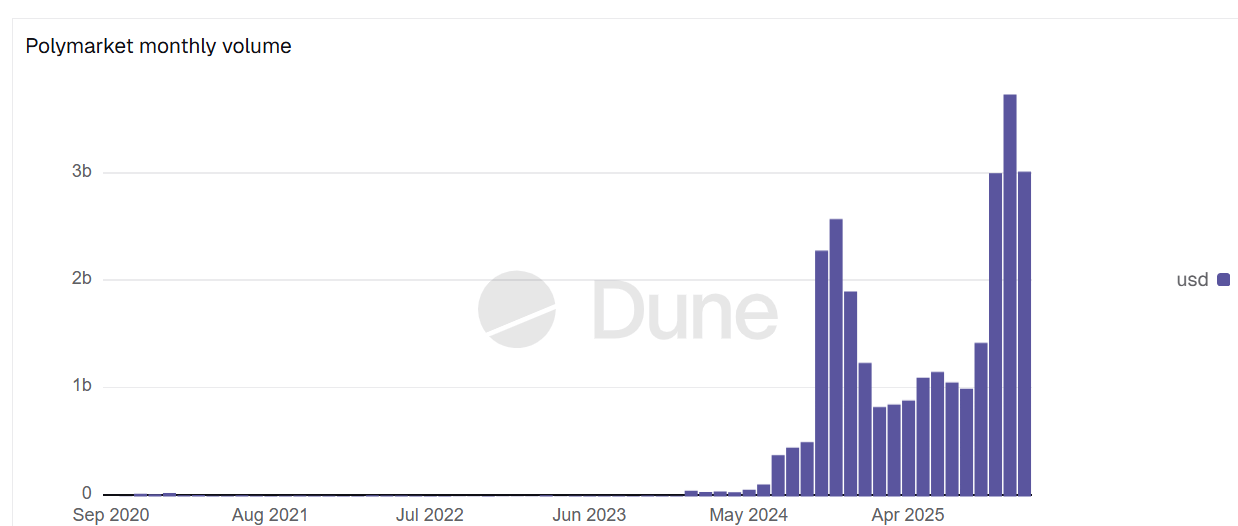
Polymarket’s monthly volumes began to surge in the run-up to the 2024 US presidential election. Source: Dune

Related: DraftKings eyes crypto offerings as it expands into prediction markets

Perguntas relacionadas

QWhat is the primary reason Crypto.com is building an internal market-making team, according to the company?

ACrypto.com states that building an internal market-making team is intended to improve liquidity and create a better overall experience for customers, and it is fully aligned with federal regulations.

QHow does Crypto.com address concerns about conflicts of interest and unfair advantages for its internal market maker?

ACrypto.com states that its internal market maker does not get a 'first look' at proprietary data or customer order flow before other market participants, and all market makers operate under the same rules to ensure fairness and integrity.

QBesides Crypto.com, which other prediction-market operators use market makers to support liquidity, as mentioned in the article?

AThe article mentions that competitors such as Kalshi and Polymarket also use professional trading companies or dedicated liquidity providers to facilitate trading on their platforms.

QWhat is Crypto.com's stated business model regarding proprietary trading and revenue?

ACrypto.com states that it does not rely on proprietary trading as a revenue source and has a simple business model of providing retail customers access to digital assets for a fee while staying risk neutral.

QWhich quantitative trading company has been reported to provide market-making services to Kalshi since 2024?

AQuantitative trading company Susquehanna International Group has been reported to provide market-making services to Kalshi since 2024.

Leituras Relacionadas

Super-Rich Hoarded Record Cash in February, Stock Market Hit New Highs Four Months Later: Who's Getting Fooled?

In February, the total assets in US money market funds reached a record high of approximately $8.25 trillion, a trend highlighted by high-net-worth individuals increasing their cash holdings. Notably, Warren Buffett's Berkshire Hathaway amassed a $381.7 billion cash pile ahead of his 2025 retirement, while other prominent figures like Peter Thiel sold tech stocks, fueling narratives of wealthy investors seeking safety. However, by June, the trend reversed. Money market fund assets fell to around $7.87 trillion, indicating a flow of capital back into equities. Concurrently, the S&P 500 and Nasdaq reached all-time highs, with the S&P 500 surpassing 7600 points. This market surge occurred despite the earlier defensive moves, highlighting a potential opportunity cost for those who retreated to cash. Analysis shows that since early 2022, the S&P 500's total return significantly outpaced that of prime money market funds. The capital shifted from equities appears to have been partly reallocated into alternative investments like real estate, art, and private credit, especially among ultra-high-net-worth individuals. Meanwhile, major investment banks like Goldman Sachs and Morgan Stanley have raised their year-end targets for the S&P 500, citing AI-driven earnings growth, while also cautioning about risks including market concentration and economic fragility beneath the surface rally.

marsbitHá 19m

Super-Rich Hoarded Record Cash in February, Stock Market Hit New Highs Four Months Later: Who's Getting Fooled?

marsbitHá 19m

Robot Vacuums Have Been Competing for 20 Years, So Why Are 90% of Chinese Households Still Hesitant?

The article explores why over 90% of Chinese households are still hesitant to adopt robotic vacuum cleaners despite two decades of industry development, identifying a core "trust gap" as the primary barrier. The central issue is not a lack of need, but user concerns about reliability in dynamic, real-world home environments. Common anxieties include the robot dragging pet waste, colliding with transparent objects, tangling in cords, scattering cat litter, getting stuck on thresholds, missing corners under furniture, and requiring high-maintenance bases that develop odors. The industry's past focus on competing on technical specs (suction power, mopping functions) has not adequately addressed these practical usability and trust problems. The piece then examines DJI's entry into the market with its ROMO 2 model as a potential new approach. Leveraging its expertise in spatial perception and obstacle avoidance from drones, DJI's solution emphasizes "less intervention" through three key principles: less manual re-cleaning, less user rescue missions, and less maintenance. Specific ROMO 2 features highlighted include advanced obstacle recognition (handling transparent objects and small items), adaptive leg mechanisms for climbing thresholds (up to 8.5cm), an extendable arm for reaching under furniture, AI for identifying and appropriately handling different mess types (e.g., avoiding scattering dry debris), and a self-cleaning base designed to minimize user upkeep. The article argues the next phase of competition should shift from a "parameter race" to a "trust race." It draws a parallel to the iPhone's simplification of the smartphone, suggesting that focusing on a reliable, low-hassle user experience—where people feel confident leaving their floors to the machine—is what's needed to finally convince the vast majority of观望ing families. The ultimate test for products like the ROMO 2 will be long-term user adoption, retention, and口碑, not just technical specifications.

marsbitHá 19m

Robot Vacuums Have Been Competing for 20 Years, So Why Are 90% of Chinese Households Still Hesitant?

marsbitHá 19m

The Unclear American Economy: Resilient or Cooling Down?

**U.S. Economic Outlook: Resilient or Cooling Down?** This analysis examines whether the U.S. economy is heading towards a recession. While still growing, the economy shows significant signs of strain. Key data points include Q1 2026 GDP growth of 1.6% and Q1 PCE inflation at 4.5% (annualized), more than double the Fed's target. The labor market remains resilient but is softening, with unemployment at 4.3%. Critical recession indicators present a mixed picture: the yield curve has normalized after a prolonged inversion (historically a late-cycle signal), and the Conference Board's Leading Economic Index has been declining. Current recession probability for 2026 is estimated at 19%, but rises to 41% for 2027, indicating heightened delayed risks. Major pressures are building: a wall of corporate debt refinancing at higher rates, depleted consumer savings, a contracting housing sector, and an energy price shock. The economy exhibits stagflationary characteristics—high inflation alongside slowing growth—which constrains the Federal Reserve's policy options. Historical patterns show recessions are often preceded by Fed tightening and yield curve inversions. If a recession occurs, it is expected to be mild, similar to 2001 rather than 2008. For investors, a defensive portfolio shift toward staples, healthcare, and short-term high-quality bonds may be prudent, while maintaining a long-term, diversified perspective. Key developments to monitor include upcoming GDP, employment, and inflation data, as well as policy signals from the new Fed Chair.

marsbitHá 26m

The Unclear American Economy: Resilient or Cooling Down?

marsbitHá 26m

Trading

Spot
Futuros
活动图片