Insurance Veteran Re-Entrepreneurship, Re Opens the Door to Reinsurance with On-Chain Protocols

Foresight NewsPublicado em 2026-06-15Última atualização em 2026-06-15

Resumo

Insurance veteran Karn Saroya leads Re, a protocol aiming to digitize the global reinsurance market by bridging it on-chain. It tackles high regulatory barriers by using a licensed reinsurer, Cover Re SPC, to handle compliant contracts, separating legal risk from the protocol layer. Users can deposit stablecoins into two tokenized tranches: reUSD (senior, principal-protected with fixed yield) and reUSDe (junior, higher-yield, first-loss). The protocol has secured $409 million in underlying premiums across low-volatility commercial lines like auto and workers' compensation. Re has raised $21 million from investors including Tribe Capital and Electric Capital. Its fixed-supply 1 billion RE governance token, part of an ongoing points program, is planned for a Coinbase listing. Re differentiates itself by offering non-correlated real-world asset yields, a compliant structure, and substantial scaled capital compared to peers like Nexus Mutual or Ensuro.


Author:angelilu,Foresight News


Reinsurance might be the last major financial market that has not yet been digitized. Last year, the global scale of RWA tokenization grew by more than 10 times, and the market value of stablecoins exceeded $320 billion, but the reinsurance sector has seen almost no substantial deployment of on-chain infrastructure.


One reason is the extremely high regulatory barriers. Reinsurance entities need to obtain licenses in jurisdictions, meet solvency requirements, and achieve segregated custody standards—which are difficult for ordinary DeFi teams to bypass.
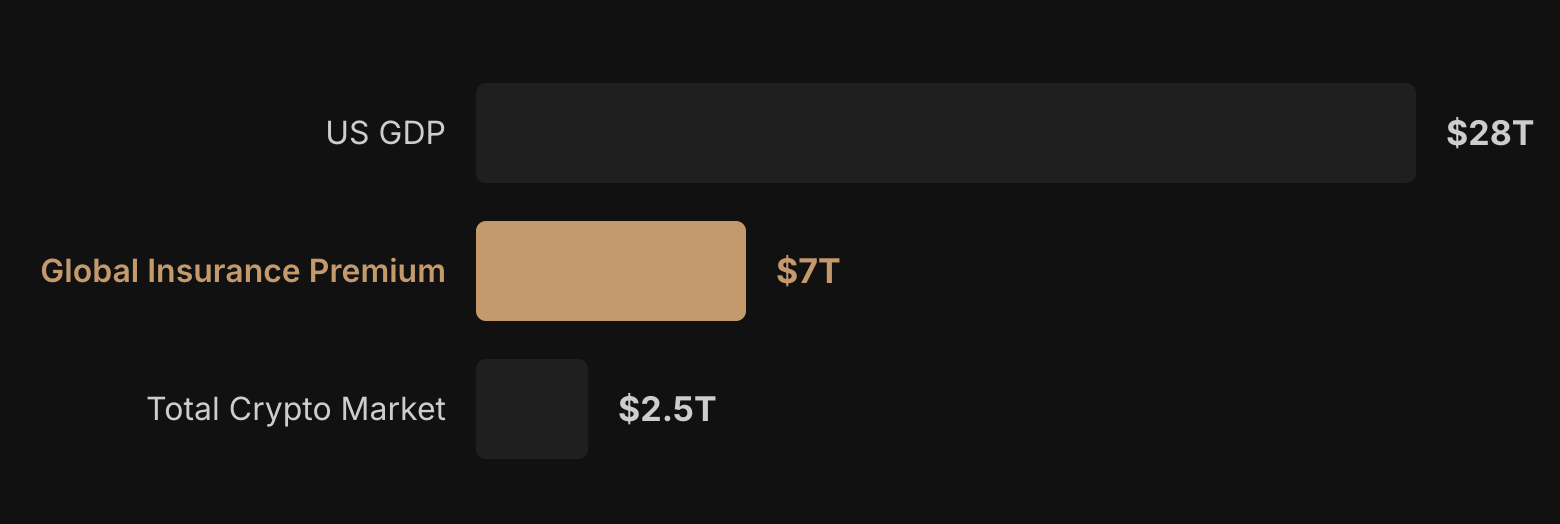


A team composed of insurance technology veterans and on-chain developers is prying open this door to the 'global reinsurance market'.


Moving Reinsurance Companies' Capital Pools On-Chain


The global reinsurance market is dominated by a few giants like Munich Re and Swiss Re, where external capital cannot enter, underwriting conditions are opaque, and solvency cannot be verified. What the Re protocol does is to move reinsurance companies' capital pools on-chain, allowing anyone to deposit money into them and earn premium income.


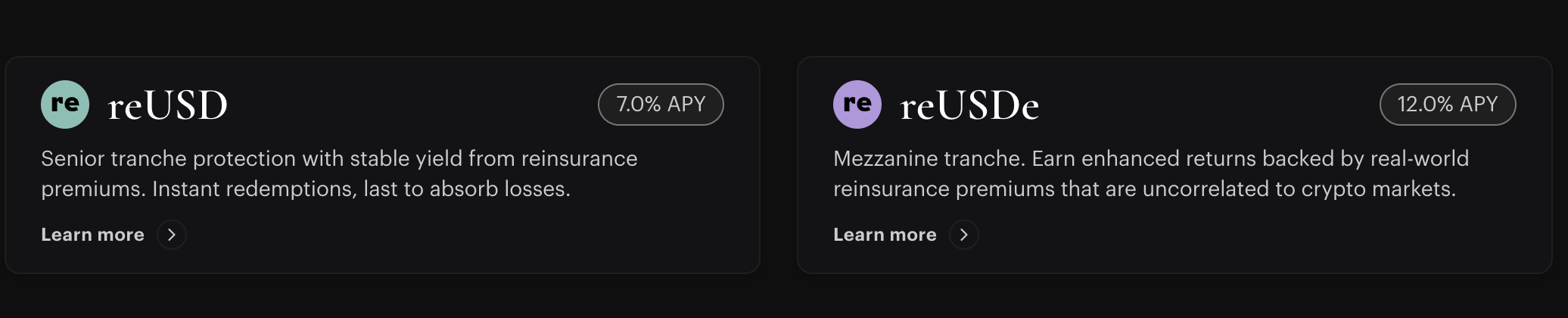
Its core model is not complicated: Insurance companies bundle part of their risks into reinsurance contracts, which are compliantly underwritten by their licensed reinsurance entity Cover Re. Decentralized liquidity providers can then deposit stablecoins into two types of tokenized tranches to earn insurance underwriting income, with the two product forms corresponding to different risk appetites:


reUSD is the senior (stable) tranche, offering principal-protected fixed income (benchmark rate + 250 basis points), with risks absorbed first by the junior tranche; reUSDe is the high-yield tranche, bearing first-loss risk, with a current highest annualized yield of about 23%. The loss absorption order is: first by reUSDe holders and Re Capital, then by reUSD.


To address the regulatory barriers, Re's solution is to separate the operation of the on-chain protocol from the licensed entity: Cover Re SPC (Cayman Islands) acts as an independent reinsurance entity to undertake compliant contracts, while the Resilience Foundation is responsible for issuing the governance token. This achieves legal separation of compliance risk from the technical risk at the protocol layer through an independent licensed entity.


Points and TGE


Re is about to launch its governance token RE. The core role of the token is to enable market participants to formulate protocol rules, but specific revenue, profits, or insurance fund flows are still operated by the licensed entity.


Re's points program aims to reward wallets that provide and store funds within the ecosystem. Its Season 1 points event recently concluded, with 7% of the total RE supply allocated to Season 1 participants. Specific claim windows and vesting mechanisms have not yet been announced. Season 2 started on June 1, 2026, currently with 2,904 active users and a total of 41.2 billion points.


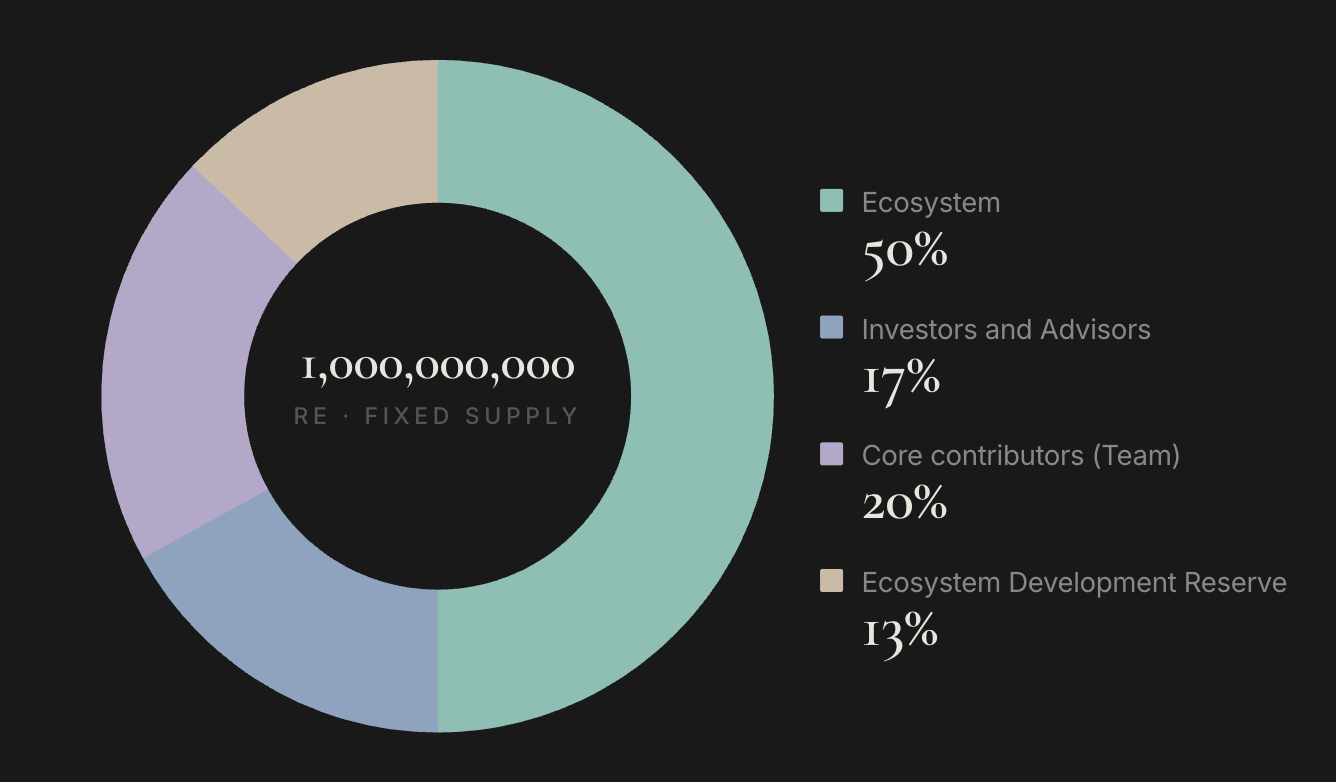
The total supply of RE is fixed at 1 billion tokens, divided into four parts:


  • Ecosystem 50%: 500 million tokens, for community incentives, points program redemptions, and other ecosystem allocations. The 7% supply for Season 1 is allocated from here.
  • Core Contributors / Team 20%: 200 million tokens, team allocation, typically with a vesting period; specific lock-up arrangements have not been announced.
  • Investors and Advisors 17%: 170 million tokens, corresponding to seed round and strategic round investors, also expected to have lock-up periods.
  • Ecosystem Development Reserve 13%: 130 million tokens, for future partnerships, protocol development, etc., managed by the foundation.


RE has been included in Coinbase's listing roadmap, but the specific TGE date has not been announced.


Re Reinsurance Data


Another major feature of Re is the low correlation of its assets. The income source of reinsurance comes from car accident rates, workplace injury occurrence rates, and property damage frequency—these numbers do not fluctuate with BTC price. When the crypto market oscillates repeatedly under geopolitical conflicts and macro policy pressures, the scarcity value of truly non-correlated assets is being repriced.


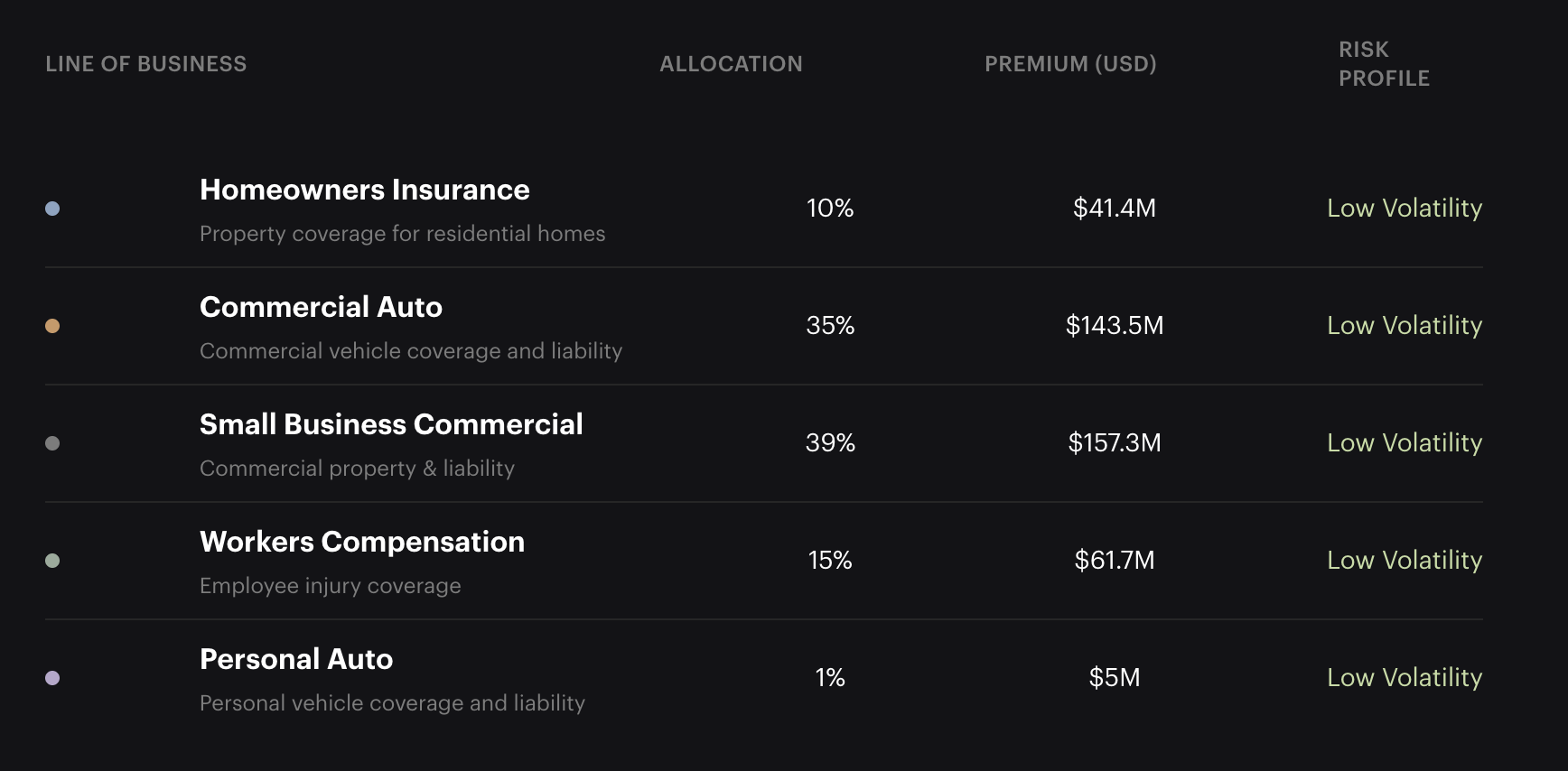
According to its official website data, as of early June 2026, its underlying underwriting portfolio totals $409 million, distributed across commercial auto insurance (35%), small business commercial insurance (39%), workers' compensation (15%), residential insurance (10%), and personal auto insurance (1%). All are in low-volatility daily insurance types, with no high-volatility catastrophic risk exposure. Each reinsurance contract is fully collateralized, with 100% cash or investment-grade assets deposited into segregated Regulation 114 trusts, and solvency can be verified on-chain.


Team and Funding


Re's CEO Karn Saroya has gone through a full round of entrepreneurial experience in the insurtech space. He previously co-founded the insurtech platform Cover, which launched in 2016, raised a total of $27 million from institutions like Exor and Tribe Capital, and later shut down due to business adjustments. Even earlier, he founded the fashion app Stylekick, which was acquired by Shopify.


Other co-founders include Anand Dhillon, Ben Aneesh, Cliff White, and Tribe Capital co-founder Arjun Sethi (the project started under the Tribe Capital crypto incubation system). The specific roles of team members have not been fully disclosed through official channels.


Re completed a $14 million seed round in September 2022, with investors including Tribe Capital, Framework Ventures, Morgan Creek Digital, global reinsurer SiriusPoint, Exor, and Stratos. Post-seed valuation was approximately $100 million. In May 2024, an additional $7 million strategic round was raised, led by Electric Capital, with participation from Nexus Mutual and Avalanche Labs, bringing total funding to about $21 million.


Competitors in the Sector


Comparable projects in the same sector have different directions.


Nexus Mutual is the longest-standing protocol in the on-chain insurance field, but it covers crypto-native risks like DeFi smart contract vulnerabilities and hacker attacks, not involving real-world insurance contracts.


Neptune Mutual focuses on parametric insurance (automatic payouts based on predefined trigger conditions), with a TVL of about $13 million. Its scale is significantly different from Re's, mainly targeting DeFi protocol security scenarios, and has not entered the real-world insurance market.


Ensuro's positioning is closest to Re's—obtaining a regulatory license in Bermuda, partnering with Nexus Mutual to connect on-chain capital with real insurance risks—but publicly disclosed scale data is limited, and it has not yet gained visibility in the mainstream market.


The core differences from the above three are: Re covers insurance types like commercial auto and workers' compensation, which have extremely low correlation with the crypto market; the compliant structure of the licensed reinsurance entity Cover Re allows institutional funds to enter legally; and the $400 million in already underwritten premium volume makes it the only on-chain protocol in this sector that has reached a real commercial scale.


Perguntas relacionadas

QWhat is the main business model and value proposition of the Re protocol?

AThe Re protocol aims to digitize and open up the traditionally opaque global reinsurance market. Its core model involves transferring a reinsurance company's capital pool onto the blockchain. This allows anyone to deposit stablecoins to earn premium income from underwriting real-world insurance risks. It offers two tokenized positions: reUSD (senior/stable tranche with principal protection and fixed yield) and reUSDe (high-yield/junior tranche that absorbs first losses for higher returns). The protocol uses a licensed reinsurance entity, Cover Re SPC, to handle compliant contracts, separating regulatory risk from the protocol's technical layer.

QHow does Re protocol address the high regulatory barriers in the reinsurance industry?

ARe protocol addresses regulatory barriers by implementing a legal separation between its on-chain protocol and licensed operational entities. A licensed reinsurance entity, Cover Re SPC based in the Cayman Islands, independently underwrites compliant reinsurance contracts. The Resilience Foundation handles governance token issuance. This structure isolates the compliance and regulatory risks associated with the insurance business from the technical and operational risks of the decentralized protocol layer.

QWhat are the key characteristics of RE token's distribution and its planned use?

AThe total fixed supply of the RE governance token is 1 billion. It is distributed across four categories: 50% to the Ecosystem for community incentives and point program rewards; 20% to Core Contributors/Team; 17% to Investors and Advisors; and 13% to an Ecosystem Development Reserve managed by the foundation. Its core function is to allow market participants to govern protocol rules, while the actual insurance cash flows and income are managed by the separate, licensed operating entity. 7% of the total supply is allocated for Season 1 point program participants.

QAccording to the article, what makes the assets underlying Re protocol valuable, especially in the context of the crypto market?

AThe assets underlying Re protocol are valuable due to their low correlation with the crypto market. The protocol's yield is derived from real-world risk events like car accident rates, workplace injury frequency, and property damage—factors that do not fluctuate with Bitcoin's price. As of June 2026, its underwriting portfolio of $409 million is spread across low-volatility, everyday insurance lines like commercial auto, small business commercial, workers' compensation, and residential insurance, with no exposure to high-volatility catastrophe risks. This provides a source of non-correlated yield.

QHow does Re protocol compare to other projects in the on-chain insurance space, such as Nexus Mutual, Neptune Mutual, and Ensuro?

ARe protocol differs from competitors in several key ways: 1) It covers real-world, low-correlation insurance lines (e.g., commercial auto, workers' comp), unlike Nexus Mutual and Neptune Mutual which focus on crypto-native risks like smart contract exploits. 2) It operates through a licensed reinsurance entity (Cover Re SPC), enabling institutional participation. 3) With a $409 million underlying portfolio, it has achieved a significant commercial scale not yet seen by other protocols in this niche. Ensuro has a similar real-world insurance focus and a license, but Re currently has greater market visibility and scale.

Leituras Relacionadas

Must-Watch Events Next Week|CLARITY Act Could Face Senate Vote; SpaceX, Circle to Report Earnings (8.3-8.9)

**Summary: Key Events and Developments to Watch (August 3-9)** The upcoming week is marked by significant financial disclosures, key legislative deadlines, and notable product updates. **Major Financial Events:** Several companies are scheduled to release their Q2 2026 earnings. American Bitcoin (ABTC) will report on August 3, followed by SpaceX and Hut 8 Mining Corp. on August 4, and Circle on August 5. Notably, a significant portion of SpaceX shares (up to 12% of total shares) will be unlocked on August 6 following their earnings release. **Key Legislative Deadline:** The U.S. Senate faces an August 7 deadline to secure 60 votes for the CLARITY Act, a bipartisan bill aiming to establish a federal regulatory framework for cryptocurrencies. The Senate may hold a full vote on the bill during the week. **Economic Data:** The U.S. July Non-Farm Payrolls report will be released on August 7, providing crucial labor market data. **Technology & Product Updates:** * **Shutdowns:** DeFi portfolio tracker Zapper and wallet app Ctrl Wallet will cease operations on August 3. * **Upgrades:** LayerZero will deprecate its v1 relayers on August 3. XRP Ledger's new version 3.3.0, featuring five new functions, is expected next week. * **AI:** Elon Musk announced that the advanced Grok 4.6 AI model is set for release around August 7. * **Bitcoin:** The BIP-110 forced signaling for a potential Bitcoin network change is scheduled to begin around August 8. **Other Notable Events:** Chinese robotics firm Unitree Tech has set its preliminary price inquiry for its IPO for August 5. South Korean exchange Upbit will delist AQT and AERGO tokens on August 3.

marsbitHá 44m

Must-Watch Events Next Week|CLARITY Act Could Face Senate Vote; SpaceX, Circle to Report Earnings (8.3-8.9)

marsbitHá 44m

Stocks Are Plummeting More Sharply Than Cryptocurrencies. Where Has the Money Gone?

Stock Markets Plunge Deeper Than Cryptocurrencies: Where Did the Money Go? In late July, Seoul's Kospi index triggered circuit breakers for two consecutive days, plummeting over 40% from its June high. The collapse was led by heavyweight stocks like SK Hynix, whose record profits still disappointed investors, and devastating leveraged ETFs, with one major product losing over 83% of its value. This signaled a global, forced deleveraging targeting the most crowded trades. Interestingly, while stocks exhibited extreme volatility akin to crypto markets, Bitcoin rose nearly 15% in July after a prior steep drop. Analysis shows the money fleeing equities did not flow into Bitcoin. Instead, Bitcoin had already absorbed its sell-off in May-June, when U.S. spot Bitcoin ETFs saw historic outflows. The true safe-haven beneficiary was gold, whose price rose over 20% year-on-year, highlighting a decoupling between Bitcoin and gold as "digital gold." The sell-off was a targeted unwinding of leveraged positions in tech and semiconductors, accelerated by broker-dealer risk management and shifts in the AI narrative, including new competition from Chinese memory chipmakers. The retreat path was clear: from high-valuation tech stocks to cash and U.S. Treasuries, then to gold. For Bitcoin to attract sustained institutional inflows, conditions like eased global liquidity pressure, a "soft-landing" Fed rate cut, and U.S. regulatory clarity via legislation like the stalled CLARITY Act are needed. Currently, Bitcoin is not a safe haven but an already-cleared asset. Its low correlation with tech stocks, however, makes it a potential diversification play for institutional portfolios once the storm passes. The money isn't here yet, but the positioning is underway.

marsbitHá 44m

Stocks Are Plummeting More Sharply Than Cryptocurrencies. Where Has the Money Gone?

marsbitHá 44m

In Conversation with Ray Dalio: We Are Currently in an AI Bubble, with 1% of My Portfolio in Bitcoin

Ray Dalio, founder of Bridgewater Associates, warns in an interview that the current AI boom shows classic bubble characteristics, which could lead to significant economic downturns as seen in past cycles like 1929 or 2000. He explains that speculative enthusiasm, fueled by debt and overvaluation, often precedes a crash when rising rates or taxation force asset sales, causing widespread losses and recession. Dalio also outlines his "Big Cycle" theory, describing an approximate 80-year pattern where widening wealth gaps, massive government deficits, and shifting geopolitical power (like China's rise) create internal conflict and global instability. He emphasizes that we are in a late-cycle, transitional phase where traditional powers like the US and UK face decline. For personal wealth protection, Dalio advises diversification beyond cash into assets like stocks, bonds, real estate, and particularly gold, which he prefers over Bitcoin. While he holds about 1% of his portfolio in Bitcoin as a non-printable hard asset, he views gold as more secure from technological or governmental threats. Regarding AI's impact, Dalio believes it will disproportionately benefit capital owners, worsening inequality by replacing both physical and cognitive labor. He suggests that human intuition and emotional intelligence, combined with AI, will be key for future workers. On taxation, Dalio argues that wealth taxes are impractical and risk triggering asset sell-offs, reducing productive investment. He points to the UK as a cautionary example of debt, low productivity, and political strife. Geopolitically, Dalio foresees a more regionalized world, with the US showing weakness in prolonged conflicts like with Iran, akin to past imperial declines. The ideal outcome, he suggests, is coexisting powerful blocs (e.g., Americas, China-Asia Pacific) without major war.

marsbitHá 4h

In Conversation with Ray Dalio: We Are Currently in an AI Bubble, with 1% of My Portfolio in Bitcoin

marsbitHá 4h

Daily 7.2 Trillion KRW: Foreign Capital's Record Net Buying on Friday! Wall Street Says Headwinds for Korean Stock Fund Flows Have Subsided

South Korean stock market sees a dramatic shift in fund flows. On July 31, foreign investors made a record net purchase of approximately KRW 7.2 trillion in KOSPI stocks, marking a fundamental reversal from the persistent large-scale net outflows seen in previous months. This contributed to a significant narrowing of foreign net selling in July to KRW 9.8 trillion, down sharply from KRW 48.4 trillion in June and KRW 44.5 trillion in May. Simultaneously, domestic institutional pressure eased. South Korean pension funds and asset managers turned to a net buying position in July, purchasing KRW 1.0 trillion worth of KOSPI shares, contrasting with net sales in May and June. Market volatility is expected to be dampened by new financial regulations. Effective July 31, the Financial Services Commission tightened access for retail investors to single-stock leveraged ETFs by raising the minimum cash deposit requirement. Trading volumes for these products subsequently dropped to about 50% of their monthly average. Citigroup Research maintains its year-end KOSPI target of 10,000 points. The firm cites several supportive factors: the substantial easing of headwinds from capital outflows, a robust fundamental outlook for the semiconductor sector, historically low market valuations, strong economic fundamentals, and the potential for policy support from financial authorities if needed.

marsbitHá 4h

Daily 7.2 Trillion KRW: Foreign Capital's Record Net Buying on Friday! Wall Street Says Headwinds for Korean Stock Fund Flows Have Subsided

marsbitHá 4h

Trading

Spot
活动图片




