Crypto Treasury Firms Face $15B Selling Pressure From MSCI Decision

bitcoinistPublicado em 2025-12-19Última atualização em 2025-12-19

Resumo

Analysts estimate that passive funds could pull between $10 billion and $15 billion from companies holding significant crypto assets if MSCI proceeds with a proposed rule change. The index provider is reviewing a policy to exclude firms holding over 50% of their assets in digital currencies from its benchmarks, a decision expected by January 2026. If enacted, index-tracking funds would be forced to sell shares of affected companies. JPMorgan analysis singles out MicroStrategy as the most impacted, potentially facing $2.8 billion in outflows. Beyond stock sales, there is a risk the companies themselves might liquidate crypto holdings, adding direct selling pressure to both equity and crypto markets. Industry groups are pushing back against the proposal, arguing for an operations-based classification instead.

Analysts have calculated that passive funds could pull as much as $11.6 billion from companies that treat large crypto holdings as corporate treasuries if MSCI removes them from its indexes, a move that would force index-tracking vehicles to sell shares.

Reports say that number comes from adding direct MSCI-tracked outflows to possible follow-on selling by other index providers.

Estimated Outflows Range

The figure sits inside a wider band of estimates. Some analysts and press pieces put the possible damage anywhere between $10 billion and $15 billion, depending on whether other major index providers copy MSCI’s decision and how much passive money is forced to move.

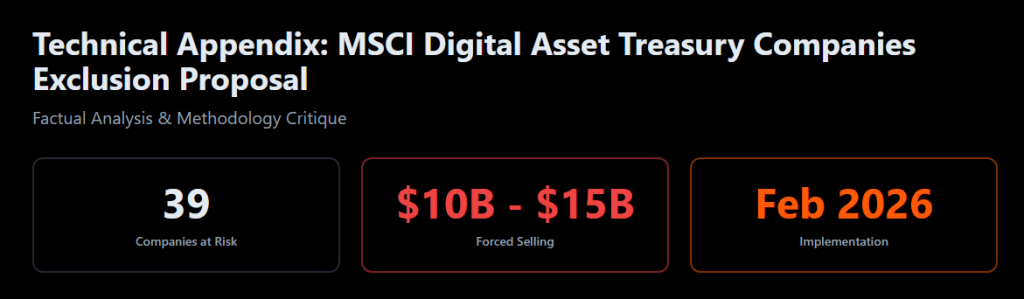
The analysis that produced these numbers looked at roughly 39 listed companies that meet MSCI’s proposed definition of a digital-asset treasury firm.

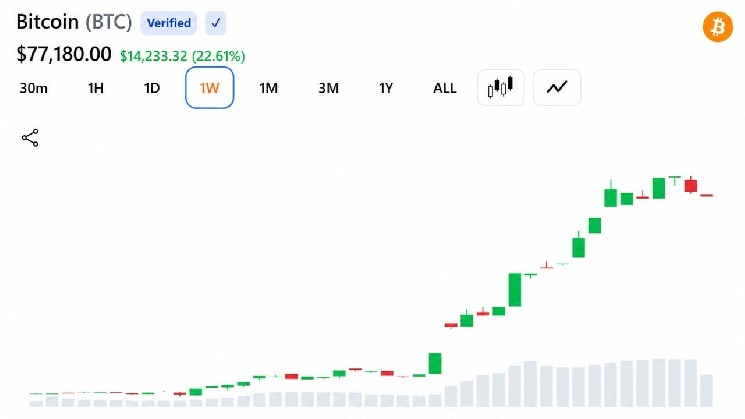
BTCUSD now trading at $87,105. Chart: TradingView

MSCI’s Proposal And The Mechanics

According to MSCI’s own consultation documents, the index provider is reviewing a rule that would treat companies holding more than 50% of their assets in digital assets as non-constituents of its broad equity indexes.

MSCI extended the consultation through December and said it expects to announce conclusions by January 15, 2026, with any changes applied in the February 2026 index review. If a firm is removed, funds that track MSCI benchmarks typically must reduce or sell their stakes automatically.

Strategy Stands Out

JPMorgan’s work has been singled out in multiple reports. According to that note, Strategy alone could face about $2.8 billion in passive outflows if removed from MSCI indexes, and larger losses if other index families follow.

Analysts say Strategy’s unique position — with a very high share of its balance sheet in Bitcoin — makes it the single biggest driver of the total outflow math.

Risk To Crypto Holdings

Some sectors warn that, beyond stock selling, the companies themselves might liquidate crypto positions to meet margin or liquidity needs, which could push crypto asset sales toward a figure as high as $15 billion in the worst scenarios. That would add direct selling pressure to both the equities and crypto markets.
Source: Bitcoin for Corporations

Industry Pushback

Based on reports, a group named Bitcoin For Corporations, along with several affected firms, pushed back, saying the MSCI test relies on a single balance-sheet threshold that doesn’t reflect how these companies actually operate.

The campaign has drawn public comments and petitions; several reports put the signature count at about 1,200 to 1,300. Companies have filed feedback with MSCI and have argued for an operations-based classification instead of a holdings-based cut-off.

Featured image from Unsplash, chart from TradingView

Perguntas relacionadas

QWhat is the estimated amount of selling pressure that crypto treasury firms could face due to MSCI's proposed rule change?

AAnalysts estimate that crypto treasury firms could face selling pressure ranging from $10 billion to $15 billion.

QWhat is the specific threshold in MSCI's proposal that would cause a company to be excluded from its indexes?

AMSCI's proposal would treat companies holding more than 50% of their assets in digital assets as non-constituents of its broad equity indexes.

QWhich company is singled out as the single biggest driver of the total outflow math and why?

AMicroStrategy is singled out as the biggest driver due to its unique position with a very high share of its balance sheet in Bitcoin, potentially facing about $2.8 billion in passive outflows.

QBeyond stock selling, what additional risk to the crypto market is highlighted in the article?

AThe article warns that the companies themselves might be forced to liquidate their crypto positions to meet margin or liquidity needs, which could add direct selling pressure to the crypto market.

QWhat is the main argument made by the industry group 'Bitcoin For Corporations' against MSCI's proposal?

AThe group argues that the MSCI test relies on a single balance-sheet threshold that doesn't reflect how these companies actually operate, and they have advocated for an operations-based classification instead.

Leituras Relacionadas

Unitree's IPO Frenzy: The Real Mystery is How It Will Spend the 42 Billion Raised

Unitree, a Chinese robotics company, is set for a public listing after its IPO registration was approved by regulators. The company, which started with quadruped robots and has expanded into humanoids, plans to raise approximately 4.2 billion yuan through its offering. The article traces Unitree's rapid growth from its founding in 2016 to its current status. It highlights key milestones like the 2021 CCTV Spring Festival Gala performance, the 2023 launch of its affordable Go2 robot dog and the H1 humanoid robot, and a series of subsequent product launches. By 2025, the company reported revenue of 1.71 billion yuan, profitability, and sales exceeding 5,500 humanoid robots. As the first publicly-listed humanoid robot company on China's STAR Market, Unitree's main challenges are sustaining growth and deploying its newly raised capital effectively. The humanoid robot sector in China is crowded, with over 140 companies. Competitors include UBTech (focusing on industrial and consumer markets), Fourier, and international players like Tesla Optimus and 1X NEO. The article outlines three critical challenges for Unitree: establishing a strong second product line beyond its quadruped robots, maintaining its price advantage while ensuring quality, and successfully advancing its embodied AI capabilities through partnerships like the one with NVIDIA for the H2 Plus platform. Unitree's likely strategy involves a "developer tools + industry benchmarks" approach: using low-cost models like the R1 and G1 to build developer adoption and volume, leveraging high-end platforms for AI training, and securing pilot projects in sectors like logistics and manufacturing to build case studies. The company's future success hinges on converting its current momentum in shipments and pilot programs into sustainable, large-scale commercial contracts as the broader market evolves.

marsbitHá 1h

Unitree's IPO Frenzy: The Real Mystery is How It Will Spend the 42 Billion Raised

marsbitHá 1h

Examining the Open USD Partner Lineup: Follow Who's Joining to See Where the Money Flows

**Title: Deciphering the Open USD Partner Roster: Following the Money** The launch of Open USD is notable less for the stablecoin itself and more for its expansive list of over 140 founding partners, which reads like a "who's who" of global finance and tech. This coalition, including asset managers like BlackRock, card networks Visa and Mastercard, banks (BNY Mellon, Standard Chartered, etc.), tech giants (Google, IBM), merchants (Shopify), and crypto firms (Coinbase, Ripple, Aave, MetaMask), signals a strategic shift. The diverse membership reveals that stablecoins are increasingly viewed not as products to compete over, but as shared infrastructure too critical to be left to any single entity. Each partner category has distinct motives. Asset managers like BlackRock seek to manage the large, sticky cash reserves, a lucrative fee-generating opportunity. Merchants like Shopify aim for lower-cost settlement and potential yield on balances. Banks join defensively to retain custody and settlement roles, fearing deposit outflows to stablecoins. Tech companies bet on programmable money for future machine-to-machine commerce. Crypto firms gain mainstream legitimacy and distribution channels. Remarkably, the consortium includes direct competitors (Visa vs. Mastercard, Coinbase vs. Ripple), indicating that the fear of exclusion from this emerging financial layer outweighs competitive rivalries. However, this shared governance could also lead to slow decision-making. The roster's composition is the real message: it represents a collective bet that a widely accepted, consortium-owned stablecoin is preferable to proprietary versions or having none at all. For incumbents like Circle and Tether, this alliance poses a significant threat, as potential clients have collectively chosen to build their own alternative. The absence of major U.S. retail banks (busy with their own tokenized deposit networks) is equally telling. In essence, the partner list maps where the industry believes value and risk will flow in a tokenized dollar future, marking stablecoin's evolution from a product to a utility.

Foresight NewsHá 1h

Examining the Open USD Partner Lineup: Follow Who's Joining to See Where the Money Flows

Foresight NewsHá 1h

Trading

Spot
活动图片