‘Incentivize democracy’ at the cost of security? Inside Bonk’s $20M exploit

ambcryptoPublicado em 2026-07-07Última atualização em 2026-07-07

Resumo

BonkDAO, the governance body for the memecoin BONK, suffered a $20 million exploit due to a malicious governance proposal. The attacker acquired enough BONK to create a proposal with a 1% vote threshold, which then authorized transferring 4.4 trillion BONK to their wallet. Security analysts criticized the low approval threshold and lack of safeguards like lock periods for treasury transfers, calling it an operational security failure. The incident fueled debate about balancing decentralized governance with security. Following the news, BONK's price dropped 10%, though on-chain data indicated continued accumulation by large holders since June. The project is collaborating with law enforcement and exchanges to mitigate the situation.

BonkDAO has become the latest crypto hack victim, after suffering a $20 million loss. The memecoin project confirmed that the exploit was enabled by a “malicious governance proposal.”

It added that it was collaborating with law enforcement, the Solana Foundation, bridges, and exchanges to mitigate the situation.

The BonkDAO exploit adds to a growing list of crypto stolen funds that hit a record high in H1 2026.
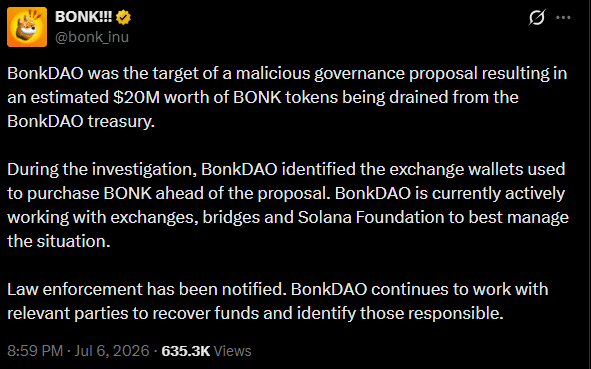
Source: X

However, security analysts have flagged the exploited weakness as the failure of the memecoin project.

Community blames Bonk for the exploit

The BonkDAO attacker acquired enough BONK to create a new governance proposal (Sowellian BonkDAO). With only a 1% community vote threshold, the attacker was able to create a proposal that added ‘metadata’ and sent 4.4 trillion BONK (approximately $20 million) to the hacker’s wallet.

One security analyst slammed the 1% community threshold configuration. He highlighted that direct treasury transfers should have a lock period or require multiple approvals. He added that,

Kinda silly, to be honest, to have such configurations, but yeah sad to see one of the OG projects.

For Taylor Monahan, another renowned Web3 security researcher, the update underscored how useless the broader DAO (decentralized autonomous organization) model is. For her, there is no need to “incentivize democracy” through DAOs at the expense of security.

In other words, the hack is part of the broader ‘operational security’ failures that have been the major driver of the record number of exploits in 2026.

BONK memecoin dumps 10%

BONK memecoin price crashed 10% following the exploit update. The losses could extend to the June range low of $0.0000040, which also doubled as the October crash dip.
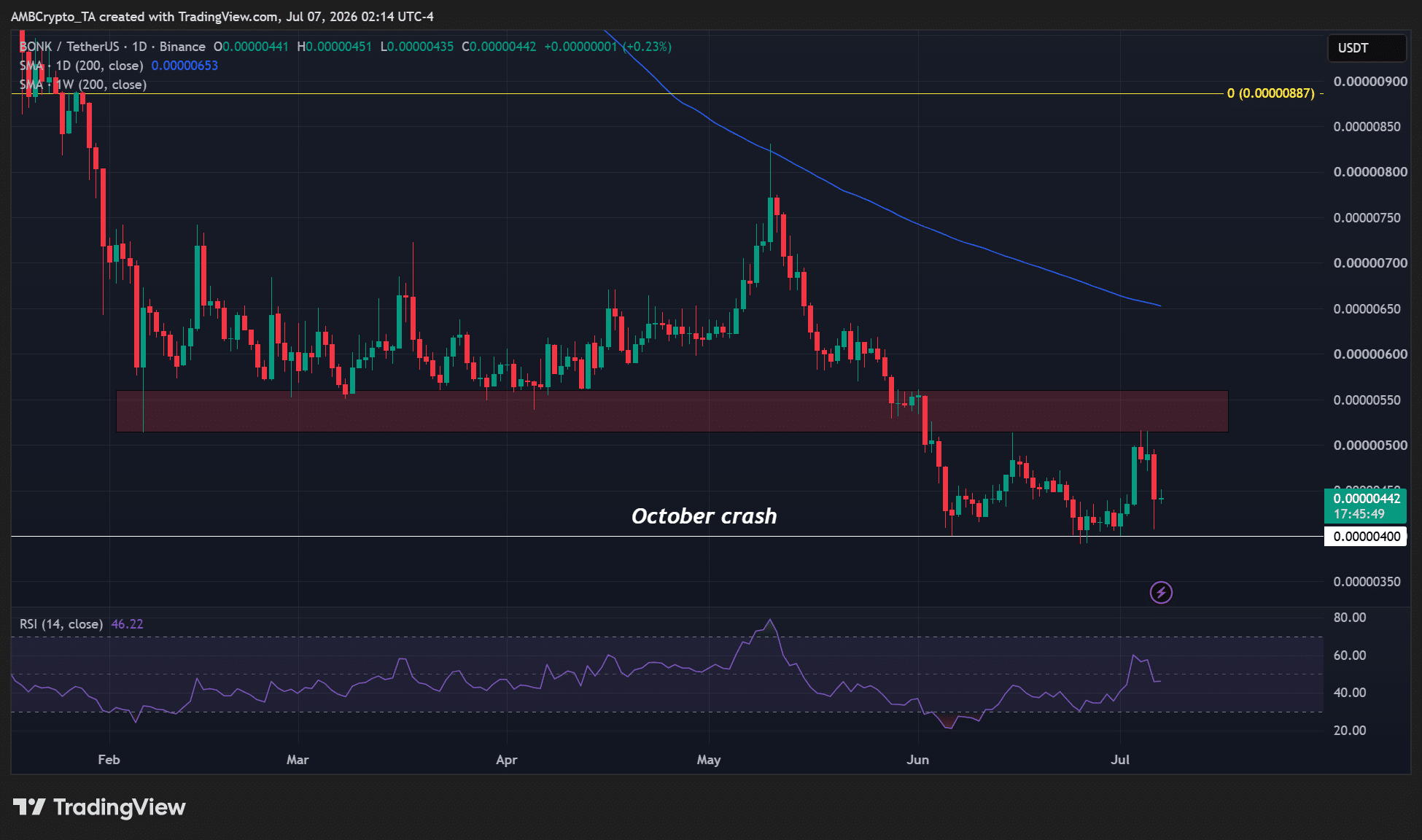
Source: BONK/USDT, TradingView

Since June, bulls have been able to defend the support. Whether it will hold after the exploit remains to be seen.

On the demand front, especially from whale wallets, there was a negligible change. Only two whale wallets with over 1T BONK reduced their spot exposure to the memecoin. Overall, whale wallets with over 10M BONK have been accumulating since mid-June.
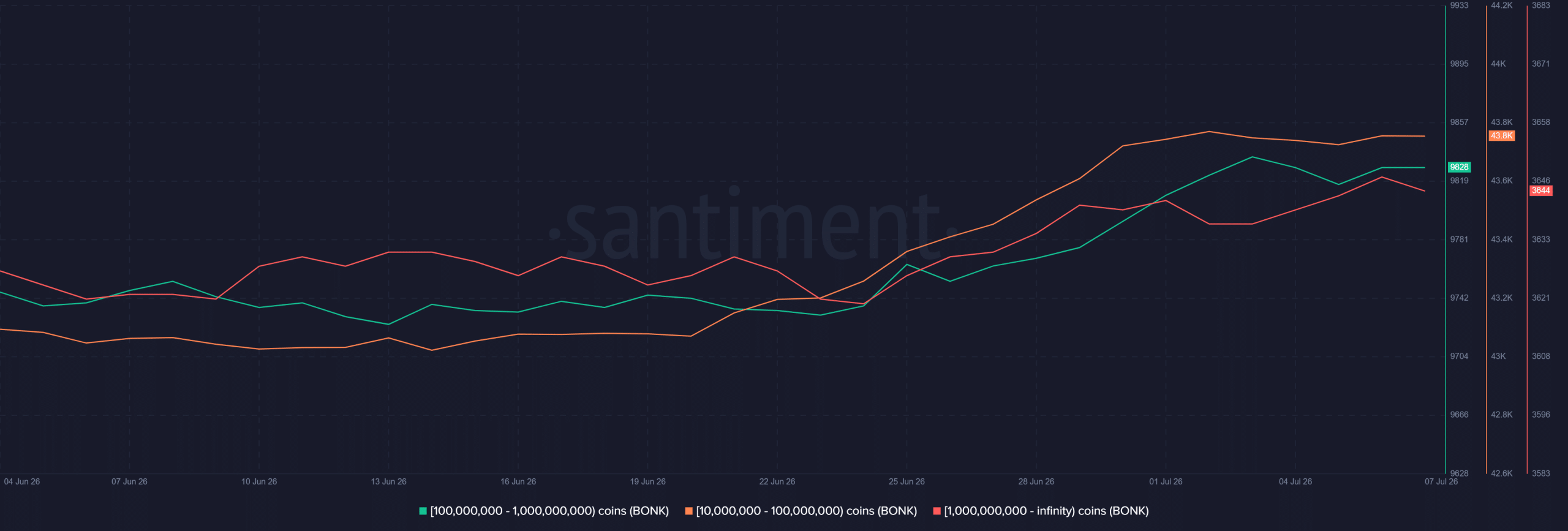
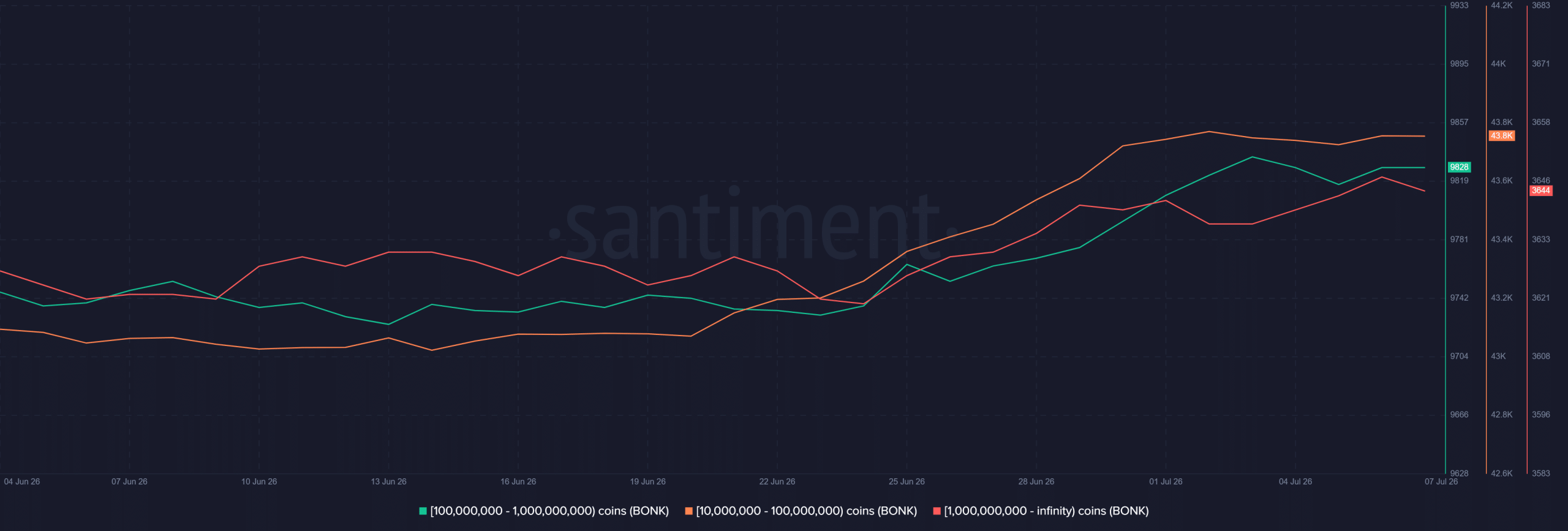
Source: Santiment

If the spot accumulation by whales continues, the June price range could be extended. However, if the exploit and broader market sentiment worsen into Q3, the memecoin could print a new yearly low on the price chart.


Final Summary

  • The $20M Bonk treasury exploit was another operational security failure, according to analysts.
  • On-chain data showed whales have been accumulating since June, and the exploit didn’t taper the demand.


Criptomoedas em alta

Perguntas relacionadas

QWhat was the main cause of the $20M BonkDAO exploit according to security analysts?

ASecurity analysts attributed the exploit primarily to operational security failures, specifically criticizing the configuration that allowed a governance proposal to pass with only a 1% community vote threshold and execute a direct treasury transfer without sufficient safeguards like a lock period or multi-signature approval.

QHow did the attacker manage to steal funds from BonkDAO?

AThe attacker acquired enough BONK tokens to create a new governance proposal called 'Sowellian BonkDAO'. With BonkDAO's low 1% community vote threshold, the attacker successfully passed a proposal that added malicious metadata, enabling the transfer of 4.4 trillion BONK (worth approximately $20 million) to their own wallet.

QWhat was the immediate impact on BONK's price following the exploit news?

AFollowing the announcement of the exploit, the price of the BONK memecoin crashed by 10%.

QWhat is Taylor Monahan's criticism regarding DAOs in the context of this hack?

ATaylor Monahan, a Web3 security researcher, criticized the broader DAO model as 'useless' in this context, arguing that there is no need to 'incentivize democracy' through DAOs at the expense of security.

QWhat does on-chain data indicate about whale activity for BONK around the time of the exploit?

AOn-chain data from Santiment showed that whale wallets holding over 10 million BONK had been accumulating the token since mid-June. The exploit did not significantly dampen this demand, with only two wallets holding over 1 trillion BONK reducing their spot exposure.

Leituras Relacionadas

Tiger Research: Three Strategies for Financial Institutions to Keep Up with the Tokenization Wave

Tiger Research's in-depth report analyzes the strategic choices for financial institutions entering the rapidly growing Real-World Asset (RWA) tokenization market. With the market projected to be worth $25-36 billion and a lack of complete regulatory frameworks in many jurisdictions, institutions face three options: waiting for domestic legislation, using regulatory sandboxes for limited experiments, or moving first into established overseas markets to gain a competitive edge. Tokenization is not magic; it requires meticulous preparation. Before entry, institutions must strategically plan across six core areas: choosing a jurisdiction, obtaining necessary licenses, defining the asset type, targeting the appropriate investor base, selecting settlement currencies, and designing operational requirements like custody and governance. The report outlines two main operational paths. The first is a direct jurisdictional path, establishing a legal presence in mature markets like Hong Kong, Singapore, or the U.S., often leveraging local licensed platforms to accelerate market entry. The second is a chain-native path, using platforms like Ondo or Plume that are built with regulatory compliance embedded, allowing for faster, more flexible market access without being tied to a specific jurisdiction. Ultimately, the report advises against waiting for perfect regulation. The preparation process can take 6-12 months and requires thorough legal review. Using the example of a mid-sized securities firm, it details steps from evaluating existing entities to final execution. The core message is that accumulating real-world operational experience is paramount, as the market is moving ahead and will not wait for latecomers.

Foresight NewsHá 23m

Tiger Research: Three Strategies for Financial Institutions to Keep Up with the Tokenization Wave

Foresight NewsHá 23m

Unitree's IPO Frenzy: The Real Mystery is How It Will Spend the 42 Billion Raised

Unitree, a Chinese robotics company, is set for a public listing after its IPO registration was approved by regulators. The company, which started with quadruped robots and has expanded into humanoids, plans to raise approximately 4.2 billion yuan through its offering. The article traces Unitree's rapid growth from its founding in 2016 to its current status. It highlights key milestones like the 2021 CCTV Spring Festival Gala performance, the 2023 launch of its affordable Go2 robot dog and the H1 humanoid robot, and a series of subsequent product launches. By 2025, the company reported revenue of 1.71 billion yuan, profitability, and sales exceeding 5,500 humanoid robots. As the first publicly-listed humanoid robot company on China's STAR Market, Unitree's main challenges are sustaining growth and deploying its newly raised capital effectively. The humanoid robot sector in China is crowded, with over 140 companies. Competitors include UBTech (focusing on industrial and consumer markets), Fourier, and international players like Tesla Optimus and 1X NEO. The article outlines three critical challenges for Unitree: establishing a strong second product line beyond its quadruped robots, maintaining its price advantage while ensuring quality, and successfully advancing its embodied AI capabilities through partnerships like the one with NVIDIA for the H2 Plus platform. Unitree's likely strategy involves a "developer tools + industry benchmarks" approach: using low-cost models like the R1 and G1 to build developer adoption and volume, leveraging high-end platforms for AI training, and securing pilot projects in sectors like logistics and manufacturing to build case studies. The company's future success hinges on converting its current momentum in shipments and pilot programs into sustainable, large-scale commercial contracts as the broader market evolves.

marsbitHá 1h

Unitree's IPO Frenzy: The Real Mystery is How It Will Spend the 42 Billion Raised

marsbitHá 1h

Examining the Open USD Partner Lineup: Follow Who's Joining to See Where the Money Flows

**Title: Deciphering the Open USD Partner Roster: Following the Money** The launch of Open USD is notable less for the stablecoin itself and more for its expansive list of over 140 founding partners, which reads like a "who's who" of global finance and tech. This coalition, including asset managers like BlackRock, card networks Visa and Mastercard, banks (BNY Mellon, Standard Chartered, etc.), tech giants (Google, IBM), merchants (Shopify), and crypto firms (Coinbase, Ripple, Aave, MetaMask), signals a strategic shift. The diverse membership reveals that stablecoins are increasingly viewed not as products to compete over, but as shared infrastructure too critical to be left to any single entity. Each partner category has distinct motives. Asset managers like BlackRock seek to manage the large, sticky cash reserves, a lucrative fee-generating opportunity. Merchants like Shopify aim for lower-cost settlement and potential yield on balances. Banks join defensively to retain custody and settlement roles, fearing deposit outflows to stablecoins. Tech companies bet on programmable money for future machine-to-machine commerce. Crypto firms gain mainstream legitimacy and distribution channels. Remarkably, the consortium includes direct competitors (Visa vs. Mastercard, Coinbase vs. Ripple), indicating that the fear of exclusion from this emerging financial layer outweighs competitive rivalries. However, this shared governance could also lead to slow decision-making. The roster's composition is the real message: it represents a collective bet that a widely accepted, consortium-owned stablecoin is preferable to proprietary versions or having none at all. For incumbents like Circle and Tether, this alliance poses a significant threat, as potential clients have collectively chosen to build their own alternative. The absence of major U.S. retail banks (busy with their own tokenized deposit networks) is equally telling. In essence, the partner list maps where the industry believes value and risk will flow in a tokenized dollar future, marking stablecoin's evolution from a product to a utility.

Foresight NewsHá 2h

Examining the Open USD Partner Lineup: Follow Who's Joining to See Where the Money Flows

Foresight NewsHá 2h

Trading

Spot

Artigos em Destaque

Como comprar BONK

Bem-vindo à HTX.com!Tornámos a compra de Bonk (BONK) simples e conveniente.Segue o nosso guia passo a passo para iniciar a tua jornada no mundo das criptos.Passo 1: cria a tua conta HTXUtiliza o teu e-mail ou número de telefone para te inscreveres numa conta gratuita na HTX.Desfruta de um processo de inscrição sem complicações e desbloqueia todas as funcionalidades.Obter a minha contaPasso 2: vai para Comprar Cripto e escolhe o teu método de pagamentoCartão de crédito/débito: usa o teu visa ou mastercard para comprar Bonk (BONK) instantaneamente.Saldo: usa os fundos da tua conta HTX para transacionar sem problemas.Terceiros: adicionamos métodos de pagamento populares, como Google Pay e Apple Pay, para aumentar a conveniência.P2P: transaciona diretamente com outros utilizadores na HTX.Mercado de balcão (OTC): oferecemos serviços personalizados e taxas de câmbio competitivas para os traders.Passo 3: armazena teu Bonk (BONK)Depois de comprar o teu Bonk (BONK), armazena-o na tua conta HTX.Alternativamente, podes enviá-lo para outro lugar através de transferência blockchain ou usá-lo para transacionar outras criptomoedas.Passo 4: transaciona Bonk (BONK)Transaciona facilmente Bonk (BONK) no mercado à vista da HTX.Acede simplesmente à tua conta, seleciona o teu par de trading, executa as tuas transações e monitoriza em tempo real.Oferecemos uma experiência de fácil utilização tanto para principiantes como para traders experientes.

391 Visualizações TotaisPublicado em {updateTime}Atualizado em 2026.06.02

Como comprar BONK

Discussões

Bem-vindo à Comunidade HTX. Aqui, pode manter-se informado sobre os mais recentes desenvolvimentos da plataforma e obter acesso a análises profissionais de mercado. As opiniões dos utilizadores sobre o preço de BONK (BONK) são apresentadas abaixo.

活动图片