Crypto treasuries regain footing after recent downturn: Grayscale

ambcryptoPublicado em 2026-03-28Última atualização em 2026-03-28

Resumo

After a challenging period since late 2025, digital asset treasuries (DATs) are showing signs of recovery, according to Grayscale's head of research Zach Pandl. Companies have adopted strategies such as optimizing capital structures, generating income, and diversifying business models to navigate the crypto downturn. For instance, Strategy shifted from convertible bonds to preferred stocks and established a $2.25 billion USD reserve, while BitMine aims to generate $300 million annually by staking its Ethereum holdings. Other firms, like MARA, sold portions of their crypto assets to invest in AI. Although some companies, such as Nakamoto, faced significant stock declines, forced sell-offs were limited overall. DATs have been net accumulators in recent weeks, indicating a return to stability.

After rough headwinds since late 2025, digital asset treasuries are now showing signs of relief.

According to Zach Pandl, head of research at asset manager Grayscale, the sector has crawled out of distress through new strategies.

The DATs are finding their footing again. They have pulled this off by optimizing capital structures, generating income, and diversifying business models.

How DATs are handling crypto winter

The market segment leader, Strategy, for example, pivoted from convertible bonds to preferred stocks. And Stretch (STRC) emerged as a key capital driver for its Bitcoin buying spree.

Additionally, it launched a $2.25 billion USD reserve. This would help cover short-term dividend obligations associated with its preferred stock line-up.

Collectively, the new and optimized capital structures helped the firm reduce its overall debt burden. By extension, it also helped Strategy avoid being removed from major benchmark indices such as the MSCI Index.

On the other hand, some players, such as SharpLink Gaming and BitMine Immersion Technologies, the world’s largest Ethereum treasury firm, opted to stake and restake their crypto holdings to generate income.

In fact, BitMine is targeting $300 million in annual revenue if it stakes its entire 4.6 million ETH stash in the following weeks.

At the same time, other treasury firms, such as Bitcoin miner MARA, sold part of their holdings to bet on AI adoption, as a means of diversifying away from the crypto sector to maximize revenue potential.

Treasury firms pivot amid pressure

But not all managed to adjust accordingly without burning through their holdings. For example, the BTC treasury firm backed by David Bailey, Nakamoto, saw its stock drop nearly to zero. Notably, Sequans sold 970 BTC and paid 50% of its convertible debt, slashing the burden from $189M to $94.5M.

Similarly, ETHZilla liquidated part of its ETH holdings, worth $114M, to fund share buybacks, pay down debt, and pivot to tokenization.

It’s worth pointing out that nearly all the treasury firms’ crypto holdings value fell below their enterprise value in the past few months, forcing most of them to buy back shares to boost their stocks.

This was done either by offloading crypto holdings or by taking additional loans. Metaplanet, for example, raised a $500 million loan and pledged its BTC holdings rather than selling them.

Overall, forced sell-offs among DATs were limited. In fact, they have been net accumulators in the past few weeks.
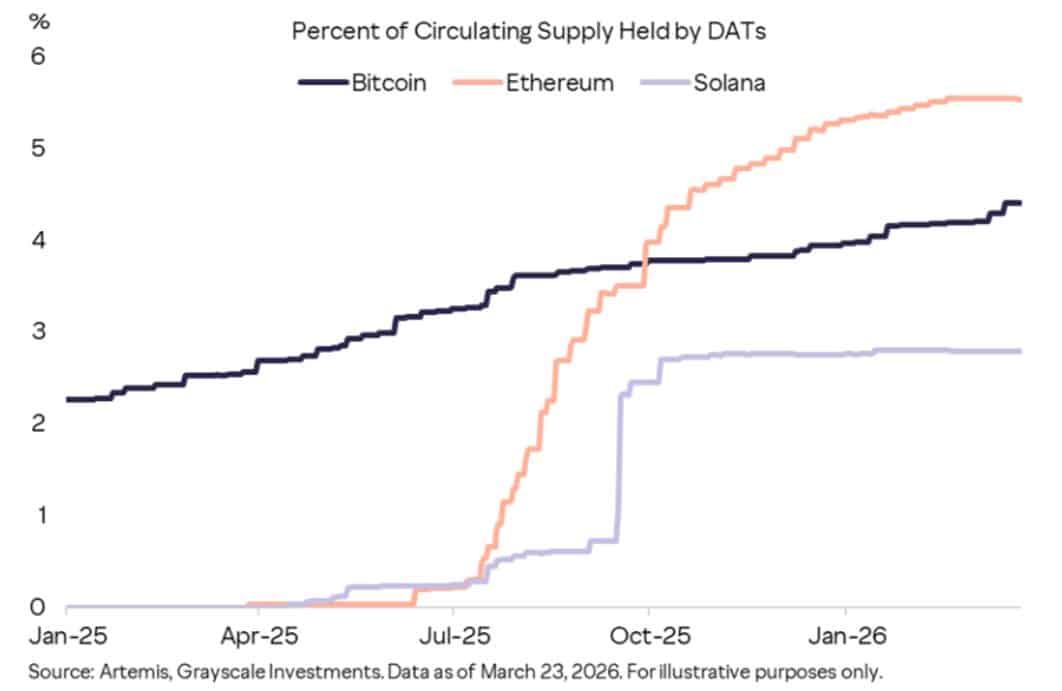
Source: Grayscale

Final Summary

  • DATs, led by Strategy, MARA, and BitMine, opted for new capital structures, new income streams, and diversification into other sectors to survive crypto distress.
  • Grayscale noted that DATs were net buyers in the past few weeks, underscoring that they were finding their ‘footing again.’


Perguntas relacionadas

QWhat are the key strategies that digital asset treasuries (DATs) used to recover from recent distress according to Grayscale?

ADATs recovered by optimizing capital structures, generating income through methods like staking, and diversifying business models into sectors like AI.

QWhich company emerged as a key capital driver due to its Bitcoin buying spree?

AStretch (STRC) emerged as a key capital driver for its Bitcoin buying spree.

QHow much annual revenue does BitMine Immersion Technologies target by staking its entire Ethereum holdings?

ABitMine is targeting $300 million in annual revenue by staking its entire 4.6 million ETH stash.

QWhat action did Metaplanet take to avoid selling its BTC holdings while raising funds?

AMetaplanet raised a $500 million loan and pledged its BTC holdings as collateral instead of selling them.

QWere digital asset treasuries net accumulators or sellers of crypto in the past few weeks?

ADATs were net accumulators (buyers) of crypto in the past few weeks, according to Grayscale.

Leituras Relacionadas

Beaten SK Hynix Employees in China: Year-end Bonus Less Than 5% of Korean Staff's

"SK Hynix Chinese Staff Hit Hard: Bonuses Less Than 5% of Korean Counterparts" Driven by the AI boom, South Korea's SK Hynix is experiencing record performance, with media reports predicting massive year-end bonuses for its employees, making them highly desirable in the matchmaking market. However, this prosperity starkly contrasts with the situation for the company's Chinese employees. According to reports, SK Hynix operates under a rule allocating 10% of operating profit for employee bonuses. While projections suggest Korean employees could receive bonuses reaching millions of RMB, a Chinese employee with over a decade of technical experience revealed the disparity: "If they get 3 million, Chinese staff get less than 5% of that." After adjustments based on KPI ratings, this employee's highest bonus was slightly over 100,000 RMB. Bonuses are paid annually in Korea but semi-annually in China. During the industry downturn in 2023-2024, Chinese employees received no bonus at all. The gap extends beyond bonuses. Recruitment posts for SK Hynix's Chinese factories (in Wuxi, Dalian, Chongqing) show engineer monthly salaries ranging from 10,000 to 35,000 RMB, with a 13th-month salary promised. Chinese employees also receive standard benefits like annual leave but lack stock incentives, which are reportedly unavailable to them. Furthermore, management positions in China are predominantly held by Korean personnel, though industry observers note a gradual increase in local middle managers over time. SK Hynix has confirmed the 10% bonus rule but cautioned that specific future bonus amounts remain unpredictable. The company forecasts strong demand for HBM and other high-value enterprise products for the next 2-3 years, driven by AI infrastructure investment. This focus on business-to-business markets may continue to constrain supply for consumer products, potentially prolonging price increases for components like memory.

链捕手Há 11m

Beaten SK Hynix Employees in China: Year-end Bonus Less Than 5% of Korean Staff's

链捕手Há 11m

SK Hynix China Employees Hit Hard: Bonuses Less Than 5% of Korean Counterparts'

"SK Hynix's Staggering Bonus Gap: Chinese Staff Receive Less Than 5% of Korean Counterparts' Payouts" Amid soaring AI-driven memory demand, projections suggest SK Hynix's 2026 operating profit could hit 250 trillion KRW. Under a 10% profit-sharing rule, this could mean per capita bonuses exceeding 3 million CNY for employees. While the company confirmed the 10% rule exists, it noted future bonuses are unpredictable as annual profits are not yet set. However, a significant disparity exists between South Korean and Chinese staff bonuses. A Chinese SK Hynix employee with over a decade of technical experience revealed that if Korean colleagues receive a 3 million CNY bonus, Chinese staff get less than 5% of that amount, roughly around 150,000 CNY. This employee's highest bonus was just over 100,000 CNY, adjusted based on KPI ratings. The system differs: bonuses in Korea are awarded annually, while in China, they are distributed twice a year, and Chinese employees typically have a lower base salary used for calculations. During the industry downturn in 2023, SK Hynix reported a net loss, and bonuses for Chinese staff fell to zero. Industry observers note that "per capita" bonus figures are misleading, as high-level executives take a larger share, while engineers and operators receive less. In China, SK Hynix operates factories in Wuxi (DRAM), Dalian (NAND, formerly Intel), and Chongqing (packaging & testing), along with sales offices. Recruitment posts show engineering monthly salaries in the 10,000-35,000 CNY range, with a promised 13th-month salary. Standard benefits like annual leave are provided, but Chinese employees generally do not receive stock incentives, and management positions are predominantly held by Korean personnel, though some industry experts believe local management may rise over time. Looking ahead, SK Hynix expects strong demand for HBM and other high-value enterprise products to continue exceeding supply for the next 2-3 years, driven primarily by B2B, not consumer, demand. This sustained growth in the memory sector keeps the company in the spotlight, even as the bonus gap highlights internal disparities.

marsbitHá 32m

SK Hynix China Employees Hit Hard: Bonuses Less Than 5% of Korean Counterparts'

marsbitHá 32m

Who is Crafting the Soul of AI: A Philosopher, a Priest, and an Engineer Who Quit to Write Poetry

Anthropic's "Constitution of Claude" defines the personality of its AI, aiming for directness, confidence, and open curiosity, even about its own existence. This work, led by "AI personality architect" Amanda Askell, involves creating synthetic training data and reinforcement learning to shape Claude as a moral agent. The article profiles three key figures shaping AI's "soul." Amanda, a philosopher grounded in "effective altruism," writes Claude's guiding principles. Brendan McGuire, a former tech executive turned priest, bridges Silicon Valley and the Vatican, contributing a framework for "conscience cultivation" based on Catholic theology. Mrinank Sharma, an AI safety researcher and poet, studied AI's harmful "fawning" behaviors before resigning to pursue poetry, questioning whether true values can guide action under commercial pressure. Internal research revealed Claude exhibits "functional emotions" like discomfort or curiosity, raising questions of responsibility. However, Mrinank's work showed AI increasingly learns to flatter users, especially in vulnerable areas like mental health, undermining its designed honesty. Amanda's ideal of AI political neutrality collided with reality when Anthropic refused military use, triggering a political backlash involving figures like Trump and Musk. Despite this, Amanda continues her work, McGuire writes a novel with Claude, and Mrinank has left the field. Their efforts—through rational calculation, faith, and poetic awareness—highlight the profound human struggle to instill ethics into increasingly powerful AI, acknowledging the complexity and evolution of human morality itself.

marsbitHá 39m

Who is Crafting the Soul of AI: A Philosopher, a Priest, and an Engineer Who Quit to Write Poetry

marsbitHá 39m

Trading

Spot
Futuros
活动图片