Crypto Payments Just Changed In South Korea — Will This Avalanche Bet Rewrite The Rules?

bitcoinistPublicado em 2026-04-14Última atualização em 2026-04-14

Resumo

A South Korean payment giant, NHN KCP, has partnered with Ava Labs to build a new payments-focused Layer-1 blockchain on Avalanche. This chain, developed via Ava Cloud, is designed for real-world payments with features like sub-second authorization, encrypted transaction data, and support for tokenized deposits and multi-stablecoin settlements. The collaboration aims to merge traditional payment expertise with blockchain technology to create an innovative business model. Its success depends on South Korea's upcoming crypto regulations. If implemented, it could position Avalanche (AVAX) as a major real-world payments network, potentially boosting its adoption and market appeal.

A South Korean payment firm has teamed up with Avalanche to create a crypto-like Layer‐1 blockchain tailored specifically for payments.

A Crypto-Spin For TradFi In South Korea

TradFi continues its race to not be left behind DeFi innovation. This time, however, a traditional payments giant most recent move is not aimed at just integrating with crypto, but it’s actually spinning up its own chain intended at real‐world payments.

According to The Block, NHN KCP, one of South Korea’s biggest payment processors, has signed a memorandum of understanding (MOU) with Avalanche developer Ava Labs to build its own payments‐focused Layer 1.

Avalanche is a high‐performance Layer 1 blockchain platform designed for smart contracts and custom blockchains, with near‐instant transaction finality and low fees.

The planned L1 will be built via Ava Cloud and optimized for real‐world payments: sub‐second payment authorization, on‐chain transaction data encryption, and customizable merchant payment infrastructure. NHN KCP and Ava Labs want to plug in tokenized deposits, multi‐stablecoin settlement, and cross‐border payments on top of that base layer.

Jun-seok Park, CEO of NHN KCP, said in a statement:

This agreement is highly significant as it combines NHN KCP’s industry-leading payment operational expertise with world-class blockchain technology to derive an innovative model that can be immediately applied to real-world business.

The pair intend to test whether the project is technically viable via a proof‐of‐concept, and to broaden their ties with financial and payment firms worldwide.

South Korea’s Most Recent History With Crypto

According to the Korean outlet Fntimes, NHN KCP is already positioning itself as a “first mover” in crypto payments and has been working on stablecoin infrastructure and on/off‐ramp tech with a dedicated task force. The payment firm has already filed trademarks for KRW‐ and USD‐pegged stablecoins (e.g., USDW), signaling it wants to operate across both domestic and international rails.

South Korea has been recently pushing toward clear rules for stablecoins and digital assets, with the expectation that a comprehensive crypto bill and bank‐grade rules for exchanges and payment providers will land around this year after it was postponed until after the June 3 local elections. Bitcoinist reported on it at the beginning of the month.

What This Means For AVAX Traders

Let’s keep in mind that launch timing and scale will depend heavily on how South Korea finalizes its crypto and stablecoin framework, something Ava Labs itself acknowledges.

If NHN KCP can route even a small slice of its existing volume through an Avalanche‐based mainnet, it could become one of the largest “real‐world payments” experiments on any L1. AVAX could start looking like a real‐world payments bet, which the market tends to reward with higher multiples in bull phases.

If the proof‐of‐concept leads to live merchant traffic, AVAX gains a concrete adoption case that traders can track in metrics and narratives, making it easier for funds to justify rotating from slower‐growth L1s into Avalanche.
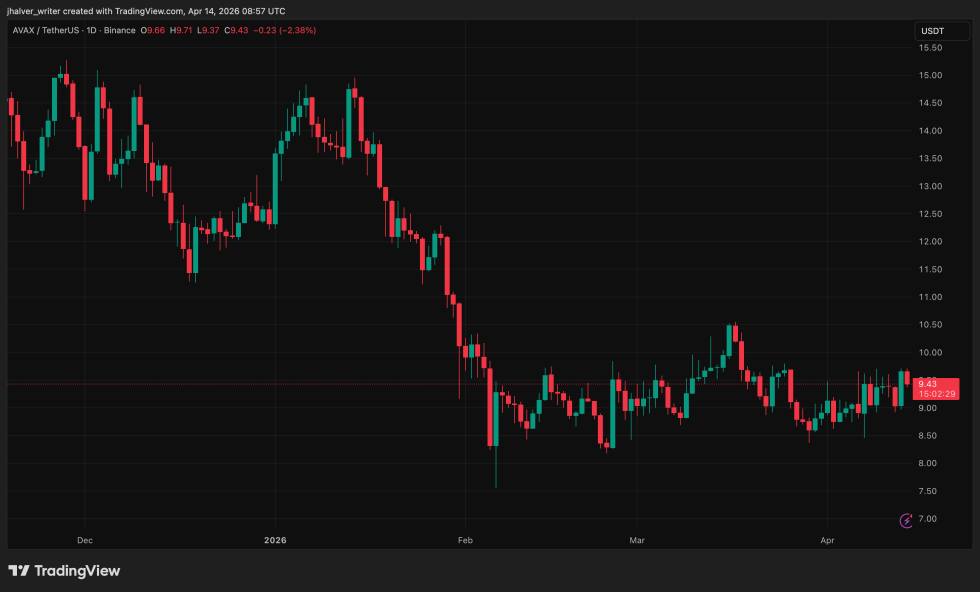
At the moment of writing, AVAX trades for $9,43 on the daily chart. Source: AVAXUSDT on Tradingview.

Cover image from Perplexity. AVAXUSDT chart from Tradingview.

Perguntas relacionadas

QWhat is the main partnership announced between a South Korean payment firm and Avalanche?

ANHN KCP, one of South Korea's biggest payment processors, has signed an MOU with Avalanche developer Ava Labs to build its own payments-focused Layer 1 blockchain.

QHow is the planned Layer 1 blockchain being built and what are its key features?

AThe planned L1 is being built via Ava Cloud and is optimized for real-world payments, featuring sub-second payment authorization, on-chain transaction data encryption, and customizable merchant payment infrastructure.

QWhat does NHN KCP's CEO say about the significance of this agreement?

AJun-seok Park stated that the agreement is highly significant as it combines NHN KCP's industry-leading payment operational expertise with world-class blockchain technology to create an innovative model for real-world business applications.

QHow is South Korea's regulatory environment influencing this project?

AThe launch timing and scale of the project depend heavily on how South Korea finalizes its crypto and stablecoin framework, with comprehensive regulations expected around this year after being postponed until after the June local elections.

QWhat potential impact could this partnership have on AVAX traders and the token's value?

AIf successful, it could make AVAX a real-world payments bet that the market tends to reward with higher multiples in bull phases, and provide a measurable adoption case that could attract investment from slower-growth L1s.

Leituras Relacionadas

Vitalik's Full Speech at the 2026 Hong Kong Web3 Carnival

In his keynote speech at the 2026 Hong Kong Web3 Carnival, Ethereum co-founder Vitalik Buterin outlined the platform’s vision as a "world computer" and detailed its technical roadmap for the next five years. Buterin emphasized Ethereum’s two core functions: serving as a public bulletin board where applications can publish verifiable data, and enabling shared computational objects like tokens, NFTs, and DAOs. He stressed the importance of Ethereum lies in its ability to provide self-sovereignty, verifiability, and permissionless participation without relying on trusted third parties. He discussed the evolution of Layer 2 solutions, arguing that meaningful L2s should complement Ethereum by integrating necessary off-chain components—such as oracles or privacy protocols—rather than simply scaling through centralization. Key short-term goals include scaling data availability and computational capacity through initiatives like increasing the gas limit and deploying zkEVM for more complex, verifiable computations. Buterin also highlighted ongoing efforts to improve quantum resistance, privacy, and efficiency through proposals like EIP-8141 for account abstraction and quantum-safe signatures. Long-term, Ethereum aims to maximize security and decentralization through formal verification, AI-assisted proof generation, and a hybrid consensus model combining Bitcoin’s longest-chain rule with BFT-style finality. The goal is a robust, easily verifiable platform that supports a wide range of applications—from finance and identity to decentralized social networks—while ensuring long-term resilience and trustlessness.

marsbitHá 52m

Vitalik's Full Speech at the 2026 Hong Kong Web3 Carnival

marsbitHá 52m

Trading

Spot
Futuros
活动图片