Crypto nears its ‘Netscape moment’ as industry approaches inflection point

cointelegraphPublicado em 2025-12-09Última atualização em 2025-12-09

Resumo

The cryptocurrency industry is approaching its "Netscape moment," driven by advancements in blockchain infrastructure and the rise of regulated investment products, according to Paradigm co-founder Matt Huang. This inflection point mirrors the early internet's mass adoption phase, where ease of use and institutional accessibility became key catalysts. Onchain systems enable open, programmable finance, while regulated products like ETFs attract traditional investors by offering familiar, compliant access. Analysts note over 200 crypto ETPs may launch soon, broadening participation. Despite concerns about speculation and memecoin dominance on some networks, experts argue that centralized platforms and ETFs expand the onchain economy rather than threaten it. The true risk lies in slowed technological progress; continued innovation in functionality and market structures is essential for long-term value creation.

The cryptocurrency industry is approaching its “Netscape moment,” as steady progress in blockchain infrastructure and the rise of regulated investment products drive a new wave of institutional adoption, according to Paradigm co-founder Matt Huang.

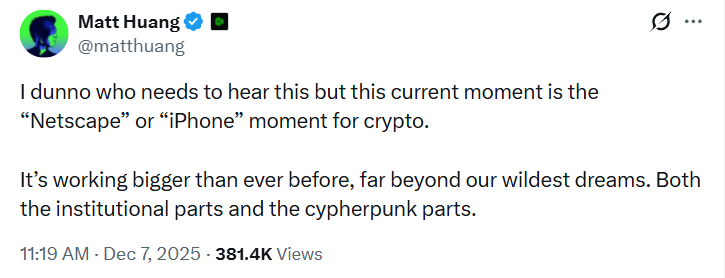
The crypto sector is “facing its ‘Netscape’ or ‘iPhone’ moment,” Huang wrote Sunday in a post on X. “It’s working bigger than ever before, far beyond our wildest dreams. Both the institutional parts and the cypherpunk parts.”

Netscape launched the first easy-to-use web browser for mainstream users in 1994 before going public with a successful initial public offering (IPO) in August 1995, marking the first building block that triggered the internet’s mass adoption.

However, Microsoft saw the large-scale interest and capitalized on it on it by freely bundling Internet Explorer as a pre-installed component of the Windows operating system, outcompeting Netscape to become the most widely used internet browser.
Source: Matt Huang

Onchain usability meets regulated access

In the crypto world, Bitcoin’s (BTC) peer-to-peer model and decentralized finance (DeFi) have enabled a new vision of an open, programmable financial system that cuts out intermediaries.

At the same time, centralized platforms and traditional investment vehicles are attracting a growing share of new capital because they are easier to use and fit within familiar regulatory frameworks.

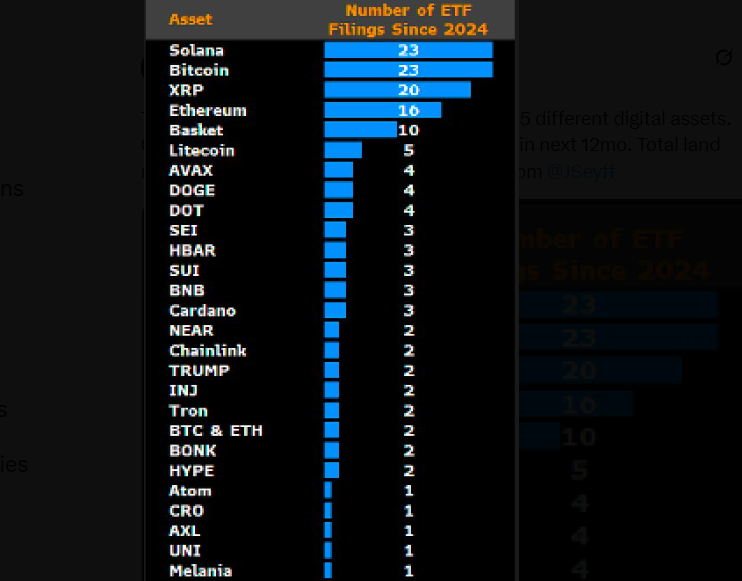
About 200 crypto-based exchange-traded products (ETPs) could launch on the market in the next year, with 155 awaiting approval as of Oct. 22, according to Bloomberg’s senior ETF analyst, Eric Balchunas.

Crypto ETPs provide easier access to altcoins for traditional investors on brokerage platforms that don’t have an account on a centralized cryptocurrency exchange.
Source: Eric Balchunas

Related: Prediction markets emerge as speculative ‘arbitrage arena’ for crypto traders

Onchain products are becoming easier to use, while “regulated” investment vehicles are making crypto more accessible, signaling that the industry may be at the tipping point ahead of mass adoption, Lacie Zhang, market analyst at Bitget Wallet, told Cointelegraph.

“ETFs and similar products legitimize digital assets but don’t replace what onchain systems uniquely offer, such as direct ownership, programmable settlement, and real-time transfers.”

She added that regulated access points tend to pull more liquidity onto underlying networks by drawing in institutional capital and new participants, rather than “displacing onchain activity.”

Related: Bitcoin now settles Visa-scale volumes, but most is for wholesale, not coffee

Despite some concerns about centralization, the rise of centralized finance (CeFi) platforms and ETFs is an “expansion of the onchain economy,” not an inherent threat, according to Marcin Kazmierczak, co-founder of RedStone, a blockchain oracle solutions provider.

“The Netscape moment isn’t about onchain versus CeFi. It’s about the broader crypto ecosystem finally attracting capital that actually stays around long-term,” he told Cointelegraph, adding that the two ecosystems are “not adversarial.”

Netscape moment or dot-com bubble repeat?

However, the crypto industry may still risk a market crash akin to the dot-com bubble, considering that the majority of revenue is derived from speculative memecoin trading for some blockchain networks.

On Solana, memecoin trading accounted for 62% of the network’s decentralized app revenue in June, and the majority of its $1.6 billion in revenue for the first half of 2025.

To reach its true potential, the developers need to focus on advancing the industry’s real-world utility, as the only “real risk” to the industry is a “slowdown in technological development,” according to Edwin Mata, lawyer, co-founder and CEO of tokenization platform Brickken.

“What matters is that onchain environments continue creating functionality, automation, and new market structures, because that is where fundamental value is produced,” he told Cointelegraph.

Magazine: Solana vs Ethereum ETFs, Facebook’s influence on Bitwise — Hunter Horsley

Leituras Relacionadas

Anthropic Starts Poaching Scientists? $27K Weekly Onsite Stipend to Fix Claude's Expert-Level Errors

Anthropic has launched a new STEM Fellow program, offering $3,800 per week for a three-month, in-person residency in San Francisco. The role targets experts from science, technology, engineering, and mathematics (STEM) fields—machine learning experience is helpful but not required. Instead, Anthropic values scientific judgment and a willingness to learn quickly. Fellows will work with Claude models and internal tools under the guidance of an Anthropic researcher. Example projects include a materials scientist identifying errors in Claude’s reasoning or a climate scientist integrating atmospheric modeling software with Claude. The goal is to have experts "tell Claude where it's wrong" and improve its scientific capabilities. This initiative is part of Anthropic’s broader strategy to strengthen its scientific ecosystem, following earlier programs like the AI Safety Fellows and AI for Science programs. The company acknowledges that current AI models, while powerful, still produce high-confidence errors and lack end-to-end research autonomy. The program aims to embed domain expertise directly into model development, turning scientists into "high-level reviewers" for AI. Anthropic CEO Dario Amodei has previously emphasized AI’s potential to accelerate scientific breakthroughs, particularly in biology and healthcare. The company believes that the next phase of AI competition will depend not on scaling parameters, but on integrating human expertise to refine model accuracy and reliability.

marsbitHá 10m

Anthropic Starts Poaching Scientists? $27K Weekly Onsite Stipend to Fix Claude's Expert-Level Errors

marsbitHá 10m

On the Eve of X Money's Launch, Musk Dismantles the Referee First

"X Money Launches After Dismantling Regulator: Musk's 9-Day Power Play" In February 2025, a team from the "Department of Government Efficiency" (DOGE), led by Elon Musk, entered the Consumer Financial Protection Bureau (CFPB) headquarters. Shortly after, the CFPB was effectively dismantled—its funding frozen, activities suspended, and nearly 90% of staff laid off. This move came just nine days after X announced a partnership with Visa and as X Money prepared to launch. The article contrasts this with the decade-long regulatory battles faced by companies like Coinbase and PayPal. Coinbase spent over $75 million in political contributions and endured a major SEC lawsuit to operate legally. PayPal complied with strict state and federal rules for its stablecoin PYUSD, including 100% reserve requirements and monthly audits. However, Musk’s approach was different. After the CFPB introduced a rule placing large digital payment apps under federal oversight, Musk tweeted "Delete CFPB." Within months, the rule was revoked by Congress. Meanwhile, DOGE operatives gained "god-tier" access to CFPB databases, potentially obtaining sensitive competitive information from rivals like Apple, Google, and PayPal. The article also highlights a "suspicious exemption clause" in the GENIUS Act, which allows private companies like X to issue stablecoins with fewer restrictions. Senator Elizabeth Warren questioned whether Musk, who was a senior presidential advisor during the Act’s drafting, influenced this clause. X Money offers a 6% APY on deposits, despite FDIC warnings that stablecoin users are not insured. As X Money launches to 600 million monthly users, the article questions the fairness of a system where Musk can bypass regulations that others spent years and millions to comply with. The dismantling of the CFPB and the alleged regulatory advantages raise concerns about the future of equitable rule-making in the U.S. financial system.

marsbitHá 19m

On the Eve of X Money's Launch, Musk Dismantles the Referee First

marsbitHá 19m

Trading

Spot
Futuros
活动图片