Crypto market’s weekly winners and losers – TAO, CC, DOT, WLD

ambcryptoPublicado em 2026-03-29Última atualização em 2026-03-29

Resumo

The crypto market saw mixed performance over the past week, with Bitcoin declining by 3% and altcoins dropping 1.52%. Despite the overall bearish sentiment, several tokens stood out as winners. Bittensor (TAO) led with a 44.7% rally, breaking key resistance levels. Memecore surged 33%, boosting the memecoin sector, while Canton (CC) rose 13.47% in a single day. Other notable gainers included DeXe (18.5%), FET (11.8%), and Chiliz (11.9%). On the losing side, Polkadot (DOT) fell sharply, testing February support levels. Aave dropped 10.7%, continuing a six-month downtrend, and NEAR Protocol declined 9.7%. Other underperformers included ICP, ENA, MNT, and Worldcoin (WLD), which fell 12.5%. Despite Bitcoin holding above $65.6k and Ethereum above $2k, market stability remains fragile amid macroeconomic uncertainties.

Bitcoin [BTC] was down by another 3% over the past week, having fallen 3.8% the previous week. The altcoin market cap was down by 1.52%, meaning that Bitcoin has registered more losses than the altcoin market put together.

Nevertheless, many of the top 50 crypto assets by market cap were in the red due to Bitcoin’s correction and the wider market fear. A few select tokens outperformed the market by a wide margin.

Let’s take a closer look at these outperformers and their bearish counterparts.

Weekly winners

TAO at the helm of bullish altcoins once more
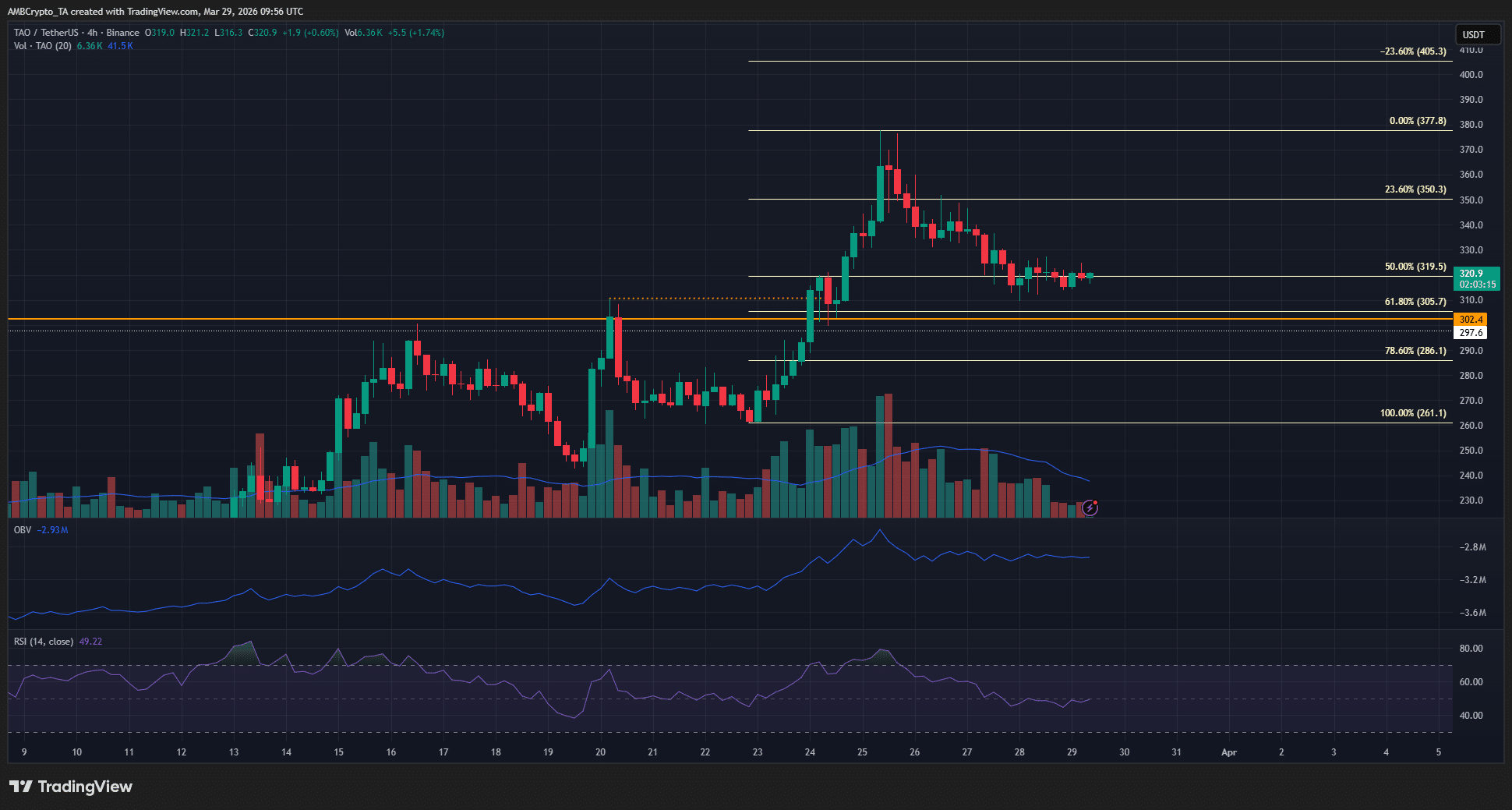
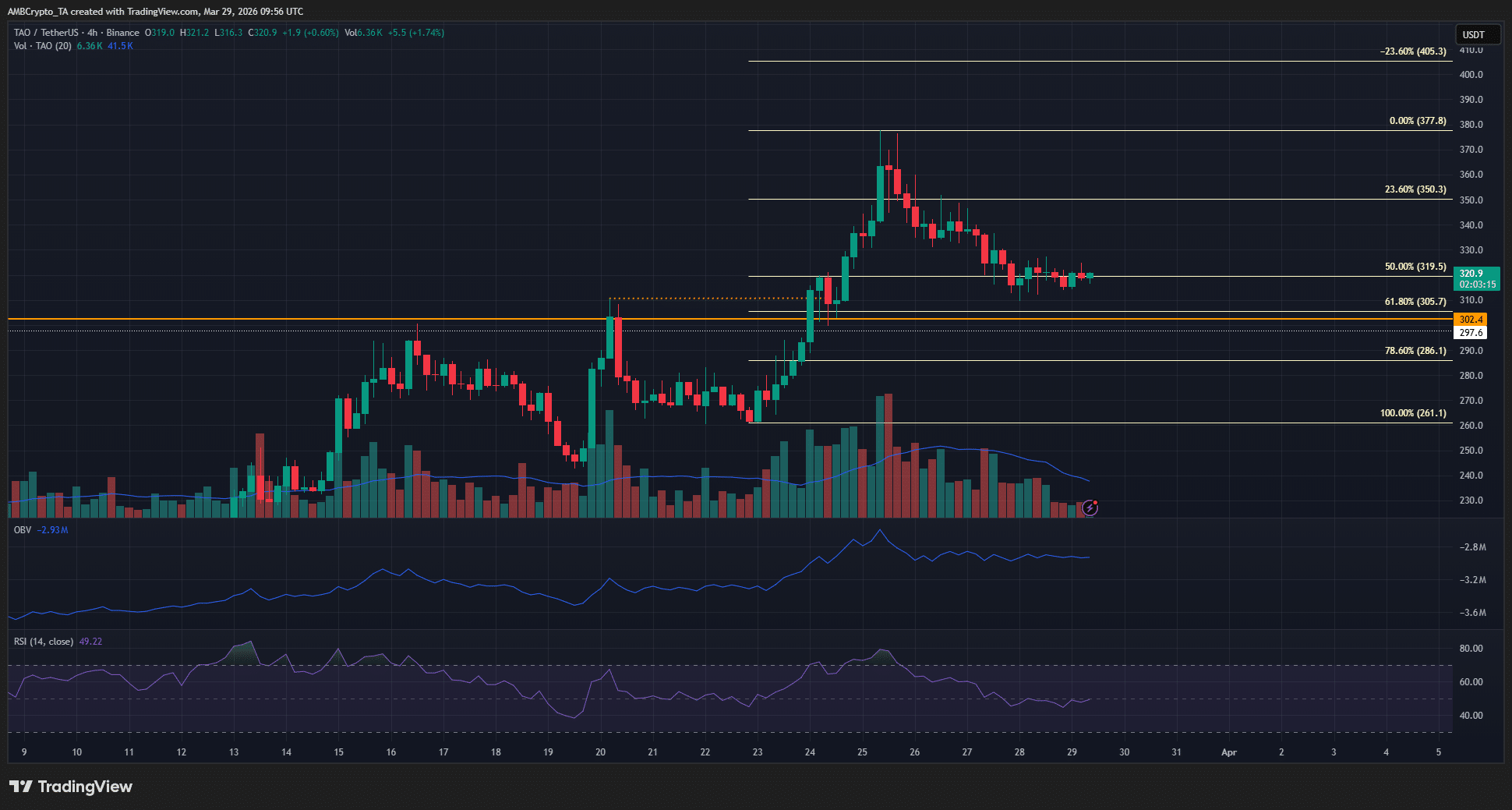
Source: TAO/USDT on TradingView

The move above $302 earlier in March broke the 1-day structure bullishly. Last week, a local high at $310.6 was breached (dotted orange), showing a bullish structure break. In other words, Bittensor experienced a bullish price structure on multiple timeframes.

The rally last week reached from $261.1 to $377.8, a whopping 44.7% move at its zenith. It has since receded to the 50% level. To the south, the $286 and $305 are key retracement zones to keep an eye on.

So long as the price is above $261, the bullish chances of TAO remain strong.

Memecore eclipses major memecoins with a 33% move

Glassnode data showed that the memecoin sector has been an outperforming one over the past week. It was up 5.8%, while Bitcoin and Ethereum [ETH] were down by 3.5% and 5%, respectively.

Memecore’s strong gains likely boosted the overall memecoin market cap. Another meme, siren [SIREN], also contributed.

Other popular memes such as Dogecoin [DOGE], Shiba Inu [SHIB], and Pepe [PEPE] have moved less than 0.5% each.

Canton rockets to local highs after being in retracement mode in March

Canton was a surprise weekly winner. It rallied 13.47% in 12 hours on Saturday, the 28th of March. The higher timeframe price structure was bullish, but CC has been retracing from $0.19 to $0.14 since the first week of February.

Towards the end of February, it saw a rally that challenged the local high at $0.175, measuring almost 9% in a day, before the retracement continued. A similar scenario can play out once again.

Other notable winners

DeXe [DEXE] and Artificial Superintelligence Alliance [FET] were up 18.5% and 11.8% for the week. Chiliz rallied by 11.9% over speculation of increased fan token activity for the upcoming FIFA World Cup 2026.

Midnight [NIGHT] rallied almost 9% but continued to labor within a downtrend, having faced rejection at $0.065 at the start of March. Ondo [ONDO] also rallied by 8.4% as RWA inflows bolstered its narrative.

Weekly losers

Polkadot sinks back to February support
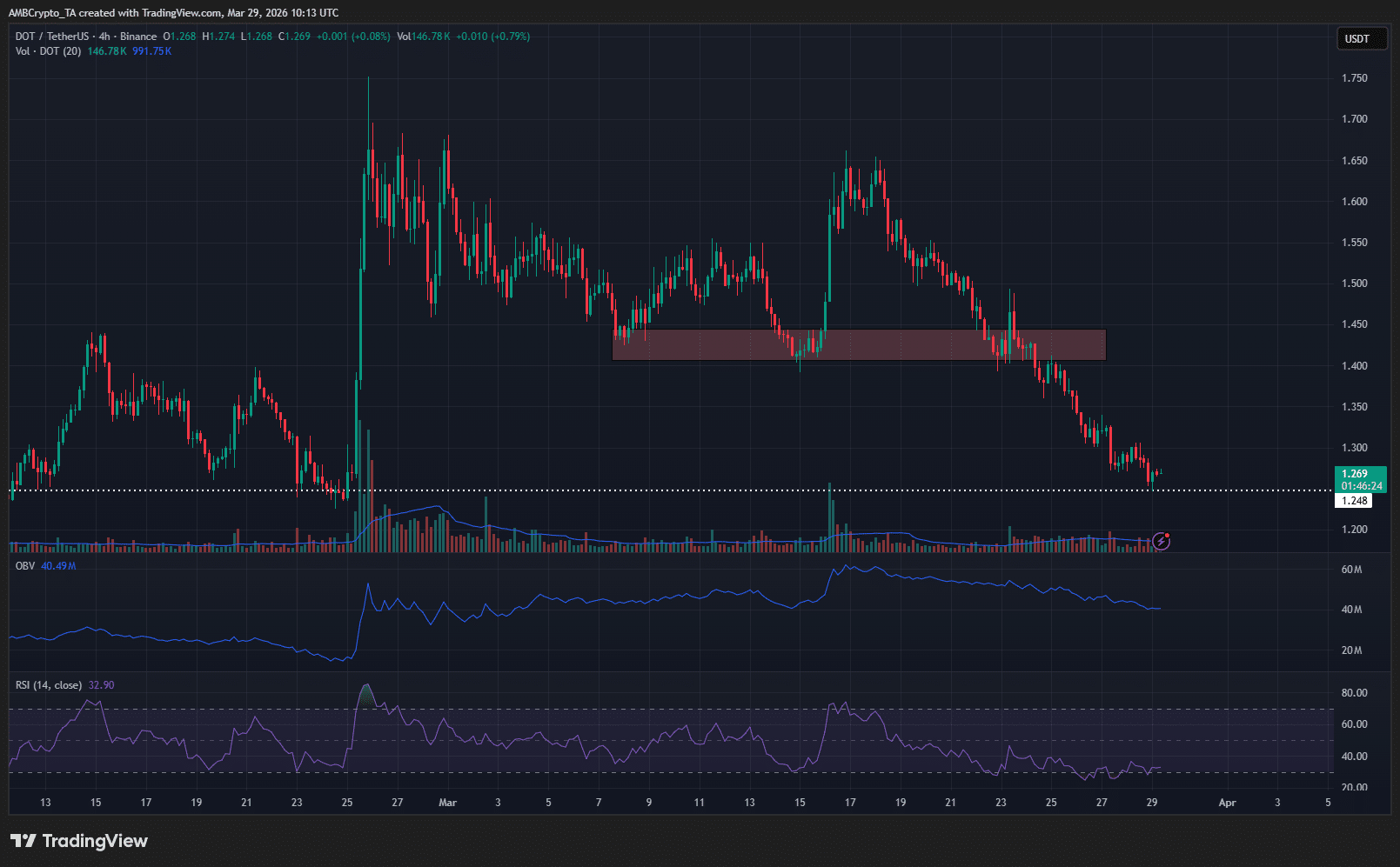
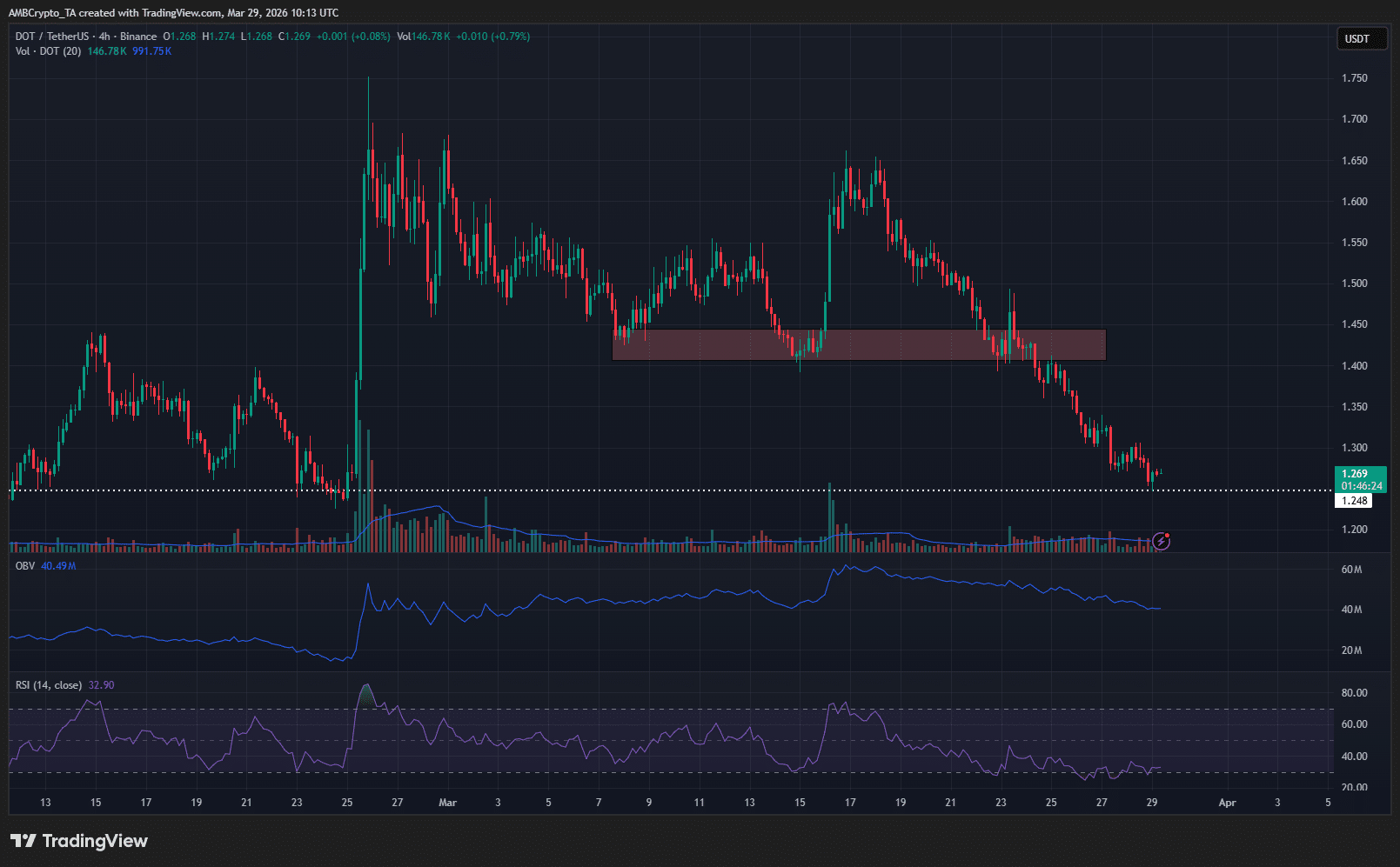
Source: DOT/USDT on TradingView

DOT has been in down-only mode on the price charts over the past week. The mid-March support at $1.40-$1.45 was tested on Monday, the 23rd of February. It held for a brief time but was broken by the selling pressure a day later.

At the time of writing, the $1.25 support from early February was under siege. The RSI was forming a bullish divergence with the price in recent days, which could yield a price bounce soon.

Aave racks up considerable weekly losses

Popular DeFi protocol Aave continued its six-month downtrend and notched up 10.7% loss for the week. The $100-$105 support zone from February was finally breached.

Rising exchange reserves reinforced selling pressure. As things stand, more losses remain likely for the altcoin.

NEAR Protocol prices test $1.3 as resistance before sliding lower

The relative strength of the AI sector has faded away, with only a few tokens showing remarkable strength. NEAR was not one of them, having shed 9.7% over the past week.

The $1.3 and $1.2 levels had been interim supports established earlier in the month but had fallen below them both and were at $1.16 at the time of writing.

Other notable losers

The erratic crypto AI sector token performance was highlighted by Internet Computer [ICP] falling 7.1% for the week. The sector has tokens in both categories, showing that select, strong altcoins and evolving narratives are what traders should look out for.

Ethena [ENA] and Mantle [MNT] shed 6.5% and 7.2%, respectively. Worldcoin [WLD] was another standout weak performer, with a weekly drop of 12.5%.

Bitcoin is at a decision point, but volatility could still hit hard

It was encouraging that Bitcoin was able to defend the $65.6k local lows, and Ethereum continued to remain above $2,000. This stability could be fragile. Oil-driven inflation and escalations in the Middle East could put further stress on the crypto market.


Final Summary

  • DeXe and FET continued their stellar performance, with Bittensor being a leading bull in the altcoin sector.
  • Memecore and SIREN performances gave a positive spin to an otherwise stagnant memecoin market.

Criptomoedas em alta

Perguntas relacionadas

QWhich cryptocurrency was highlighted as the top weekly performer and what was its key support level?

ATAO (Bittensor) was the top weekly performer, with a key support level at $261.

QWhat was the overall trend for Bitcoin and the altcoin market cap over the past week?

ABitcoin was down by 3%, while the altcoin market cap decreased by 1.52%.

QWhich memecoin significantly outperformed major memecoins like Dogecoin and Shiba Inu?

AMemecore significantly outperformed with a 33% move, while Dogecoin, Shiba Inu, and Pepe moved less than 0.5% each.

QWhat were the primary reasons for Chiliz's (CHZ) price rally?

AChiliz rallied due to speculation of increased fan token activity for the upcoming FIFA World Cup 2026.

QWhich two major support levels did Polkadot (DOT) lose during its decline?

APolkadot lost the mid-March support at $1.40-$1.45 and was testing the $1.25 support from early February.

Leituras Relacionadas

Two Legends Lost in Three Days: Is Google's AI Talent Dam Cracking?

In three days, Google lost two AI legends. On June 18, Noam Shazeer, co-author of the seminal "Attention is All You Need" paper and Gemini co-lead, left for OpenAI. Just 48 hours later, John Jumper, 2024 Nobel laureate and AlphaFold lead, departed DeepMind for Anthropic. This follows Andrej Karpathy joining Anthropic in May. These moves highlight a structural trend: top AI talent is concentrating at mission-driven, pre-IPO firms like OpenAI and Anthropic, while Google becomes a primary source. The exodus stems from a core mission mismatch. Google's ad-centric model often subordinates AI research to product and revenue goals, creating friction for pioneers like Shazeer, who returned in 2024 only to leave again. In contrast, OpenAI and Anthropic offer singular focus on pushing AI boundaries, whether towards AGI or safety-aligned models, which deeply appeals to top researchers like Jumper. Financial incentives amplify the pull. With both OpenAI and Anthropic nearing IPO, employees stand to gain immensely from equity, an upside Google's mature stock cannot match. Furthermore, the 2023 merger of Google Brain and DeepMind, intended to consolidate strength, has instead created cultural tension and slowed the path from research to product, as evidenced by Gemini's pace. This talent redistribution is reshaping the AI landscape. While Google retains vast data and compute resources, its true crisis is the quiet, continuous loss of the people who define the field's future. The real moat in AI is not infrastructure, but the concentration of brilliant minds—a battle Google is currently losing.

marsbitHá 25m

Two Legends Lost in Three Days: Is Google's AI Talent Dam Cracking?

marsbitHá 25m

Behind the AI Report Card, Lies a Chinese 'Exam Setter'

Beyond the familiar performance charts like MMLU-Pro and MMMU, which major AI models strive to ace, stands a key "examiner": Chinese-Canadian researcher Wenhu Chen. An assistant professor at the University of Waterloo and founder of TIGERLab, Chen addresses the crucial need for more rigorous AI evaluation. As models like GPT-4 began scoring near-perfect results on older benchmarks like MMLU, it became difficult to distinguish their true capabilities. In response, Chen introduced MMLU-Pro in 2024, featuring harder, more reasoning-focused questions with more answer choices, successfully reintroducing meaningful performance gaps. His work extends to multi-modal evaluation with MMMU and its enhanced version, MMMU-Pro. These benchmarks test a model's ability to understand and reason with complex information from images, charts, and text across diverse academic subjects, exposing the significant challenges even top models face in genuine comprehension. Chen's background in complex QA, table reasoning, and his experience at Google DeepMind on projects like Gemini inform his approach. He understands that effective benchmarks must anticipate how models might "cheat" by memorizing data or avoiding visual analysis. His lab also actively researches video understanding and generation models (e.g., UniVideo, Vamba), ensuring his evaluation work is grounded in practical model-building challenges. Now at Meta's Super Intelligence Lab, Chen continues his focus on multi-modal data and evaluation, representing the deep yet often unseen contributions of Chinese talent in shaping the fundamental tools of the AI industry.

marsbitHá 36m

Behind the AI Report Card, Lies a Chinese 'Exam Setter'

marsbitHá 36m

Alliance Co-founder's Letter to Entrepreneurs: Written at the Moment Cursor Sold for $600 Billion

Alliance Co-founder's Letter to Entrepreneurs: On Cursor's $60 Billion Sale Many aspiring founders see massive exits like Cursor's $60B sale and wonder why they can't achieve the same, often concluding opportunities are exhausted. But great companies aren't built in obvious, crowded spaces. Cursor, like Stripe, Figma, and Shopify before it, started with a non-consensus belief about the future. Before ChatGPT, they believed AI would transform knowledge work. They focused on a genuinely exciting domain, became their own customer, and obsessed over power users. Their journey involved years of "glass-chewing" effort before the market was ready. The pattern is consistent: identify a long-term technological shift, find a missed entry point, and execute for years before the trend becomes obvious. First-generation products (PayPal, Adobe, Amazon) prove a market exists. Second-generation winners (Stripe, Figma, Shopify) rebuild that market around new insights, technology, or changing customer behaviors. Founders must identify their phase in the cycle. Early entrants like Coinbase or Cursor focus on making new technology usable for power users. Later entrants find the "yin" to the established "yang"—the blind spots incumbents miss as they grow distant from individual users. The key is deep market immersion. Use every product in your space. Talk to users. Build an audience. Stop looking for ideas and start *seeing* them everywhere. Then, choose one. The idea must offer a 10x improvement or solve a "hair-on-fire" pain point—something severe enough that users are already crafting workarounds. When building, avoid feature bloat. Ask: why would someone switch? Great startups rarely force new behaviors; they improve familiar workflows with drastically lower friction (e.g., Cursor forked VS Code instead of creating a new editor). Distribution is the underestimated moat. Before product-market fit, achieve distribution-market fit. How do customers discover new tools? Founders like those at Airbnb, Stripe, and Cursor did unscalable, manual work to recruit early users. The final, unteachable ingredient is resilience. Cursor built for years pre-market, faced rejection, and persisted. So did Airbnb, Nvidia, and Rain (which launched post-FTX collapse). The lesson isn't that these founders were smarter, but that they stayed in the game long enough for their insights to compound. Framework: Spot technological cycles. Cultivate unique insight. Obsess over your market. Talk to customers. Find a hair-on-fire problem. Build the simplest wedge. Win your distribution channel. Above all, don't quit when it gets hard. Most people won't do these things consistently. The few who do build the next generation of great companies. Go build.

marsbitHá 40m

Alliance Co-founder's Letter to Entrepreneurs: Written at the Moment Cursor Sold for $600 Billion

marsbitHá 40m

Weekly Editor's Picks (0613-0619)

Weekly Editor's Picks (0613-0619): Market Insights & Analysis This weekly digest curates in-depth analysis often lost in the information flow, focusing on key insights across macro trends, investment, and technology. **Macro & Geopolitics:** With the Strait of Hormuz reopening and military conflict shifting to negotiation, markets are pivoting from "war shock" to "supply restoration." Trades include shorting crude risk premiums, longing airlines/tourism, Asian energy importers, and bond duration, while shorting inflation expectations. LNG, fertilizer, and chemical chains are also being repriced. **Investment & VC:** Ray Dalio advises against betting on concentrated AI giants dominating indices, advocating for diversified portfolios of high-quality, low-correlation assets instead. Analysis covers the 4-year crypto cycle, predicting the core surviving product by 2029 will be asset trading markets. Current BTC metrics suggest a potential bottoming zone, presenting a patient accumulation window. SpaceX's high-profile IPO at a $2.1T valuation faces scrutiny over fundamentals, with key watchpoints being its likely inclusion in the Nasdaq index and Q2 earnings. Concerns are raised about potential "gamma squeeze" and systemic risks if its narrative-driven valuation gets amplified by passive index funds. Robinhood (HOOD) is noted for breaking its high correlation with crypto, bolstered by its stock trading and new underwriting business. **Web3 & AI:** A warning highlights ~$1.8T in off-balance-sheet AI infrastructure commitments (purchase commitments, leases) as a potential systemic risk if AI monetization lags. AI models are being used for World Cup predictions, adding a new layer for betting markets. A cost breakdown of a $20 AI subscription reveals the supply chain from model companies to cloud, GPUs, and power. **Prediction Markets:** The emergence of prediction market "concept stocks" is noted, with Robinhood developing its own platform, Rothera, signaling a shift from market competition to a "channel war" for user access. **CeFi & DeFi:** The SpaceX IPO tested perpetual contract mechanisms for pre-IPO assets, highlighting challenges in handling corporate actions like stock splits on-chain. The de-pegging of STRC (Strategy's preferred share) to ~$89 reflects market concerns over MicroStrategy's capital structure and BTC-backed leverage model. BlackRock's covered-call Bitcoin ETF (BITA) offers yield but caps upside, appealing to yield-seeking institutions. **Ethereum:** An opinion piece argues Ethereum's core strength is its vast developer community and composability, solidifying its role as the default operating system for the financial internet. **Weekly Hot Topics:** Include the US-Iran deal reopening the Strait of Hormuz, Fed's hawkish hold, Anthropic restricting model access, SpaceX acquiring Cursor, and a humorous stock surge for "Liuliumei" due to its "LLM" ticker.

marsbitHá 45m

Weekly Editor's Picks (0613-0619)

marsbitHá 45m

Alliance's Co-Founder's Letter to Entrepreneurs: Written on the Occasion of Cursor's $60 Billion Sale

In this letter to entrepreneurs, Alliance reflects on the success of Cursor's $60 billion sale to Elon Musk, using it as a case study to counter the misconception that opportunities in crowded fields like AI or crypto are exhausted. The piece argues that great companies like Cursor, Stripe, Figma, and Shopify are not built by geniuses with perfect ideas, but by founders who start with a non-consensus belief about the future and build for years before that future becomes obvious to everyone. They identify long-term shifts, find overlooked entry points, and execute relentlessly. The framework for success involves: 1. **Identifying your place in the technology cycle**: Early-stage opportunities focus on making new tech usable for power users (e.g., Coinbase, Cursor). Later-stage opportunities involve finding the "yin" to an existing "yang"—the blind spots of first-generation players (e.g., Stripe vs. PayPal, Figma vs. Adobe). 2. **Cultivating unique insights**: Immerse yourself deeply in the market. Use every product, talk to users, and build an audience. Insights will emerge naturally from deep engagement. 3. **Finding a "hair-on-fire" problem**: Look for a 10x improvement or a severe, urgent pain point. The strongest signal is people already building clumsy workarounds. 4. **Building a focused MVP**: Don't just add features because you can. Ask why users would abandon their current tool for yours. The best startups rarely force new behaviors; they improve familiar workflows with drastically lower friction. 5. **Winning a distribution channel**: Distribution is often the moat. Before product-market fit, achieve channel-market fit. Find where your customers are and build an engine to reach them, even through unscalable, manual efforts initially. 6. **Persistence**: The final, unteachable ingredient is resilience. Success stories like Cursor, Airbnb, and Nvidia involved years of grinding, rejection, and perseverance when the path forward seemed unclear. The conclusion is that there is no secret. Most people fail to consistently execute these steps over the long term. The few who do build the companies that define the next era. The world is yours to create.

链捕手Há 50m

Alliance's Co-Founder's Letter to Entrepreneurs: Written on the Occasion of Cursor's $60 Billion Sale

链捕手Há 50m

Trading

Spot
Futuros

Artigos em Destaque

Como comprar WLD

Bem-vindo à HTX.com!Tornámos a compra de Worldcoin (WLD) simples e conveniente.Segue o nosso guia passo a passo para iniciar a tua jornada no mundo das criptos.Passo 1: cria a tua conta HTXUtiliza o teu e-mail ou número de telefone para te inscreveres numa conta gratuita na HTX.Desfruta de um processo de inscrição sem complicações e desbloqueia todas as funcionalidades.Obter a minha contaPasso 2: vai para Comprar Cripto e escolhe o teu método de pagamentoCartão de crédito/débito: usa o teu visa ou mastercard para comprar Worldcoin (WLD) instantaneamente.Saldo: usa os fundos da tua conta HTX para transacionar sem problemas.Terceiros: adicionamos métodos de pagamento populares, como Google Pay e Apple Pay, para aumentar a conveniência.P2P: transaciona diretamente com outros utilizadores na HTX.Mercado de balcão (OTC): oferecemos serviços personalizados e taxas de câmbio competitivas para os traders.Passo 3: armazena teu Worldcoin (WLD)Depois de comprar o teu Worldcoin (WLD), armazena-o na tua conta HTX.Alternativamente, podes enviá-lo para outro lugar através de transferência blockchain ou usá-lo para transacionar outras criptomoedas.Passo 4: transaciona Worldcoin (WLD)Transaciona facilmente Worldcoin (WLD) no mercado à vista da HTX.Acede simplesmente à tua conta, seleciona o teu par de trading, executa as tuas transações e monitoriza em tempo real.Oferecemos uma experiência de fácil utilização tanto para principiantes como para traders experientes.

212 Visualizações TotaisPublicado em {updateTime}Atualizado em 2026.06.02

Como comprar WLD

Discussões

Bem-vindo à Comunidade HTX. Aqui, pode manter-se informado sobre os mais recentes desenvolvimentos da plataforma e obter acesso a análises profissionais de mercado. As opiniões dos utilizadores sobre o preço de WLD (WLD) são apresentadas abaixo.

活动图片