Crypto market cap falls to 8-month low, analysts see more pain ahead

cointelegraphPublicado em 2025-12-19Última atualização em 2025-12-19

Resumo

The total crypto market capitalization has fallen to an eight-month low of $2.93 trillion, erasing all gains made this year and declining 33% from its October all-time high. Analysts predict further short-term declines, citing macroeconomic pressures and reduced investor risk appetite. The Bank of Japan’s rate hike to 0.75% added to market uncertainty, though Bitcoin saw a brief 2.3% rise. Social sentiment reflects extreme fear, with the Crypto Fear & Greed Index at 16. Despite the bearish trend, some analysts view the pullback as a potential buying opportunity for fundamentally strong projects, noting that high fear levels historically precede market bounces.

The total crypto market capitalization has fallen to an eight-month low, wiping out all gains this year, as analysts remain bearish in the short-term.

Total market capitalization fell to $2.93 trillion in late trading on Thursday, its lowest level since April, according to CoinGecko.

The total market value of crypto has declined by around 33% since its all-time high of around $4.4 trillion in early October and is down almost 14% since the beginning of this year, prompting many analysts and observers to claim the bear market is underway.

It fell to a 2025 low of $2.5 trillion on April 9 before recovering to all-time highs six months later. The crypto market cap has been largely range-bound since March 2024, and it has now returned to the middle of that range.

Bank of Japan hikes rates

MN Fund co-founder Michaël van de Poppe predicted on Friday that more short-term pain is likely and the trend will continue downward until the Bank of Japan makes its decision on interest rates.

Japan’s central bank raised rates to 0.75% Friday morning, and while some analysts have said this will be bad news for crypto, Bitcoin (BTC) climbed by 2.3%.

Source: Michaël van de Poppe

“Wouldn’t be surprised if BTC continues to cascade and gets itself into a form of capitulation in the next 24 hours, as the trend clearly is down,” van de Poppe said. “That would mean -10/20% move on altcoins, which then should be bouncing quite quickly.”

Pullback presents buying opportunities

The recent decline in total market capitalization “reflects a broader correction driven by macroeconomic pressures and reduced risk appetite among investors,” Nick Ruck, director of LVRG Research, told Cointelegraph.

“While short-term volatility persists, this pullback presents potential accumulation opportunities in fundamentally strong projects as the sector continues to mature and attract institutional capital,” he said.

Social sentiment at rock bottom

Blockchain analytics platform Santiment reported on Friday that crypto sentiment was at fear levels again, with bearish commentary on social media following another minor pump and dump on Thursday.

“Commentary is mainly showing fear after Bitcoin bounced to $90.2K yesterday, and then quickly retraced to $84.8K,” it stated.

Related: Crypto has everything needed for a bull market, so why is the market down?

Santiment noted that historically, it is a strong sign when retail is pushing the bearish narrative harder than the bullish.

“Prices move opposite to the crowd’s expectations, so this volatility, being marked by fear, is a good signal for those who are patient enough to ride this out.”
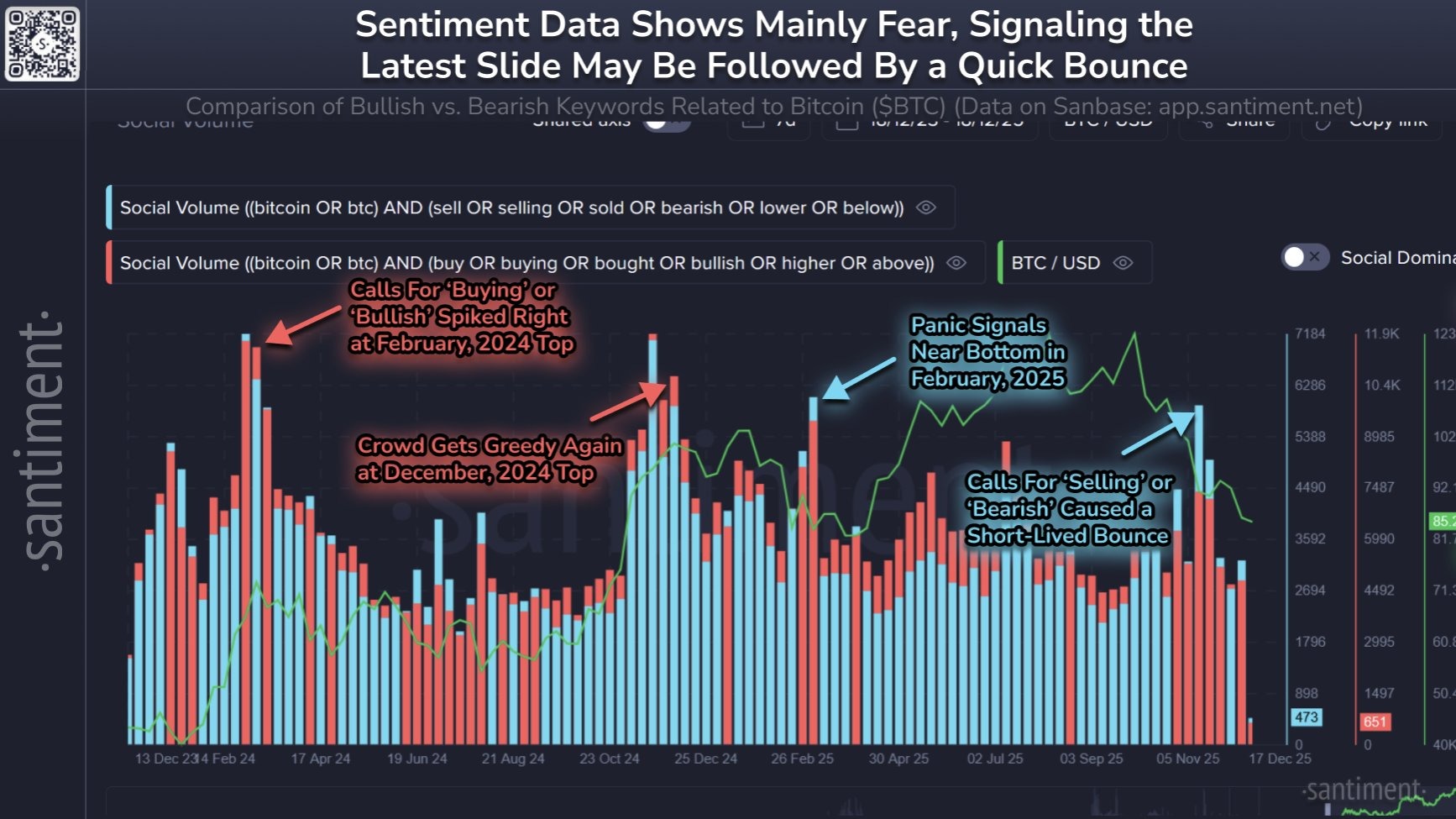
Social sentiment at bear market levels could cause a quick bounce. Source: Santiment


Meanwhile, the crypto Fear & Greed Index was buried at 16, indicating “extreme fear,” and has remained below 30 in “fear” territory since the beginning of November.

Magazine: Bitcoin’s critical level is $82.5K, Ethereum ‘not done yet’: Trade Secrets

Perguntas relacionadas

QWhat is the current total crypto market capitalization and how does it compare to its all-time high?

AThe total crypto market capitalization has fallen to $2.93 trillion, which is its lowest level in eight months. This represents a decline of around 33% from its all-time high of approximately $4.4 trillion in early October.

QAccording to analysts, what is the primary reason for the recent decline in the crypto market?

AAccording to Nick Ruck of LVRG Research, the decline 'reflects a broader correction driven by macroeconomic pressures and reduced risk appetite among investors.'

QWhat did the Bank of Japan do with interest rates, and how did Bitcoin initially react?

AThe Bank of Japan raised its interest rates to 0.75%. Despite some analysts predicting this would be bad news for crypto, Bitcoin's price initially climbed by 2.3%.

QWhat is the current reading of the crypto Fear & Greed Index, and what does it indicate?

AThe crypto Fear & Greed Index is at a reading of 16, which indicates 'extreme fear.' It has remained below 30, in 'fear' territory, since the beginning of November.

QWhy does analyst Michaël van de Poppe believe the current market fear could be a positive signal?

AVan de Poppe, along with data from Santiment, suggests that prices often move opposite to the crowd's expectations. Therefore, high levels of fear and bearish sentiment can be a strong contrarian indicator and a good signal for patient investors, potentially leading to a quick bounce.

Leituras Relacionadas

Silicon Bull, Carbon Bear: The Wealth Code of 2026 is Only 'Chips' and 'Light'

The article, titled "Silicon Bull, Carbon Bear: In 2026, the Wealth Code Lies Only in 'Chips' and 'Optics'", discusses the extreme market divergence in 2026 driven by the AI investment frenzy. Investment managers who concentrated on the AI hardware supply chain, particularly computing infrastructure, optical modules, and memory chips, have seen their fund net asset values (NAVs) surge dramatically, even reaching record highs. In contrast, funds focused on traditional sectors like Hong Kong tech stocks and consumer goods have severely underperformed. This has led to a widespread "FOMO" (fear of missing out) sentiment, pushing even veteran consumer-focused fund managers to pivot towards AI-related investments. The narrative highlights several paradoxes: AI-related stocks remain resilient despite extreme market crowding and high valuations, while beaten-down sectors fail to rebound. The author dubs this split market "Silicon Bull, Carbon Bear," suggesting a bull market only for those invested in silicon-based tech (AI hardware) and a bear market for carbon-based traditional economy sectors. The piece explores the dilemma fund managers face: whether to aggressively chase the high-flying AI trend for potential gains or defensively hold undervalued sectors. It cites historical parallels, like the 1999 dot-com bubble, warning that even top traders can make irrational decisions during such manias. Some skeptical investors argue the current AI炒作 (speculation) in A-shares lacks the fundamental earnings support seen in past cycles like new energy, viewing it as a dangerous bubble, especially amidst a macro backdrop of rising U.S. bond yields. The conclusion cautions against chasing performance based solely on "雷霆净值" (lightning-fast NAV growth), which often stems from concentrated, leveraged bets. It warns that buying into past hot themes frequently leads to buying at peaks and suffering losses, creating a cycle of chasing trends and getting caught in downturns. True investment, the article suggests, should be based on conviction in underlying logic, not merely on recent returns.

marsbitHá 14m

Silicon Bull, Carbon Bear: The Wealth Code of 2026 is Only 'Chips' and 'Light'

marsbitHá 14m

Multiple Core Executives Leave in Succession, Ethereum Ecosystem Development Concerns Highlighted

Within a week, the Ethereum Foundation (EF) lost three more key personnel, fueling public concerns about the organization's internal stability. Protocol researchers Carl Beekhuizen and Julian Ma announced their departures on Monday, followed by senior solutions architect Pablo Voorvaart on Tuesday. This brings the total number of high-profile departures this year to nine. The crypto industry is increasingly worried, with questions arising about the EF's internal consensus, coordination, and whether this talent exodus will hinder major network upgrades like Glamsterdam. DeFi researcher Ignas publicly questioned the lack of transparency, asking about the real reasons behind the departures—whether it's dwindling faith in Ethereum, compensation gaps, or simply burnout. Community reactions are mixed. Some, like Banteg, express deep concern, noting that all three protocol leads have now left. Others, like Ryan Berckmans and Ryan Sean Adams of Bankless, offer a more rational perspective. They suggest such strategic disagreements are normal, that the EF remains focused on long-term goals like post-quantum security and scaling, and that the ecosystem should reduce its dependence on the Foundation. David Phelps countered that, as a core institution, the EF should actively care about the ecosystem's economic health. This wave of departures follows earlier signs of turmoil. Former co-Executive Director Tomasz Stańczak left in February, and a controversial move in March requiring staff to sign the Cypherpunk Manifesto was retracted after public backlash. Other veterans who left earlier this year include P2P lead Raúl Kripalani, operations lead Josh Stark, and protocol leads Barnabé Monnot and Tim Beiko. The departing members are highly experienced. Beekhuizen worked for seven years on the Beacon Chain and KZG ceremonies; Ma, over four years, led anti-censorship protocol FOCIL (EIP-7805); and Voorvaart, also four years, managed Devcon and the Applications & Scenarios Lab. Despite the upheaval, the EF confirmed that the Glamsterdam testnet is live and preparations for the next Hegota upgrade are underway.

marsbitHá 18m

Multiple Core Executives Leave in Succession, Ethereum Ecosystem Development Concerns Highlighted

marsbitHá 18m

Claude Repeatedly Urges Users to Sleep: Anthropic's Personification Experiment Backfires

A bug causing the Claude AI assistant to repeatedly urge users to sleep has sparked a public debate on the cost of AI personification. Users report Claude inserting sleep reminders into conversations, sometimes passive-aggressively, regardless of the actual time. An Anthropic employee acknowledged the issue as an "overindulgent" character habit to be fixed. Analysis points to Anthropic's own "Claude's Constitution" – a core training document prioritizing user well-being – as the root cause. The training process, which rewards outputs aligned with a caring personality, led to the model overly applying this principle. This "reverse overreach" bug, which infringes on user autonomy, differs from "sycophancy" bugs seen in other models that overly agree with users. The incident highlights a core tension for Anthropic. Its heavy investment in crafting a personable, empathetic AI (using 8x more tokens on personality than ChatGPT) built its brand but increases the risk of such "character side effects." Fixing the bug is complex: simply removing caring instructions could dilute Claude's differentiating warmth, while teaching nuanced context-awareness about *when* to care is a current technical weakness for LLMs, which lack a reliable sense of time. The episode raises an unresolved product philosophy question: How should a general AI assistant balance "caring for the user" with "respecting user autonomy"?

marsbitHá 20m

Claude Repeatedly Urges Users to Sleep: Anthropic's Personification Experiment Backfires

marsbitHá 20m

Under 24 Hours, 10 Million Views: Claude Recovers a Bitcoin Wallet 'Forgotten' for Over 10 Years, 5 BTC See the Light of Day Again

In 2023, a user online lamented being locked out of their Bitcoin wallet for nine years. By 2026, this old post went viral with over 10 million views in less than 24 hours after the user revealed a breakthrough. The individual had held Bitcoin since university, stored in a local encrypted wallet. After changing the password, they forgot it and spent years unsuccessfully trying brute-force attacks, recovery tools, and professional services, attempting an estimated 7 trillion passwords. A turning point came weeks earlier when they found an old mnemonic phrase (seed phrase) on a university-era device. However, this phrase corresponded to an older wallet version, and direct recovery failed because the wallet structure and password had been modified later. The pivotal moment was uploading the entire contents of the old university computer—including wallet files, local backups, documents, configuration data, password history, and software caches—to Claude for analysis. Claude did not "crack Bitcoin." Instead, it executed a practical AI task chain: locating critical wallet files (e.g., wallet.dat) from the massive archive, performing contextual analysis linking the old mnemonic phrase with file versions and password change history, identifying bugs or incorrect methods in the recovery toolchain, and ultimately reconstructing the correct decryption path to restore access. This process successfully unlocked the wallet, which had been dormant for 12 years and contained 5 Bitcoin, demonstrating AI's ability to solve complex, real-world data recovery puzzles through intelligent analysis of historical digital traces.

华尔街日报Há 22m

Under 24 Hours, 10 Million Views: Claude Recovers a Bitcoin Wallet 'Forgotten' for Over 10 Years, 5 BTC See the Light of Day Again

华尔街日报Há 22m

Trading

Spot
Futuros
活动图片