Crypto Funding Soars 50%, But Most Startups Are Getting Shut Out: Analysts

bitcoinistPublicado em 2026-03-10Última atualização em 2026-03-10

Resumo

Cryptocurrency fundraising surged nearly 50% year-over-year through March 2026, but the number of individual deals dropped by 46%, according to Messari data. The average deal size soared 272% to $34 million, reflecting a trend of capital concentration in fewer, larger rounds. Three major deals in February alone accounted for 44% of the month’s total funding. While early-stage activity remains fragmented, late-stage and strategic mega-rounds dominate. A significant concern is the decline in new venture fund closures, with few major crypto VCs raising fresh capital beyond Dragonfly’s recent $650 million fund. This suggests that despite headline growth, the industry faces a potential future funding shortage.

Three deals last February ate up nearly half of all the money raised in crypto that month. Just three. That single fact tells you more about where crypto funding stands right now than the headline numbers do.

A Shrinking Pool Of Big Bets

According to data from research firm Messari, total crypto fundraising climbed almost 50% in the 12 months ending March 2026 compared to the year before.

But the number of individual deals fell 46% over the same period. Fewer rounds. Bigger checks. The average deal size hit $34 million — a 272% jump from a year earlier. The number of active investors dropped by about a third, down to 3,225.

Those three February standouts were Tether’s $200 million investment into online marketplace Whop, a $75 million Series B for sports prediction platform Novig led by Pantera Capital, and a $70 million Series B for ARQ, a Latin American fintech app built around stablecoins, backed by Sequoia Capital. Together, they accounted for 44% of the close to $800 million raised across the entire month.

Messari describes the pattern as capital concentration driven by late-stage and strategic mega-rounds. A handful of well-positioned companies are pulling in enormous sums while smaller players scramble for scraps.

Early-stage fundraising, reports say, remains active but scattered. Messari pointed to Interstate’s $1.5 million round, which pulled in more than 15 backers — a mix of firms like Bloccelerate VC and individual angel investors. That kind of fragmented, small-dollar activity is happening in volume. But it exists in a different world from the mega-rounds grabbing the headlines.
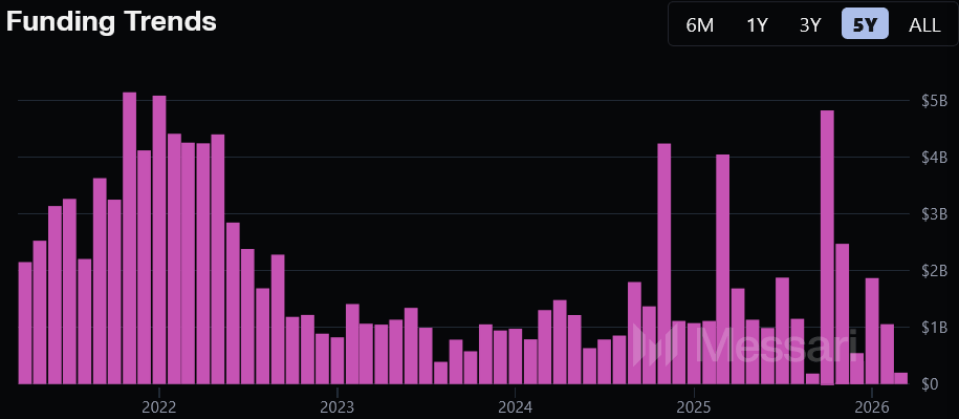
Five-year trend of monthly crypto fundraising changes. Source: Messari

The VC Drought No One Is Talking About

Here is the part the headline buries. Messari CEO Eric Turner flagged a problem that goes beyond deal counts: outside of Dragonfly Capital, no major crypto venture firm has recently closed a new fund. Dragonfly closed a $650 million fund with a focus on real-world assets, but it stands largely alone. Turner put it bluntly — the industry needs fresh capital.

BTCUSD trading at $68,749 on the 24-hour chart: TradingView

Crypto Investors Stay Active As New Funds Decline

That matters because venture funds have a shelf life. Firms raise a fund, deploy it over several years, then raise again. When new fund closes dry up, the money flowing into deals eventually does too.

The 50% year-over-year gain may look strong on paper, but it is being powered by existing pools that are not being replenished at the same rate.

Coinbase Ventures, QUBIC Labs, and Somnia ranked as the three most active crypto investors over the past three months, based on Messari data.

Featured image from KuCoin, chart from TradingView

Criptomoedas em alta

Perguntas relacionadas

QWhat was the overall trend in crypto fundraising in the 12 months ending March 2026, and what was the percentage change?

ATotal crypto fundraising climbed almost 50% in the 12 months ending March 2026 compared to the year before.

QDespite the increase in total funds raised, what happened to the number of individual deals and the average deal size?

AThe number of individual deals fell 46% over the same period, while the average deal size hit $34 million, a 272% jump from a year earlier.

QAccording to Messari, what is the pattern driving the concentration of capital in the crypto fundraising market?

AMessari describes the pattern as capital concentration driven by late-stage and strategic mega-rounds, where a handful of well-positioned companies are pulling in enormous sums.

QWhich major crypto venture firm was noted as a standout for closing a new fund recently, and how much did it raise?

ADragonfly Capital was the standout, closing a $650 million fund with a focus on real-world assets.

QWhat problem did Messari CEO Eric Turner flag that goes beyond the deal counts in the crypto fundraising space?

AHe flagged that outside of Dragonfly Capital, no major crypto venture firm has recently closed a new fund, indicating a need for fresh capital in the industry.

Leituras Relacionadas

In-depth: The Foreign Guest Genspark

The article "The Foreign Guest: Genspark" investigates the identity and business practices of AI startup Genspark, which presents itself as a Palo Alto-based "AI Costco" offering a subscription bundle of over 70 models and numerous AI agent tools. Despite its official Silicon Valley narrative, Genspark's founding team has deep roots in Chinese tech giant Baidu, a history systematically downplayed in its branding. The company actively cultivates an image as an elite US firm, heavily publicizing partnerships and endorsements from OpenAI, Anthropic, and Microsoft, while distancing itself from the Chinese AI community and obscuring its connections to Chinese investors and open-weight models (like those from DeepSeek, Moonshot AI, and MiniMax) that power its services. Genspark's core strategy involves rapidly cloning and integrating successful AI product concepts (e.g., from Perplexity, Manus, Plaud) into its unified platform, supported by aggressive marketing, including Super Bowl ads and paid native content in publications like The Wall Street Journal. Critically, the article suggests a significant portion of its engineering and product development is conducted by a team in Beijing, operating outside its official US corporate structure. This duality allows Genspark to leverage Chinese talent and models for efficiency and cost reduction while constructing a public facade as a purely American success story. The piece concludes that Genspark's most effective agent is its own corporate identity, meticulously engineered to obscure its Chinese underpinnings and be perceived solely as a Silicon Valley company.

marsbitHá 40m

In-depth: The Foreign Guest Genspark

marsbitHá 40m

Debate: Korean Workers Fear Unemployment, While Musk Envisions a Society 'Without Work'?

While South Korean auto workers fear job losses from robotics, Elon Musk envisions a future where AI and robots render most work optional. This article explores the growing tension between immediate anxieties over automation and long-term visions of a post-work society. The piece begins with recent strikes at Hyundai's Korean plants, where unions, amid standard wage negotiations, also sought job guarantees against advancing robotics—specifically mentioning Boston Dynamics' Atlas. This reflects how anxiety about technological displacement is emerging even before robots are fully capable of replacing skilled labor on assembly lines. The author argues that while current robotics still struggle with the nuanced, experiential knowledge of veteran workers, the *perception* of imminent replacement is fueling social conflict prematurely. This modern "Luddite" sentiment is compared to the 19th-century English textile workers who smashed machines. Historically, Luddites weren't simply anti-technology; they were protesting the rapid devaluation of their skills and the unequal distribution of productivity gains. Similarly, today's workers ask who will bear the cost of transition and share in the new wealth created by machines. In contrast, figures like Elon Musk propose an optimistic endpoint: with AI and robotics driving extreme abundance, the link between work and survival could break. He suggests concepts like "Universal High Income" could allow society to share the technological bounty, transforming work from a necessity into a choice. The core challenge, however, lies in the transition. The author notes that technology's benefits diffuse slowly, while its disruptive costs—job losses, skill obsolescence—can be concentrated and immediate. The risk is a painful interim period where productivity gains are captured by a few before new social contracts, safety nets, and retraining systems are established. The conclusion calls for proactive governance. Just as past industrial revolutions gave rise to labor standards and social safety nets, the robotics era needs its own frameworks. These should address job transition support, distribution of productivity gains, safety liability, and ethical deployment. Embracing such "constraints" is not opposition to progress but a necessary step to ensure technology benefits society broadly. The discussion sparked by Hyundai's workers, therefore, is not premature but essential.

marsbitHá 53m

Debate: Korean Workers Fear Unemployment, While Musk Envisions a Society 'Without Work'?

marsbitHá 53m

Trading

Spot

Artigos em Destaque

Como comprar T

Bem-vindo à HTX.com!Tornámos a compra de Threshold Network Token (T) simples e conveniente.Segue o nosso guia passo a passo para iniciar a tua jornada no mundo das criptos.Passo 1: cria a tua conta HTXUtiliza o teu e-mail ou número de telefone para te inscreveres numa conta gratuita na HTX.Desfruta de um processo de inscrição sem complicações e desbloqueia todas as funcionalidades.Obter a minha contaPasso 2: vai para Comprar Cripto e escolhe o teu método de pagamentoCartão de crédito/débito: usa o teu visa ou mastercard para comprar Threshold Network Token (T) instantaneamente.Saldo: usa os fundos da tua conta HTX para transacionar sem problemas.Terceiros: adicionamos métodos de pagamento populares, como Google Pay e Apple Pay, para aumentar a conveniência.P2P: transaciona diretamente com outros utilizadores na HTX.Mercado de balcão (OTC): oferecemos serviços personalizados e taxas de câmbio competitivas para os traders.Passo 3: armazena teu Threshold Network Token (T)Depois de comprar o teu Threshold Network Token (T), armazena-o na tua conta HTX.Alternativamente, podes enviá-lo para outro lugar através de transferência blockchain ou usá-lo para transacionar outras criptomoedas.Passo 4: transaciona Threshold Network Token (T)Transaciona facilmente Threshold Network Token (T) no mercado à vista da HTX.Acede simplesmente à tua conta, seleciona o teu par de trading, executa as tuas transações e monitoriza em tempo real.Oferecemos uma experiência de fácil utilização tanto para principiantes como para traders experientes.

544 Visualizações TotaisPublicado em {updateTime}Atualizado em 2026.06.02

Como comprar T

Discussões

Bem-vindo à Comunidade HTX. Aqui, pode manter-se informado sobre os mais recentes desenvolvimentos da plataforma e obter acesso a análises profissionais de mercado. As opiniões dos utilizadores sobre o preço de T (T) são apresentadas abaixo.

活动图片