Crypto Donations Branded ‘Dangerous’? UK Security Panel Urges Immediate Ban

bitcoinistPublicado em 2026-03-18Última atualização em 2026-03-18

Resumo

A UK National Security Panel has called for an immediate ban on political donations made with cryptocurrency, labeling them an "unnecessary and unacceptably high risk" to the integrity of the political finance system. The cross-party committee warns that crypto donations create a "gaping hole" in national security defenses, making it difficult to verify donors due to pseudonymous wallets, mixers, and foreign payment processors. The report urges stricter donor-identity checks, wealth-source verification, and a single-agency lead for enforcement to prevent foreign interference and illicit finance. Proposed rules would require donations to go through FCA-registered platforms, prohibit mixed coins, and mandate conversion to pounds within 48 hours. This is framed as a national security measure, not a blanket attack on crypto.

UK National Security Panel has deemed donations made with crypto assets as an “unnecessary and unacceptably high risk” and it is asking the government for an immediate ban.

Too High Of A Crypto-Risk

The Joint Committee on the National Security Strategy has called today for a moratorium on crypto political donations (an official temporary ban), alongside new donor‐verification rules, to tackle illicit finance and foreign interference in UK politics. The latest report of the Joint Committee warns that crypto donations to UK political parties are a high‐risk channel for illicit and foreign money. Crypto donations pose an “unnecessary and unacceptably high risk to the integrity of the political finance system”, the report reads.

The Government must immediately ban political donations made through cryptocurrency until firm rules can be developed, in order to keep UK politics safe from illicit finance, a cross-party Committee has found.

This decision follows a letter issued on February 24 by Committee Chair of the House of Commons Matt Western to Housing Secretary Steve Reed, urging the government to act before the next general election, warning that hostile states may exploit opaque crypto flows, as reported by Bitcoinist.

Inside The Warning Report

The main concerns expressed by the parliamentary include pseudonymous wallets, mixers and foreign‐based payment processors make it hard to verify who is really bankrolling UK parties, creating a “gaping hole” in national‐security defenses. In order to tackle this, the committee is asking for stricter donor‐identity checks and wealth‐source verification, plus a clear single‐agency lead over political finance enforcement to avoid the current fragmentation across multiple bodies.

Responsibility for policing risks of foreign influence in political finance is dispersed across several services, including the Electoral Commission, Metropolitan Police, Counter Terrorism Policing, MI5, the National Crime Agency and other police services. The Committee argues that accountability and governance are “inadequate”, and notes that a clearer set up with a single national lead would help address low public trust in enforcement of the rules.

What Happens Next?

Under the specific conditions proposed for any future digital assets donations after the moratorium, parties would only be allowed to accept coins that move through fully FCA‐registered platforms, closing off the offshore exchanges and bespoke portals currently used to route funds into Westminster. Any crypto that has passed through mixers or tumblers would be flat‐out prohibited and, on top of that, parties would have to convert donated tokens into pounds within roughly 48 hours, sharply limiting the time funds remain on‐chain and making it easier for regulators and watchdogs to audit who is really paying for UK politics.

The UK is trying to position itself as a “global hub” for digital assets in trading and custody, even as its national‐security apparatus moves aggressively to regulate crypto assets.

The committee frames this as a national‐security and anti‐corruption issue, not a blanket attack on crypto markets, but the political narrative still feeds into a broader crackdown theme investors cannot ignore. While spot crypto trading in the UK remains unaffected in the short term, headlines about “illicit money” and “foreign interference” can sap risk appetite, weigh on politically exposed tokens, and add another layer of regulatory overhang for any UK‐facing exchanges or payment rails.
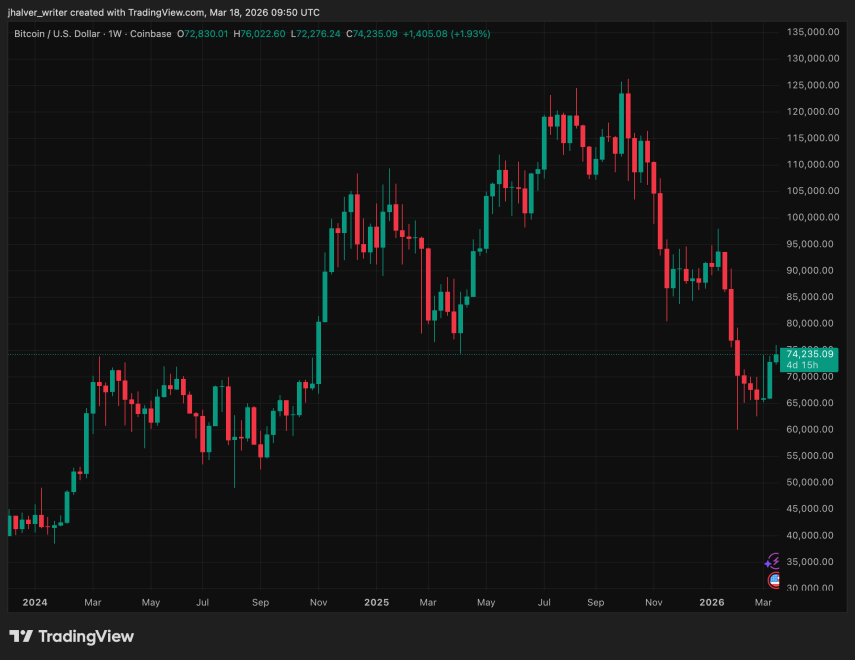
At the time of writing, BTC’s price stays on the $74k. Source: BTCUSD on Tradingview

Cover image from Perplexity, BTCUSD chart from Tradingview

Criptomoedas em alta

Perguntas relacionadas

QWhat is the main recommendation of the UK National Security Panel regarding crypto political donations?

AThe UK National Security Panel has recommended an immediate ban (moratorium) on political donations made through cryptocurrency to protect the integrity of the political finance system from illicit finance and foreign interference.

QWhat specific risks did the committee identify with crypto donations?

AThe committee identified risks including pseudonymous wallets, mixers, and foreign-based payment processors that make it difficult to verify the true source of donations, creating a 'gaping hole' in national security defenses.

QWhat conditions are proposed for allowing crypto donations after the moratorium?

AAfter the moratorium, parties would only be allowed to accept crypto that moves through fully FCA-registered platforms, must convert donated tokens to pounds within 48 hours, and any crypto that has passed through mixers or tumblers would be prohibited.

QWhich UK agencies are currently responsible for policing risks of foreign influence in political finance?

AResponsibility is dispersed across several services including the Electoral Commission, Metropolitan Police, Counter Terrorism Policing, MI5, the National Crime Agency, and other police services.

QHow does the committee frame this issue in relation to the UK's broader crypto ambitions?

AThe committee frames this as a national security and anti-corruption issue, not a blanket attack on crypto markets, even as the UK tries to position itself as a 'global hub' for digital assets in trading and custody.

Leituras Relacionadas

Misjudged A-Shares: Resilience, Expectations, and Confidence

China's A-share market recently faced selling pressure, especially in tech sectors, initially triggered by a global tech sell-off that began in South Korea. However, the article argues this is a case of "mistaken injury" and highlights the market's underlying resilience. This resilience stems from three main pillars: **1) Tech Sector Fundamentals:** Unlike Korea's market dominated by a few memory chip stocks, China's tech sector is diversified across computing, communications, electronics, and semiconductors, supported by dual narratives of global AI supply chains and domestic substitution. Core areas like optical modules and fiber optics continue to show strong earnings growth. **2) "National Team" Support:** State-backed institutions and large corporations have made significant market purchases and announced buybacks, providing liquidity and signaling confidence. This is seen as a stabilizing policy signal, often associated with market bottoms. **3) Broader Market Pillars:** Other major sectors are showing endogenous recovery momentum. Consumer stocks benefit from stabilizing CPI and signs of sector recovery (e.g., liquor price hikes). Cyclical sectors like aluminum have high earnings, potential price increases due to tight supply, and low valuations. The financial sector offers stable dividends and low valuations. The conclusion is that the sell-off was driven by external contagion, not a collapse in fundamentals. With strong policy support and recovering momentum across key sectors, the A-share market possesses the toughness to regain stability.

marsbitHá 28m

Misjudged A-Shares: Resilience, Expectations, and Confidence

marsbitHá 28m

The Clarity Act's Journey Through Congress: The Thorny Path of Bipartisan Compromise in the U.S.

The U.S. Congress is struggling to advance the crypto market structure bill known as the Clarity Act, with bipartisan compromise proving difficult. Key hurdles include unresolved disputes over "yield" products and, more critically, the inclusion of strong ethics provisions for elected officials—a non-negotiable demand for many Democrats. While a compromise on yield was reached in May, securing only limited Democratic support in committee, the separate Senate Agriculture Committee version later passed with no Democratic votes due to the ethics impasse. As Republicans push for a full Senate vote in July, demands for ethics rules have expanded, and other contentious issues like developer protections and concerns from law enforcement and large banks further complicate negotiations. Despite consensus on the need for legislation, the path forward is unclear. Recent discussions between senators and White House officials aim to find acceptable ethics language. Some lawmakers question whether a compromise text can garner enough bipartisan support, with one Democrat stating the current proposal lacks the strong ethics provisions required for their vote. Potential short-term goals for the crypto community include symbolic Senate action before the August recess, a longer-term aim for passage by 2026, or establishing a detailed framework that addresses ethics and other compromises. The process remains arduous, relying on the traditional, vote-by-vote effort to build bipartisan support.

marsbitHá 47m

The Clarity Act's Journey Through Congress: The Thorny Path of Bipartisan Compromise in the U.S.

marsbitHá 47m

Are Kalshi and Polymarket Founders at Odds? This Business Rivalry Is More Brutal Than You Think

"The Rivalry Between Kalshi and Polymarket Founders Turns Bitter and Litigious" The intense feud between Tarek Mansour, CEO of Kalshi, and Shayne Coplan, founder of Polymarket, has escalated far beyond typical business competition into personal animosity and regulatory battles. Both lead billion-dollar prediction market platforms, but their approaches differ sharply. Kalshi positions itself as the compliant operator, securing U.S. regulatory approval before launching. In contrast, Polymarket initially operated offshore, allowing U.S. users to access its platform via VPN, which drew regulatory scrutiny. The conflict reached a peak in November 2024 when FBI agents raided Coplan's New York apartment. While Coplan publicly blamed political motives, his team privately suspected Kalshi was involved. According to sources, Kalshi's lawyers had previously reported Polymarket's operations to federal prosecutors, highlighting its accessibility to U.S. users despite a ban. This incident fueled mutual accusations and underhanded tactics, including social media smear campaigns and attempts to sabotage each other's major business deals. Their rivalry also played out in Washington, influencing regulatory debates. Kalshi actively lobbied against Polymarket's practices, framing them as illegal and unethical. Polymarket, after facing a CFTC fine and investigation, later acquired a licensed U.S. firm to launch a domestic app, regaining a foothold. Despite the hostility, both companies have seen massive growth, with combined trading volumes soaring. However, increased regulatory scrutiny, particularly around insider trading on Polymarket's platform, continues to pose challenges. The founders' deep-seated mutual disdain ensures their battle for market dominance remains as much a personal vendetta as a commercial one.

marsbitHá 56m

Are Kalshi and Polymarket Founders at Odds? This Business Rivalry Is More Brutal Than You Think

marsbitHá 56m

Trading

Spot

Artigos em Destaque

Como comprar BAN

Bem-vindo à HTX.com!Tornámos a compra de Comedian (BAN) simples e conveniente.Segue o nosso guia passo a passo para iniciar a tua jornada no mundo das criptos.Passo 1: cria a tua conta HTXUtiliza o teu e-mail ou número de telefone para te inscreveres numa conta gratuita na HTX.Desfruta de um processo de inscrição sem complicações e desbloqueia todas as funcionalidades.Obter a minha contaPasso 2: vai para Comprar Cripto e escolhe o teu método de pagamentoCartão de crédito/débito: usa o teu visa ou mastercard para comprar Comedian (BAN) instantaneamente.Saldo: usa os fundos da tua conta HTX para transacionar sem problemas.Terceiros: adicionamos métodos de pagamento populares, como Google Pay e Apple Pay, para aumentar a conveniência.P2P: transaciona diretamente com outros utilizadores na HTX.Mercado de balcão (OTC): oferecemos serviços personalizados e taxas de câmbio competitivas para os traders.Passo 3: armazena teu Comedian (BAN)Depois de comprar o teu Comedian (BAN), armazena-o na tua conta HTX.Alternativamente, podes enviá-lo para outro lugar através de transferência blockchain ou usá-lo para transacionar outras criptomoedas.Passo 4: transaciona Comedian (BAN)Transaciona facilmente Comedian (BAN) no mercado à vista da HTX.Acede simplesmente à tua conta, seleciona o teu par de trading, executa as tuas transações e monitoriza em tempo real.Oferecemos uma experiência de fácil utilização tanto para principiantes como para traders experientes.

608 Visualizações TotaisPublicado em {updateTime}Atualizado em 2026.06.02

Como comprar BAN

Discussões

Bem-vindo à Comunidade HTX. Aqui, pode manter-se informado sobre os mais recentes desenvolvimentos da plataforma e obter acesso a análises profissionais de mercado. As opiniões dos utilizadores sobre o preço de BAN (BAN) são apresentadas abaixo.

活动图片