Crypto Developers Could Get Long-Term Shield Under New Senate Bill

bitcoinistPublicado em 2026-01-14Última atualização em 2026-01-14

Resumo

US Senators Cynthia Lummis and Ron Wyden introduced the Blockchain Regulatory Certainty Act, a standalone bill to protect blockchain developers and non-custodial infrastructure providers from being classified as money transmitters. The legislation creates a safe harbor for those who write code or maintain networks without controlling user funds, meaning liability depends on custody of assets rather than software development. This aims to reduce legal risks for node operators and open-source developers. The move follows industry lobbying and delays in broader crypto market-structure legislation. While welcomed by many, some caution that clear definitions are needed to prevent loopholes and ensure the protection applies only to builders, not asset handlers.

US Senators Cynthia Lummis and Ron Wyden introduced a standalone measure that would protect blockchain developers and other non-custodial infrastructure providers from being treated as money transmitters solely for writing code or maintaining networks. The bill is being filed as the Blockchain Regulatory Certainty Act, a name that also appears in earlier House paperwork filed last year.

Crypto: Bill Aims To Protect Non-Custodial Developers

The draft would create a safe harbor for developers who do not control user funds, making liability turn on actual custody or control of assets rather than on the act of creating software. That change would mean node operators, protocol maintainers, and many open-source coders could avoid money-transmitter rules so long as they do not hold or direct users’ tokens.

Industry Pressure And A History Of Concern

Reports have disclosed months of lobbying from exchanges, developer groups, and advocacy coalitions that urged lawmakers to clarify this point. Those groups warned that without clear language, developers could face licensing and enforcement risks that would chill US-based development. The House version of the measure first appeared in May last year and set out similar safe-harbor text.

Total crypto market cap currently at $3.1 trillion. Chart: TradingView

Senate Markup Delayed As Negotiations Continue

Lawmakers have paused a larger Senate market-structure push while they work through a range of open issues, including stablecoin policy and yield rules. With that broader package pushed later into the month, sponsors moved the developer protections into a standalone bill to give that issue its own spotlight. Reports suggests the pause means Congress may act on the developer language sooner than the full market bill.
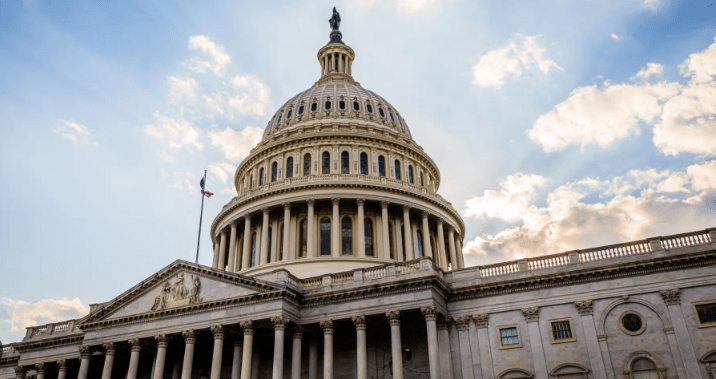
The US Senate. Image: Omar Chatriwala/Getty Images

What Developers And Advocates Are Saying

Some protocol teams and industry lawyers welcomed the step as a much-needed clarification, saying it would reduce legal uncertainty for projects that do not custody funds.

Others urged care, noting that clear definitions will be crucial to prevent loopholes and to make sure bad actors cannot hide behind the safe harbor. Coverage indicates sponsors emphasized the bill’s goal is narrow: protect those who build and maintain, not those who handle other people’s assets.

The proposal for a separate law is being introduced while there are still many uncertainties surrounding how cryptocurrencies will be regulated in the US. In the latter part of 2025 and into 2026, the crypto sector has demonstrated that it has a great deal of clout within political circles in Washington D.C.

There has been a significant increase in lobbying by large crypto-related businesses as legislators review various options for regulating this industry. Several reports have linked the current political environment to the legislative actions taken to regulate crypto in Congress, as well as how interest in legislative action has increased due to Trump’s administration.

Featured image from Unsplash, chart from TradingView

Perguntas relacionadas

QWhat is the main purpose of the Blockchain Regulatory Certainty Act introduced by Senators Lummis and Wyden?

AThe main purpose is to protect blockchain developers and non-custodial infrastructure providers from being treated as money transmitters solely for writing code or maintaining networks, by creating a safe harbor for those who do not control user funds.

QAccording to the bill, what determines liability for developers under the proposed safe harbor?

ALiability turns on actual custody or control of assets rather than on the act of creating software, meaning developers are protected as long as they do not hold or direct users' tokens.

QWhy did the developer protection measure become a standalone bill instead of part of a larger package?

AThe larger Senate market-structure push was paused to work on open issues like stablecoin policy, so sponsors moved the developer protections into a standalone bill to give it separate attention and potentially faster action.

QWhat concern do some industry lawyers have about the safe harbor provision?

ASome lawyers urge care, noting that clear definitions are crucial to prevent loopholes and ensure bad actors cannot hide behind the safe harbor to evade regulation.

QHow has the crypto industry demonstrated political influence in Washington D.C. according to the article?

AThe crypto sector has shown significant clout through increased lobbying by large crypto-related businesses and heightened legislative activity, with reports linking this to the current political environment and Trump's administration.

Leituras Relacionadas

Vitalik's Algorithmic Stablecoin Vision: Interpreting the Mechanism and Challenges from an Options Perspective

Vitalik Buterin's recent algorithmic stablecoin proposal envisions using an option-like mechanism to create a stablecoin without the liquidation risks inherent in traditional collateralized debt position (CDP) models. The design splits one unit of ETH into two components: a 'stable' leg (P) that maintains value up to a certain strike price, and an 'upside' leg (N) that captures any appreciation above that price. Together, they always sum to one ETH, eliminating the need for debt or liquidation mechanisms. From an options perspective, the stable leg essentially functions as a synthetic, covered call position. However, significant challenges exist. For the stable asset to maintain its peg, it must continuously roll deep in-the-money call options, leading to potential rollover slippage, predictable trading paths vulnerable to front-running, and liquidity issues. Crucially, the system's scalability depends on a constant demand for the upside leg—a form of leveraged ETH long position without funding rates or liquidation risk. It's unclear if such persistent, specific demand will materialize from speculators or market makers who have simpler alternatives like perpetual swaps. The author, drawing from experience with Rysk, argues that DeFi options have struggled as standalone trading products due to complexity and fragmented liquidity. Their potential lies instead as foundational infrastructure underpinning more complex financial primitives like stablecoins, structured yields, or index products—transforming from a direct product into a core pricing and risk distribution engine for the next generation of on-chain finance.

marsbitHá 17m

Vitalik's Algorithmic Stablecoin Vision: Interpreting the Mechanism and Challenges from an Options Perspective

marsbitHá 17m

GPT-5.6 Countdown: Abandon the Illusion of a Single API, Computational Iteration Can't Outpace a Single Page of Compliance

In mid-June, three seemingly independent industry events—the compliance-driven throttling of Fable 5, the open-sourcing of GLM-5.2, and the leaked release timeline for GPT-5.6—are pushing the global AI industry toward a watershed moment. These shifts signal a fundamental restructuring of the industry's underlying logic. First, **"usability" has substantially overtaken "advanced capabilities"** as the primary weight, pushing the global large language model (LLM) supply chain into a "dual-track" phase of controlled closed-source and local open-source coexistence. Second, **the competitive moats of closed-source giants are shifting**. Their technical focus is moving from "language intelligence" toward "spatial intelligence (world models)"—a domain heavily reliant on computing power. Third, faced with常态化 transnational compliance risks, **a "model-agnostic" decoupled design has become a survival necessity for application-layer developers to maintain business continuity.** The article details how Anthropic's Fable 5, despite its advanced engineering feats, was restricted for non-U.S. citizens within 72 hours of launch, highlighting how geopolitical compliance can instantly limit even the most advanced models. In response, the open-source camp, exemplified by Zhipu AI's MIT-licensed GLM-5.2, is gaining market share by offering stable performance improvements and significant cost advantages (up to 70% savings for enterprises), while achieving full adaptation with domestic semiconductor platforms. Meanwhile, closed-source leaders like OpenAI are pivoting. The anticipated GPT-5.6 reportedly shifts focus from language to spatial intelligence and world models, aiming to rebuild a generational gap in areas like 3D understanding, simulation, and industrial design that demand immense compute. The core conclusion is that the LLM supply chain's logic has changed. Enterprises must now evaluate infrastructure based on a composite of technical performance and policy compliance. For developers, complete reliance on a single closed-source API poses unacceptable risk. Implementing a truly model-agnostic architecture—enabling swift switches to compliant, locally deployable open-source alternatives—is no longer just good practice but a fundamental baseline for business continuity.

marsbitHá 3h

GPT-5.6 Countdown: Abandon the Illusion of a Single API, Computational Iteration Can't Outpace a Single Page of Compliance

marsbitHá 3h

Is the 'Token Subsidy War' Among AI Giants Almost Over?

The article discusses the ongoing "token subsidy war" among AI giants like OpenAI and Anthropic, questioning whether it's nearing its end. It reveals that current AI subscription prices are heavily subsidized, with some plans offering tokens at up to 70 times the actual cost to attract and retain heavy users, especially developers and enterprises. This strategy mirrors past internet-era subsidy battles, but with a key difference: AI tokens lack "lock-in" effects. Unlike ride-hailing or food delivery apps, users can easily switch between AI providers as APIs become standardized, making it difficult for companies to raise prices post-subsidy. The piece highlights a structural asymmetry in the competition. Giants like Google, with massive advertising revenue, can afford to subsidize tokens indefinitely, akin to using "tokens as a weapon." In contrast, venture-backed companies like OpenAI and Anthropic face pressure to become profitable, especially as they approach IPO. The article cites Google Ventures founder Bill Maris, who suggests Google could slash token prices by 80%, putting immense pressure on competitors. Two potential endgames are presented: the "internet service" model (subsidize, monopolize, then raise prices) and the "utility" model (tokens become a standardized, low-margin commodity like electricity). Given the low switching costs, the latter seems more likely. The competition may not have a single winner but could instead accelerate AI's evolution into a foundational, infrastructure-level technology, akin to a public utility. For now, users continue to benefit from heavily subsidized token costs.

marsbitHá 3h

Is the 'Token Subsidy War' Among AI Giants Almost Over?

marsbitHá 3h

Trading

Spot
Futuros
活动图片