Crypto Developers Could Get Long-Term Shield Under New Senate Bill

bitcoinistPublicado em 2026-01-14Última atualização em 2026-01-14

Resumo

US Senators Cynthia Lummis and Ron Wyden introduced the Blockchain Regulatory Certainty Act, a standalone bill to protect blockchain developers and non-custodial infrastructure providers from being classified as money transmitters. The legislation creates a safe harbor for those who write code or maintain networks without controlling user funds, meaning liability depends on custody of assets rather than software development. This aims to reduce legal risks for node operators and open-source developers. The move follows industry lobbying and delays in broader crypto market-structure legislation. While welcomed by many, some caution that clear definitions are needed to prevent loopholes and ensure the protection applies only to builders, not asset handlers.

US Senators Cynthia Lummis and Ron Wyden introduced a standalone measure that would protect blockchain developers and other non-custodial infrastructure providers from being treated as money transmitters solely for writing code or maintaining networks. The bill is being filed as the Blockchain Regulatory Certainty Act, a name that also appears in earlier House paperwork filed last year.

Crypto: Bill Aims To Protect Non-Custodial Developers

The draft would create a safe harbor for developers who do not control user funds, making liability turn on actual custody or control of assets rather than on the act of creating software. That change would mean node operators, protocol maintainers, and many open-source coders could avoid money-transmitter rules so long as they do not hold or direct users’ tokens.

Industry Pressure And A History Of Concern

Reports have disclosed months of lobbying from exchanges, developer groups, and advocacy coalitions that urged lawmakers to clarify this point. Those groups warned that without clear language, developers could face licensing and enforcement risks that would chill US-based development. The House version of the measure first appeared in May last year and set out similar safe-harbor text.

Total crypto market cap currently at $3.1 trillion. Chart: TradingView

Senate Markup Delayed As Negotiations Continue

Lawmakers have paused a larger Senate market-structure push while they work through a range of open issues, including stablecoin policy and yield rules. With that broader package pushed later into the month, sponsors moved the developer protections into a standalone bill to give that issue its own spotlight. Reports suggests the pause means Congress may act on the developer language sooner than the full market bill.
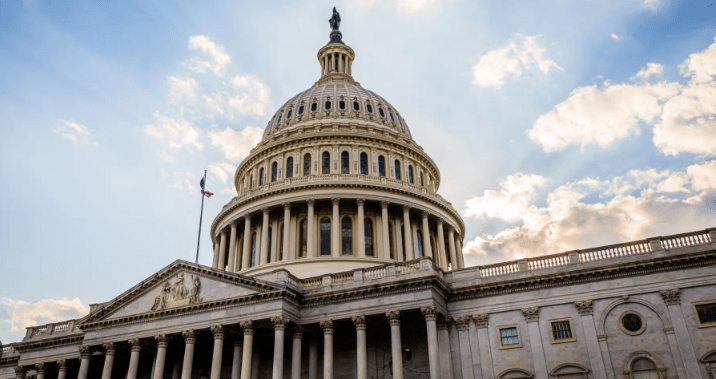
The US Senate. Image: Omar Chatriwala/Getty Images

What Developers And Advocates Are Saying

Some protocol teams and industry lawyers welcomed the step as a much-needed clarification, saying it would reduce legal uncertainty for projects that do not custody funds.

Others urged care, noting that clear definitions will be crucial to prevent loopholes and to make sure bad actors cannot hide behind the safe harbor. Coverage indicates sponsors emphasized the bill’s goal is narrow: protect those who build and maintain, not those who handle other people’s assets.

The proposal for a separate law is being introduced while there are still many uncertainties surrounding how cryptocurrencies will be regulated in the US. In the latter part of 2025 and into 2026, the crypto sector has demonstrated that it has a great deal of clout within political circles in Washington D.C.

There has been a significant increase in lobbying by large crypto-related businesses as legislators review various options for regulating this industry. Several reports have linked the current political environment to the legislative actions taken to regulate crypto in Congress, as well as how interest in legislative action has increased due to Trump’s administration.

Featured image from Unsplash, chart from TradingView

Perguntas relacionadas

QWhat is the main purpose of the Blockchain Regulatory Certainty Act introduced by Senators Lummis and Wyden?

AThe main purpose is to protect blockchain developers and non-custodial infrastructure providers from being treated as money transmitters solely for writing code or maintaining networks, by creating a safe harbor for those who do not control user funds.

QAccording to the bill, what determines liability for developers under the proposed safe harbor?

ALiability turns on actual custody or control of assets rather than on the act of creating software, meaning developers are protected as long as they do not hold or direct users' tokens.

QWhy did the developer protection measure become a standalone bill instead of part of a larger package?

AThe larger Senate market-structure push was paused to work on open issues like stablecoin policy, so sponsors moved the developer protections into a standalone bill to give it separate attention and potentially faster action.

QWhat concern do some industry lawyers have about the safe harbor provision?

ASome lawyers urge care, noting that clear definitions are crucial to prevent loopholes and ensure bad actors cannot hide behind the safe harbor to evade regulation.

QHow has the crypto industry demonstrated political influence in Washington D.C. according to the article?

AThe crypto sector has shown significant clout through increased lobbying by large crypto-related businesses and heightened legislative activity, with reports linking this to the current political environment and Trump's administration.

Leituras Relacionadas

The Value Distribution of Stablecoins

**Summary: The Value Distribution of Stablecoins** The article argues that stablecoins are evolving from mere trading tools into broader channels for dollar access. It divides the stablecoin ecosystem into four layers to analyze how value is distributed: 1. **Issuance Layer:** Mints stablecoins, holds reserve assets, and captures the spread between reserve yield and user costs (e.g., Tether, Circle). This layer currently earns the largest profit margin. 2. **Infrastructure Layer:** Connects stablecoins to the traditional financial system, handling fiat on/off-ramps, banking integration, compliance (KYC/AML), and asset management (e.g., Bridge, BVNK). This is the "unglamorous" but critical work, building the essential bridges between crypto and real-world finance. 3. **Acquiring/Distribution Layer:** Integrates stablecoins into merchant systems, manages payment flows, and provides enterprise financial software (e.g., Stripe, Coinbase). They act as the access point for businesses. 4. **Application Layer:** The end-users and businesses that ultimately use stablecoins for payments, settlements, or as a store of value. They benefit from convenience but have little pricing power. The core thesis is that while the issuance layer currently dominates profits, the often-overlooked **infrastructure layer holds significant long-term potential**. The real challenge and barrier to mass adoption is not the on-chain transfer of stablecoins (which is simple), but the complex "last mile" integration into existing business workflows, banking systems, and regulatory frameworks across different countries. Companies in this layer are currently in a "land grab" phase, investing heavily to build networks, secure bank partnerships, and establish compliance pathways. While their position is currently pressured by the profitable issuers above and distribution platforms below, the article suggests that if stablecoins become a default financial rail for businesses, the infrastructure providers who have done the hard work of integration will ultimately gain strong pricing power and become entrenched, essential players.

marsbitHá 22m

The Value Distribution of Stablecoins

marsbitHá 22m

The Value Distribution of Stablecoins

The Value Distribution of Stablecoins The article argues that stablecoins are evolving from a mere trading tool into a broad "dollar channel." It analyzes the industry's value chain through four layers: 1. **Issuance Layer (e.g., Tether, Circle):** The top layer that mints stablecoins, holds reserve assets, and captures the thickest interest rate spread. 2. **Infrastructure Layer (e.g., Bridge, BVNK):** Connects stablecoins to the traditional financial system, handling critical but complex "dirty work" like fiat on/off-ramps, banking integration, compliance (KYC/AML), and cross-border settlement. 3. **Acquiring/Distribution Layer (e.g., Stripe, Coinbase):** Embeds stablecoins into merchant systems, manages payment flows, and integrates with enterprise software. 4. **Application Layer:** End-users and businesses that ultimately use stablecoins for payments, settlement, or storing value. The author posits that while the issuance layer currently captures the most profit, the most overlooked and potentially critical layer is infrastructure. The core challenge for stablecoin adoption isn't the on-chain transfer (which is simple), but bridging the gap between blockchain and the real-world financial system. This involves solving practical problems for businesses: fiat conversion, reconciliation, tax handling, and user onboarding. Infrastructure companies are currently in a difficult "land-grab" phase—building networks, securing banking relationships, and achieving compliance country-by-country. They face pressure from both the profitable issuance layer above and distribution platforms below. However, the author suggests this layer is building a crucial moat. Once stablecoins become a default business rail, the infrastructure players who have done the hard work of integration may gain significant, durable value and pricing power.

链捕手Há 25m

The Value Distribution of Stablecoins

链捕手Há 25m

How to Do Research Well: Deliberately Practice the Real Skills That Matter

No one truly teaches you how to do research. You're often given a desk, a pre-selected problem, and vague instructions to "create something new." Consequently, many people reverse-engineer the job based on visible outputs—papers, posts, announcements—learning only how to *appear* like a researcher rather than how to *become* one. True research capability is built from stacking small, trainable skills, nearly all of which can be developed through deliberate practice. **Pick Your Own Problem:** Most researchers absorb problems from advisors or trends, lacking the underlying reasoning. Choosing a problem you genuinely care about, as John Schulman advises, leads to original work. Develop "taste" like a muscle: predict experiment outcomes, guess paper results from methods, and track which findings remain important over time. **Upgrade Your Inputs:** Relying on shared reading lists (arXiv hot lists, filtered group chats) leads to unoriginal conclusions. Undervalued old literature often holds crucial insights (e.g., MoE, LSTM, backpropagation). Richard Sutton's "The Bitter Lesson" or Claude Shannon's 1952 talk on creative thinking are more predictive than lengthy modern surveys. Breadth matters as much as depth: draw from neuroscience, mechanism design, hardware knowledge, and honest statistics. Read papers directly, especially appendices and limitations sections. **Write Everything Down:** As Paul Graham noted, writing exposes flaws in seemingly mature ideas. Writing is the cheapest defense against self-deception. Following Feynman's principle, Darwin programmatically wrote down facts contradicting his theory to combat memory bias. Maintain a detailed log of hypotheses, setups, predictions, results, and updated understandings. Reviewing past logs fosters essential humility.

marsbitHá 2h

How to Do Research Well: Deliberately Practice the Real Skills That Matter

marsbitHá 2h

Trading

Spot
Futuros
活动图片