Crypto Credit Crisis Deepens As BlockFills Files For Bankruptcy

bitcoinistPublicado em 2026-03-16Última atualização em 2026-03-16

Resumo

Crypto lender BlockFills and three related entities under parent firm Reliz LTD have filed for Chapter 11 bankruptcy protection. The filing comes after the company halted customer withdrawals last month, citing a sharp Bitcoin selloff as the reason. Prior to the bankruptcy, a Delaware court had already ordered 71 Bitcoin frozen due to a customer fund dispute. Chapter 11 allows the company to continue operating while it restructures its finances and negotiates a repayment plan with creditors. Customers with balances on the platform are considered unsecured creditors, meaning they will be last in line for repayment. The amount and timing of any recovery depend on the company's assets and may take months or years to resolve. This situation mirrors previous crypto lending failures, such as Celsius and Voyager, where customers faced long waits for partial repayments. BlockFills has not disclosed its total liabilities or the number of affected customers.

A Delaware court had already ordered 71 Bitcoin frozen over a customer fund dispute before crypto lender BlockFills formally declared it could no longer operate.

That freeze — tied to a legal battle with creditors over how client money was handled — cast a shadow over the company well before it filed for Chapter 11 protection this week.

Customers Locked Out As Withdrawals Halt

BlockFills stopped letting customers move their money last month. The company pointed to a sharp Bitcoin selloff — the coin dropped from above $97,000 to below $64,000 between mid-January and early February — as the reason it needed to protect both itself and its clients.

Deposits and withdrawals went dark. No timeline for restoration was given.

Now the company and three related entities, all operating under parent firm Reliz LTD, have taken their case to federal bankruptcy court in Delaware.

The filing seeks a Chapter 11 restructuring, which allows a company to keep running while it works out a repayment plan with the people it owes money to.
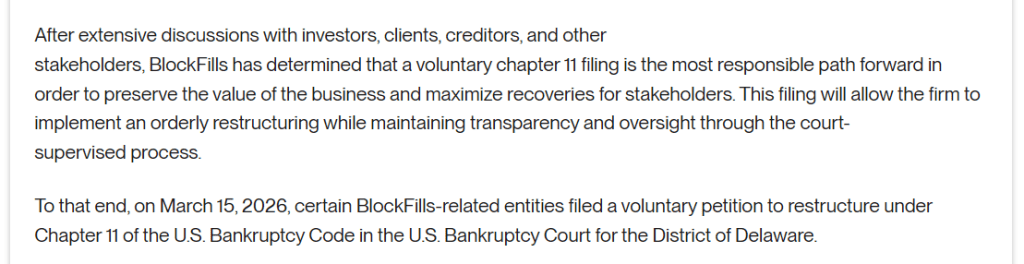
BlockFills' statement on company updates and Chapter 11 bankruptcy filing.

In a statement, BlockFills said the decision came after talks with investors, clients, and creditors. The company said it believes the court process will give it the time and structure needed to stabilize operations, find additional sources of cash, and look at possible deals with outside parties.

Officials said the goal is a consensual restructuring — meaning one that creditors agree to rather than one forced on them by a judge.

What Chapter 11 Means For Those Owed Money

Chapter 11 is not a wind-down. It is a legal system that provides a company with a moratorium to restructure its finances during which an automatic stay prevents creditors from collecting their debts.

BTCUSD now trading at $73,450. Chart: TradingView

As for customers who have balances on the platform, the situation is not so straightforward. They would be considered unsecured creditors in a bankruptcy case, which means they would be last in line after secured creditors and expenses approved by the court.

The amount they will get back and when that will happen is dependent on what assets BlockFills actually owns. That process can take months or, in complex cases, years.

BTCUSD trading at $73,240 on the 24-hour chart: TradingView

Bankruptcy Filing Caps A Difficult Period For The Firm

BlockFills has been under pressure from multiple directions. The frozen Bitcoin order involving Dominion Capital pointed to deeper disputes over whether customer funds were properly segregated — a question that goes beyond market timing.

Reports indicate the company had been in talks with stakeholders for an extended period before concluding that a court-supervised restructuring was the only viable path forward.

The collapse follows a pattern seen in earlier crypto lending failures. Companies including Celsius, Voyager, and BlockFi all suspended withdrawals before filing for bankruptcy during the 2022 market downturn. In each case, customers waited — sometimes years — for partial repayment.

BlockFills has not disclosed total liabilities, the number of affected customers, or the full value of assets under its control. This is a developing situation, and more details are expected to emerge as court documents become public.

Featured image from Unsplash, chart from TradingView

Perguntas relacionadas

QWhat was the primary reason cited by BlockFills for halting customer withdrawals last month?

ABlockFills cited a sharp Bitcoin selloff, where the coin dropped from above $97,000 to below $64,000 between mid-January and early February, as the reason it needed to protect both itself and its clients.

QWhat type of bankruptcy protection did BlockFills and its related entities file for?

ABlockFills and three related entities filed for Chapter 11 bankruptcy protection, which allows a company to continue operating while it works out a repayment plan with its creditors.

QHow are customers with balances on the BlockFills platform classified in the bankruptcy case?

ACustomers with balances on the platform are considered unsecured creditors, meaning they are last in line for repayment after secured creditors and court-approved expenses.

QWhat significant event involving customer funds occurred before the formal bankruptcy filing?

AA Delaware court had already ordered 71 Bitcoin to be frozen due to a customer fund dispute, which was tied to a legal battle with creditors over how client money was handled.

QWhich other crypto companies does the article mention as having followed a similar pattern of suspending withdrawals before filing for bankruptcy in 2022?

AThe article mentions Celsius, Voyager, and BlockFi as companies that suspended withdrawals before filing for bankruptcy during the 2022 market downturn.

Leituras Relacionadas

From Survival to Accelerated Growth: The Journey of Zcash's Three-Year Rise as Told by the Founder of ZODL

**From Survival to Accelerated Growth: Zcash Founder Details the 3-Year Rise** Three years ago, Zcash (ZEC) was a struggling pioneer in privacy technology, with a price near $30, low shielded supply (11%), and a community mired in governance disputes. Today, ZEC trades around $600, with over 31% of its supply (~$3B) in user-controlled shielded pools. This transformation resulted from breaking key constraints. First, **governance shackles were removed**. The old model guaranteed funding to two entities (ECC and ZF) regardless of performance, creating a monopoly. In 2024, ECC rejected further direct funding, forcing a change. The NU6 upgrade ended direct funding, allocating 8% to community grants and 12% to a protocol-controlled treasury for retroactive rewards, expiring in 2028 unless renewed by overwhelming consensus. The entities also relinquished their trademark-based veto power, freeing community governance. Second, the **product focus shifted** from pure cryptography to user growth. Previously, engineering excelled at privacy tech but failed to attract users. In early 2024, the team (later ZODL) pivoted to building products users wanted, like the Zodl wallet (default privacy, hardware support, cross-asset swaps). This drove shielded supply to grow over 400% in ZEC terms, with 86.5% of recent transactions being shielded, representing real user adoption. Third, the **narrative evolved** from the limiting "privacy coin" label to "unstoppable private money." This clarified Zcash's value proposition: a Bitcoin-like monetary policy with verifiable private payments via advanced cryptography. This structural narrative—protocol (Zcash), asset (ZEC), gateway (Zodl)—enabled broader exchange listings, institutional interest, and ETF filings. Finally, **organizational constraints were broken**. In early 2026, the ECC team left its non-profit structure after disputes over control, forming Zcash Open Development Lab (ZODL). ZODL raised $25M from top VCs (Paradigm, a16z, etc.), gaining the capital and agility of a startup to scale consumer products. Current metrics show strong momentum: social discussion volume for ZEC surged 15,245% in a year, with 81% positive sentiment. The focus is now on enhancing user experience (Zodl wallet), scalability (Tachyon project targeting Visa-level throughput with 25-second blocks), and post-quantum security (quantum-recoverable wallets coming soon). Zcash is positioned to become faster, more usable, scalable, and quantum-resistant.

marsbitHá 5m

From Survival to Accelerated Growth: The Journey of Zcash's Three-Year Rise as Told by the Founder of ZODL

marsbitHá 5m

Five Counterparty Risk Architectures: A Settlement-Layer Methodology for Classifying TradFi Models in Crypto Exchanges

**Summary:** This companion piece reframes the five TradFi-on-crypto exchange architectures, previously classified by "architectural fingerprint," through the lens of counterparty risk. The core question is: whose balance sheet bears the loss first in a stress scenario, and has it historically done so? Each of the five models corresponds to a distinct risk holder with its own documented failure modes. * **Model 1 (Stablecoin-Settled CEX Perpetuals):** Risk is held by the stablecoin issuer (e.g., reserve composition, bank connectivity) and the CEX's own book. History includes Tether's banking disconnections (2017) and reserve misrepresentations (CFTC 2021 Order). * **Model 2 (CFD Brokers):** Risk resides on the broker's balance sheet (B-book model). Regulatory differences (e.g., ESMA's mandatory negative balance protection vs. Mauritius FSC's lack thereof) define loss allocation rules, as seen in the 2015 SNB event (Alpari UK insolvency). * **Model 3 (Off-Chain Custody & Transfer Agent Chain):** Risk lies with the off-chain custodian/platform. User asset recovery depends on Terms of Use and corporate structure, exemplified by the Celsius bankruptcy ruling (2023) where Earn Account assets were deemed property of the estate. * **Model 4 (DEX Perpetual Protocols):** No single balance sheet bears risk. Loss absorption relies on a protocol's insurance fund and Auto-Deleveraging (ADL) mechanism, as demonstrated in the GMX V1 (2022) and dYdX v3 YFI (2023) incidents. * **Model 5 (Regulated CCP - DCM-DCO-FCM):** The most institutionalized model concentrates risk in the Central Counterparty (CCP). However, history shows CCPs can employ non-standard tools under extreme stress, such as mass trade cancellation (LME Nickel, 2022) or enabling negative price settlements (CME WTI, 2020). The report argues that regulatory choices and counterparty risk structures are co-extensive, not in an upstream-downstream relationship. It concludes with five separate observation checklists (not predictions) for monitoring the structural vulnerabilities of each risk model.

marsbitHá 22m

Five Counterparty Risk Architectures: A Settlement-Layer Methodology for Classifying TradFi Models in Crypto Exchanges

marsbitHá 22m

Trading

Spot
Futuros
活动图片





