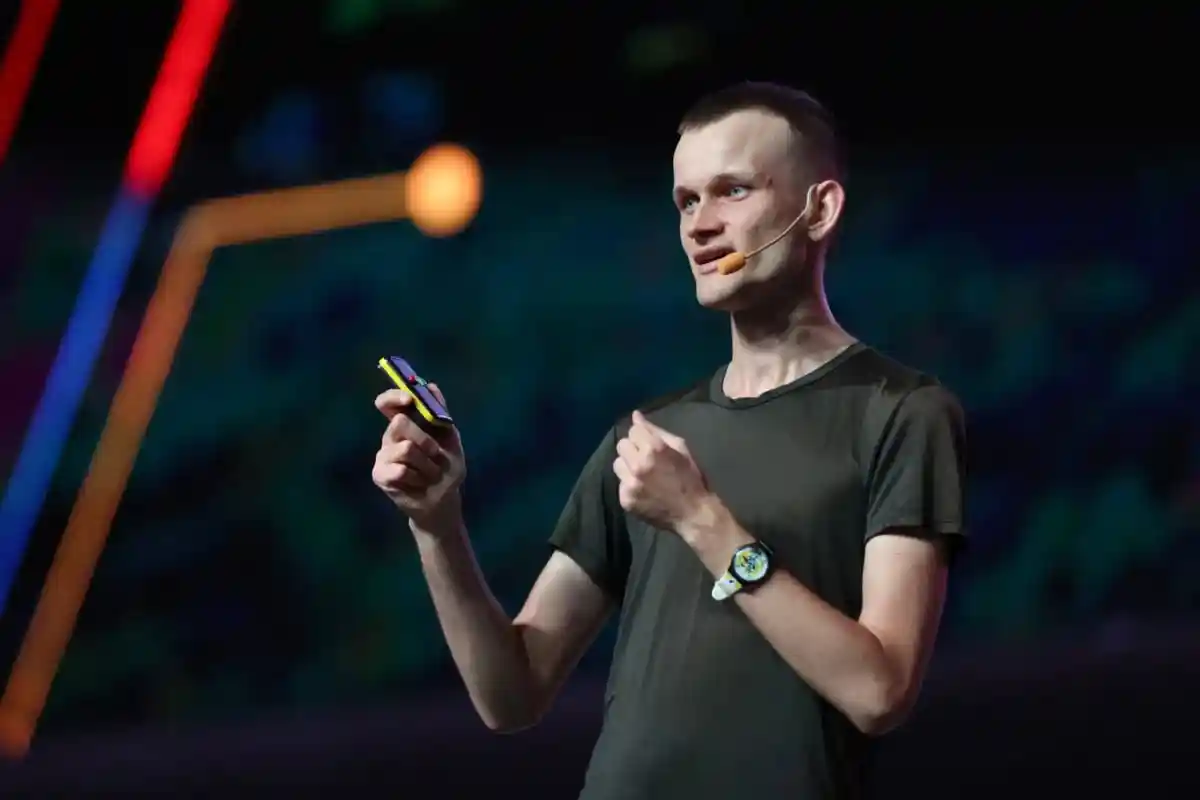
Cross-Border Collaboration: Tom Lee Invests $200 Million, Partnering with Global Top Streamer MrBeast

marsbitPublicado em 2026-01-16Última atualização em 2026-01-16

Resumo

Wall Street analyst Tom Lee's BitMine Immersion Technologies (BMNR) is investing $200 million in MrBeast's holding company, Beast Industries, which plans to integrate DeFi into its upcoming financial services platform. MrBeast, whose YouTube channels have over 4.6 billion subscribers, has built a massive but costly content empire, with single videos often costing $3-5 million to produce. His company, Beast Industries, generates over $400 million in annual revenue but operates with thin margins due to high content expenses. Its profitable chocolate brand, Feastables, brings in $250 million in sales. Despite a valuation around $5 billion, MrBeast has described himself as "cash poor," reinvesting nearly all earnings back into the business. The partnership with Tom Lee signals a strategic move to explore decentralized finance solutions, potentially creating a programmable financial infrastructure for creators and fans, though specific plans remain undisclosed.

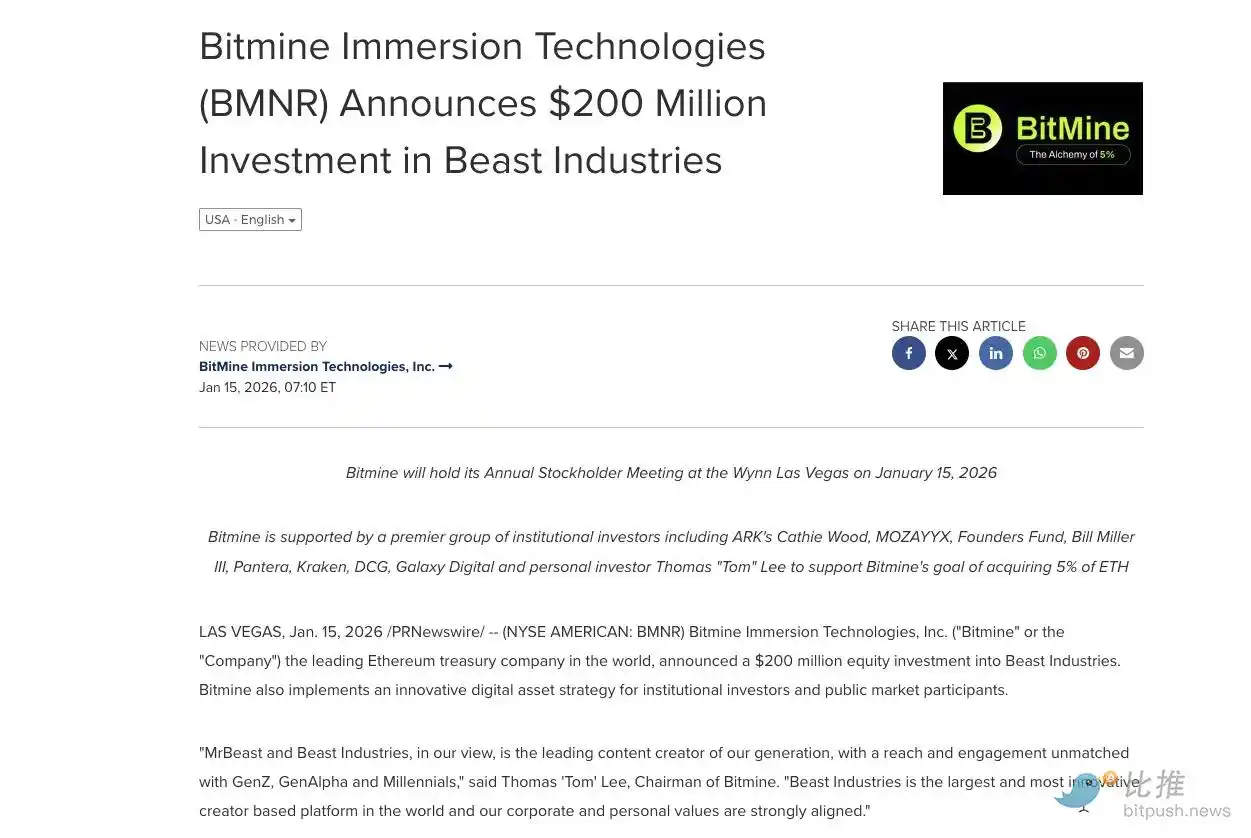
$200 million is the figure just announced today.

BitMine Immersion Technologies (BMNR), chaired by renowned Wall Street analyst Tom Lee, announced that it will invest in Beast Industries, the holding company behind global top streamer MrBeast. Meanwhile, Beast Industries mentioned in its official statement that the company will explore how to "integrate DeFi into the upcoming financial services platform" in the future.
If you only look at the news, it seems like another familiar crossover: traditional, crypto, internet celebrity, entrepreneurship. On one side is the YouTube霸主 with cumulative global subscriptions exceeding 400 million, whose single video can make the algorithm spontaneously weight you; on the other side is Wall Street's top analyst best at telling crypto narratives, skilled at writing grand blockchain concepts into balance sheets. Everything seems logical.

MrBeast's Journey

Looking back at MrBeast's early videos, it's hard to connect them with today's Beast Industries valued at $5 billion.
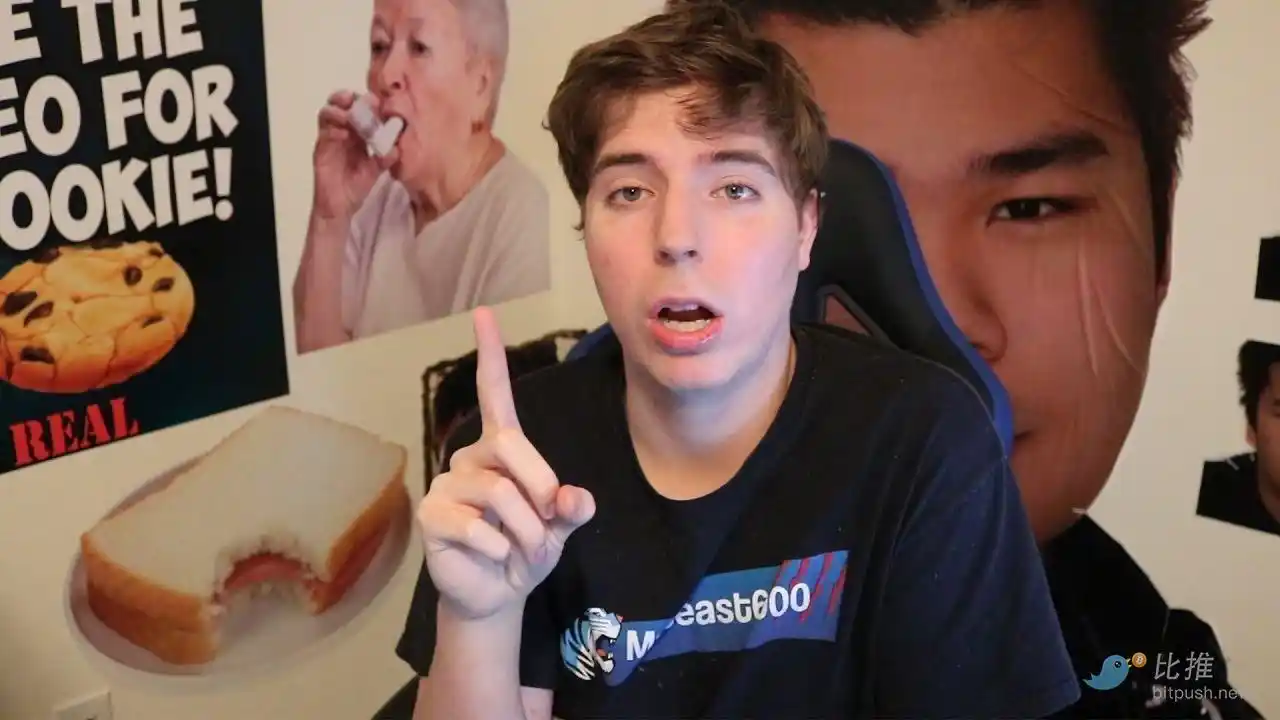
In 2017, Jimmy Donaldson, who had just graduated from high school, uploaded a video of himself counting continuously for 44 hours—"Challenge to count from 1 to 100,000!" The content was simple to the point of childishness, with no plot, no editing, just a person repeating numbers in front of the camera, yet it became a turning point in his content career.

At that time, he was not yet 19 years old, with only about 13,000 channel subscribers. After the video was released, it quickly exceeded a million views, becoming the first globally viral case.

Later, he recalled that time in an interview with one sentence:

"I didn't actually want to become famous at that time; I just wanted to know if the result would be different if I was willing to put all my time into something no one else was willing to do."

Jimmy Donaldson successfully built his account, becoming the later well-known MrBeast. But more importantly, from that moment on, he formed an almost obsessive belief: attention is not a gift of talent but something earned through investment and endurance.

Treating YouTube as a Company, Not a Creative Platform

Many creators choose to "conservatize" after becoming famous: reduce risks, improve efficiency, turn content into stable cash flow.

MrBeast chose the opposite path.

He repeatedly emphasized one thing in multiple interviews:

"The money I earn is basically spent on the next video."

This is the core of his business model.

By 2024, his main channel had over 460 million subscribers, with cumulative video views exceeding 100 billion. But behind this is extremely high costs:

· The production cost of a single top video is consistently between $3 million and $5 million;

· Some large challenges or public welfare projects can cost over $10 million;

· "Beast Games" on Amazon Prime Video, described by himself as "completely out of control," and he admitted in an interview: losses reached tens of millions of dollars.

When he said this, he did not show regret:

"At this level, you can't win while trying to save money."

This sentence can almost be used as the key to understanding Beast Industries.

Beast Industries: Annual Revenue of $400 Million, but Thin Profits

By 2024, MrBeast consolidated all businesses under the name Beast Industries.

From public information, this company has far exceeded the scope of "creator side business":

· Annual revenue exceeds $400 million;

· Businesses span content production, fast-moving consumer goods retail, licensed merchandise, tool-based products;

· After the latest round of financing, the general expectation for its valuation is around $5 billion.

But it's not easy.

MrBeast's YouTube main channel and Beast Games bring huge exposure but almost consume all profits.
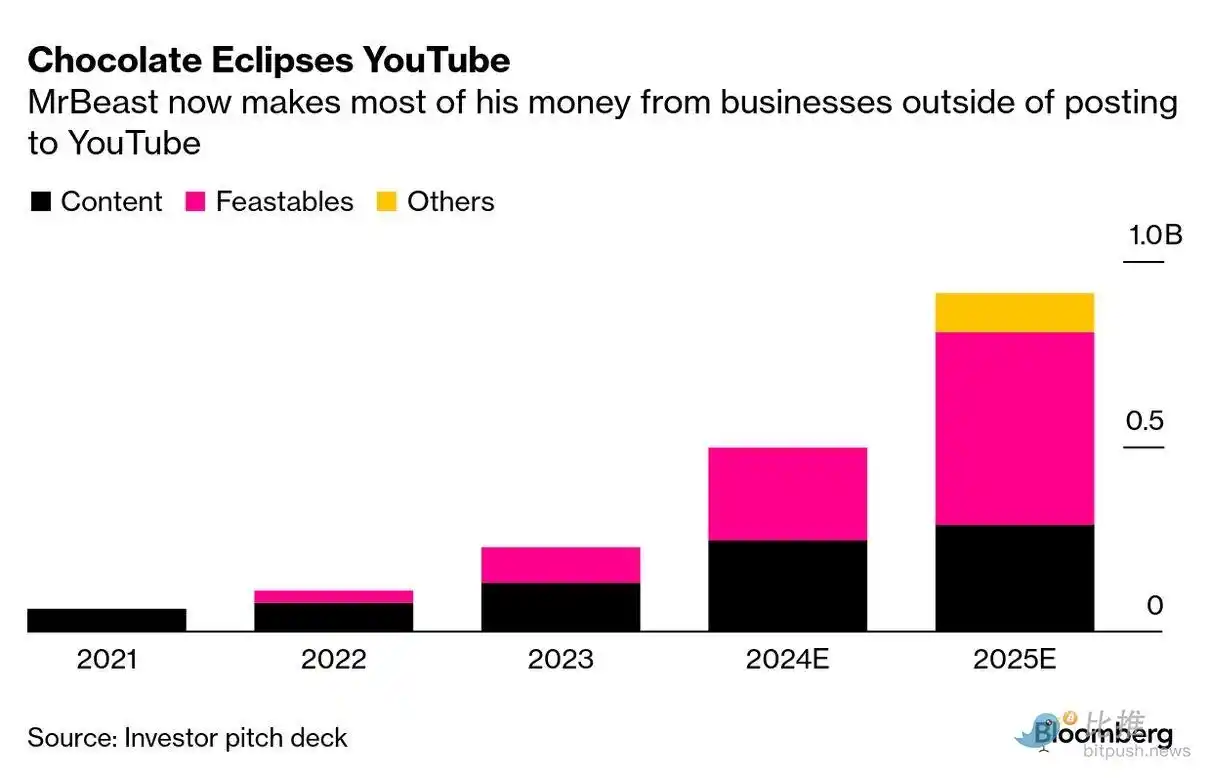
In stark contrast to the content is his chocolate brand Feastables. Public information shows that in 2024, Feastables sales were about $250 million, contributing over $20 million in profit. This is the first time Beast Industries has seen a stable, replicable cash flow business. By the end of 2025, Feastables had entered over 30,000 physical retail stores in North America (including Walmart, Target, 7-Eleven, etc.), covering the United States, Canada, and Mexico, greatly enhancing the brand's offline sales capabilities.

MrBeast has坦言 on multiple occasions that video production costs are getting higher and even "increasingly difficult to break even." But he still insists on investing heavily in content production because, in his view, this is not just paying for videos but buying traffic for the entire business ecosystem.

The core barrier of the chocolate business is not production but the ability to reach consumers. While other brands need to spend huge sums on advertising exposure, he only needs to release one video. Whether the video itself is profitable is no longer important; as long as Feastables can continue to sell, this business闭环 can continue to operate.

"I'm Actually Broke"

In early 2026, MrBeast revealed in a Wall Street Journal interview that he was broke, sparking discussion:

"I'm basically in a 'negative cash' state now. They all say I'm a billionaire, but there's not much money in my bank account."

This statement is not "humblebragging" but a natural result of his business model.

MrBeast's wealth is highly concentrated in unlisted equity; although he holds slightly over 50% of Beast Industries shares, the company continues to expand and almost pays no dividends; he personally甚至 deliberately does not retain cash.

In June 2025, he坦言 on social media that because he spent all his savings on video production, he even had to borrow money from his mother to pay for wedding expenses.
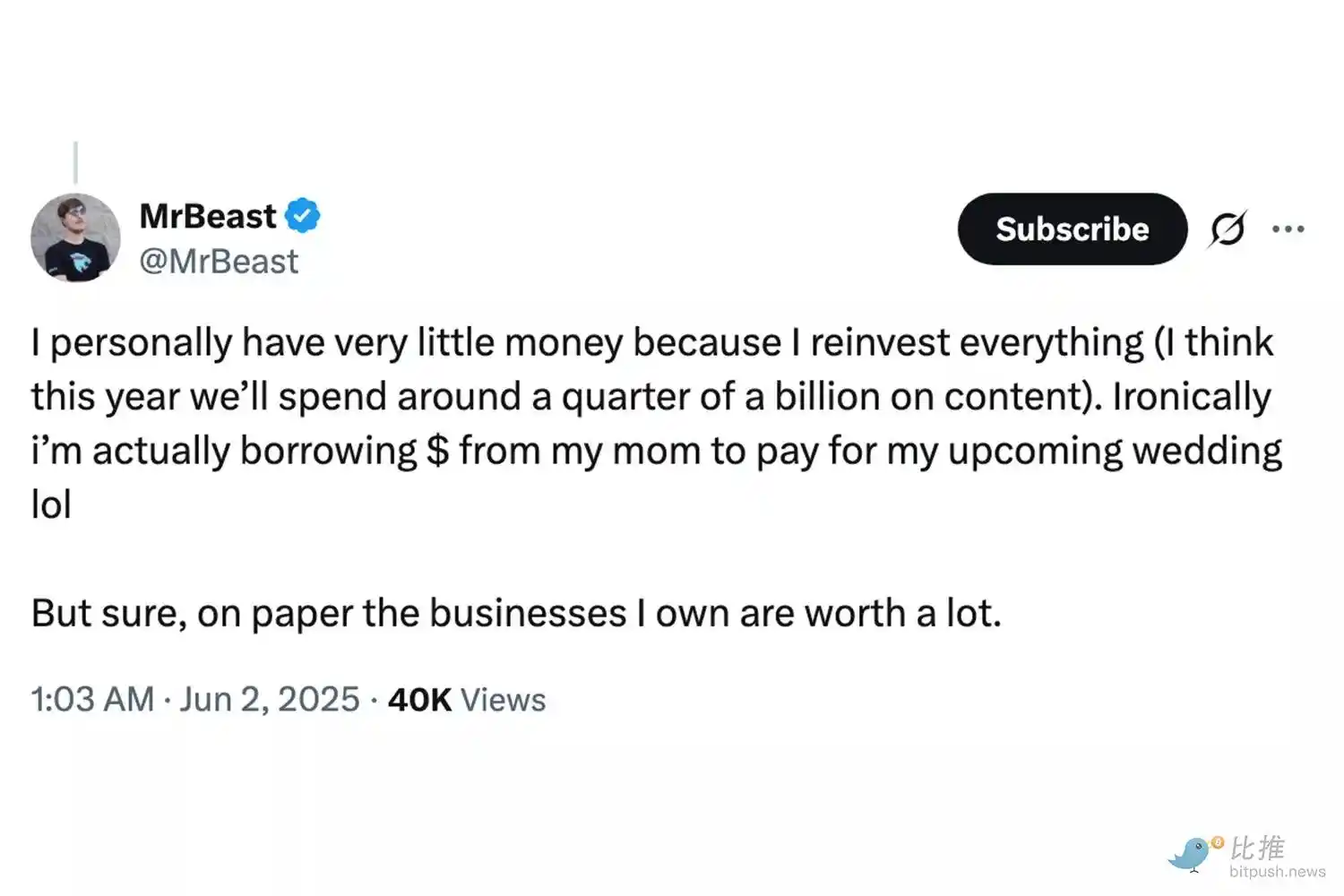
As he later explained more bluntly:

"I don't look at my bank account—it affects my decision-making."

And the tracks he invests in are no longer limited to content and consumer goods.

In fact, as early as the 2021 NFT热潮, on-chain records show that he had purchased and traded multiple CryptoPunks, some of which were sold for 120 ETH each (worth hundreds of thousands of dollars at the time).
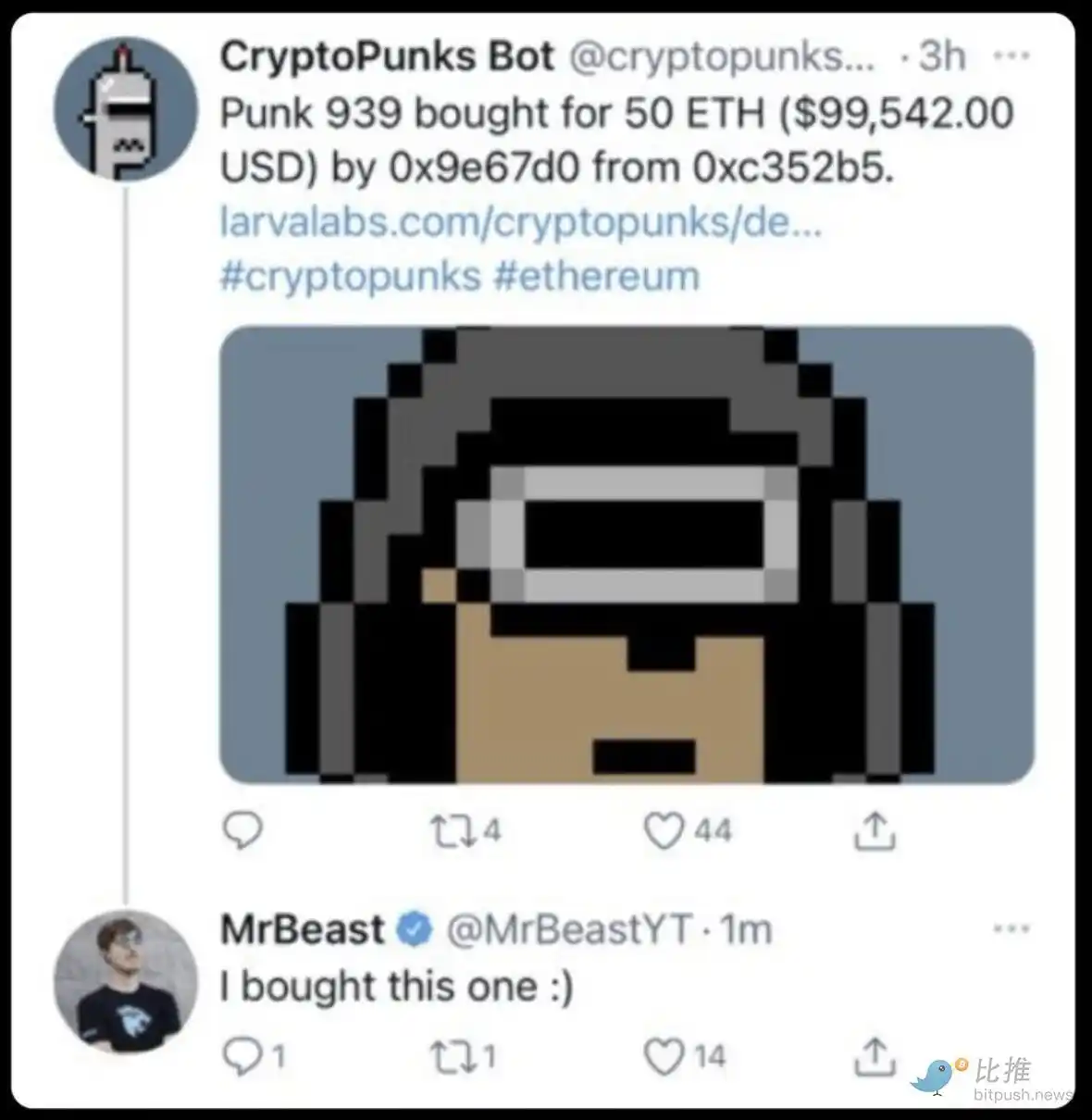
However, as the market entered a correction period, his attitude became more cautious.

The real turning point is that the "MrBeast" business model itself has reached a critical edge.

When a person controls the world's top traffic入口 but is长期 in a state of high investment, cash紧张, expansion relying on financing, finance is no longer just an investment option but becomes infrastructure that must be重构.

The命题 repeatedly discussed within Beast Industries in recent years has gradually become clear: how to make users no longer just "watch content, buy goods" but enter a long-term, stable, sustainable economic relationship?

This is precisely the direction traditional internet platforms have been trying for years: payment, accounts, credit systems. And at this node, the appearance of Tom Lee and BitMine Immersion (BMNR) leads this path to a more structural possibility.

Partnering with Tom Lee to Build a DeFi Foundation

On Wall Street, Tom Lee has always played the role of a "narrative architect." From early explanations of Bitcoin's value logic to emphasizing the strategic significance of Ethereum in corporate balance sheets, he is good at translating technological trends into financial language. BMNR's investment in Beast Industries is not chasing internet celebrity热度 but betting on the programmable future of attention入口.

So, what exactly does DeFi mean here?

Currently, public information is extremely restrained: no token issuance, no profit promises, no fan-exclusive financial products. But the expression "integrating DeFi into the financial services platform" points to several possibilities:

- Lower-cost payment and settlement layer;

- Programmable account system for creators and fans;

- Asset recording and equity structure based on decentralized mechanisms.

The imagination space is large, but the real challenges are also clear. In the current market, whether native DeFi projects or traditional institutions exploring转型, most have not yet truly run a sustainable model. If they cannot find a differentiated path in this fierce competition, the complexity of financial business may反而 erode the core capital he has accumulated over the years: fan loyalty and trust. After all, he has repeatedly stated publicly:

"If one day what I do harms the audience, I would rather do nothing."

This sentence may be repeatedly tested in every future financialization attempt.

So, when the world's strongest attention machine starts seriously building financial infrastructure, will it become a new generation platform or a "too brave" crossover?

The answer will not be revealed soon.

But one thing he knows better than anyone: the greatest capital is not past glory but the right to "start over."

After all, he is only 27 years old.

Perguntas relacionadas

QWhat is the amount of investment announced by Tom Lee's BitMine Immersion Technologies in Beast Industries?

A$200 million.

QWhat is the core business model of MrBeast (Jimmy Donaldson) as described in the article?

AHe reinvests almost all earnings into the next video, using high-cost content to drive traffic for his broader commercial ecosystem, including consumer goods like Feastables.

QWhich product of Beast Industries generated over $2.5 billion in sales and contributed more than $20 million in profit in 2024?

AFeastables, the chocolate brand.

QWhy did MrBeast describe himself as 'broke' despite his company's high valuation?

AHis wealth is tied up in equity, the company reinvests heavily and does not pay dividends, and he personally avoids holding cash to avoid influencing his investment decisions.

QWhat potential applications of DeFi are hinted at in Beast Industries' collaboration with Tom Lee's company?

ALower-cost payment and settlement layers, programmable account systems for creators and fans, and asset recording and equity structures based on decentralized mechanisms.

Leituras Relacionadas

Vitalik's Algorithmic Stablecoin Vision: Interpreting the Mechanism and Challenges from an Options Perspective

Vitalik Buterin's recent algorithmic stablecoin proposal envisions using an option-like mechanism to create a stablecoin without the liquidation risks inherent in traditional collateralized debt position (CDP) models. The design splits one unit of ETH into two components: a 'stable' leg (P) that maintains value up to a certain strike price, and an 'upside' leg (N) that captures any appreciation above that price. Together, they always sum to one ETH, eliminating the need for debt or liquidation mechanisms. From an options perspective, the stable leg essentially functions as a synthetic, covered call position. However, significant challenges exist. For the stable asset to maintain its peg, it must continuously roll deep in-the-money call options, leading to potential rollover slippage, predictable trading paths vulnerable to front-running, and liquidity issues. Crucially, the system's scalability depends on a constant demand for the upside leg—a form of leveraged ETH long position without funding rates or liquidation risk. It's unclear if such persistent, specific demand will materialize from speculators or market makers who have simpler alternatives like perpetual swaps. The author, drawing from experience with Rysk, argues that DeFi options have struggled as standalone trading products due to complexity and fragmented liquidity. Their potential lies instead as foundational infrastructure underpinning more complex financial primitives like stablecoins, structured yields, or index products—transforming from a direct product into a core pricing and risk distribution engine for the next generation of on-chain finance.

marsbitHá 8m

Vitalik's Algorithmic Stablecoin Vision: Interpreting the Mechanism and Challenges from an Options Perspective

marsbitHá 8m

GPT-5.6 Countdown: Abandon the Illusion of a Single API, Computational Iteration Can't Outpace a Single Page of Compliance

In mid-June, three seemingly independent industry events—the compliance-driven throttling of Fable 5, the open-sourcing of GLM-5.2, and the leaked release timeline for GPT-5.6—are pushing the global AI industry toward a watershed moment. These shifts signal a fundamental restructuring of the industry's underlying logic. First, **"usability" has substantially overtaken "advanced capabilities"** as the primary weight, pushing the global large language model (LLM) supply chain into a "dual-track" phase of controlled closed-source and local open-source coexistence. Second, **the competitive moats of closed-source giants are shifting**. Their technical focus is moving from "language intelligence" toward "spatial intelligence (world models)"—a domain heavily reliant on computing power. Third, faced with常态化 transnational compliance risks, **a "model-agnostic" decoupled design has become a survival necessity for application-layer developers to maintain business continuity.** The article details how Anthropic's Fable 5, despite its advanced engineering feats, was restricted for non-U.S. citizens within 72 hours of launch, highlighting how geopolitical compliance can instantly limit even the most advanced models. In response, the open-source camp, exemplified by Zhipu AI's MIT-licensed GLM-5.2, is gaining market share by offering stable performance improvements and significant cost advantages (up to 70% savings for enterprises), while achieving full adaptation with domestic semiconductor platforms. Meanwhile, closed-source leaders like OpenAI are pivoting. The anticipated GPT-5.6 reportedly shifts focus from language to spatial intelligence and world models, aiming to rebuild a generational gap in areas like 3D understanding, simulation, and industrial design that demand immense compute. The core conclusion is that the LLM supply chain's logic has changed. Enterprises must now evaluate infrastructure based on a composite of technical performance and policy compliance. For developers, complete reliance on a single closed-source API poses unacceptable risk. Implementing a truly model-agnostic architecture—enabling swift switches to compliant, locally deployable open-source alternatives—is no longer just good practice but a fundamental baseline for business continuity.

marsbitHá 2h

GPT-5.6 Countdown: Abandon the Illusion of a Single API, Computational Iteration Can't Outpace a Single Page of Compliance

marsbitHá 2h

Is the 'Token Subsidy War' Among AI Giants Almost Over?

The article discusses the ongoing "token subsidy war" among AI giants like OpenAI and Anthropic, questioning whether it's nearing its end. It reveals that current AI subscription prices are heavily subsidized, with some plans offering tokens at up to 70 times the actual cost to attract and retain heavy users, especially developers and enterprises. This strategy mirrors past internet-era subsidy battles, but with a key difference: AI tokens lack "lock-in" effects. Unlike ride-hailing or food delivery apps, users can easily switch between AI providers as APIs become standardized, making it difficult for companies to raise prices post-subsidy. The piece highlights a structural asymmetry in the competition. Giants like Google, with massive advertising revenue, can afford to subsidize tokens indefinitely, akin to using "tokens as a weapon." In contrast, venture-backed companies like OpenAI and Anthropic face pressure to become profitable, especially as they approach IPO. The article cites Google Ventures founder Bill Maris, who suggests Google could slash token prices by 80%, putting immense pressure on competitors. Two potential endgames are presented: the "internet service" model (subsidize, monopolize, then raise prices) and the "utility" model (tokens become a standardized, low-margin commodity like electricity). Given the low switching costs, the latter seems more likely. The competition may not have a single winner but could instead accelerate AI's evolution into a foundational, infrastructure-level technology, akin to a public utility. For now, users continue to benefit from heavily subsidized token costs.

marsbitHá 3h

Is the 'Token Subsidy War' Among AI Giants Almost Over?

marsbitHá 3h

Beyond the Stadium: The Profitable Games Surrounding the World Cup

"Beyond the Pitch: The Profit Game Around the World Cup" The FIFA World Cup transcends being a sporting spectacle, evolving into a massive global arena for speculation and profit-seeking. The 2026 tournament has amplified this dynamic, creating a multi-layered ecosystem of financial opportunism alongside the football. **Prediction markets** have surged into the mainstream. Platforms like Polymarket and Kalshi saw trading volumes for World Cup contracts soar, attracting new users with their financial trading model and high-profile, chain-based wealth stories that overshadow traditional sports betting in terms of growth and narrative. However, **traditional sportsbooks** remain the dominant force, leveraging established user habits, legal markets, and comprehensive product offerings to handle the vast majority of speculative wagers, with projections suggesting record-breaking betting volumes. Capital markets also react. **"Concept stocks"** in countries like South Korea and Japan experience volatile price swings based on team performance and anticipated fan spending on items like chicken, beer, and viewing parties, effectively becoming a stock market reflecting fan sentiment. The **ticket resale market** has become a sophisticated arena for arbitrage. Prices fluctuate wildly based on team draws and star power, with sellers sometimes listing tickets they don't yet own in a practice akin to short-selling, while FIFA's own "Right to Buy" tokens add another layer of speculative trading. **Collectibles and merchandise** offer another avenue. Panini sticker albums, with their inherent scarcity and nostalgic value, can become high-value collectibles. Limited-edition or locally themed jerseys command significant premiums on secondary markets, and even counterfeit vendors profit from fans' desire for affordable match-day identity. The **cryptocurrency** space has seen a frenzy of speculative, unauthorized World Cup-themed meme coins on chains like Solana. These tokens, often exploiting team names and player imagery, experience extreme pump-and-dump cycles, creating stories of massive gains for a few early entrants and steep losses for many others. Finally, an entire industry thrives on **providing information and tools** to other speculators. Developers create platforms like SeatSidekick to track ticket inventory and prices, while paid Telegram groups and subscriptions sell betting tips and predictions, monetizing the widespread desire for an informational edge. In essence, the World Cup has become a compressed, global laboratory for speculation. While the games determine champions on the field, a parallel, complex network of financial transactions—spanning prediction contracts, bets, stocks, tickets, collectibles, crypto, and information services—settles its own scores in the global market.

marsbitHá 3h

Beyond the Stadium: The Profitable Games Surrounding the World Cup

marsbitHá 3h

Trading

Spot
Futuros
活动图片