Convicted FTX CEO SBF Cries ‘Biden Lawfare’ In Trump Pardon Pitch

bitcoinistPublicado em 2026-02-10Última atualização em 2026-02-10

Resumo

Sam Bankman-Fried (SBF) claimed in a February 9th X thread that his criminal conviction was part of "Biden’s political lawfare," comparing his case to those of Donald Trump and former FTX executive Ryan Salame in what many interpreted as a direct appeal for a future pardon. He argued that the Biden administration and the DOJ brought bogus charges and prevented him from presenting evidence, specifically claiming the court "gagged" him and hid proof that FTX was solvent and that no money was stolen. SBF criticized Judge Lewis Kaplan, who also presided over a Trump case, for rubber-stamping DOJ requests and imposing a gag order. He drew parallels between his pretrial detention and Trump's legal battles. The thread was widely seen as a political maneuver rather than a legal argument, with critics accusing him of angling for a pardon from Trump.

Sam Bankman-Fried (SBF) used a new X thread on Feb. 9 to reframe his criminal case as “Biden’s political lawfare,” positioning himself alongside Donald Trump and former FTX executive Ryan Salame in what read like a direct appeal for a future pardon.

“Biden’s lawfare machine threw bogus charges at me, Donald Trump, Ryan Salame, etc.,” Bankman-Fried wrote. “To make the charges stick, they prevented us from even being allowed to respond.” He opened with a blunt claim about process rather than facts: “Rule No. 1 of Biden’s political lawfare: Don’t let them present evidence.”

SBF Cries ‘Gagged Trial,’ Claims DOJ Hid Evidence

SBF’s argument hinges on the idea that authorities and the court curtailed what the jury could hear. He repeatedly singled out Judge Lewis Kaplan, who presided over his trial, claiming the court “rubber-stamped everything Biden’s DOJ wanted” and “made sure I couldn’t show the jury the truth.”

The “truth,” as SBF cast it, is a solvency narrative: “So they lied, said I stole billions of dollars and bankrupted FTX. But the money was always there and FTX was always solvent.” He also argued that restrictions prevented him from advancing that line at trial, writing that he was “prohibited” from “pointing out FTX was solvent” and from “even mentioning lawyers.”

In the thread, SBF linked to a court filing he said was authored by his prosecutor, “Sassoon,” describing it as “a 70-page document on all the evidence they didn’t want the jury to see,” and he framed the episode as part of a broader political effort to “silence the truth.”

A significant chunk of the thread is dedicated to Trump’s New York hush-money bookkeeping case, which Bankman-Fried portrayed as a routine classification dispute blown into criminality. “Charged him with 34 crimes over his bookkeeping of an NDA expense—should it be legal, campaign, or personal?,” he wrote. “These questions come up all the time when you’re running a business, and it’s often unclear.”

He then drew a parallel between court-imposed limits on Trump and his own pre-trial detention. “They then got the judge to impose a gag order on Donald Trump,” he wrote. “Biden’s DOJ silenced me, too—getting Judge Kaplan to gag and then jail me before trial. President Trump also had Kaplan as a judge.”

Bankman-Fried also amplified Salame’s complaints about licensing advice and charging decisions, alleging prosecutors leaned on pressure tactics to force a plea, including claims involving Salame’s fiancée, assertions presented as fact in the thread but not accompanied by supporting documentation beyond links to Salame’s posts.

The reaction underneath was unsparing, with multiple industry figures interpreting the thread less as a legal critique than a political pitch. “You’re a Delusional criminal who is now angling for a pardon,” wrote trader Bob Loukas. Attorney Ariel Givner was even more direct: “We GET it. You want a pardon from Trump.”

At press time, FTT traded at $0.3021.
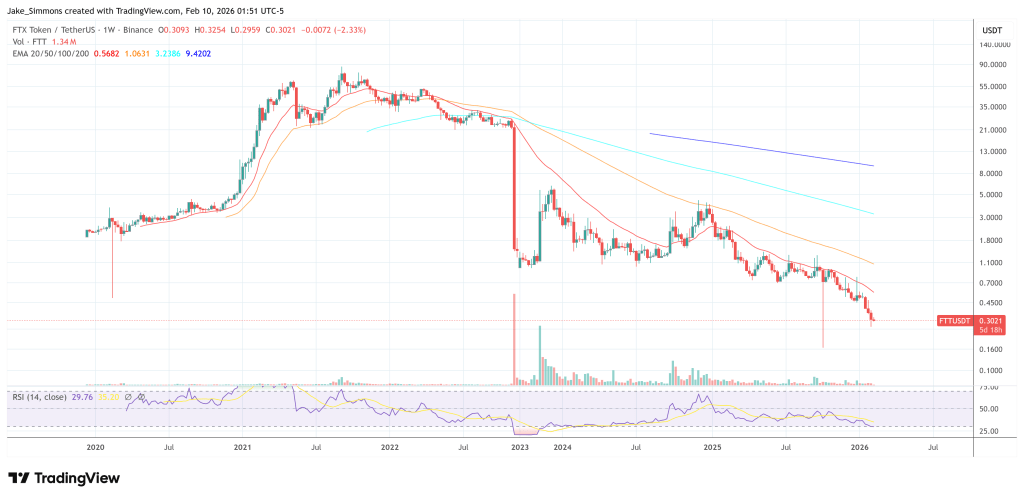
FTT continues its freefall, 1-week chart | Source: FTTUSDT on TradingView.com

Perguntas relacionadas

QWhat is the main argument in his recent X thread regarding his criminal case?

AHe argues that his criminal case is 'Biden's political lawfare,' claiming the Biden administration prevented him from presenting evidence and responding to the charges.

QWho did SBF specifically single out as being responsible for curtailing what the jury could hear in his trial?

AHe singled out Judge Lewis Kaplan, claiming the judge 'rubber-stamped everything Biden's DOJ wanted' and ensured he 'couldn't show the jury the truth.'

QWhat does SBF claim was the 'truth' about FTX that he was prevented from presenting in court?

AHe claims the 'truth' was that 'the money was always there and FTX was always solvent,' and he was prohibited from pointing this out or even mentioning lawyers.

QHow does SBF attempt to draw a parallel between his own case and that of former President Donald Trump?

AHe draws a parallel by claiming both were subjected to Biden's 'lawfare machine,' faced gag orders and pre-trial detention, and were prevented from presenting evidence, noting that Trump also had Judge Kaplan in one of his cases.

QHow did some industry figures interpret SBF's thread, according to the article?

AIndustry figures like trader Bob Loukas and attorney Ariel Givner interpreted it less as a legal critique and more as a political pitch, specifically an attempt to angle for a pardon from Donald Trump.

Leituras Relacionadas

Five Counterparty Risk Architectures: A Settlement-Layer Methodology for Classifying TradFi Models in Crypto Exchanges

**Summary:** This companion piece reframes the five TradFi-on-crypto exchange architectures, previously classified by "architectural fingerprint," through the lens of counterparty risk. The core question is: whose balance sheet bears the loss first in a stress scenario, and has it historically done so? Each of the five models corresponds to a distinct risk holder with its own documented failure modes. * **Model 1 (Stablecoin-Settled CEX Perpetuals):** Risk is held by the stablecoin issuer (e.g., reserve composition, bank connectivity) and the CEX's own book. History includes Tether's banking disconnections (2017) and reserve misrepresentations (CFTC 2021 Order). * **Model 2 (CFD Brokers):** Risk resides on the broker's balance sheet (B-book model). Regulatory differences (e.g., ESMA's mandatory negative balance protection vs. Mauritius FSC's lack thereof) define loss allocation rules, as seen in the 2015 SNB event (Alpari UK insolvency). * **Model 3 (Off-Chain Custody & Transfer Agent Chain):** Risk lies with the off-chain custodian/platform. User asset recovery depends on Terms of Use and corporate structure, exemplified by the Celsius bankruptcy ruling (2023) where Earn Account assets were deemed property of the estate. * **Model 4 (DEX Perpetual Protocols):** No single balance sheet bears risk. Loss absorption relies on a protocol's insurance fund and Auto-Deleveraging (ADL) mechanism, as demonstrated in the GMX V1 (2022) and dYdX v3 YFI (2023) incidents. * **Model 5 (Regulated CCP - DCM-DCO-FCM):** The most institutionalized model concentrates risk in the Central Counterparty (CCP). However, history shows CCPs can employ non-standard tools under extreme stress, such as mass trade cancellation (LME Nickel, 2022) or enabling negative price settlements (CME WTI, 2020). The report argues that regulatory choices and counterparty risk structures are co-extensive, not in an upstream-downstream relationship. It concludes with five separate observation checklists (not predictions) for monitoring the structural vulnerabilities of each risk model.

marsbitHá 16m

Five Counterparty Risk Architectures: A Settlement-Layer Methodology for Classifying TradFi Models in Crypto Exchanges

marsbitHá 16m

Trading

Spot
Futuros
活动图片





