Connecticut can’t take action against Kalshi for now, judge rules

cointelegraphPublicado em 2025-12-10Última atualização em 2025-12-10

Resumo

A US judge has temporarily blocked Connecticut from taking enforcement action against prediction markets platform Kalshi, which received a cease and desist order from the state’s Department of Consumer Protection (DCP) for allegedly conducting unlicensed sports gambling. Kalshi sued the DCP, arguing its event contracts are legal under federal law and fall under the exclusive jurisdiction of the Commodity Futures Trading Commission. The court has paused enforcement while it reviews Kalshi’s motion for a preliminary injunction, with further legal proceedings scheduled through February. Kalshi, a CFTC-regulated platform that saw record trading volume in November, is also engaged in similar legal battles with multiple states, including New York, Massachusetts, New Jersey, Nevada, Maryland, and Ohio, over regulatory jurisdiction and gambling licensing.

A US judge has granted prediction markets platform Kalshi a temporary reprieve from enforcement after the state of Connecticut sent it a cease and desist order last week for allegedly conducting unlicensed gambling.

The Connecticut Department of Consumer Protection (DCP) sent Kalshi, along with Robinhood and Crypto.com, cease and desist orders on Dec. 2, accusing them of “conducting unlicensed online gambling, more specifically sports wagering, in Connecticut through its online sports event contracts.”

Kalshi sued the DCP a day later, arguing its event contracts “are lawful under federal law” and its platform was subject to the Commodity Futures Trading Commission’s “exclusive jurisdiction,” and filed a motion on Friday to temporarily stop the DCP’s action.
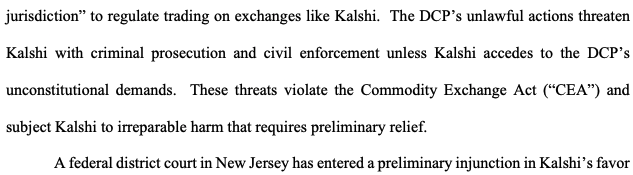
An excerpt from Kalshi’s preliminary injunction motion arguing that the DCP’s action violates federal commodities laws. Source: CourtListener

Connecticut federal court judge Vernon Oliver said in an order on Monday that the DCP must “refrain from taking enforcement action against Kalshi” as the court considers the company’s bid to temporarily stop the regulator.

The order adds that the DCP should file a response to the company by Jan. 9 and Kalshi should file further support for its motion by Jan. 30, with oral arguments for the case to be held in mid-February.

Kalshi is in a battle with multiple US states

Kalshi is a federally regulated designated contract maker under the CFTC and, in January, began offering contracts nationally that allow bets on the outcome of events such as sports and politics.

Related: How prediction markets raise insider trading and credit risks

Its platform has become hugely popular this year and saw a record $4.54 billion monthly trading volume in November, attracting billions in investments, with Kalshi closing a $1 billion funding round earlier this month at a valuation of $11 billion.

However, multiple US state regulators have taken issue with Kalshi’s offerings, which have led to the company being embroiled in lawsuits over whether it is subject to state-level gambling laws.

Kalshi sued the New York State Gaming Commission in October after the regulator sent a cease and desist order claiming it offered a platform for sports wagering without a license.

In September, Massachusetts’ state attorney general sued Kalshi in state court, which the company asked to be tossed. So far this year, Kalshi has sued state regulators in New Jersey, Nevada, Maryland and Ohio, accusing each of regulatory overreach.

Magazine: Can Robinhood or Kraken’s tokenized stocks ever be truly decentralized?

Criptomoedas em alta

Leituras Relacionadas

Bitcoin Withdrawals Continue: 8 Years of Storage in a Coldcard Cold Wallet Ended in Zero

Coldcard Hardware Wallet Hacked: Losses Mount Due to Vulnerable Seed Generation A critical vulnerability in Coldcard hardware wallets has led to a continued wave of fund thefts. According to Galaxy Research, the total stolen has reached 1,367.05 BTC (approx. $88.6 million) from 4,585 addresses, a significant increase from the initial 594.5 BTC reported on July 30, 2026. Most of the stolen funds remain on the attackers' addresses. The issue is not with the current firmware, which Coinkite has updated, but with seed phrases generated on vulnerable devices between March 2021 and the release of fixed firmware versions. Due to a programmer error, devices switched from using a hardware random number generator to the software-based Yasmarang generator, which was initialized with publicly accessible data like the chip's serial number. This made the seed phrases predictable through offline brute-force attacks, meaning wallets remain at risk until funds are moved to a new wallet generated with the patched firmware. Affected devices include Mk2/Mk3 with firmware 4.0.1–4.1.9 (and up to 5.0.3), Mk4/Mk5 up to version 5.6.0, and Q models up to 1.5.0Q. The only exceptions are seeds created with a high-entropy method like at least 50 independent dice rolls or a strong unique BIP-39 passphrase. All other owners must generate a new seed on the fixed firmware and transfer their assets. A case highlighting the human impact involves a 39-year-old long-term investor who lost 2 BTC (approx. $130,000) in minutes. He had accumulated the Bitcoin over eight years through physical labor, viewing it as a financial lifeline and a retirement plan in a country suffering from hyperinflation. His story underscores that even conservative "buy and hold in cold storage" strategies can be compromised by such underlying technical flaws. From a technical perspective, this incident echoes historical failures where weak random number generators undermined cryptographic security, challenging the assumption that offline storage is automatically foolproof.

cryptonews.ruHá 12m

Bitcoin Withdrawals Continue: 8 Years of Storage in a Coldcard Cold Wallet Ended in Zero

cryptonews.ruHá 12m

Trading

Spot

Artigos em Destaque

Como comprar T

Bem-vindo à HTX.com!Tornámos a compra de Threshold Network Token (T) simples e conveniente.Segue o nosso guia passo a passo para iniciar a tua jornada no mundo das criptos.Passo 1: cria a tua conta HTXUtiliza o teu e-mail ou número de telefone para te inscreveres numa conta gratuita na HTX.Desfruta de um processo de inscrição sem complicações e desbloqueia todas as funcionalidades.Obter a minha contaPasso 2: vai para Comprar Cripto e escolhe o teu método de pagamentoCartão de crédito/débito: usa o teu visa ou mastercard para comprar Threshold Network Token (T) instantaneamente.Saldo: usa os fundos da tua conta HTX para transacionar sem problemas.Terceiros: adicionamos métodos de pagamento populares, como Google Pay e Apple Pay, para aumentar a conveniência.P2P: transaciona diretamente com outros utilizadores na HTX.Mercado de balcão (OTC): oferecemos serviços personalizados e taxas de câmbio competitivas para os traders.Passo 3: armazena teu Threshold Network Token (T)Depois de comprar o teu Threshold Network Token (T), armazena-o na tua conta HTX.Alternativamente, podes enviá-lo para outro lugar através de transferência blockchain ou usá-lo para transacionar outras criptomoedas.Passo 4: transaciona Threshold Network Token (T)Transaciona facilmente Threshold Network Token (T) no mercado à vista da HTX.Acede simplesmente à tua conta, seleciona o teu par de trading, executa as tuas transações e monitoriza em tempo real.Oferecemos uma experiência de fácil utilização tanto para principiantes como para traders experientes.

540 Visualizações TotaisPublicado em {updateTime}Atualizado em 2026.06.02

Como comprar T

Discussões

Bem-vindo à Comunidade HTX. Aqui, pode manter-se informado sobre os mais recentes desenvolvimentos da plataforma e obter acesso a análises profissionais de mercado. As opiniões dos utilizadores sobre o preço de T (T) são apresentadas abaixo.

活动图片













