Commerce Ministry's Latest Export Controls Target 10 US Companies: Three Market-Moving Threads Explained

marsbitPublicado em 2026-06-22Última atualização em 2026-06-22

Resumo

China's Ministry of Commerce placed 10 U.S. entities, including MP Materials, USA Rare Earth, Red Cat Holdings, and Teal Drones, on an export control list, banning the export of dual-use items. This move is seen as part of an ongoing countermeasure in the rare earth sector. The analysis suggests the primary impact is on U.S. companies within the **military, drone, and rare earth** sectors, aiming to restrict their access to critical Chinese materials and technology. For the Chinese market, the event is interpreted as reinforcing the **strategic value and pricing power** of domestic rare earth suppliers. However, the potential stock market reactions are nuanced: 1. **Chinese Rare Earth Upstream:** Companies like Northern Rare Earth are near yearly highs, indicating this event's "beneficiary" logic is largely priced in. It may confirm the trend but is unlikely to be a new major catalyst. 2. **Chinese Rare Earth Mid/Downstream & Drones:** Sectors like magnetic materials (e.g., Da Di Bear, Zhenghai Magnetic) and military drones (e.g., China Aerospace) are relatively undervalued. While the drone listing highlights sectoral competition, it doesn't directly translate to new orders for Chinese firms. 3. **Impact on Listed U.S. Companies:** The effect on stocks like MP Materials is ambiguous. While Chinese restrictions pose a challenge, these companies are also core to U.S. supply chain security efforts and may receive increased government support, potentially offsetting negative...

Author: David, Chao Xiang Research

On June 22nd, the Ministry of Commerce issued Announcement No. 23 of 2026, adding 10 U.S. entities including Ivex, Red Cat Holdings, and MP Materials to the export control list, prohibiting the export of dual-use items to them; on the same day, an additional 46 U.S. companies were added to the government procurement restriction list.

(Author's note: Dual-use items refer to goods, technologies, and services that have both civilian and military applications or can enhance military potential.)

This marks another round in the normalization of China's rare earth countermeasures since October 2025. The 10 targeted U.S. companies are primarily concentrated in three sectors: defense, drones, and rare earths.

The two most prominent names on the list are MP Materials and USA Rare Earth, both flagships of the U.S. rare earth industry. China's action against them prompted the market's initial reaction to favor the A-share rare earth sector: with competitors being restricted, domestic players gain greater scarcity and value.

The question is, the rare earth sector has been rising from last October until now, with leading upstream companies already near their year-to-date highs. Is it too late to react now?

If it is late, where might the money go?

The Commerce Ministry's control list involves more than just the rare earth thread. The fully appreciated rare earth sector might still have further catalysts ahead, and overlooked, less popular threads might still be under the radar.

We attempt to outline the potentially affected threads and place them on a price coordinate for reference.

Key Conclusions

1 The upstream A-share rare earth sector is fully priced-in; this control measure is not a new catalyst.

Northern Rare Earth's current price of 52.9 yuan is only about 20% away from its one-year high of 63.6 yuan; Guangdong Rising Nonferrous Metals at 115 yuan and Shenghe Resources at 33.6 yuan are both close to their one-year highs. These upstream resource stocks have been trending upward since October last year, and the logic of "benefiting from rare earth countermeasures" has largely been priced in. For the upstream rare earth industry, this control measure is more of a reconfirmation of the trend rather than a new starting point for a rally.

2 The relatively underpriced segments are the mid-to-downstream rare earth magnet materials and the drone industry chain.

Within the same rare earth chain, valuations in the midstream and downstream are significantly lower than upstream:

Magnet sector players like Earth-Panda (30.7 yuan) and Sinomag (13.7 yuan) are still near the lower end of their one-year ranges, their gains notably lagging behind upstream resource stocks. The drone sector corresponding to Red Cat and Teal Drones on the control list is even quieter, with Avic UAS near its one-year low and receiving limited market attention. The pricing progress of various segments is not uniform under the same event.

3 The targeted U.S. stocks do not necessarily constitute a one-sided negative; the open market needs to verify.

MP Materials and USA Rare Earth are core players in the U.S. domestic rare earth supply chain, with MP having background investment from the U.S. Department of Defense.

For such companies, China's export controls and U.S. policy support are two coexisting forces, and their impact directions may not align. All three mentioned stocks were not at low levels before the announcement. The announcement was made on Monday before U.S. markets opened, so their true pricing reaction awaits the market's verdict.

Investors holding related positions should pay close attention to the post-open price action.

Why Do Export Controls Benefit Domestic Rare Earths?

Many find it counterintuitive at first glance: banning exports means Chinese businesses do less trade, so how is that a positive?

The key lies in the direction of the control. This ban prevents China from selling rare earth-related items to those 10 U.S. companies, cutting off the supply sources for these American firms, not the raw material procurement for Chinese manufacturers.

China's rare earth industry, from mining, smelting, and separation to magnet manufacturing, is the world's most complete chain, self-sufficient and not reliant on sourcing from the U.S. In other words, this announcement does not affect Chinese suppliers' upstream operations; they can produce and export as usual.

It's the U.S. side that is truly pinched.

Companies like MP Materials and USA Rare Earth want to build a self-reliant supply chain bypassing China, yet they still depend on China for separation technology, equipment, and some intermediate materials. Restricting competitors' access conversely enhances the scarcity and bargaining power of Chinese companies within the global rare earth landscape, which is the real reason the market interprets this as positive for A-share rare earths.

Rare Earth Upstream is Fully Priced; Money Hasn't Flowed Downstream

First, clarify the chain. Rare earths are mined, then smelted and separated into materials like praseodymium-neodymium oxide; this is the upstream, handled by companies like Northern Rare Earth, Guangdong Rising Nonferrous Metals, and Shenghe Resources.

These raw materials are further processed into NdFeB permanent magnet materials and installed into various motors; this is the midstream and downstream, where JL Mag, Sinomag, and Earth-Panda operate.

The upstream sells raw materials; the downstream sells magnet materials.

In this round of market movement, money primarily surged into the upstream. Northern Rare Earth at 52.9 yuan, Guangdong Rising Nonferrous Metals at 115 yuan, and Shenghe Resources at 33.6 yuan are all near their one-year highs. The logic is straightforward: every time rare earths' strategic importance is emphasized, the first beneficiaries are the upstream players with mines and smelting capacity, whose scarcity is tangible.

In my view, this control event is a positive in the same direction for the upstream, but the price has already digested this expectation. Entering now is more like taking over at high levels, offering less favorable risk-reward.
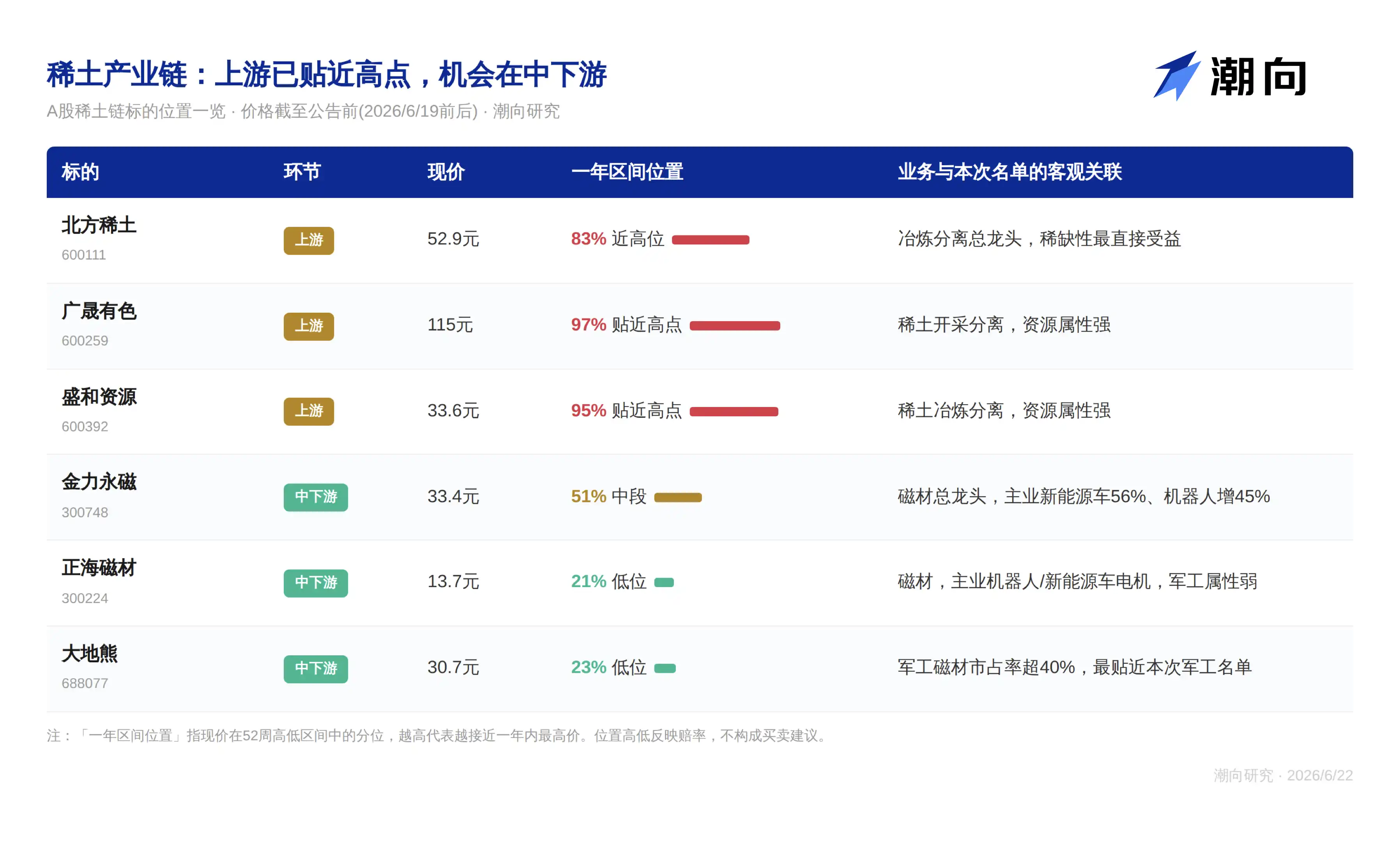
Moving downstream to magnet materials, the pricing progress is noticeably slower.

Among the three magnet leaders, JL Mag, with 7.7 billion yuan in revenue and doubled net profit, saw its 2025 stock price rise over 90%, placing it at a high level. However, Sinomag and Earth-Panda are still pressed near the lower end of their one-year price ranges, not catching up with the upstream gains.

There is a background detail easily overlooked:

Since the second half of 2025, China has opened up exports to U.S. magnet manufacturers. For instance, JL Mag's U.S. sales reached 500 million yuan for the full year, up 40%; Sinomag and Earth-Panda also obtained U.S. export licenses. China's addition of 10 companies to the control list this time is a precise move under the framework of "allowing ordinary commercial customers while cutting off specific defense entities," not a comprehensive embargo.

Therefore, the impact of this logic on magnet companies' financial statements is actually limited.

The 10 restricted U.S. companies were not among their major clients to begin with. The real revenue for JL Mag and Sinomag comes from new energy vehicle and robot motors, largely unrelated to defense exports to the U.S.

This control measure is more of a sentiment boost for the magnet stock sector, unlikely to translate into tangible orders. However, regarding the rare earth downstream, what's truly noteworthy might be which company's business aligns more closely with the defense theme of this list.
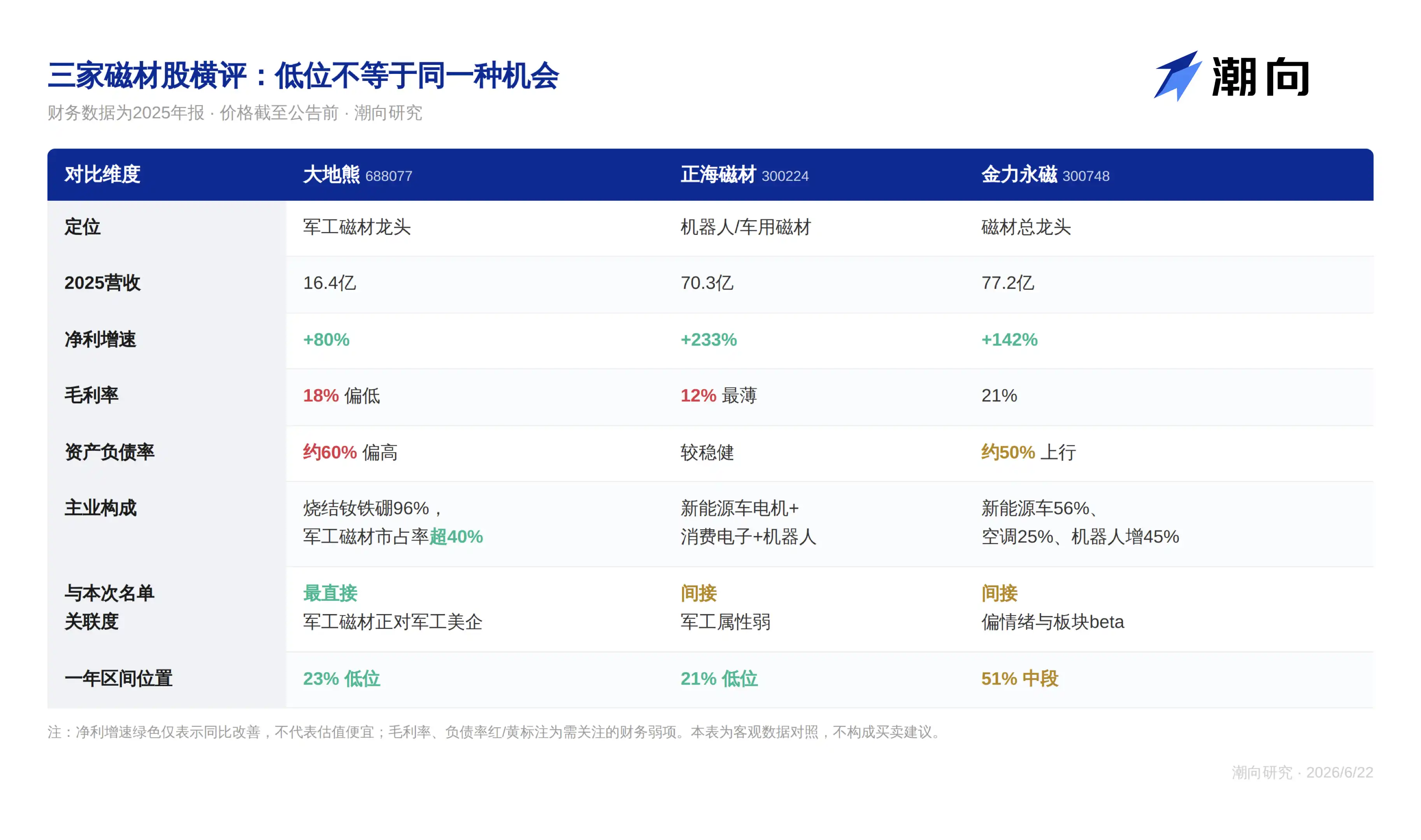
On this point, Earth-Panda aligns better than the other two.

Earth-Panda has a small market cap, with 2025 revenue of 1.6 billion yuan and net profit of 57.4 million yuan. However, it is a major domestic supplier of defense magnet materials, with publicly available data showing over 40% market share in this segment. Its products are used in equipment like aero engines and missiles, directly corresponding to the targeted defense and drone U.S. companies on the control list. This is its most direct narrative link to the event.

However, narrative alignment doesn't equal stability: financially, its gross margin is only 18%, and its debt ratio is nearing 60%, indicating weaker profitability and financial safety compared to peers. Combined with its small market cap, its stock price can bounce up quickly but also plummet sharply.

It suits those who can tolerate volatility and prioritize "purest theme," not as a cornerstone holding.

Sinomag represents another type. Its 2025 net profit more than tripled, a reversal much stronger than Earth-Panda's, but driven by humanoid robots and new energy vehicle motors, largely unrelated to this defense list. Its low price is more due to the robotics story not being fully priced in by the market yet.

Therefore, reading the rare earth thread reveals two different situations upstream and downstream.

Upstream holds resources with the most tangible scarcity, but prices have already reflected the positives; it's now a high-level handoff. Downstream magnet materials are still at low levels. Earth-Panda aligns more with the defense list, at the cost of a small market cap and weak finances. Sinomag is cheap but has weak relevance.

Drones: The List Points to This Thread, But No Direct Positive

Red Cat Holdings and its subsidiary Teal Drones on the control list produce military reconnaissance and strike drones in the U.S., exactly the type of military drone suppliers the U.S. aims to support to replace Chinese products.

The market naturally associates this with the A-share military drone sector, but the positive logic here is likely not the same as for rare earths. This won't directly bring orders to any specific Chinese drone company. It's more about bringing "Sino-U.S. competition in military drones" to the forefront, prompting the market to refocus on the strategic value and military export competitiveness of domestic military drones.

Following this thread to find corresponding A-share targets, the most business-aligned company is Avic UAS.

Avic UAS is a leader in large domestic military drones. Its core product is the Wing Loong series of reconnaissance-strike integrated drones, with drone systems accounting for over 90% of its main revenue. It primarily exports through military trade, being a main force in China's military drone exports.

In terms of business alignment, it indeed competes in the same arena as the targeted U.S. drone companies, making it the highest relevance play on this thread.

Its current price is 44 yuan, at the lower end of its one-year range. However, this position formed after a decline from highs, not from a lack of movement.

Its 2025 financial report shows significant performance growth with military trade orders, with revenue in the first three quarters more than tripling year-on-year, and the stock price once reached 48 yuan. The current pullback is more akin to cooling off after realization.

It's important to note that military trade revenue heavily depends on single large orders. Revenue fell nearly 70% year-on-year in 2024, turning to a loss, then rebounded strongly in 2025. This boom-bust characteristic means judging its cheapness based on price position is unreliable. The real variable is the signing and delivery rhythm of subsequent military trade orders. Valuation-wise, the company's P/E ratio has long been in the tens, not constituting undervaluation.

Export Restrictions Do Not Equate to Pure Negatives for Corresponding U.S. Stocks

This is the primary concern for holders of related U.S. stocks, and the answer might differ from intuition: not necessarily.

The most significant names on the export control list, MP Materials and USA Rare Earth, are core vehicles for the U.S. to reduce its reliance on Chinese rare earths. MP is the only vertically integrated rare earth producer of scale in the U.S., receiving investment from the U.S. Department of Defense in 2025, making it an object of national strategic support. This status determines its dual-sided situation:

China cuts off its access to Chinese dual-use items, but precisely due to supply chain security concerns, the U.S. government might instead provide it with more orders and subsidies.

Pre-announcement prices also support this view. MP, USA Rare Earth, and Red Cat Holdings were not at low levels before the control news emerged. The market did not sell off in advance due to "potential sanctions," indicating investors had not previously priced them simply as victims.

Of course, the final direction depends on the market opening. The announcement was made on Monday before U.S. markets opened. Whether sanctions are read as a material negative or offset by support expectations will be answered by post-open trading.
Note: This article is for information organization and viewpoint analysis. The mentioned stocks, ratings, and target prices are from public sources and are time-sensitive, constituting no investment advice. The market involves risks; decisions require independent judgment.


Criptomoedas em alta

Perguntas relacionadas

QAccording to the article, which A-share sectors are most impacted by China's new export controls on 10 US companies, and what is their current market pricing situation?

AThe export controls primarily impact three A-share sectors: 1) Rare Earth Upstream (e.g., Northern Rare Earth, Guang Sheng Nonferrous): These stocks are already trading near their yearly highs, meaning the 'benefit from export controls' logic is largely priced in. 2) Rare Earth Mid/Downstream (Magnet materials like Da Di Bear, Zhenghai Magnetic Material): These are still at the lower end of their yearly price range, with valuations significantly lagging behind upstream stocks. 3) Drone Sector (e.g., AVIC UAV): Specifically, military drones like AVIC UAV are mentioned as thematically related to the sanctioned US drone companies, but the stock is near its yearly low without a direct order boost from this event.

QWhy does the article suggest that the export controls could be a positive for China's rare earth sector, even though it restricts business?

AThe controls restrict Chinese companies from selling dual-use items *to* the 10 listed US firms, cutting off their supply sources. Since China's rare earth sector has a complete, self-sufficient supply chain and does not rely on raw materials from the US, its production is unaffected. By constraining key US competitors like MP Materials and USA Rare Earth (which still depend on some Chinese technology/inputs), the controls enhance the scarcity and bargaining power of Chinese rare earth suppliers in the global market, which is interpreted as a positive for the sector.

QAmong the rare earth magnet material (downstream) companies mentioned, which one is highlighted as having the most direct thematic link to the US entities on the sanctions list, and what are the associated risks?

ADa Di Bear (大地熊) is highlighted as having the most direct link because it is a major domestic supplier of rare earth magnets for military applications (e.g., aircraft engines, missiles), aligning with the sanctioned US defense and drone companies. The associated risks are its smaller market capitalization, weaker financials (lower gross margin, higher debt ratio), and higher stock price volatility, making it suitable only for investors who can tolerate high risk and prioritize thematic purity.

QWhat is the article's assessment of the potential impact on the US companies (like MP Materials) added to the export control list? Is it purely negative?

ANo, the impact is not necessarily purely negative. The article argues that for core US strategic companies like MP Materials (which has US Department of Defense investment), the situation is two-sided. While Chinese export controls cut off access to certain Chinese dual-use items, these companies are also central to US efforts to build domestic supply chains. This strategic importance may lead to increased US government orders, subsidies, and policy support, which could counteract the negative impact of the sanctions. The market's pre-announcement pricing (these stocks were not at lows) also suggested investors hadn't priced them as simple victims.

QRegarding the drone sector, which A-share company is considered the most thematically aligned with the sanctioned US drone firms, and what key factor drives its investment value according to the article?

AAVIC UAV (中无人机) is considered the most thematically aligned, as its core product, the Wing Loong series of military reconnaissance/strike drones, competes directly in the same military export market as the sanctioned US companies (Red Cat, Teal Drones). However, the article states the export controls do not directly translate into new orders for AVIC UAV. Its investment value is primarily driven by the rhythm of subsequent military export order signings and deliveries, not its current stock price level. The company's revenue is characterized by significant year-to-year fluctuations based on large individual contracts.

Leituras Relacionadas

A Company Once on the Brink of Bankruptcy Just Surpassed Bitcoin in Market Cap

On June 22nd, driven by rising stock prices, SK Hynix’s market capitalization reached $1.35 trillion, surpassing Bitcoin's total market cap of approximately $1.29 trillion. This temporarily made it South Korea's highest-valued company. The core driver of this surge is HBM (High Bandwidth Memory), for which SK Hynix is the primary supplier to NVIDIA, holding over 60% market share. AI's demand for high memory bandwidth has translated into immense profitability, with SK Hynix reporting a 72% operating profit margin in Q1. The company's success follows a 13-year bet on HBM technology, beginning in 2009. It nearly failed after the 2001 dot-com bubble, was acquired by SK Group in 2012, and was subsequently recapitalized to continue its long-term HBM development. The article contrasts this with the Crypto AI narrative. Capital currently favors AI infrastructure players like SK Hynix due to "real orders, physical barriers, and quantifiable profit margins." In comparison, Crypto AI projects, promising decentralized compute and data markets, remain largely conceptual with limited tangible progress. Examples include Bittensor, whose core mechanisms are still under development, and Bitcoin miners transitioning to AI, who face significant funding gaps and execution challenges. The piece cites analysis suggesting the AI sector has absorbed nearly all new market liquidity since 2022, leaving little for crypto. It concludes that the current AI infrastructure红利 is captured by entities with proven technical barriers and supply capabilities, while crypto networks still need to define their concrete role in the value chain.

链捕手Há 22m

A Company Once on the Brink of Bankruptcy Just Surpassed Bitcoin in Market Cap

链捕手Há 22m

Bittensor Moves Towards Ultimate Decentralization: The Critical 18 Months for the TAO Ecosystem is Here?

Bittensor, a decentralized AI protocol, is accelerating its transition to full decentralization over the next 18 months, as outlined in a recent post by co-founder Const. The project currently operates in a "semi-decentralized" state: ownership and network participation are open and permissionless, with TAO distribution based on competitive contribution. However, protocol upgrades and governance have remained under core team control to enable rapid iteration in the fast-evolving AI sector. This strategic shift comes as the ecosystem matures, boasting 128 subnets and a large community. Const argues that continued centralization now poses risks, including single points of failure and regulatory scrutiny. The upcoming decentralization roadmap includes optimizing validator competition, opening liquidity pools, introducing governance rights for Alpha holders, and refining economic models. The move could fundamentally reshape TAO's value proposition, adding governance premiums to its existing valuation based on AI narrative and scarcity. It also signals a potential maturation of the AI crypto sector, where competition may shift from hype to sustainable protocol design and real economic activity. Bittensor positions itself not just as another AI token, but as foundational infrastructure aiming to decentralize intelligence production—analogous to Bitcoin's role in decentralizing money—with the goal of creating a resilient "Millennium Intelligence Federation."

marsbitHá 35m

Bittensor Moves Towards Ultimate Decentralization: The Critical 18 Months for the TAO Ecosystem is Here?

marsbitHá 35m

Japan's AI Dark Horse Emerges: How a 7B Small Model Challenges Fable and Mythos?

In June 2026, Sakana AI's new model Fugu caused a stir in the AI community. Its Fugu Ultra variant achieved scores of 73.7 on SWE-Bench Pro and 82.1 on TerminalBench 2.1, surpassing GPT-5.5 and Claude Opus 4.8, and was claimed to be comparable to export-restricted models like Fable 5 and Mythos Preview. Remarkably, the core of this high-performance system is not a massive model, but a small 7B-parameter RL Conductor model. Fugu operates as a multi-agent orchestrator: the 7B model acts as a "foreman," dynamically analyzing user tasks and delegating subtasks to a pool of top-tier global models (e.g., GPT-5, Gemini 3.1 Pro). It then synthesizes and verifies their outputs. This architecture represents a paradigm shift from monolithic models to an expert-team approach. It enhances performance in complex, multi-step engineering tasks like code review and security testing by enabling cross-validation from specialized models, improving long-session stability and token efficiency. However, Fugu's strengths come with trade-offs: it faces inherent latency due to multiple API calls, relies heavily on underlying US model APIs (creating dependency risks), and its benchmark comparisons with Fable/Mythos are based on reported scores, not head-to-head testing. For Japan's AI ecosystem, which lacks the massive compute and data resources of the US or China, Fugu exemplifies an "asymmetric breakthrough" strategy. Instead of competing directly in parameter scale, it focuses on intelligent orchestration of existing global models, offering a degree of AI sovereignty and resilience. While a significant system-level innovation, its ultimate capability is still bounded by the underlying models it coordinates.

marsbitHá 35m

Japan's AI Dark Horse Emerges: How a 7B Small Model Challenges Fable and Mythos?

marsbitHá 35m

Trading

Spot
Futuros

Artigos em Destaque

O que é $S$

Compreender o SPERO: Uma Visão Abrangente Introdução ao SPERO À medida que o panorama da inovação continua a evoluir, o surgimento de tecnologias web3 e projetos de criptomoeda desempenha um papel fundamental na formação do futuro digital. Um projeto que tem atraído atenção neste campo dinâmico é o SPERO, denotado como SPERO,$$s$. Este artigo tem como objetivo reunir e apresentar informações detalhadas sobre o SPERO, para ajudar entusiastas e investidores a compreender as suas bases, objetivos e inovações nos domínios web3 e cripto. O que é o SPERO,$$s$? O SPERO,$$s$ é um projeto único dentro do espaço cripto que procura aproveitar os princípios da descentralização e da tecnologia blockchain para criar um ecossistema que promove o envolvimento, a utilidade e a inclusão financeira. O projeto é concebido para facilitar interações peer-to-peer de novas maneiras, proporcionando aos utilizadores soluções e serviços financeiros inovadores. No seu núcleo, o SPERO,$$s$ visa capacitar indivíduos ao fornecer ferramentas e plataformas que melhoram a experiência do utilizador no espaço das criptomoedas. Isso inclui a possibilidade de métodos de transação mais flexíveis, a promoção de iniciativas impulsionadas pela comunidade e a criação de caminhos para oportunidades financeiras através de aplicações descentralizadas (dApps). A visão subjacente do SPERO,$$s$ gira em torno da inclusão, visando fechar lacunas dentro das finanças tradicionais enquanto aproveita os benefícios da tecnologia blockchain. Quem é o Criador do SPERO,$$s$? A identidade do criador do SPERO,$$s$ permanece algo obscura, uma vez que existem recursos publicamente disponíveis limitados que fornecem informações detalhadas sobre o(s) seu(s) fundador(es). Esta falta de transparência pode resultar do compromisso do projeto com a descentralização—uma ética que muitos projetos web3 partilham, priorizando contribuições coletivas em vez de reconhecimento individual. Ao centrar as discussões em torno da comunidade e dos seus objetivos coletivos, o SPERO,$$s$ incorpora a essência do empoderamento sem destacar indivíduos específicos. Assim, compreender a ética e a missão do SPERO é mais importante do que identificar um criador singular. Quem são os Investidores do SPERO,$$s$? O SPERO,$$s$ é apoiado por uma diversidade de investidores que vão desde capitalistas de risco a investidores-anjo dedicados a promover a inovação no setor cripto. O foco desses investidores geralmente alinha-se com a missão do SPERO—priorizando projetos que prometem avanço tecnológico social, inclusão financeira e governança descentralizada. Essas fundações de investidores estão tipicamente interessadas em projetos que não apenas oferecem produtos inovadores, mas que também contribuem positivamente para a comunidade blockchain e os seus ecossistemas. O apoio desses investidores reforça o SPERO,$$s$ como um concorrente notável no domínio em rápida evolução dos projetos cripto. Como Funciona o SPERO,$$s$? O SPERO,$$s$ emprega uma estrutura multifacetada que o distingue de projetos de criptomoeda convencionais. Aqui estão algumas das características-chave que sublinham a sua singularidade e inovação: Governança Descentralizada: O SPERO,$$s$ integra modelos de governança descentralizada, capacitando os utilizadores a participar ativamente nos processos de tomada de decisão sobre o futuro do projeto. Esta abordagem promove um sentido de propriedade e responsabilidade entre os membros da comunidade. Utilidade do Token: O SPERO,$$s$ utiliza o seu próprio token de criptomoeda, concebido para servir várias funções dentro do ecossistema. Esses tokens permitem transações, recompensas e a facilitação de serviços oferecidos na plataforma, melhorando o envolvimento e a utilidade gerais. Arquitetura em Camadas: A arquitetura técnica do SPERO,$$s$ suporta modularidade e escalabilidade, permitindo a integração contínua de funcionalidades e aplicações adicionais à medida que o projeto evolui. Esta adaptabilidade é fundamental para manter a relevância no panorama cripto em constante mudança. Envolvimento da Comunidade: O projeto enfatiza iniciativas impulsionadas pela comunidade, empregando mecanismos que incentivam a colaboração e o feedback. Ao nutrir uma comunidade forte, o SPERO,$$s$ pode melhor atender às necessidades dos utilizadores e adaptar-se às tendências do mercado. Foco na Inclusão: Ao oferecer taxas de transação baixas e interfaces amigáveis, o SPERO,$$s$ visa atrair uma base de utilizadores diversificada, incluindo indivíduos que anteriormente podem não ter participado no espaço cripto. Este compromisso com a inclusão alinha-se com a sua missão abrangente de empoderamento através da acessibilidade. Cronologia do SPERO,$$s$ Compreender a história de um projeto fornece insights cruciais sobre a sua trajetória de desenvolvimento e marcos. Abaixo está uma cronologia sugerida que mapeia eventos significativos na evolução do SPERO,$$s$: Fase de Conceituação e Ideação: As ideias iniciais que formam a base do SPERO,$$s$ foram concebidas, alinhando-se de perto com os princípios de descentralização e foco na comunidade dentro da indústria blockchain. Lançamento do Whitepaper do Projeto: Após a fase conceitual, um whitepaper abrangente detalhando a visão, os objetivos e a infraestrutura tecnológica do SPERO,$$s$ foi lançado para atrair o interesse e o feedback da comunidade. Construção da Comunidade e Primeiros Envolvimentos: Esforços ativos de divulgação foram feitos para construir uma comunidade de primeiros adotantes e investidores potenciais, facilitando discussões em torno dos objetivos do projeto e angariando apoio. Evento de Geração de Tokens: O SPERO,$$s$ realizou um evento de geração de tokens (TGE) para distribuir os seus tokens nativos a apoiantes iniciais e estabelecer liquidez inicial dentro do ecossistema. Lançamento da dApp Inicial: A primeira aplicação descentralizada (dApp) associada ao SPERO,$$s$ foi lançada, permitindo que os utilizadores interagissem com as funcionalidades principais da plataforma. Desenvolvimento Contínuo e Parcerias: Atualizações e melhorias contínuas nas ofertas do projeto, incluindo parcerias estratégicas com outros players no espaço blockchain, moldaram o SPERO,$$s$ em um jogador competitivo e em evolução no mercado cripto. Conclusão O SPERO,$$s$ é um testemunho do potencial do web3 e das criptomoedas para revolucionar os sistemas financeiros e capacitar indivíduos. Com um compromisso com a governança descentralizada, o envolvimento da comunidade e funcionalidades inovadoras, abre caminho para um panorama financeiro mais inclusivo. Como em qualquer investimento no espaço cripto em rápida evolução, potenciais investidores e utilizadores são incentivados a pesquisar minuciosamente e a envolver-se de forma ponderada com os desenvolvimentos em curso dentro do SPERO,$$s$. O projeto demonstra o espírito inovador da indústria cripto, convidando a uma exploração mais aprofundada das suas inúmeras possibilidades. Embora a jornada do SPERO,$$s$ ainda esteja a desenrolar-se, os seus princípios fundamentais podem, de facto, influenciar o futuro de como interagimos com a tecnologia, as finanças e uns com os outros em ecossistemas digitais interconectados.

72 Visualizações TotaisPublicado em {updateTime}Atualizado em 2024.12.17

O que é $S$

O que é AGENT S

Agent S: O Futuro da Interação Autónoma no Web3 Introdução No panorama em constante evolução do Web3 e das criptomoedas, as inovações estão constantemente a redefinir a forma como os indivíduos interagem com plataformas digitais. Um projeto pioneiro, o Agent S, promete revolucionar a interação humano-computador através do seu framework aberto e agente. Ao abrir caminho para interações autónomas, o Agent S visa simplificar tarefas complexas, oferecendo aplicações transformadoras em inteligência artificial (IA). Esta exploração detalhada irá aprofundar-se nas complexidades do projeto, nas suas características únicas e nas implicações para o domínio das criptomoedas. O que é o Agent S? O Agent S é um framework aberto e agente, especificamente concebido para abordar três desafios fundamentais na automação de tarefas computacionais: Aquisição de Conhecimento Específico de Domínio: O framework aprende inteligentemente a partir de várias fontes de conhecimento externas e experiências internas. Esta abordagem dupla capacita-o a construir um rico repositório de conhecimento específico de domínio, melhorando o seu desempenho na execução de tarefas. Planeamento ao Longo de Longos Horizontes de Tarefas: O Agent S emprega planeamento hierárquico aumentado por experiência, uma abordagem estratégica que facilita a decomposição e execução eficientes de tarefas intrincadas. Esta característica melhora significativamente a sua capacidade de gerir múltiplas subtarefas de forma eficiente e eficaz. Gestão de Interfaces Dinâmicas e Não Uniformes: O projeto introduz a Interface Agente-Computador (ACI), uma solução inovadora que melhora a interação entre agentes e utilizadores. Utilizando Modelos de Linguagem Multimodais de Grande Escala (MLLMs), o Agent S pode navegar e manipular diversas interfaces gráficas de utilizador de forma fluida. Através destas características pioneiras, o Agent S fornece um framework robusto que aborda as complexidades envolvidas na automação da interação humana com máquinas, preparando o terreno para uma infinidade de aplicações em IA e além. Quem é o Criador do Agent S? Embora o conceito de Agent S seja fundamentalmente inovador, informações específicas sobre o seu criador permanecem elusivas. O criador é atualmente desconhecido, o que destaca ou o estágio nascente do projeto ou a escolha estratégica de manter os membros fundadores em anonimato. Independentemente da anonimidade, o foco permanece nas capacidades e no potencial do framework. Quem são os Investidores do Agent S? Como o Agent S é relativamente novo no ecossistema criptográfico, informações detalhadas sobre os seus investidores e financiadores não estão explicitamente documentadas. A falta de informações disponíveis publicamente sobre as fundações de investimento ou organizações que apoiam o projeto levanta questões sobre a sua estrutura de financiamento e roteiro de desenvolvimento. Compreender o apoio é crucial para avaliar a sustentabilidade do projeto e o seu impacto potencial no mercado. Como Funciona o Agent S? No núcleo do Agent S reside uma tecnologia de ponta que lhe permite funcionar eficazmente em diversos ambientes. O seu modelo operacional é construído em torno de várias características-chave: Interação Humano-Computador Semelhante: O framework oferece planeamento avançado em IA, esforçando-se para tornar as interações com computadores mais intuitivas. Ao imitar o comportamento humano na execução de tarefas, promete elevar as experiências dos utilizadores. Memória Narrativa: Utilizada para aproveitar experiências de alto nível, o Agent S utiliza memória narrativa para acompanhar os históricos de tarefas, melhorando assim os seus processos de tomada de decisão. Memória Episódica: Esta característica fornece aos utilizadores orientações passo a passo, permitindo que o framework ofereça suporte contextual à medida que as tarefas se desenrolam. Suporte para OpenACI: Com a capacidade de funcionar localmente, o Agent S permite que os utilizadores mantenham o controlo sobre as suas interações e fluxos de trabalho, alinhando-se com a ética descentralizada do Web3. Fácil Integração com APIs Externas: A sua versatilidade e compatibilidade com várias plataformas de IA garantem que o Agent S possa integrar-se perfeitamente em ecossistemas tecnológicos existentes, tornando-o uma escolha apelativa para desenvolvedores e organizações. Estas funcionalidades contribuem coletivamente para a posição única do Agent S no espaço cripto, à medida que automatiza tarefas complexas e em múltiplos passos com mínima intervenção humana. À medida que o projeto evolui, as suas potenciais aplicações no Web3 podem redefinir a forma como as interações digitais se desenrolam. Cronologia do Agent S O desenvolvimento e os marcos do Agent S podem ser encapsulados numa cronologia que destaca os seus eventos significativos: 27 de Setembro de 2024: O conceito de Agent S foi lançado num artigo de pesquisa abrangente intitulado “Um Framework Agente Aberto que Usa Computadores como um Humano”, mostrando a base para o projeto. 10 de Outubro de 2024: O artigo de pesquisa foi disponibilizado publicamente no arXiv, oferecendo uma exploração aprofundada do framework e da sua avaliação de desempenho com base no benchmark OSWorld. 12 de Outubro de 2024: Uma apresentação em vídeo foi lançada, proporcionando uma visão visual das capacidades e características do Agent S, envolvendo ainda mais potenciais utilizadores e investidores. Estes marcos na cronologia não apenas ilustram o progresso do Agent S, mas também indicam o seu compromisso com a transparência e o envolvimento da comunidade. Pontos-Chave Sobre o Agent S À medida que o framework Agent S continua a evoluir, várias características-chave destacam-se, sublinhando a sua natureza inovadora e potencial: Framework Inovador: Concebido para proporcionar um uso intuitivo de computadores semelhante à interação humana, o Agent S traz uma abordagem nova à automação de tarefas. Interação Autónoma: A capacidade de interagir autonomamente com computadores através de GUI significa um avanço em direção a soluções computacionais mais inteligentes e eficientes. Automação de Tarefas Complexas: Com a sua metodologia robusta, pode automatizar tarefas complexas e em múltiplos passos, tornando os processos mais rápidos e menos propensos a erros. Melhoria Contínua: Os mecanismos de aprendizagem permitem que o Agent S melhore a partir de experiências passadas, aprimorando continuamente o seu desempenho e eficácia. Versatilidade: A sua adaptabilidade em diferentes ambientes operacionais, como OSWorld e WindowsAgentArena, garante que pode servir uma ampla gama de aplicações. À medida que o Agent S se posiciona no panorama do Web3 e das criptomoedas, o seu potencial para melhorar as capacidades de interação e automatizar processos significa um avanço significativo nas tecnologias de IA. Através do seu framework inovador, o Agent S exemplifica o futuro das interações digitais, prometendo uma experiência mais fluida e eficiente para os utilizadores em diversas indústrias. Conclusão O Agent S representa um ousado avanço na união da IA e do Web3, com a capacidade de redefinir a forma como interagimos com a tecnologia. Embora ainda esteja nas suas fases iniciais, as possibilidades para a sua aplicação são vastas e cativantes. Através do seu framework abrangente que aborda desafios críticos, o Agent S visa trazer interações autónomas para o primeiro plano da experiência digital. À medida que avançamos mais profundamente nos domínios das criptomoedas e da descentralização, projetos como o Agent S desempenharão, sem dúvida, um papel crucial na formação do futuro da tecnologia e da colaboração humano-computador.

686 Visualizações TotaisPublicado em {updateTime}Atualizado em 2025.01.14

O que é AGENT S

Como comprar S

Bem-vindo à HTX.com!Tornámos a compra de Sonic (S) simples e conveniente.Segue o nosso guia passo a passo para iniciar a tua jornada no mundo das criptos.Passo 1: cria a tua conta HTXUtiliza o teu e-mail ou número de telefone para te inscreveres numa conta gratuita na HTX.Desfruta de um processo de inscrição sem complicações e desbloqueia todas as funcionalidades.Obter a minha contaPasso 2: vai para Comprar Cripto e escolhe o teu método de pagamentoCartão de crédito/débito: usa o teu visa ou mastercard para comprar Sonic (S) instantaneamente.Saldo: usa os fundos da tua conta HTX para transacionar sem problemas.Terceiros: adicionamos métodos de pagamento populares, como Google Pay e Apple Pay, para aumentar a conveniência.P2P: transaciona diretamente com outros utilizadores na HTX.Mercado de balcão (OTC): oferecemos serviços personalizados e taxas de câmbio competitivas para os traders.Passo 3: armazena teu Sonic (S)Depois de comprar o teu Sonic (S), armazena-o na tua conta HTX.Alternativamente, podes enviá-lo para outro lugar através de transferência blockchain ou usá-lo para transacionar outras criptomoedas.Passo 4: transaciona Sonic (S)Transaciona facilmente Sonic (S) no mercado à vista da HTX.Acede simplesmente à tua conta, seleciona o teu par de trading, executa as tuas transações e monitoriza em tempo real.Oferecemos uma experiência de fácil utilização tanto para principiantes como para traders experientes.

1.3k Visualizações TotaisPublicado em {updateTime}Atualizado em 2026.06.02

Como comprar S

Discussões

Bem-vindo à Comunidade HTX. Aqui, pode manter-se informado sobre os mais recentes desenvolvimentos da plataforma e obter acesso a análises profissionais de mercado. As opiniões dos utilizadores sobre o preço de S (S) são apresentadas abaixo.

活动图片