Coinbase to acquire The Clearing Company in prediction markets push

cointelegraphPublicado em 2025-12-22Última atualização em 2025-12-22

Resumo

Coinbase has agreed to acquire The Clearing Company, an on-chain prediction markets startup, as part of its strategy to become an "Everything Exchange." The acquisition, expected to close in January, will expand Coinbase’s offerings beyond digital assets to include prediction markets spanning politics, sports, and culture. The Clearing Company, founded earlier this year and backed by Coinbase Ventures, recently applied to become a Derivatives Clearing Organization with the CFTC. Coinbase views prediction markets as a major growth opportunity, citing regulatory developments and potential tax advantages over traditional gambling. The move aligns with broader industry interest in event-based markets, with players like Polymarket and Kalshi also active in the space.

Coinbase has agreed to acquire The Clearing Company, an on-chain prediction markets startup that spans digital assets, politics, sports, and culture, as it expands its push to become an “Everything Exchange” offering a broad range of investment products.

In an announcement shared with Cointelegraph, Coinbase said it has entered into a definitive agreement to acquire The Clearing Company, with the transaction expected to close in January. Financial terms of the deal were not disclosed.

The acquisition marks a rapid turnaround for The Clearing Company, which was founded earlier this year and counted Coinbase Ventures among its investors in a $15 million funding round alongside Union Square Ventures, Haun Ventures and several other venture firms and angel investors.

The Clearing Company is an on-chain prediction markets platform built by veterans of the cryptocurrency, prediction markets, and cloud infrastructure sectors. It was founded by Toni Gemayel, who previously worked with prediction market platforms Polymarket and Kalshi. Its broader team brings experience from companies including Polymarket, 0x, Dune and Coinbase.

Coinbase unveiled the acquisition less than a week after announcing its entry into prediction markets as part of its broader “Everything Exchange” strategy in partnership with Kalshi.

At the same time, Coinbase stated it will begin offering stock trading, further broadening its product lineup beyond digital assets.

Taken together, the acquisition highlights how event-based markets are moving closer to the regulated financial mainstream, with cryptocurrency infrastructure increasingly serving as the backbone for emerging market types.

“The Everything Exchange is a unified platform to trade crypto, equities, and everything else people want to trade,” Max Branzburg, Coinbase’s vice president of product management, told Cointelegraph. “Prediction markets are an important part of that platform.”

A Coinbase spokesperson added that markets tied to real-world outcomes represent “a natural extension of modern financial infrastructure.”

Source: Haun Ventures

This momentum is unfolding alongside a shifting regulatory landscape. Last month, The Clearing Company applied with the US Commodity Futures Trading Commission to become a Derivatives Clearing Organization, in a step that could further integrate prediction markets into established financial frameworks.

Related: Coinbase borrows Kalshi’s playbook, sues three states over prediction markets

Why Coinbase is betting on prediction markets

Coinbase’s push into prediction markets comes as the company increasingly views the sector as a major growth opportunity rather than a niche product.

In its latest market outlook report, which was covered by Cointelegraph, Coinbase identified prediction markets as one of the most important categories to watch through 2026, citing rising user engagement, regulatory clarity, and expanding real-world use cases.

In the report, Coinbase pointed to a tax provision in President Donald Trump’s “One Big Beautiful Bill,” which would limit the deductibility of gambling losses against winnings to 90%, down from the current 100%.

While the change may appear modest, Coinbase warned it could result in taxpayers being taxed on so-called “phantom income,” even in cases where net winnings are minimal or losses are incurred.

In this environment, Coinbase argued that prediction markets, which rely on contracts structurally similar to derivatives, could emerge as a more tax-efficient alternative to traditional sportsbooks and casinos, particularly if they are treated differently under the tax code.
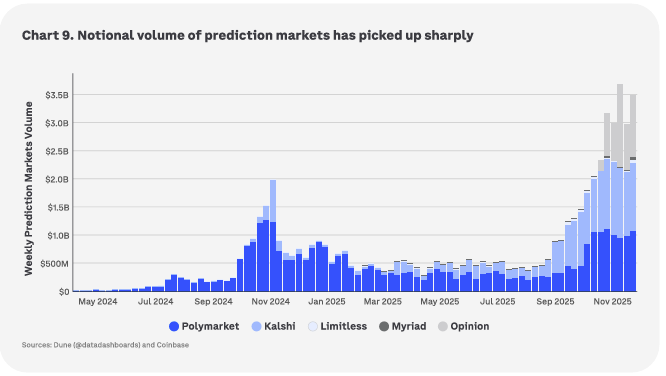
Prediction market activity has surged since the 2024 US presidential election. Source: Coinbase

While prediction markets remain a relatively nascent industry, the space is already dominated by a handful of major players. Chief among them is Polymarket, a decentralized platform built on the Polygon network that allows users to trade on political, economic, and cultural outcomes using blockchain-based contracts.

Kalshi has also emerged as a leading centralized player, operating under US regulatory oversight. Meanwhile, publicly traded sports betting company DraftKings has entered the prediction markets space, with plans to eventually offer crypto-linked contracts.

DraftKings would join a growing list of companies signaling interest in the sector, including Bitnomial Clearinghouse, a derivatives clearing organization, and crypto exchange Gemini.

Related: Polymarket shows stronger retention than most DeFi, wallets and exchanges

Criptomoedas em alta

Perguntas relacionadas

QWhat is the main reason for Coinbase's acquisition of The Clearing Company?

ACoinbase is acquiring The Clearing Company to expand its push into prediction markets as part of its broader strategy to become an 'Everything Exchange' offering a wide range of investment products.

QWhen is the acquisition of The Clearing Company by Coinbase expected to be finalized?

AThe transaction is expected to close in January, though the specific financial terms of the deal were not disclosed.

QWhat regulatory step did The Clearing Company take recently to integrate prediction markets into established financial frameworks?

AThe Clearing Company applied with the US Commodity Futures Trading Commission (CFTC) to become a Derivatives Clearing Organization.

QAccording to Coinbase, why could prediction markets emerge as a more tax-efficient alternative to traditional sports betting?

ACoinbase argues that prediction markets, which use contracts similar to derivatives, could be more tax-efficient if treated differently under the tax code, especially in light of a proposed provision that would tax 'phantom income' from gambling even with minimal net winnings or losses.

QName two major existing players in the prediction markets space mentioned in the article.

ATwo major players mentioned are Polymarket, a decentralized platform on Polygon, and Kalshi, a centralized platform operating under US regulatory oversight.

Leituras Relacionadas

Upbit is Anxious: A Hasty Counterattack Aimed at Regaining Stablecoin Market Share

Title: Upbit's Rushed Counterattack to Reclaim Stablecoin Market Share Facing a dramatic shift in South Korea's stablecoin market, leading exchange Upbit launched a promotional campaign from July 26 to August 9, waiving the 0.05% trading fee for stablecoins paired with the Korean Won (KRW) and rapidly listing new stablecoins like RLUSD and USDG. This move is a direct response to its plummeting market share in this sector. Historically a duopoly with Bithumb, the market has been reshaped since October 2025 when Coinone permanently removed fees for USDC trading. By June 2026, Coinone led with 34.8% of stablecoin volume, followed by Bithumb (31.1%) and Upbit (30.1%). This contrasts sharply with the overall crypto market, where Upbit commands 60%. The data shows stablecoin demand is highly sensitive to fees, as users primarily buy them to transfer capital overseas for derivatives trading or forex arbitrage. South Korean exchanges have seen a net outflow of stablecoins for 18 consecutive months, totaling approximately 14.9 trillion KRW, underscoring their role as a cross-border capital conduit. Upbit's limited-time promotion initially boosted its daily stablecoin volume by 162%, but the surge was almost entirely in USDT (98.1% of volume). The newly listed stablecoins saw negligible, fleeting interest. Furthermore, the promotional effect quickly waned in the second week, with volume dropping 33% on weekdays. A concurrent weakening of the KRW also contributed to the trading spike, independent of the fee waiver. The analysis suggests that once the promotion ends, Upbit is unlikely to retain its temporary gains unless it matches Coinone's permanent zero-fee policy, forcing a choice between market share and fee revenue. Upbit's strategic push may be less about immediate profit and more about preparing for future regulatory shifts. With South Korea's *Digital Asset Basic Act* on the horizon, which will regulate KRW-backed stablecoins, and following Dunamu's (Upbit's parent) integration into Naver Financial to build a payment ecosystem, securing a dominant position in the dollar stablecoin distribution channel holds long-term strategic value. However, potential regulatory conflicts could prevent Upbit from listing a future Naver-issued KRW stablecoin, making the current fight for dollar stablecoin flow even more critical.

marsbitHá 4h

Upbit is Anxious: A Hasty Counterattack Aimed at Regaining Stablecoin Market Share

marsbitHá 4h

Michael Saylor Compares Bitcoin and Gold!

Michael Saylor, founder of MicroStrategy, argues that Bitcoin fundamentally changes how wealth is stored and transferred by transforming digital scarcity into economic value. He describes Bitcoin as the first digital monetary network, combining computers, digital networks, and cryptography. It digitizes monetary assets, allowing their supply to be controlled by public protocols rather than institutions, thus converting economic value into information transmissible over global networks. Comparing Bitcoin to gold, Saylor states that while increasing Bitcoin's supply is harder, its integration with software and transfer is easier. He highlights Bitcoin's proof-of-work mechanism, which ties it to the physical world by consuming real energy to secure the ledger, making past transactions immutable. This creates a shared security system involving miners, energy companies, and investors. Saylor suggests "digital monetary energy" is a more accurate term than "digital gold." He emphasizes that the Bitcoin network is an adaptive ecosystem of miners, nodes, developers, and users. Its core design is intentionally simple, focused on maintaining a secure ledger for scarce digital assets, with complex functionalities built in higher-layer applications. This architecture allows Bitcoin to serve as a foundation for transmitting value and fostering innovation in payments and financial services. Saylor notes Bitcoin's deeper impact lies in creating digital sovereignty, where private keys give individuals permissionless control over their economic power, with ownership verified mathematically, not by institutions. He concludes that while gold's physical scarcity makes it money, Bitcoin's digital scarcity does the same, characterizing Bitcoin as the monetary energy of the digital age.

cryptonews.ruHá 5h

Michael Saylor Compares Bitcoin and Gold!

cryptonews.ruHá 5h

Trading

Spot

Artigos em Destaque

Como comprar PUSH

Bem-vindo à HTX.com!Tornámos a compra de Push Protocol (PUSH) simples e conveniente.Segue o nosso guia passo a passo para iniciar a tua jornada no mundo das criptos.Passo 1: cria a tua conta HTXUtiliza o teu e-mail ou número de telefone para te inscreveres numa conta gratuita na HTX.Desfruta de um processo de inscrição sem complicações e desbloqueia todas as funcionalidades.Obter a minha contaPasso 2: vai para Comprar Cripto e escolhe o teu método de pagamentoCartão de crédito/débito: usa o teu visa ou mastercard para comprar Push Protocol (PUSH) instantaneamente.Saldo: usa os fundos da tua conta HTX para transacionar sem problemas.Terceiros: adicionamos métodos de pagamento populares, como Google Pay e Apple Pay, para aumentar a conveniência.P2P: transaciona diretamente com outros utilizadores na HTX.Mercado de balcão (OTC): oferecemos serviços personalizados e taxas de câmbio competitivas para os traders.Passo 3: armazena teu Push Protocol (PUSH)Depois de comprar o teu Push Protocol (PUSH), armazena-o na tua conta HTX.Alternativamente, podes enviá-lo para outro lugar através de transferência blockchain ou usá-lo para transacionar outras criptomoedas.Passo 4: transaciona Push Protocol (PUSH)Transaciona facilmente Push Protocol (PUSH) no mercado à vista da HTX.Acede simplesmente à tua conta, seleciona o teu par de trading, executa as tuas transações e monitoriza em tempo real.Oferecemos uma experiência de fácil utilização tanto para principiantes como para traders experientes.

743 Visualizações TotaisPublicado em {updateTime}Atualizado em 2026.06.02

Como comprar PUSH

Discussões

Bem-vindo à Comunidade HTX. Aqui, pode manter-se informado sobre os mais recentes desenvolvimentos da plataforma e obter acesso a análises profissionais de mercado. As opiniões dos utilizadores sobre o preço de PUSH (PUSH) são apresentadas abaixo.

活动图片












