Coinbase Hit With Nevada Lawsuit Over Illegal Betting Claims

bitcoinistPublicado em 2026-02-05Última atualização em 2026-02-05

Resumo

Coinbase faces a civil lawsuit from the Nevada Gaming Control Board for offering event contracts that regulators claim constitute unlicensed sports betting. The state seeks a temporary restraining order and injunction to halt these operations, arguing they violate Nevada gaming laws. Coinbase contends that such contracts fall under federal CFTC jurisdiction, not state oversight, and has sued multiple states in response. The legal conflict highlights ongoing tension between state and federal regulators regarding prediction markets, as the CFTC considers new rules clarification. Similar enforcement actions are occurring in other states.

Coinbase is facing a civil enforcement action in Nevada after state gaming regulators said the company offered event contracts that look like wagers to local users.

Based on reports, the Nevada Gaming Control Board filed suit in state court asking a judge to stop Coinbase from offering these contracts inside Nevada and to grant a temporary restraining order and preliminary injunction.

Nevada Files Civil Enforcement Action

The complaint says Coinbase’s event contracts operate like unlicensed sports betting under Nevada law, and that the exchange did not hold the required state gaming license to offer them.
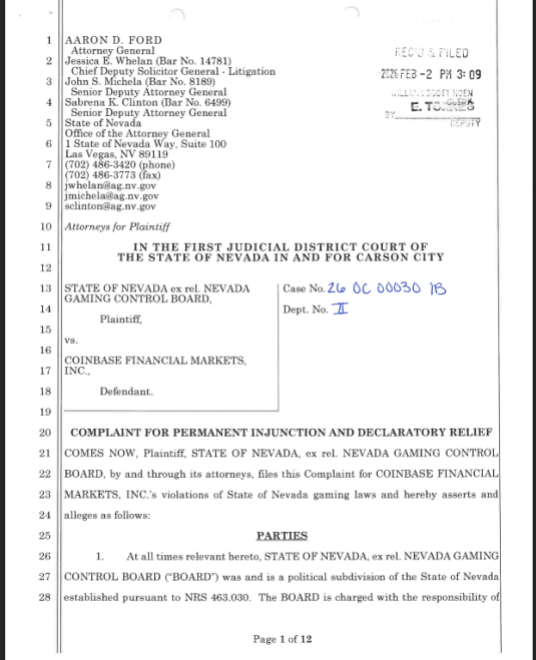
Source: Nevada Gaming Control Board

The filing seeks immediate court steps to halt the products while the state pursues its claims. Reports note the move follows similar actions against other prediction platforms and comes as the legal fight over where these products belong—state gaming law or federal derivatives law—intensifies.

Background On Prediction Markets And Coinbase’s Response

Prediction markets have grown quickly. Coinbase rolled out a prediction market product that lets customers take positions on the outcomes of sports and other real-world events, working with established market operators.

BTCUSD currently trading at $76,059. Chart: TradingView

Coinbase has pushed back by suing multiple states in federal court, arguing that event contracts are regulated by the federal Commodity Futures Trading Commission and not by individual state gaming regulators. Those federal suits targeted Connecticut, Illinois, and Michigan, among others.

Federal Regulator Signals New Rules

Reports say the CFTC’s chair has signaled a shift toward clearer federal rules for event contracts and suggested the agency may issue new guidance that affects ongoing state cases.

That announcement could change the legal balance, since a stronger federal stance would bolster exchanges that claim CFTC jurisdiction over these products. Still, state claims press on, and courts will have to sort out who has the power to regulate.

Nevada’s Push Comes As Other States Act

Nevada’s action is not isolated. A Nevada state court recently granted a temporary restraining order that barred another major prediction platform from offering event contracts in the state for a short period while the matter moved toward a hearing.

Regulators in several states have issued cease-and-desist letters or sued operators they say are offering unlicensed wagering.

Featured image from Shutterstock, chart from TradingView

Perguntas relacionadas

QWhat is the main reason Nevada is taking legal action against Coinbase?

ANevada is taking legal action because state gaming regulators claim Coinbase offered event contracts that operate like unlicensed sports betting without holding the required state gaming license.

QWhat specific legal measures did the Nevada Gaming Control Board request from the court?

AThe Nevada Gaming Control Board filed a suit asking the court to stop Coinbase from offering these contracts in Nevada and to grant a temporary restraining order and preliminary injunction.

QHow has Coinbase responded to similar regulatory challenges from other states?

ACoinbase has pushed back by suing multiple states, including Connecticut, Illinois, and Michigan, in federal court, arguing that event contracts are regulated by the federal CFTC and not by state gaming regulators.

QWhat potential shift in the regulatory landscape is mentioned regarding the CFTC?

AThe CFTC's chair has signaled a shift toward clearer federal rules for event contracts and suggested the agency may issue new guidance, which could bolster exchanges' claim of CFTC jurisdiction.

QIs Nevada's action an isolated case, or are other states taking similar steps?

ANevada's action is not isolated; regulators in several states have issued cease-and-desist letters or sued operators they allege are offering unlicensed wagering.

Leituras Relacionadas

20 Billion Valuation, Alibaba and Tencent Competing to Invest, Whose Money Will Liang Wenfeng Take?

DeepSeek, an AI startup founded by Liang Wenfeng, is reportedly in talks with Alibaba and Tencent for an external funding round that could value the company at over $20 billion. This marks a significant shift, as DeepSeek had previously relied solely on funding from its parent company,幻方量化 (Huanfang Quantitative), and had resisted external investment. The potential valuation would place DeepSeek among the top-tier AI model companies in China, comparable to competitors like MoonDark (valued at ~$18 billion) and ahead of recently listed firms like MiniMax and Zhipu. The funding—which could range from $600 million (for a 3% stake) to $2 billion (for 10%)—is seen as a move to secure resources for model development, retain talent, and support infrastructure needs, particularly as competition in inference models and AI agents intensifies. Both Alibaba and Tencent are eager to invest, not only for financial returns but also to integrate DeepSeek into their broader AI ecosystems. However, DeepSeek’s leadership is cautious about maintaining independence and may prefer financial investors over strategic ones to avoid being locked into a specific tech ecosystem. Alternative options, such as state-backed funds, offer longer-term capital and policy support but may come with slower decision-making and potential constraints on global expansion. With competing AI firms accelerating their IPO plans, DeepSeek’s window for securing optimal terms may be narrowing. The final decision will reflect a trade-off between capital, resources, and strategic independence.

marsbitHá 1h

20 Billion Valuation, Alibaba and Tencent Competing to Invest, Whose Money Will Liang Wenfeng Take?

marsbitHá 1h

After Losing 97% of Its Market Value, iQiyi Attempts to Use AI to Forcefully Extend Its Lifespan

After losing 97% of its market value since its 2018 peak, iQiyi is aggressively pivoting to AI in a desperate attempt to survive. At its 2026 World Conference, CEO Gong Yu announced an "AI Artist Library" with over 100 virtual performers and a new AIGC platform, "NaDou Pro," promising faster production and lower costs. This shift comes as the company faces severe financial distress: its market cap sits near delisting thresholds at $1.36 billion, with significant losses, declining membership revenue, and depleted cash flow. The AI strategy has sparked controversy. Top actors have issued legal threats against unauthorized digital replicas, while in Hengdian, over 134,000 background actors are seeing their already scarce job opportunities vanish as AI replaces them for background roles. iQiyi's move represents a fundamental shift from being a high-cost content buyer to a landlord" to becoming a "platform capitalist" that transfers production risk to creators. This contrasts with competitors like Douyin (TikTok's Chinese counterpart), which is investing heavily in *real* actor-led short dramas, betting that authentic human connection retains users better than AI-generated content. The article draws a parallel to the 1920s transition to "talkies," which made cinema musicians obsolete but ultimately enriched the art form. In contrast, iQiyi's AI drive is framed not as an artistic evolution but as a cost-cutting measure that could degrade storytelling, replacing genuine human emotion with algorithmically calculated stimulation and potentially numbing audiences' capacity for empathy. The core question remains: can a company focused solely on financial survival preserve the art of storytelling?

marsbitHá 1h

After Losing 97% of Its Market Value, iQiyi Attempts to Use AI to Forcefully Extend Its Lifespan

marsbitHá 1h

Trading

Spot
Futuros
活动图片