Coinbase ‘cautiously optimistic’ on 2026 as crypto nears institutional inflection point

cointelegraphPublicado em 2025-12-19Última atualização em 2025-12-19

Resumo

Coinbase Institutional's 2026 outlook is cautiously optimistic, forecasting a potential institutional inflection point for crypto driven by regulatory clarity, stablecoin adoption, and an improving macro backdrop. The report highlights key U.S. policy developments, including stablecoin legislation and market structure bills, as crucial for institutional integration. It projects the stablecoin market could grow to $1.2 trillion by 2028. Bitcoin's volatility has moderated, now resembling high-growth tech stocks, with 90-day historical volatility declining to 35-40% by end-2025. Despite 2025's price swings and leverage-induced corrections, Bitcoin is now seen as an established part of the global financial conversation.

After a year of unexpected turbulence for crypto markets, 2026 could mark a turning point driven by regulatory clarity, accelerating stablecoin adoption and an improving macroeconomic backdrop, according to a new outlook from Coinbase Institutional.

In its 70-page report, Coinbase Institutional said digital assets have evolved “from a niche market to an emerging pillar of global market infrastructure,” even as price volatility and uneven liquidity defined much of 2025.

Looking ahead, Coinbase’s institutional arm expects clearer global regulatory frameworks to provide stronger policy guardrails, supporting innovation and long-term market maturation.

Rather than another retail-driven boom-and-bust cycle, 2026 is framed as a year of institutional integration and regulatory maturity, with clearer rules enabling deeper participation from traditional financial players.

In the United States, Coinbase Institutional pointed to landmark policy developments, including progress on stablecoin legislation such as the GENIUS Act and momentum toward a broader crypto market structure bill, as key factors shaping the next phase of adoption.

These efforts are expected to influence everything from risk management and compliance standards to institutional portfolio strategies.
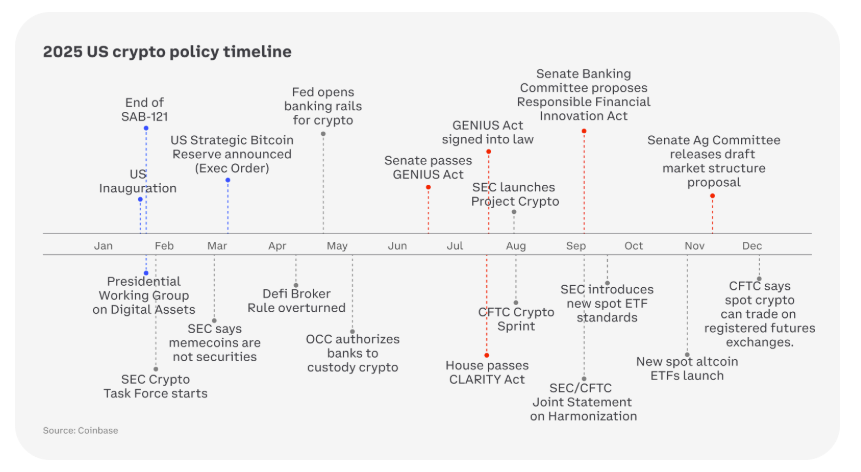
Coinbase Institutional flags the evolution of US crypto policy as a key driver of a potentially transformative 2026. Source: Coinbase Institutional

Stablecoins remain one of crypto’s most established use cases, with Coinbase Institutional projecting significant expansion in the years ahead. Its model forecasts that the stablecoin market could grow to about $1.2 trillion by 2028, driven by increased use in payments, settlement, payroll and cross-border remittances.
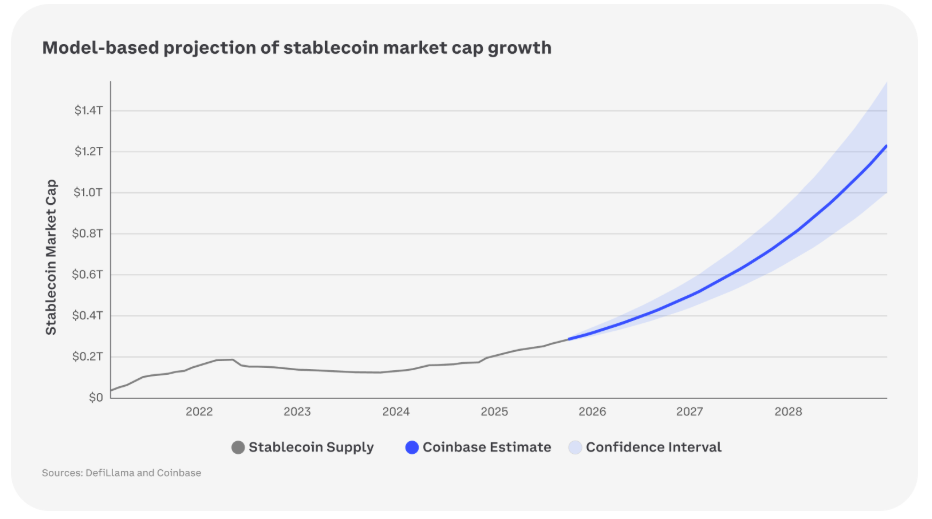
After years of rapid expansion, Coinbase Institutional’s model forecasts that the stablecoin market could reach $1.2 trillion by 2028. Source: Coinbase Institutional

Still, the outlook stops short of outright optimism. Coinbase Institutional described its macroeconomic expectations as “cautiously optimistic,” arguing that while economic growth may remain uneven, the US economy has shown greater resilience than recent data implies.

Persistent inflation risks and the timing of potential interest rate cuts remain key variables that could influence crypto market recovery heading into 2026.

Related: US banks may soon issue stablecoins under FDIC plan to implement GENIUS Act

Bitcoin’s volatility profile is shifting

One of Coinbase Institutional’s key observations is that Bitcoin’s volatility profile has gradually evolved. Rather than standing out as an extreme outlier among major asset classes, Bitcoin’s volatility now resembles that of high-growth technology stocks, the report said.

Coinbase pointed to Bitcoin’s (BTC) 90-day historical volatility, which declined to about 35% to 40% by the end of 2025, down from levels above 60% in mid-2024. The moderation occurred even as the market absorbed major structural changes, including the approval and rollout of spot Bitcoin exchange-traded funds.
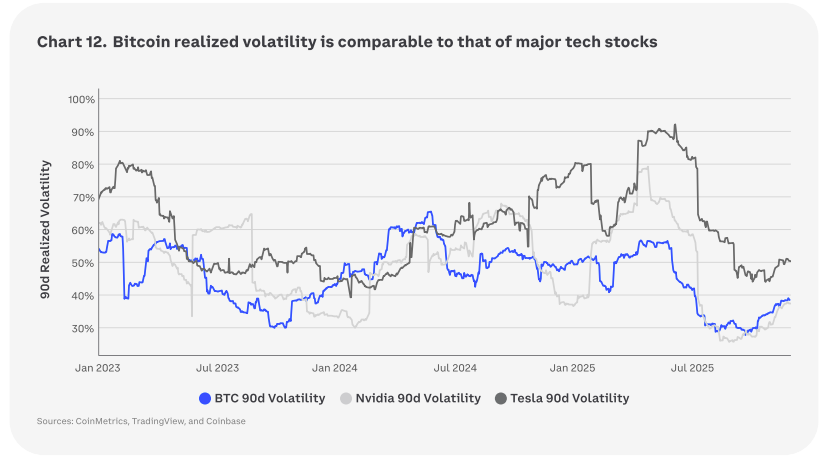
Bitcoin’s volatility profile is now comparable to major technology stocks. Source: Coinbase Institutional

Still, 2025 proved to be a volatile and emotionally charged year for Bitcoin holders. The asset experienced sharp price swings, reaching new cycle highs before undergoing a steep correction later in the year amid elevated leverage and forced liquidations across crypto markets.

While such moves have renewed debate around Bitcoin’s role as a safe-haven asset, Coinbase Institutional said that 2025 ultimately marked a milestone year. The report described Bitcoin as having been “firmly established as a critical component of the global financial conversation,” even as it remains subject to the growing pains of a maturing asset class.

Related: Why the ‘great China Bitcoin mining crackdown’ fell short of early claims

Perguntas relacionadas

QWhat is Coinbase Institutional's overall outlook for the crypto market in 2026?

ACoinbase Institutional is 'cautiously optimistic' about 2026, framing it as a potential turning point driven by regulatory clarity, accelerating stablecoin adoption, and an improving macroeconomic backdrop, rather than another retail-driven boom-and-bust cycle.

QWhat key US policy developments does the report highlight as factors shaping the next phase of crypto adoption?

AThe report highlights landmark policy developments, including progress on stablecoin legislation such as the GENIUS Act and momentum toward a broader crypto market structure bill.

QWhat is the projected growth for the stablecoin market by 2028 according to Coinbase's model?

ACoinbase Institutional's model forecasts that the stablecoin market could grow to about $1.2 trillion by 2028.

QHow has Bitcoin's volatility profile changed, according to the report?

ABitcoin's volatility profile has evolved to resemble that of high-growth technology stocks, with its 90-day historical volatility declining to about 35% to 40% by the end of 2025, down from levels above 60% in mid-2024.

QWhat are the key macroeconomic variables that could influence the crypto market recovery heading into 2026?

APersistent inflation risks and the timing of potential interest rate cuts remain key variables that could influence the crypto market recovery.

Leituras Relacionadas

An Open-Source AI Tool That No One Saw Predicted Kelp DAO's $292 Million Vulnerability 12 Days Ago

An open-source AI security tool flagged critical risks in Kelp DAO’s cross-chain architecture 12 days before a $292 million exploit on April 18, 2026—the largest DeFi incident of the year. The vulnerability was not in the smart contracts but in the configuration of LayerZero’s cross-chain bridge: a 1-of-1 Decentralized Verifier Network (DVN) setup allowed an attacker to forge cross-chain messages with a single compromised node. The tool, which performs AI-assisted architectural risk assessments using public data, identified several unremediated risks, including opaque DVN configuration, single-point-of-failure across 16 chains, unverified cross-chain governance controls, and similarities to historical bridge attacks like Ronin and Harmony. It also noted the absence of an insurance pool, which amplified losses as Aave and other protocols absorbed nearly $300M in bad debt. The attack unfolded over 46 minutes: the attacker minted 116,500 rsETH on Ethereum via a fraudulent message, used it as collateral to borrow WETH on lending platforms, and laundered funds through Tornado Cash. While an emergency pause prevented two subsequent attacks worth ~$200M, the damage was severe. The tool’s report, committed to GitHub on April 6, scored Kelp DAO a medium-risk 72/100—later acknowledged as too lenient. It failed to query on-chain DVN configurations or initiate private disclosure, highlighting gaps in current DeFi security approaches that focus on code audits but miss config-level and governance risks. The incident underscores the need for independent, AI-powered risk assessment tools that evaluate protocol architecture, not just code.

marsbitHá 59m

An Open-Source AI Tool That No One Saw Predicted Kelp DAO's $292 Million Vulnerability 12 Days Ago

marsbitHá 59m

Trading

Spot
Futuros
活动图片





