Claude Code Announces Major Next-Gen Upgrade: You Chat, and the Backend Gets the Job Done

marsbitPublicado em 2026-06-30Última atualização em 2026-06-30

Resumo

Claude Code's next major upgrade will make its sub-agents run in the background by default, transforming the tool from a conversational interface into a multi-threaded workflow engine. Users can chat with Claude while sub-agents handle tasks like code refactoring, running tests, and opening PRs in parallel. Creator Boris Cherny, who hasn't written a line of code in eight months and sometimes manages thousands of AI agents, states that users are no longer just prompters; "another Claude writes the prompts." This evolution builds on recent features like Routines for scheduled tasks and Dynamic Workflows for complex, multi-agent jobs. The change signifies a shift where engineers focus on strategy and decision-making rather than writing code. Anthropic's internal data suggests Claude Code triples engineering output, creating a bottleneck for product managers who can't generate enough work. Spotify's case study reveals that 73% of its pull requests are AI-assisted, with executives using the tool to build prototypes directly from natural language descriptions. The core takeaway: the scarcest resource is no longer the ability to write code, but the ability to decide what code to write.

Claude Code Is Making 'Backend Work' the Default!

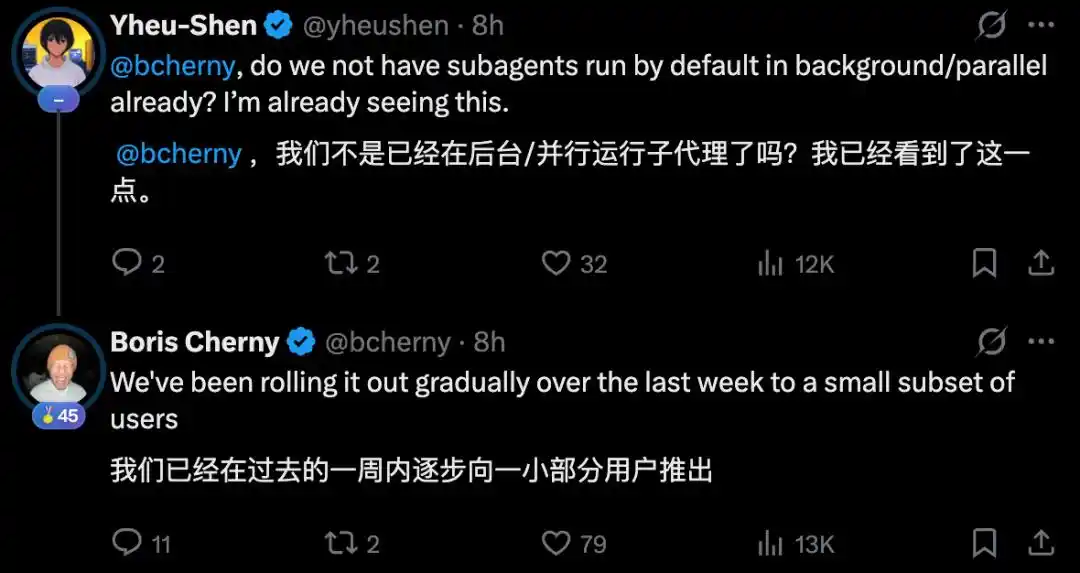
Just moments ago, Claude Code creator Boris Cherny dropped a line on X: The next version of Claude Code will have sub-agents running in the background by default.

You can chat with Claude while letting sub-agents finish tasks in the background—want a specific agent to run in the foreground? Just tell Claude.

This single statement made many developers realize something instantly: Claude Code is evolving from a "Q&A dialog box" into a "workflow engine capable of managing multiple task lines simultaneously."

While you're still discussing architecture plans with Claude, sub-agents have already finished code refactoring, run tests, and opened PRs in the background.

You just need to glance at the results after you finish chatting.

Sounds like science fiction?

No, this is Boris Cherny's daily routine—he hasn't written a single line of code by hand in eight months, and on some days, he manages thousands or even tens of thousands of AI agents simultaneously.
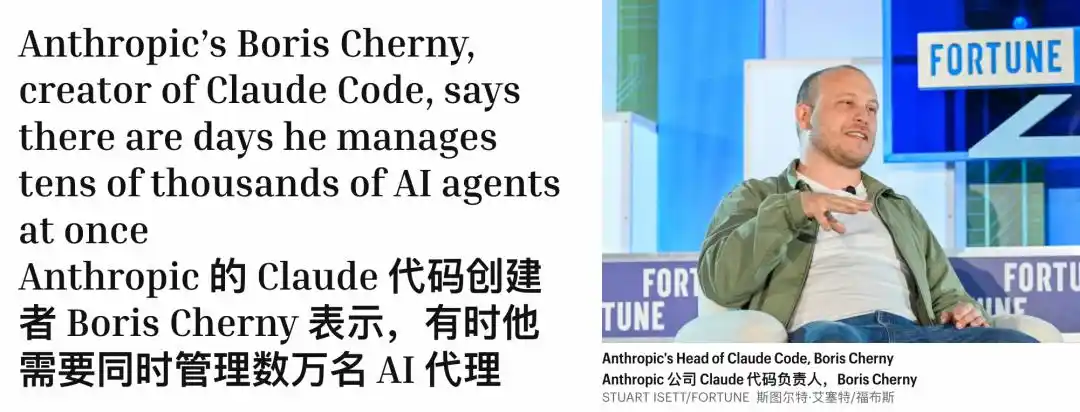
"You're no longer the one writing prompts for Claude," he says, "another Claude writes the prompts."

Some netizens have mentioned they're already using this feature.
Others noted this feature is crucial—it prevents boredom while waiting for agents to process tasks and allows planning for the next steps.

Claude Code's Blazing Trajectory

Looking back at Claude Code's evolution over the past six months, "background sub-agents" are not a sudden gimmick but a natural progression.

Boris Cherny's design philosophy when creating Claude Code was: Not chatting, but infrastructure.

In April, Anthropic first made "scheduled tasks" an official capability of Claude Code: Routines.

You can package a prompt, a code repository, and a set of connectors into a fixed workflow, triggering it by the hour, overnight, weekly, or via API calls, GitHub events, or even external webhooks.

More importantly, it runs on Anthropic's hosted cloud infrastructure—close your laptop lid, and the agents keep working.

This means cron is back, hooks are back, but this time, what's scheduled isn't scripts but a group of AI workers that can read code, modify code, and open PRs.

The engineer's role has also changed: Before, you'd close your computer before bed and continue writing the next day; now, you deploy a batch of agents before bed and review a bunch of PRs in the morning.

At the end of May, Claude Code pushed this logic further: Dynamic workflows.

For tasks too large for a single dialog—like major migrations, full-library audits, or complex research—you just need to include "use a workflow" in the prompt or enable ultracode. Claude will generate an orchestration script for the current task, scheduling dozens to hundreds of sub-agents in the background to advance in stages, perform parallel cross-validation, and finally consolidate the results into a report or a batch of changes.

This isn't "one AI writing code" anymore; it's "one AI writing the script, and a group of AIs working according to it."

Now, the step of "background sub-agents running by default" essentially bundles all the above capabilities into an out-of-the-box default behavior: You no longer need to manually say 'run in the background'; it inherently runs in the background.

You only need to focus on what you should truly be doing—thinking about the next step.

One Engineer Becomes Three

How powerful is Claude Code? The most convincing evidence isn't demos but the story of Anthropic itself being "backfired."

On June 27, VentureBeat published a heavyweight article with a straightforward title: Claude Code Turned Every Engineer Into Three. Now Companies Need More Product Thinkers.

Anthropic recently told its growth team: Hire more product managers, not more engineers.

The reason is simple—Claude Code has tripled the effective output of engineering teams. A five-person team now delivers the work of fifteen to twenty people.

The bottleneck isn't in coding; it's in the people "deciding what code to write."

Traditionally, the product manager-to-engineer ratio was about 1:8. Now, with each engineer's daily output tripled, this ratio effectively becomes 1:20.

PMs can't assign work fast enough—engineers finish coding and sit waiting for requirements, a scene that's absurd to imagine.

Spotify's 20 Million Lines of Code Managed by Claude

The best demonstration of how powerful "background sub-agents" are comes from Spotify's real-world use.

Spotify's Vice President of Engineering, Niklas Gustavsson, shared some figures in an interview with Boris Cherny:

Spotify deploys to production about 4,500 times daily, 73% of pull requests are completed with AI assistance, and PR frequency has increased by over 75%.

His own daily workflow involves: simultaneously opening 5 to 10 Claude sessions, each corresponding to an independent git worktree, letting multiple agents work in parallel in the background, while he only focuses on reviewing diffs and making decisions.

All this happens in a super-monorepo with over 20 million lines of code.

Niklas admitted he was initially worried that with such a large codebase, agents would get lost. Surprisingly, it went smoothly—Claude can even "find inspiration" from other code in the repository and know how to write.

His advice to peers sounds unsexy but exceptionally practical: The more consistent the codebase and unified the toolchain, the better Claude performs within it.

If the same thing is written in ten different ways across the repository, Claude will also get confused. This mirrors the logic of improving human engineer efficiency over the past decade, just with AI as a new player now.

Even more interestingly, Spotify opened this capability to non-engineers.

They built an infrastructure allowing product managers, designers—anyone—to describe an idea in natural language, and Claude directly implements end-to-end prototypes in real mobile and backend code.

Niklas revealed that even Spotify's co-CEO has submitted his prototypes within it.

Ideas that previously required convincing an entire engineering team to validate can now be tested and run through in just an hour or two.

When 'Chat While Working' Becomes the Default Setting

Niklas said this traces back five or six years—back then, the team noticed the codebase was growing seven times faster than the number of engineers, forcing them to think ahead about "whether machines could maintain code for people."

He found that what he truly enjoyed was never the act of coding itself but the process of solving problems.

Now, he runs several agents in the background simultaneously, using the freed-up time to figure out what to do next, what to discuss with clients, and create more prototypes.

This恰好印证了 Boris Cherny's tweet: When background sub-agents become standard, "writing code" is no longer the engineer's most important task; "deciding what to do and judging if it's right" is.

When "chat while working" evolves from a developer's personal trick to the shared working method of a 2,900-person engineering team, AI programming tools have quietly shifted to a new scale—

Engineer output triples, but the scarcest resource is no longer people who can write code, but people who know what code to write.

References:

https://x.com/kimmonismus/status/2071667876415623534

https://venturebeat.com/infrastructure/claude-code-turned-every-engineer-into-three-now-companies-need-more-product-thinkers

https://x.com/ClaudeDevs/status/2071671418245492926?s=20

This article is from the WeChat public account "新智元", author: ASI启示录

Perguntas relacionadas

QAccording to the article, what is the key new feature announced for the next version of Claude Code?

AThe key new feature is that sub-agents will run in the background by default. Users can chat with Claude while sub-agents complete tasks. Users can bring a specific agent to the foreground if needed.

QWhat design philosophy did Boris Cherny, the creator of Claude Code, hold when developing the tool?

AHis design philosophy was 'not chat, but infrastructure.' He aimed to build Claude Code as a foundational system for managing workflows, rather than just a conversational dialog tool.

QWhat significant impact did Claude Code have on the engineering team at Anthropic, according to the VentureBeat article?

AClaude Code increased the effective output of the engineering team to three times the actual headcount. This created a bottleneck where engineers were waiting for product requirements, leading the company to prioritize hiring more product managers over more engineers.

QHow does Spotify utilize Claude Code in their development process?

ASpotify uses Claude Code to handle a monorepo with over 20 million lines of code. Approximately 73% of their pull requests are assisted by AI, and deployment frequency has increased by over 75%. Non-engineers, like product managers and designers, also use it to create end-to-end prototypes from natural language descriptions.

QWhat fundamental shift in an engineer's role does the article suggest will occur as a result of features like default background sub-agents?

AThe article suggests that 'writing code' will no longer be the engineer's most important task. Instead, their critical role will shift to 'deciding what to do and judging what is correct,' focusing on strategic thinking and decision-making.

Leituras Relacionadas

Earning Six Figures and Still Struggling to Rent in San Francisco

A couple in San Francisco with a combined tech income over $360,000 struggled for months to find a one-bedroom apartment under $5,000 per month. Their story highlights how the AI wealth boom, driven by upcoming IPOs from companies like OpenAI and Anthropic, is dramatically escalating the city's cost of living. Even six-figure salaries are becoming insufficient for a comfortable lifestyle. The article details the financial reality for tech workers earning around $180,000 annually. After taxes, retirement contributions, and healthcare, take-home pay is roughly $7,000 per month. With average rents exceeding $3,800 and one-bedrooms often costing $4,500-$5,200, discretionary income shrinks to $1,500-$2,500. This contrasts sharply with reported median total compensations of $640,000 at OpenAI and $420,000 at Anthropic. The AI gold rush is identified as the primary driver. The scale of potential wealth from these IPOs, far surpassing previous tech booms, is flooding the housing market. Data shows San Francisco's average rent is now the highest in the U.S., with vacancy rates in desirable neighborhoods plummeting to around 3%. The overall cost of living is 65.6% above the national average. The piece features multiple professionals, including a 25-year-old with a $250,000 salary, facing housing instability, fierce competition for rentals, and a persistent, low-grade financial anxiety despite high earnings. It concludes that the rapid concentration of AI wealth is redefining what constitutes a "high salary" in San Francisco, pushing out mid-tier tech talent and creating a stark divide between those in the AI sector and everyone else.

marsbitHá 32m

Earning Six Figures and Still Struggling to Rent in San Francisco

marsbitHá 32m

Rate Hikes to Save STRC, Selling Bitcoin to Preserve Credit: Strategy Picks Its Two Most Expensive Paths

Over the past six weeks, Strategy has faced a significant crisis of confidence, with its core securities MSTR and STRC experiencing sharp price declines. The situation escalated as the company utilized dollar reserves intended for dividends and interest payments to repurchase debt, and then sold a small amount of Bitcoin for the first time since 2022—an action that contradicted its "never sell" narrative and signaled potential liquidity strain. In response, Strategy introduced a Digital Credit capital framework. This formalized a series of measures to manage the pressure down its capital structure: ordinary shareholders have already borne costs through equity dilution from an $11.5 billion ATM offering; new rules enforce a hard dollar reserve covering at least 12 months of expected dividend and interest payments; the STRC dividend rate was increased from 11.5% to 12%; and, most notably, Bitcoin was officially integrated into the capital toolkit, with board authorization to sell up to $1.25 billion worth if needed to support obligations and repurchase programs. The market reacted with a mix of relief and skepticism. While the announcement triggered a sharp single-day rally in both MSTR and STRC, the preferred shares still trade at a significant discount. Supporters view the framework as pragmatic crisis management that provides a price floor and clearer rules. Critics argue that institutionalizing Bitcoin sales undermines the core investment thesis and, with Bitcoin's price below the company's average cost basis, amounts to selling assets at a loss to maintain its financial structure. The broader context shows institutional Bitcoin buying drying up, highlighting that Strategy's challenges and new framework are now a key indicator for overall market risk sentiment. Ultimately, the framework buys time, but STRC's return to par value depends on market belief in the company's ability to cover dividends without further dilution or substantial Bitcoin sales—a task that would be easier if Bitcoin's price recovers.

链捕手Há 38m

Rate Hikes to Save STRC, Selling Bitcoin to Preserve Credit: Strategy Picks Its Two Most Expensive Paths

链捕手Há 38m

Has Bitcoin Bottomed? Unpacking 12 Key Data Indicators

Author: BitalkNews **Title: Has Bitcoin Bottomed? Analyzing 12 Key Data Indicators** The current Bitcoin price is around $59,600, representing a maximum drawdown of approximately 53% from the 2025 high. The market is in a deep correction phase. Multiple indicators suggest valuations are nearing historical lows, but a confirmed bottom requires more time. **Summary of Key Indicators:** 1. **Fear & Greed Index:** At 16, indicating "Extreme Fear," similar to levels seen during the 2022 FTX collapse. 2. **Rainbow Chart:** BTC has fallen into the "Bitcoin is dead" zone, only the second such occurrence historically. 3. **MVRV Ratio:** Currently around 1.13, near the lower historical band, pointing to a bottoming valuation area (approx. $53,200-$53,400). 4. **Realized Price:** The aggregate cost basis is ~$53,400; the current price is only about 12% above it but hasn't broken below yet. 5. **UTXO Profit/Loss Ratio:** Has dropped to its lowest level this cycle, signaling a potential "capitulation" event often seen near cycle bottoms. 6. **Long-Term Holder SOPR:** For holders >155 days, it's at 0.662, now negative, indicating seasoned investors are selling at a loss. 7. & 8. **Miner Health:** ~20% of miners are unprofitable, and actual miner revenue is below theoretical levels, indicating ongoing miner stress. 9. **ETF Flows:** U.S. spot BTC ETFs have seen sustained net outflows, including a 13-day streak with over $1.7B in weekly outflows. 10. **Strategy Risk:** Strategy's stock premium has significantly contracted, pressuring the traditional "borrow-to-buy" model. 11. **Bear Duration & Drawdown:** The correction has lasted >265 days with a ~52.5% drawdown, shorter in depth but lengthy in duration. 12. **Market Expectations (Polymarket):** Betting markets suggest an ~80% probability of BTC falling below $55,000 and a notable chance below $50,000. **Conclusion:** Bitcoin is in a deep correction with potential bottom formation. Valuation metrics are in historically low ranges, and on-chain capitulation signals are accumulating. However, a complete shakeout isn't finished—the realized price hasn't been breached, and ETF demand hasn't reversed. The area below $60,000 holds long-term appeal, but patience is advised. Key signals to watch for include a return to ETF inflows, a recovery in the Long-Term Holder SOPR, and easing miner pressure.

marsbitHá 46m

Has Bitcoin Bottomed? Unpacking 12 Key Data Indicators

marsbitHá 46m

Valuation Inversion Emerges, Bitcoin Treasury Companies Face Trust Crisis

"Valuation Inversion Emerges, Sparking Trust Crisis for Bitcoin Treasury Firms" The investment thesis for corporate Bitcoin treasury stocks has fundamentally shifted. Investors are no longer rewarding companies simply for accumulating more Bitcoin. Instead, the focus is now on net Bitcoin per share, with intense scrutiny on whether new financings truly benefit existing shareholders or merely dilute their stake. Key indicators highlight the new reality. Metaplanet's market capitalization has fallen below the total value of its Bitcoin holdings, indicating a valuation discount. While MicroStrategy maintains a premium, its core metric—Bitcoin per diluted share for common shareholders—has been declining due to dilution from financing activities, primarily through its STRAT permanent preferred shares. This marks a transition from a pure "asset accumulation" phase to an "equity attribution" phase. Investors now deduct costs like preferred dividends and debt to calculate the actual Bitcoin claim for common equity. The widespread adoption of spot Bitcoin ETFs has removed the scarcity value these stocks once held, forcing them to justify their structure with superior leverage, dividends, or capital efficiency. European entrants like France's Capital B and Sweden's BTC AB are testing this new environment with ambitious funding plans backed by relatively small Bitcoin holdings. They are asking investors to bear complex capital structures, betting future Bitcoin purchases will cover all dilution and dividend costs. The sector's core risk is a broken financing loop. Once a company's stock trades below its Bitcoin net asset value, it loses the ability to issue equity for accretive purchases. It is then left with unpalatable choices: dilutive financing at a discount, venturing into new businesses like Bitcoin lending, or selling assets. The winners in this next phase will be those that demonstrably increase Bitcoin per share for common shareholders with every financing move.

Foresight NewsHá 1h

Valuation Inversion Emerges, Bitcoin Treasury Companies Face Trust Crisis

Foresight NewsHá 1h

Trading

Spot
活动图片