CLARITY Act On Track For April Passage, Senator Says

bitcoinistPublicado em 2026-02-20Última atualização em 2026-02-20

Resumo

Senator Bernie Moreno stated the CLARITY Act is on track for potential passage by April, generating significant market and political reactions. The key contentious issue is the bill's proposed ban on interest-bearing stablecoins, which places the SEC as the lead regulator. This has created a divide, with crypto firms like Coinbase opposing the ban and banks expressing concerns about competition for deposits. While the White House is pushing for a quick agreement, bipartisan support remains fragile. Prediction markets initially showed increased odds of passage but later pulled back as details were questioned. The final outcome will determine clearer regulatory rules for exchanges, banks, and stablecoin issuers.

US lawmakers and crypto leaders say a major bill could move fast. According to an on-site interview, Senator Bernie Moreno told reporters he hopes the US CLARITY Act will clear Congress by April.

The comment came during a recent gathering with members of the press, and it set off a flurry of reaction across markets and inside the halls of power.

Lawmakers And Industry At Odds Over Clarity Act

Reports note that the biggest fight left on the table is stablecoin yields. Coinbase CEO Brian Armstrong said industry talks are more hopeful now, but he had pulled his group’s backing earlier because the bill would ban interest-bearing stablecoins and put the SEC front and center as the lead regulator.

That tug-of-war matters. Banks worry that easy yield on crypto tokens could pull deposits and weaken their model. Crypto firms counter that such products are useful and in demand. Both sides also want clear rules so firms can plan ahead.

Policymakers Have Momentum

Based on reports, the White House reacted strongly when one major exchange stepped back from support. The executive office signaled surprise and urged quicker agreement.

Markets noticed. Prediction markets moved, with odds on passage swinging dramatically in response to the media interview.

Polymarket showed a sharp uptick in probability that the bill would pass — then a pullback once details were questioned.
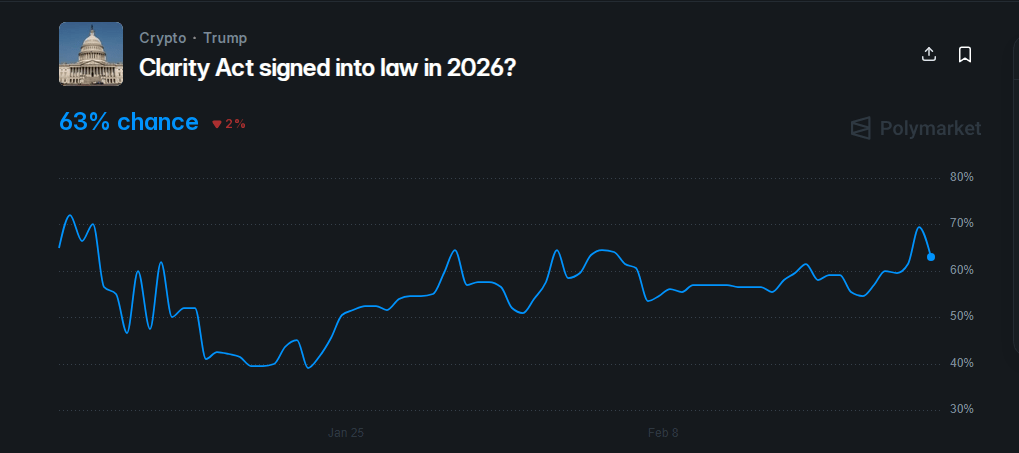
Source: Polymarket

“Hopefully by April,” Moreno said during an interview at US President Donald Trump’s Mar-a-Lago resort in Florida on Wednesday.

BTCUSD currently trading at $66,621. Chart: TradingView

What Could Break The Deal

Trump has pushed a pro-crypto message, and that helps gathering momentum among allies in Congress. But partisan lines remain.

If members tie the bill too closely to a single political brand, bipartisan support could fray. Also, banks and regulators are not uniform: some large institutions want stricter rules; others prefer limited, clearer guardrails that let certain products exist under oversight.

Why Fast Passage Is Uncertain

Reports say industry players want clarity asap, while some regulators want broader authority. That difference explains the public sparring.

Negotiators can and do move quickly when leadership prioritizes a measure, yet complex financial bills often require many rounds of drafting and amendment. Even so, lawmakers and execs at industry meetings appear to be pushing hard for a resolution soon.

If the bill clears, it could bring clearer rules for exchanges, banks, and stablecoin issuers. For investors, clarity is usually good. For firms, the shape of the final text will determine whether new products live or die.

Featured image from Wallpapers.com, chart from TradingView

Perguntas relacionadas

QWhat is the expected timeline for the CLARITY Act to pass Congress according to Senator Bernie Moreno?

ASenator Bernie Moreno hopes the CLARITY Act will clear Congress by April.

QWhat is the main point of contention regarding the CLARITY Act between lawmakers and the crypto industry?

AThe biggest fight is over stablecoin yields, specifically the bill's provision to ban interest-bearing stablecoins and establish the SEC as the lead regulator.

QHow did the prediction market Polymarket react to the news about the CLARITY Act?

APolymarket showed a sharp uptick in the probability that the bill would pass, followed by a pullback once details were questioned.

QWhy is there uncertainty surrounding the fast passage of the CLARITY Act despite momentum?

AUncertainty exists because complex financial bills often require many rounds of drafting and amendment, and there are differences between industry wanting clarity and some regulators wanting broader authority.

QWhat potential consequence could arise if the bill is tied too closely to a single political brand?

ABipartisan support for the bill could fray if it is tied too closely to a single political brand.

Leituras Relacionadas

KOL's Perspective: Why Is SOL Set to Rise from This Point?

**Summary: Why SOL is Positioned for Growth at This Level** The article argues that SOL is poised for an upward move from its current price point, citing several key factors. Primarily, SOL has just broken out of a 4-month consolidation phase. This breakout signals a return of risk appetite to the broader crypto market, as SOL is seen as a key indicator of overall crypto health. The token's ownership has reportedly shifted from short-term traders and tourists to long-term accumulators, leading to low volume. Any meaningful increase in trading activity could thus trigger significant upward momentum. Fundamental strengths include strong institutional adoption, integration with DeFi and RWAs (Real-World Assets), and the potential benefits from the Clarity Act. Despite its high volatility—having dropped 70% from its all-time high but still up 12x from its bear market low—SOL is highlighted as one of the few tokens from the last cycle to reach new highs. It boasts a robust ecosystem of applications, users, and protocols. Future catalysts include the expected influx of AI developers following the Miami Accelerate conference, which focused on AI on Solana. Furthermore, Solana is positioned as the premier chain for memecoin activity, a trend expected to continue and drive network usage and fees. The article concludes that recent price action reflects a healthy transfer to long-term holders, setting the stage for growth.

marsbitHá 48m

KOL's Perspective: Why Is SOL Set to Rise from This Point?

marsbitHá 48m

Those Pre-Bitcoin PoW Protocols Have Recently Been Reimplemented

This article details a recent surge in replicating pre-Bitcoin Proof-of-Work (PoW) protocols, specifically focusing on Hal Finney's 2004 RPOW (Reusable Proofs of Work). Within five days in May 2026, multiple independent builders in the Bitcoin/cypherpunk community launched projects inspired by this early electronic cash proposal. The initiative began with Fred Krueger's `rpow2.com`, a centralized but auditable system that replaced RPOW's original IBM 4758 hardware with Ed25519 signatures. Initially a faithful replica, it later adopted Bitcoin-like features (21M supply cap, difficulty adjustment) and a controversial 5.24% founder allocation. This sparked rapid forks, including `rpow4.com` which incorporated full Bitcoin parameters, a prediction market (`rpowmarket.com`), and a DEX (`rpow2swap.com`). Concurrently, Mike In Space created a prototype of Wei Dai's 1998 b-money proposal (`b-money.replit.app`), pushing the historical exploration even further back. The article contrasts these centralized, server-dependent experiments with Bitcoin's core innovation of decentralized, trustless consensus. It also highlights a parallel development: the `HASH` project on Ethereum, which uses smart contract hooks to enable a purely fair-launch, browser-mineable PoW token with 0% allocations to team or VCs. The collective activity is framed as a meme-driven, educational exploration of cypherpunk history rather than a serious financial movement, with all projects heavily disclaiming any investment value.

marsbitHá 52m

Those Pre-Bitcoin PoW Protocols Have Recently Been Reimplemented

marsbitHá 52m

South Korean Exchanges 'Battle' Regulators, Challenging the Boundaries of Enforcement and Legislation

South Korea's cryptocurrency industry is engaged in a rare, direct confrontation with regulators. The Financial Intelligence Unit (FIU), the primary anti-money laundering (AML) watchdog, has recently imposed heavy penalties on major exchanges like Upbit and Bithumb for alleged violations involving unregistered overseas VASPs and AML procedures. However, exchanges are now actively challenging these actions in court and through industry associations. In a significant shift, the Seoul Administrative Court ruled in favor of Upbit's operator, Dunamu, overturning part of an FIU-ordered business suspension. The court found the FIU's penalty criteria and justification insufficiently clear. Similarly, the court suspended the enforcement of a six-month business suspension against Bithumb pending a final ruling, citing potential irreversible harm to the exchange. Beyond legal battles, the industry is contesting proposed legislative amendments. The Digital Asset eXchange Alliance (DAXA) strongly opposes a draft rule that would mandate Suspicious Transaction Reports (STRs) for all crypto transfers over 10 million KRW (~$6,800). DAXA argues this "poison pill" clause violates legal principles and would overwhelm the STR system, increasing reports from 63,000 to an estimated 5.45 million annually for major exchanges, thereby crippling effective AML monitoring. This conflict highlights a structural tension in South Korea's crypto governance: comprehensive digital asset laws are still developing, while regulators rely heavily on AML enforcement. The industry's move from passive compliance to active legal and legislative challenges signifies a new phase, pressing for clearer rules and more proportionate enforcement. While short-term disputes may intensify, this clash could ultimately lead to a more mature and sustainable regulatory framework for South Korea's vibrant crypto market.

marsbitHá 1h

South Korean Exchanges 'Battle' Regulators, Challenging the Boundaries of Enforcement and Legislation

marsbitHá 1h

After 50x Storage Surge, Justin Sun Always Looks to the Next Decade

Sun Yuchen, known for his controversial stunts like a $30 million lunch with Warren Buffett (canceled due to a kidney stone) and eating a $6.2 million duct-taped banana, is often overshadowed by a significant fact: his decade-long track record of spotting major investment trends. In 2016, he famously advised young people to invest in Bitcoin, Nvidia, Tesla, and Tencent instead of buying property. A hypothetical $20,000 investment in Nvidia and Tesla from that list would now be worth over 50 million RMB. His latest major call was on November 6, 2025, predicting a "50x storage opportunity" tied to the AI boom, which materialized with Sandisk's stock surging nearly 50-fold by 2026. Looking ahead, Sun now focuses on the next frontier: Physical AI. He identifies four key areas: 1. **Embodied AI/Robotics**: He sees this reaching its "iPhone moment," with companies like UBTech and Galaxy General leading in commercialization. 2. **Drones**: Viewed as the first commercially viable form of Physical AI, revolutionizing sectors from warfare (e.g., AeroVironment's Switchblade) to logistics. 3. **Spatial Computing**: Beyond VR, it's about AI understanding physical space, a foundational technology for robotics and autonomous systems, exemplified by Apple's Vision Pro. 4. **Space Exploration**: After a 2025 suborbital flight with Blue Origin, Sun advocates for space as the ultimate frontier, discussing blockchain's potential role in space asset management and data transactions. His investment philosophy involves betting on entire, inevitable trends rather than single companies. For robotics, he sees Tesla (the body/manufacturer) and Nvidia (the brain/AI platform) as complementary plays. In defense drones, he highlights companies making tanks obsolete (AeroVironment) and those augmenting fighter jets (Kratos). For space, he participated in Blue Origin's flight and anticipates SpaceX's potential IPO to redefine the sector's valuation. Sun Yuchen's vision frames the next two decades not as a revolution in information flow (like the internet), but in the fundamental operation of the physical world through AI-powered robots, autonomous systems, and spatial intelligence, ultimately extending human and AI activity into space. While many still focus on conventional assets, he continues to look toward the next technological horizon.

marsbitHá 2h

After 50x Storage Surge, Justin Sun Always Looks to the Next Decade

marsbitHá 2h

Trading

Spot
Futuros
活动图片





