Circle: Why Do 95% of Stablecoins Ultimately Fail?

marsbitPublicado em 2026-02-03Última atualização em 2026-02-03

Resumo

The article "The Stablecoin Trap: Issuing a Stablecoin Without the Infrastructure to Run One" by Kash Razzaghi of Circle discusses the critical considerations for companies interested in stablecoins. While many executives are drawn to the idea of issuing their own stablecoin due to the market's growth (from $2050B to over $3000B in 2025), the author argues this is a strategic, not just technical, decision. Creating a stablecoin is relatively simple from an engineering perspective, but operating a trusted, regulated one requires a robust, 24/7 financial infrastructure. This includes real-time reserve management, daily bank reconciliations, independent audits, compliance reporting, and risk management systems. These operational burdens are complex, costly, and amplify reputational risk. The market has seen hundreds of stablecoin projects, but approximately 95% fail to achieve lasting, global scale. The key differentiator is not technology but trust, built through transparency, consistent redeemability, and proven performance across market cycles. Incidents like accidental trillion-dollar mints or temporary de-peggings highlight the severe consequences of operational flaws. Instead of building their own, most companies should focus on integrating existing, established stablecoins like USDC or EURC into their businesses. This allows them to benefit from instant settlement, global reach, and interoperability without the immense operational overhead. The industry is converging o...

Original Title: The Stablecoin Trap: Issuing a Stablecoin Without the Infrastructure to Run One

Original Author: Kash Razzaghi, Circle

Compiled by: Peggy, BlockBeats

Editor's Note: As regulatory clarity improves and institutional participation increases, stablecoins are evolving from technical tools into critical financial infrastructure. This article points out that issuing a stablecoin is not merely a technical choice but a long-term strategy centered on trust, liquidity, and compliance capabilities. Most projects fail to scale, and the market is naturally converging toward a few mature networks. For most businesses, the real question is not "whether to issue a coin" but "how to effectively use stablecoins" to create growth opportunities for their operations.

Below is the original text:

In recent months, I have repeatedly had familiar conversations with executives from some of the world's largest companies. They have shown strong interest in stablecoins like USDC and EURC—digital versions of the US dollar and euro—that enable near-instant, cross-border transfers. Many of them are also considering: Should we issue our own stablecoin?

This impulse is understandable. The market has already achieved significant scale and sustained growth momentum. In 2025, the total market capitalization of stablecoins grew from approximately $205 billion on January 1, 2025, to over $300 billion by December 31, 2025. USDC, issued by Circle, remains one of the core assets in this category, closing out 2025 with a market cap exceeding $75 billion.

However, before entering the market, every company should first ask itself: Do you simply want to use stablecoins for your business, or do you intend to enter the "business of issuing stablecoins"?

This is not a technical question but a strategic one: Is issuing currency a core part of your business model?

Relatively speaking, creating a stablecoin on a blockchain is the easiest part. Essentially, it is a software engineering exercise: writing and deploying a token contract on a blockchain. With an engineering team or, in some cases, leveraging white-label partners, a token can be launched in a relatively short time. But once the product is live, operating a stablecoin means supporting a 24/7 financial infrastructure.

To operate a trusted, regulated stablecoin—one that meets the expectations of institutions, regulators, and millions of users—requires real-time reserve management across different market cycles, daily reconciliation with multiple banking partners, independent audits, and compliance and regulatory reporting across multiple jurisdictions. This means building round-the-clock compliance, risk management, treasury management, and liquidity operations systems, with clear escalation and resolution mechanisms in stress scenarios and zero tolerance for errors. These capabilities are not something that can be "outsourced once and forgotten"; as scale increases, they accumulate and amplify in cost, complexity, and reputational risk.

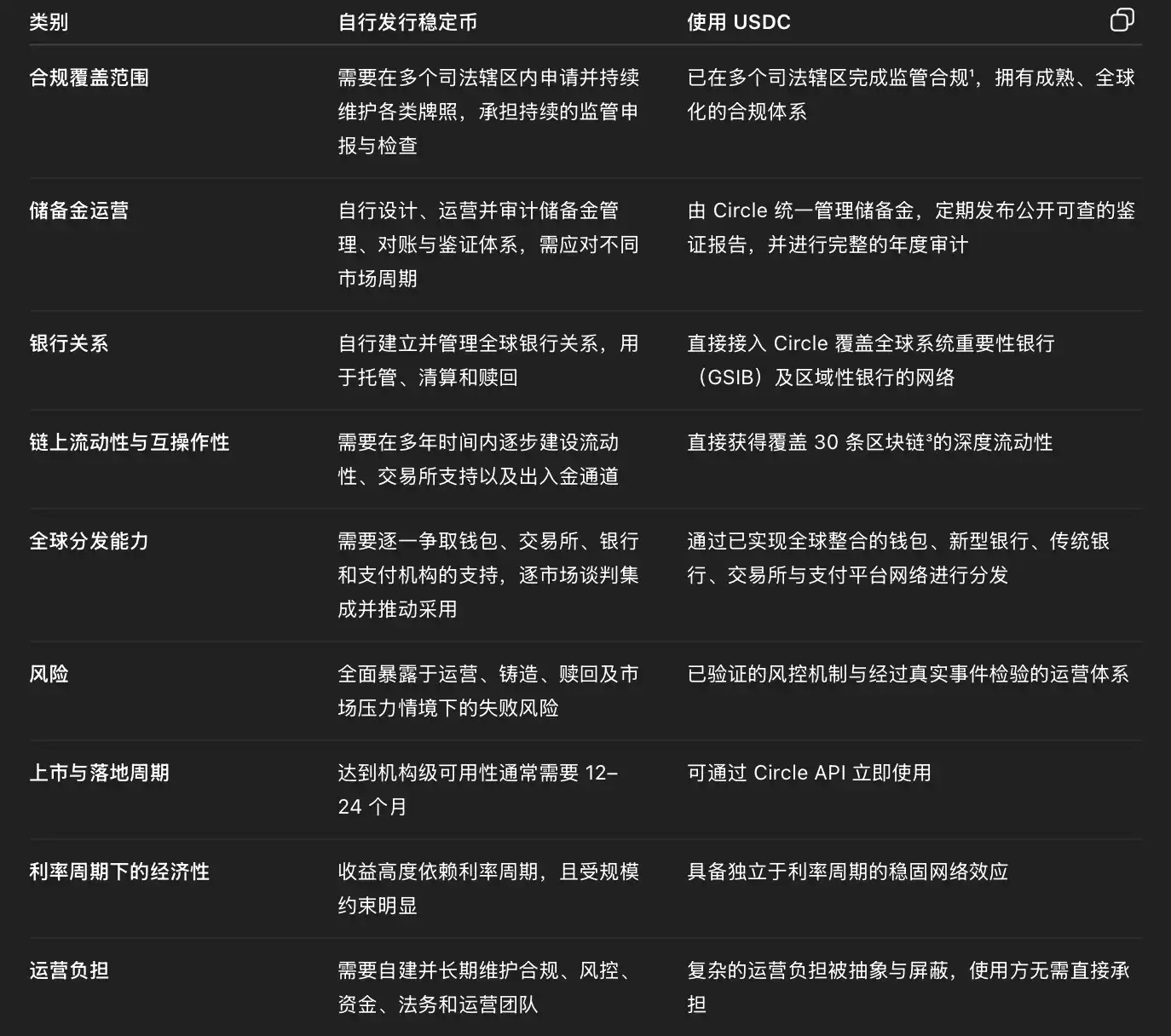
From a systemic perspective, each new, closed-loop proprietary stablecoin further fragments liquidity and trust. Each issuer is redundantly building reserves, compliance systems, and redemption channels, ultimately weakening the overall depth and resilience that stablecoins rely on during times of stress. In contrast, integrating USDC allows for the consolidation of liquidity, standards, and operational capabilities into a widely adopted, unified network from day one.

For corporate executives evaluating this decision, the differences between these two paths become particularly clear when viewed from an operational perspective:
The Temptation of Shortcuts

Currently, a wide range of newcomers—from fintech companies and payment institutions to crypto projects—are exploring or directly launching their own stablecoins. The growth of the stablecoin market in 2025 reflects both the gradual clarity of the regulatory environment and rising institutional interest. But the reality is that, although hundreds of stablecoin projects have been launched, about 95% have never achieved lasting, global scale.

Some believe it is possible to replicate the same economic returns without bearing the heavy operational costs. The reality, however, is not so romantic. Whether issuing a stablecoin on your own or through a white-label service, you are entering an industry where trust, liquidity, and scale are matters of survival.

Sometimes, the cost of mistakes is measured in "trillions." According to media reports earlier this year, one issuer accidentally minted 300 trillion tokens due to an operational error. Although it was fixed within minutes, it was enough to make headlines. On another occasion, a well-known stablecoin briefly depegged during a period of extreme market volatility, again demonstrating that even minor infrastructure flaws can be amplified and transmitted under pressure.

These incidents serve as reminders that the viability of a stablecoin depends on operational rigor in high-pressure environments. Markets and policymakers are watching closely.

Trust Is the Real Network Effect

Anyone can create a token on a blockchain. In fact, thousands already exist—most minted in minutes and forgotten just as quickly. Even in the stablecoin niche, over 300 projects have been launched, but only a handful carry almost all real-world usage and value; the vast majority, about 95%, have never truly succeeded.

The difference lies not in technology but in scale and trust. The real challenge for stablecoins begins during the expansion phase: how to sustain liquidity, redeemability, compliance, and system availability as transaction volumes grow across different markets and cycles.

You can mint a token in minutes, but you cannot mint trust in minutes. Trust stems from transparency, scale, and consistent redeemability across market cycles, accumulating over time. This is why the stablecoin market has ultimately concentrated in the hands of a few issuers—and why, as of January 30, 2026, USDC's cumulative historical settlement volume has exceeded $60 trillion.

Rather Than Reinventing the Wheel, Choose Collaboration

For most businesses, the right question is not "How should we issue our own stablecoin?" but "How can we integrate stablecoins into our business to unlock new growth?"

With USDC and EURC, companies can today embed digital dollars and euros, gaining near-instant settlement, global reach, and interoperability across dozens of blockchains, without having to bear the complexities of reserve management and regulatory compliance themselves.

Writing the Next Chapter Together

The stablecoin industry is entering a new phase. Policymakers are establishing clearer rules, institutions are raising their standards, and the market is gradually converging on a simple consensus: trust, liquidity, and compliance are the real moats.

The goal is not to have more stablecoins but to have fewer and better ones—ones that can meet current demands with shared liquidity, transparent reserves, and proven performance across cycles.

For institutions formulating their stablecoin strategies, the first step should not be to decide "what to build" but "whom to build with." If you want stablecoins to empower your business but do not want to become a stablecoin issuer yourself, the time-tested choice is clear: talk to Circle and use USDC.


Perguntas relacionadas

QAccording to the article, what is the main reason why approximately 95% of stablecoin projects fail to achieve lasting, global scale?

AThe main reason is not a technical failure, but the immense operational challenge of scaling. This includes the inability to continuously maintain liquidity, redemption capabilities, regulatory compliance, and system availability across different markets and market cycles. Trust, which is built on transparency, scale, and consistent redeemability over time, is the true barrier to success that most projects cannot overcome.

QWhat key operational capabilities does the article state are required to run a trusted, regulated stablecoin?

AThe key operational capabilities include real-time reserve management across market cycles, daily reconciliation with multiple banking partners, undergoing independent audits, and fulfilling compliance and regulatory reporting across multiple jurisdictions. This requires building 24/7 systems for compliance, risk management, treasury operations, and liquidity, with clear escalation and resolution mechanisms for stress scenarios and a zero-tolerance policy for errors.

QWhat strategic question should a business ask itself before deciding to issue a stablecoin, as suggested by the Circle executive?

AThe business should ask itself: 'Do you simply want to use stablecoins for your business, or do you intend to go into the *business* of issuing a stablecoin?' This reframes the decision from a technical one to a strategic one, questioning whether issuing currency is core to its business model.

QWhat is the article's view on the proliferation of new, closed proprietary stablecoins from a system-wide perspective?

AThe article argues that each new, closed proprietary stablecoin further fragments liquidity and trust. Each issuer is duplicating the work of building reserves, compliance systems, and redemption channels, which ultimately weakens the overall depth and resilience that stablecoins rely on, especially during times of market stress.

QWhat alternative does the article propose for companies that want the benefits of stablecoins without the burden of issuing their own?

AThe article proposes that companies should integrate existing, large-scale stablecoins like USDC and EURC into their businesses. This allows them to gain access to near-instant settlement, global reach, and interoperability across dozens of blockchains without having to shoulder the complexities of reserve management and regulatory compliance themselves.

Leituras Relacionadas

Is the 'Token Subsidy War' Among AI Giants Almost Over?

The article discusses the ongoing "token subsidy war" among AI giants like OpenAI and Anthropic, questioning whether it's nearing its end. It reveals that current AI subscription prices are heavily subsidized, with some plans offering tokens at up to 70 times the actual cost to attract and retain heavy users, especially developers and enterprises. This strategy mirrors past internet-era subsidy battles, but with a key difference: AI tokens lack "lock-in" effects. Unlike ride-hailing or food delivery apps, users can easily switch between AI providers as APIs become standardized, making it difficult for companies to raise prices post-subsidy. The piece highlights a structural asymmetry in the competition. Giants like Google, with massive advertising revenue, can afford to subsidize tokens indefinitely, akin to using "tokens as a weapon." In contrast, venture-backed companies like OpenAI and Anthropic face pressure to become profitable, especially as they approach IPO. The article cites Google Ventures founder Bill Maris, who suggests Google could slash token prices by 80%, putting immense pressure on competitors. Two potential endgames are presented: the "internet service" model (subsidize, monopolize, then raise prices) and the "utility" model (tokens become a standardized, low-margin commodity like electricity). Given the low switching costs, the latter seems more likely. The competition may not have a single winner but could instead accelerate AI's evolution into a foundational, infrastructure-level technology, akin to a public utility. For now, users continue to benefit from heavily subsidized token costs.

marsbitHá 5m

Is the 'Token Subsidy War' Among AI Giants Almost Over?

marsbitHá 5m

Beyond the Stadium: The Profitable Games Surrounding the World Cup

"Beyond the Pitch: The Profit Game Around the World Cup" The FIFA World Cup transcends being a sporting spectacle, evolving into a massive global arena for speculation and profit-seeking. The 2026 tournament has amplified this dynamic, creating a multi-layered ecosystem of financial opportunism alongside the football. **Prediction markets** have surged into the mainstream. Platforms like Polymarket and Kalshi saw trading volumes for World Cup contracts soar, attracting new users with their financial trading model and high-profile, chain-based wealth stories that overshadow traditional sports betting in terms of growth and narrative. However, **traditional sportsbooks** remain the dominant force, leveraging established user habits, legal markets, and comprehensive product offerings to handle the vast majority of speculative wagers, with projections suggesting record-breaking betting volumes. Capital markets also react. **"Concept stocks"** in countries like South Korea and Japan experience volatile price swings based on team performance and anticipated fan spending on items like chicken, beer, and viewing parties, effectively becoming a stock market reflecting fan sentiment. The **ticket resale market** has become a sophisticated arena for arbitrage. Prices fluctuate wildly based on team draws and star power, with sellers sometimes listing tickets they don't yet own in a practice akin to short-selling, while FIFA's own "Right to Buy" tokens add another layer of speculative trading. **Collectibles and merchandise** offer another avenue. Panini sticker albums, with their inherent scarcity and nostalgic value, can become high-value collectibles. Limited-edition or locally themed jerseys command significant premiums on secondary markets, and even counterfeit vendors profit from fans' desire for affordable match-day identity. The **cryptocurrency** space has seen a frenzy of speculative, unauthorized World Cup-themed meme coins on chains like Solana. These tokens, often exploiting team names and player imagery, experience extreme pump-and-dump cycles, creating stories of massive gains for a few early entrants and steep losses for many others. Finally, an entire industry thrives on **providing information and tools** to other speculators. Developers create platforms like SeatSidekick to track ticket inventory and prices, while paid Telegram groups and subscriptions sell betting tips and predictions, monetizing the widespread desire for an informational edge. In essence, the World Cup has become a compressed, global laboratory for speculation. While the games determine champions on the field, a parallel, complex network of financial transactions—spanning prediction contracts, bets, stocks, tickets, collectibles, crypto, and information services—settles its own scores in the global market.

marsbitHá 46m

Beyond the Stadium: The Profitable Games Surrounding the World Cup

marsbitHá 46m

How Does Codex Use a Computer? Three Entry Points and Permission Boundaries

This article explains the three primary methods for Codex to interact with a computer, each with distinct use cases, permission boundaries, and trust levels. **1. Computer Use:** This offers the broadest access, allowing Codex to visually control and interact with the graphical user interface of authorized macOS/Windows apps, system settings, and even iOS simulators. It's ideal for tasks lacking APIs or structured tools, such as operating legacy software or multi-app workflows. However, it's the slowest method and has the widest permission scope, requiring careful supervision for sensitive actions. **2. Chrome Extension:** This grants Codex access to the user's logged-in Chrome browser state, including cookies, profiles, and open tabs. It's best for tasks requiring user identity across websites like Gmail, LinkedIn, Salesforce, or internal dashboards. Its key advantage is multi-tab control for complex workflows. While more powerful for browser-based tasks than Computer Use, it carries higher sensitivity as actions are performed under the user's identity. **3. In-App Browser:** This is a browser isolated within the Codex thread, separate from the user's personal browsing data. It excels in web development and debugging scenarios—previewing local servers, testing responsive layouts, or annotating designs directly on the page. Its isolation is a strength for development but a limitation for tasks requiring login sessions. The core principle is to choose the narrowest, safest, and most structured interface for the task. Use plugins or MCPs first, resort to visual control (Computer Use) only for GUI-dependent tasks, employ the Chrome extension for identity-reliant browser work, and prefer the In-App Browser for isolated development. **Appshots** are clarified as a fourth, complementary tool for *inputting* context—capturing a screenshot of a window to point Codex to something—rather than a method for Codex to *act*. Together, this layered approach highlights a key to AI agent productization: not granting unlimited permissions, but constraining them within clear boundaries for specific tasks while preserving user oversight.

marsbitHá 2h

How Does Codex Use a Computer? Three Entry Points and Permission Boundaries

marsbitHá 2h

The "Iron Rule" of Chip Equipment Is Being Broken

For years, the semiconductor equipment industry followed an unwritten "iron rule": suppliers offered steep discounts for new tool introductions (Design-in) and faced consistent price pressure during repeat orders, especially during market downturns. This long-standing buyer's market dynamic is now being upended. Recently, SK Hynix's primary equipment suppliers have reportedly requested a 3-4% price *increase*, a nearly unprecedented move. This shift is driven by a severe supply-demand imbalance fueled by the AI compute boom. Securing equipment has become an urgent arms race as chipmakers' expansion speed dictates their ability to fulfill massive AI chip orders. Key areas feeling the strain include: **TCB (Thermal Compression Bonding) Equipment:** Demand is exploding, driven by the simultaneous needs of HBM4 memory stacking, AI chip Chip-on-Substrate (C2S), and logic Chiplet Chip-on-Wafer (C2W) packaging. Players like Hanmi Semiconductor, Hanwha Semitech, and ASMPT are receiving major orders. While hybrid bonding is seen as the future, TCB remains the pragmatic choice for HBM4 mass production, with its lifecycle extended by relaxed specifications and ongoing technological upgrades. **Test Equipment Bottlenecks:** Ironically, AI-driven shortages are now crippling test equipment manufacturing. Critical components like FPGAs, Driver ICs, and CPUs face severe shortages and extended lead times (up to 52 weeks for FPGAs), as AI data center and server vendors prioritize supply. This creates a paradoxical cycle: AI chip shortages drive fab expansion, which requires more test equipment, whose production is delayed because its key parts are diverted to make AI chips. The industry is entering a broad, AI-powered upcycle. SEMI forecasts global semiconductor equipment sales to hit a record $156 billion by 2027, fueled by investment in advanced logic/foundry, HBM-driven DRAM, and advanced packaging (like CoWoS). Major players like TSMC, SK Hynix, and Micron are aggressively ramping capital expenditure. In conclusion, leading equipment vendors are no longer just selling tools; they are selling the critical capability to deliver AI-era capacity. Pricing power is shifting decisively to those with indispensable technology in key process nodes like advanced logic, HBM, and advanced packaging, rewriting the industry's traditional power structure.

marsbitHá 2h

The "Iron Rule" of Chip Equipment Is Being Broken

marsbitHá 2h

Trading

Spot
Futuros
活动图片