Charity in Name, Family Gain in Reality: How the Trump Family Turns Philanthropy into Profit?

链捕手Publicado em 2026-06-17Última atualização em 2026-06-17

Resumo

Summary: The article examines how the Trump family, particularly Eric Trump, has allegedly leveraged charitable and business ventures for financial gain. It details the operations of Eric's children's cancer charity (now Curetivity), which, despite donating over $25 million to St. Jude, reportedly funneled at least $500,000 back to Trump-owned properties for event costs between 2011-2016. These transactions, often undisclosed, involved clear conflicts of interest with Trump Organization employees on the board. Following media scrutiny and a state investigation, the charity reformed but continued holding costly fundraisers at Trump venues. The piece draws parallels to Eric's role at cryptocurrency company American Bitcoin (ABTC), where he promoted unrealistic mining cost savings. Investigative reporting revealed most Bitcoin was acquired through share dilution, with actual costs far higher than claimed, contributing to a ~90% stock price drop and significant investor losses, while insiders like Eric retained substantial wealth. The pattern identified involves using misleading rhetoric, opaque accounting, and legal strategies to navigate controversies, often deflecting criticism as political attacks before resuming operations with minimal substantive change.

Author: Chloe, ChainCatcher

Last month, just hours before attending a state banquet with King Charles III, Eric Trump, the former president's second son, posted a five-paragraph defense of himself on X. The trigger was a controversy surrounding his involvement in a publicly-traded cryptocurrency company called "American Bitcoin," which he had been pitching to investors as capable of mining Bitcoin at roughly half the market price. A Forbes report had debunked that claim.

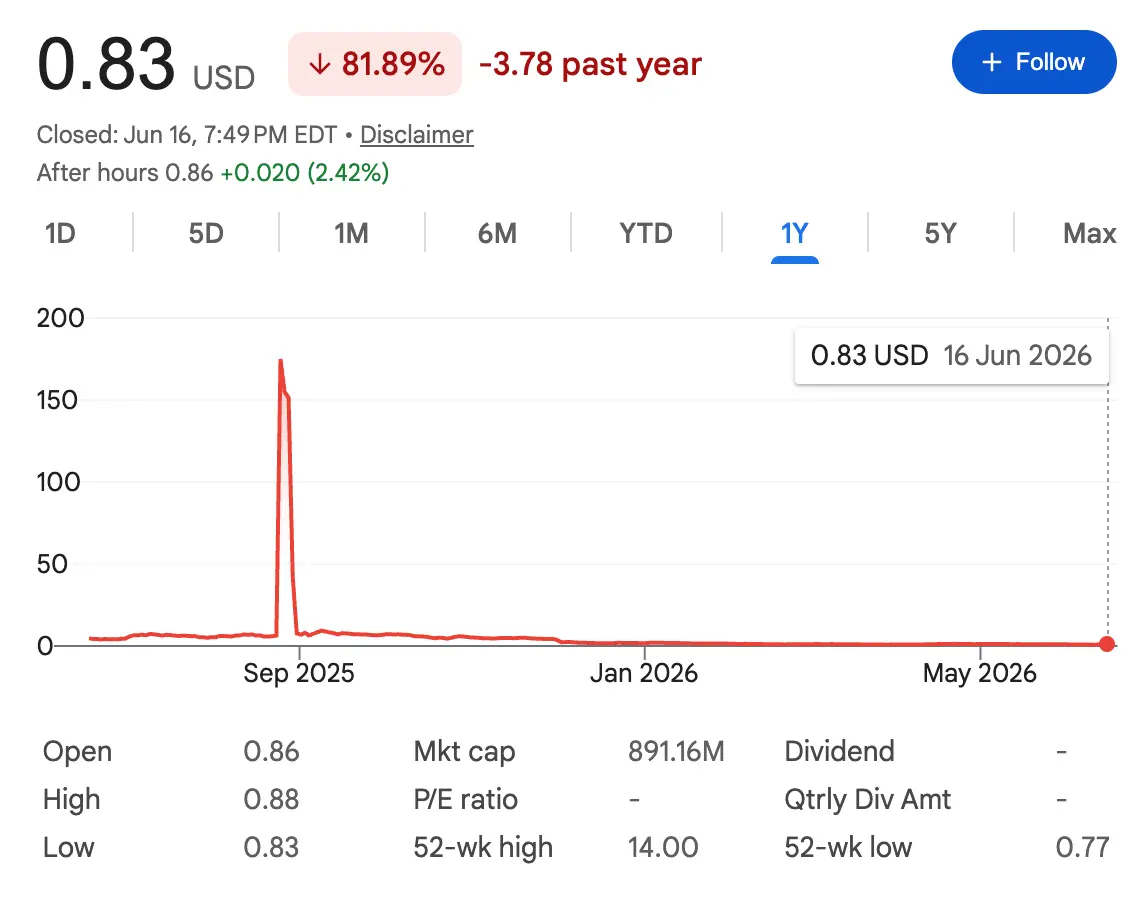
By June 17, 2026, the stock price of American Bitcoin (Nasdaq: ABTC) had fallen to about $0.83, a collapse of roughly 90% from its peak of around $175 at the end of last year and its $14 IPO price.
Then, Eric pivoted in his post to another matter weighing on him for nearly a decade: a 2017 Forbes investigation into his childhood cancer charity foundation. He wrote that the outside attacks were "insanity," as he was merely a young man "trying with all my heart to save dying children."

It is undeniable that he performed good deeds. Over the years, the foundation donated over $25 million to St. Jude Children's Research Hospital in Tennessee, operating with lean overhead, focused on fundraising while outsourcing the complex execution to others. However, its other side involves misleading rhetoric, sloppy accounting, a board entangled with interests, and unapologetic loyalty to Trump. The same playbook is now evident in the crypto industry.

The Trump Family's Habit of Emerging Unscathed from Scandals

Through Freedom of Information Act requests, Forbes obtained thousands of pages of documents revealing that between 2011 and 2016, his foundation directed at least $500,000 in charitable funds back to the family business through a series of transactions, most of which never appeared on tax filings.

These documents also explain why the Trump family consistently emerges unscathed. Their playbook is: first, mount a loud defense on television or social media; then, deploy lawyers to bury paper trails; next, adjust practices just enough to appease regulators and avoid punishment, without fundamentally changing; once the storm passes, re-emerge unabashedly as victims, asking the public for trust again—and there are always plenty willing to believe.

Eric's foundation has played this exact script from start to finish: nine years after the scandal, the renamed entity is still operating, with fundraising expanding annually, annual expenses exceeding $500,000, and events almost exclusively held at Trump-branded venues.

Blatant Conflicts of Interest, Extending Even to the White House

The foundation's origins were indeed well-intentioned. It began with Eric and his wealthy friends wanting to do good. The 2007 application to the IRS even stated: "Our family has three golf courses in New York and New Jersey available for use." The application also promised not to sign leases with any company controlled by its leadership. This held true for the first three years, with annual expenses around $50,000 and fundraising in the hundreds of thousands.

But starting in 2010, Trump Organization employees began joining the board. The following year, expenses surged to $142,000. Former club manager Ian Gillule pointed the finger directly at Trump himself in an interview: in the early days, the foundation used venues for free, and invoices often vanished. Trump was unhappy not with "helping for free," but with donating so much without leaving any paper trail or credit. He then ordered that everyone, including his own son, be charged.

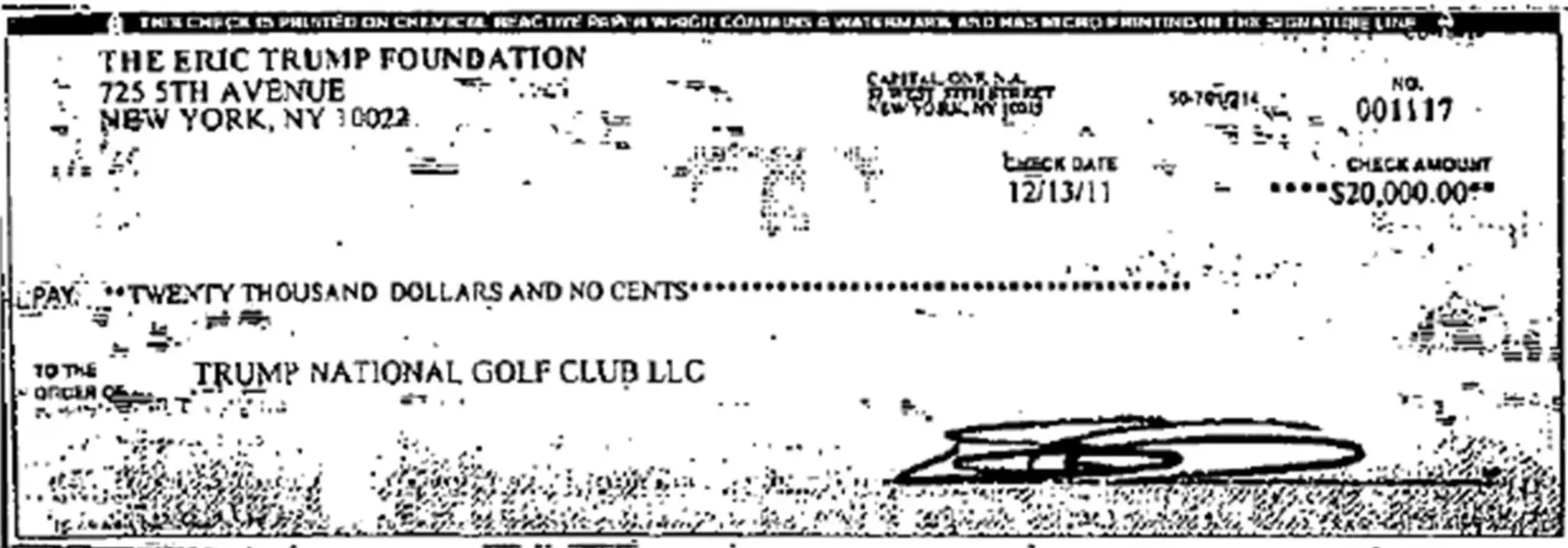
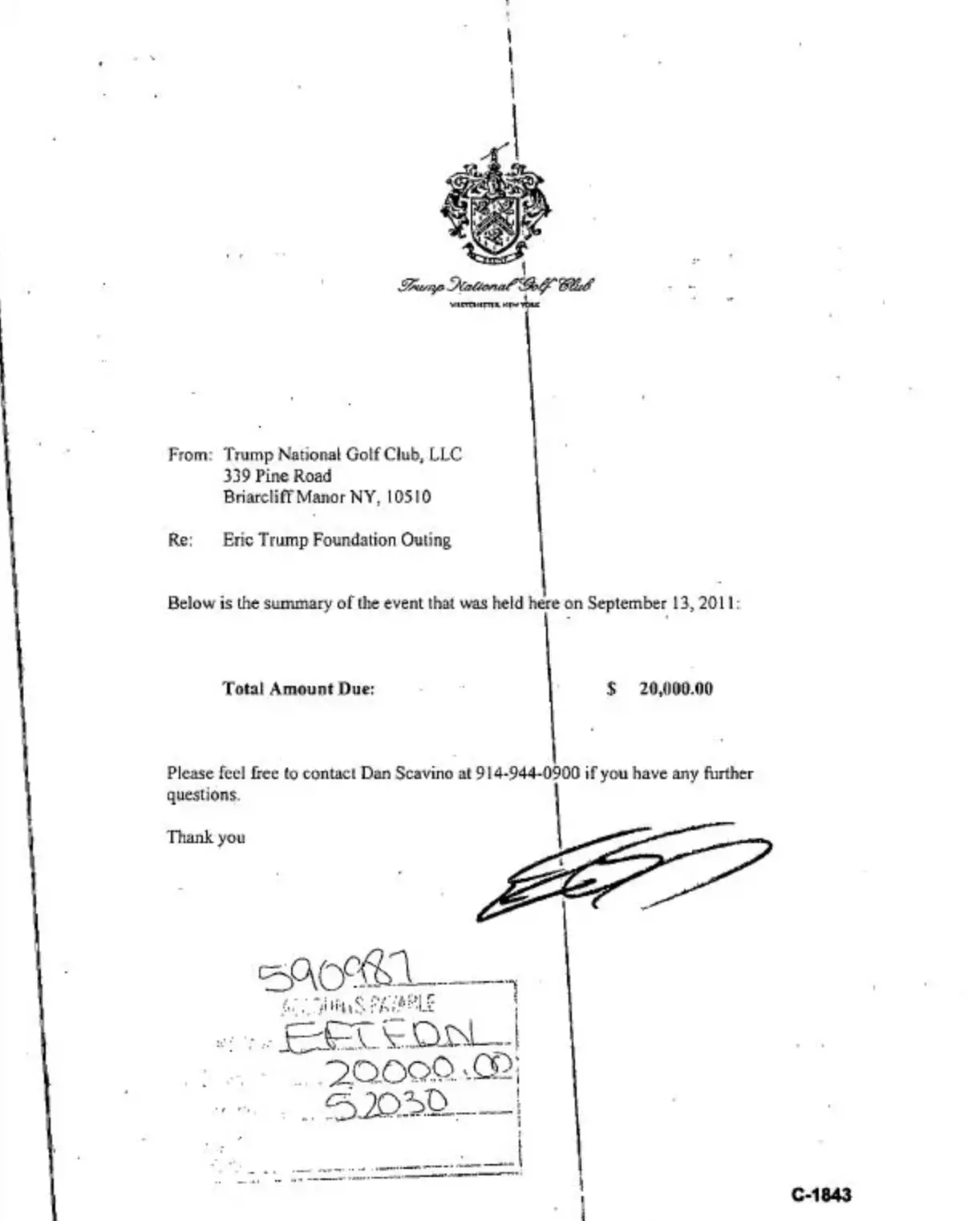
So, everyone got charged. After a 2011 event, Trump National Golf Club billed the foundation $20,000. The copy obtained by Forbes included a note: "If you have any questions, please call Dan Scavino." The conflict of interest was blatant: Dan Scavino, now White House Deputy Chief of Staff, was both the club's general manager and a foundation director at the time. The invoice also bore Eric's signature, though it's unclear in which capacity. Bills kept coming yearly: the club charged $100,000 in 2013, $99,000 in 2016, with Trump SoHo Hotel and Mar-a-Lago also taking a cut.
Toxic Candy Wrapped in Pretty Paper

"Dear Friends," Eric wrote in the 2014 fundraiser gala program, the foundation "boasts one of the lowest expense ratios in the world," insisting on using only Trump-owned venues, full-time volunteers, donated catering, and celebrity performers working pro bono, so that St. Jude received almost all proceeds.

But the books didn't match the rhetoric. The galas featured Hooters waitresses and mini Eric bobblehead dolls. Performers were mostly celebrities from "The Celebrity Apprentice." "They all performed for free," Eric claimed, yet checks he signed for performance fees totaled over $90,000. Auction items were "all donated," but the foundation spent at least $65,000 procuring them. In 2012, it even bought an item for $6,040 that sold for only $3,310. Transportation was another cost, with Sunny's alone charging over $35,000.

Furthermore, hundreds of thousands in donations flowed to other charities, several with closer ties to family interests than to childhood cancer; at least three also held fundraisers at Trump courses. In 2013, Eric even spent $1,600 of foundation funds to buy a decorative copper still and an antique bottle-washing machine near his family's winery. Of course, the foundation did donate large sums to St. Jude, increasing from $220,000 in 2007 to $2.9 million in 2016, the year of Trump's first election victory.

Eric as Victim, Feeling 'No Good Deed Goes Unpunished'

Politics soon thrust the foundation into the spotlight. In late 2016, Daily Beast and The Associated Press exposed its dealings with Trump clubs. The New York Times reported an investment manager bid nearly $60,000 at a fundraiser auction for a coffee with Ivanka Trump. The issues weren't just PR: under New York state and federal law, such related-party transactions required board votes, documentation, and disclosure on tax returns.

So Eric decided to restructure, distancing the foundation from the family: all Trump Organization employees left the board, including himself. He said his father's administration required avoiding "perception problems," and he would not personally fundraise until after his term. The foundation was renamed Curetivity, pledging all donations would go to St. Jude. Superficially, it seemed a return to its roots. But Eric remained unapologetic, telling Forbes a month after the board overhaul: "We use the best venues in the world 100% free, which is why our expense ratio is the lowest in history."

The day the article published, he appeared on Fox News, framing the scrutiny as a political witch hunt, casting himself as a victim. "I raised tens of millions of dollars, and what do I get in return? Hate."

Two days later, the Attorney General's office sent a letter requesting the books. The investigation took a toll: 2017 donations plummeted by over two-thirds, falling below $1 million, while administrative and legal costs soared from near zero to about $50,000 annually. By year-end, the AG's office wrote again, highlighting numerous issues: financial reports not conforming to accounting standards, ignoring related-party transaction rules, misleading marketing, and threatening to revoke its fundraising license.

Thereafter, the books became increasingly opaque. After Eric left the board, the occasional "related party transaction" label disappeared. The "rent/venue fees" line was often left blank. Fundraising expenses dropped from $384,000 in 2016 to $111,000 in 2017. By late 2018, when the AG's office indicated the investigation was shifting to compliance rather than enforcement, Eric re-emerged, returning to promotional materials and eventually being dubbed Curetivity's "founder." Fundraising expenses rebounded, hitting a new high of $392,000 in 2019. How much flowed back to the Trump Organization became unknowable under the murky accounting.

Today, fundraisers continue one after another at Trump-branded venues: $309,000 spent at Mar-a-Lago in 2020, with recent events held at Trump courses in North Carolina and Jupiter, Florida. If charges are similar to before, Curetivity alone could funnel around $200,000 annually into Trump's business empire, totaling over a million in two decades.

The Same Playbook Moved to Crypto

This playbook of "smooth talk, value flowing back to insiders" didn't stop at the charity foundation; it's now almost entirely replicated at American Bitcoin.

Previously, Eric packaged the company as a "money-printing machine," publicly claiming it could mine at a 53% discount to spot prices, with a cost per Bitcoin of about $57,000. It sounds strikingly similar to the foundation's "lowest expense ratio in the world." But just like the charity foundation, the books tell a different story.

The investigation was led by the same Forbes reporter, Dan Alexander, who exposed the foundation nine years ago. He found that about 70% of the company's Bitcoin wasn't mined; it was acquired by continuously issuing new shares and buying on the open market. Factoring in depreciation and SG&A, the all-in cost per coin neared $90,000, far above the $57,000 Eric claimed.

Now, the stock has crashed about 90% from its late-2025 peak of ~$175 and its $14 IPO price. Retail investors are estimated to have lost about $5 billion collectively. Financially, it's bleeding: a net loss of approximately $81.8 million in Q1 2026. Meanwhile, on the insider side, the view is completely different.

The founders originally acquired shares at near-zero cost. Even with the 90% stock drop, Eric's personal stake is still worth about $70 million; during the same period, his estimated net worth rose to around $300 million. The post-scandal script is also familiar. Facing质疑, Eric didn't directly address Forbes's calculated costs and dilution. Instead, he countered with impressive numbers like quarterly revenue growth and holdings exceeding 7,000 Bitcoins, lashing out on X that Forbes had become a political weapon and a disgrace to journalism.

Last September, Eric stood at the center of a party at the Westchester Country Club, hosting Curetivity's 19th fundraiser, surrounded by key business partners. Since his father's re-election, his estimated net worth has skyrocketed from around $40 million in 2024 to $300 million today.


Criptomoedas em alta

Perguntas relacionadas

QWhat were the main findings regarding the financial relationship between Eric Trump's charity foundation and the Trump Organization, according to the article?

AThe article states that through Freedom of Information Act requests, *Forbes* uncovered documents showing that between 2011 and 2016, Eric Trump's foundation diverted at least $500,000 in donations back to Trump family businesses through a series of transactions. These financial flows were largely absent from tax filings. The foundation paid substantial fees to Trump-owned venues like Trump National Golf Club, Trump SoHo hotel, and Mar-a-Lago for hosting its fundraising events.

QHow did Eric Trump respond to the *Forbes* investigation into his American Bitcoin company's mining cost claims?

AIn response to the *Forbes* article that challenged his claims about American Bitcoin's low mining costs, Eric Trump did not directly address the specific calculations regarding costs and share dilution. Instead, he defended the company by highlighting positive metrics like quarterly revenue growth and holdings of over 7,000 bitcoins. He also attacked *Forbes* on social media platform X, calling it a political weapon and a disgrace to journalism.

QWhat actions did the New York Attorney General's office take regarding Eric Trump's charity foundation, and what was the outcome?

AFollowing media reports, the New York Attorney General's office launched an investigation, requesting the foundation's books. The investigation identified several issues, including financial statements not conforming to accounting standards, disregard for rules on related-party transactions, and misleading marketing. The office threatened to revoke the foundation's fundraising license. By the end of 2018, the office informed the foundation that the inquiry was shifting towards compliance rather than enforcement action. Subsequently, Eric Trump returned to a prominent role in the renamed foundation, Curetivity.

QAccording to the article, what is the common pattern or 'playbook' used by the Trump family in handling controversies?

AThe article describes a recurring pattern: first, respond loudly on TV or social media to defend themselves. Then, use lawyers to bury paper records. Next, adjust practices just enough to appease regulators and avoid punishment, without changing the core behavior. Once the controversy subsides, they re-emerge portraying themselves as victims, asking for public trust again—a strategy that often finds a willing audience.

QHow does the article draw a parallel between Eric Trump's charity operations and his involvement in the cryptocurrency company American Bitcoin?

AThe article draws a parallel by stating that the playbook of 'pretty talk and value flowing back to the family' used in the charity foundation was almost copied verbatim into American Bitcoin. Similar to claiming the foundation had 'one of the lowest expense ratios in the world,' Eric Trump promoted the crypto company as a 'money-printing machine' that could mine bitcoin at a significant discount. In both cases, the article claims the actual account books did not match the rosy public claims, with hidden costs and benefits flowing to insiders.

Leituras Relacionadas

Arthur Hayes' 10,000-Word New Article: When Will the AI Wave Peak? Will the Bubble Burst? Why Am I Fiercely Buying ETH?

In his latest essay, "When Will the AI Wave Peak? Will the Bubble Burst? Why Am I Loading Up on ETH?", crypto veteran Arthur Hayes presents a contrarian thesis on the AI investment boom, framing it as an impending credit bubble rather than a tech growth story. Hayes argues that massive AI infrastructure spending (AI CAPEX) is fundamentally a real estate play—building data centers—disguised as high-growth technology. This misclassification leads to dangerous capital misallocation. He predicts the bubble is a credit bubble akin to the 2008 financial crisis, not an earnings bubble like the 2000 dot-com bust. The turning point will not be AI companies failing to profit, but a slowdown in the growth rate of data center construction, which will cause over-leveraged players to falter. He anticipates AI CAPEX growth will slow by mid-to-late 2027, entering a "slowdown phase" in 2028. However, credit will continue flowing due to profitable lending, government pressure, and implicit bailout guarantees. This creates a period of misallocation where credit exceeds valuable projects. Hayes draws parallels to the 2006-2007 housing market "no man's land." Governments, particularly the US, will inevitably print money to bail out the system, possibly through direct equity purchases via SPVs—a form of "Equity QE." This massive future liquidity injection, exceeding the 2008 crisis response, will ultimately flow into crypto, specifically Bitcoin, potentially driving it past $1 million. Regarding the current crypto market, Hayes believes the AI boom has sucked away liquidity, contributing to Bitcoin's correction. He expects Bitcoin to bottom as AI capital misallocation accelerates, with the excess fiat liquidity eventually fueling its next bull run. Finally, Hayes reveals a major personal trade: aggressively accumulating ETH. He targets $5,000 by end-2026, betting on a new narrative where Ethereum becomes the settlement layer for TradFi RWA tokenization, citing projects like Robinhood using Arbitrum L2s as a catalyst. He views ETH as a hated, high-Lindy asset with strong liquidity, presenting an asymmetric opportunity.

Odaily星球日报Há 7m

Arthur Hayes' 10,000-Word New Article: When Will the AI Wave Peak? Will the Bubble Burst? Why Am I Fiercely Buying ETH?

Odaily星球日报Há 7m

Stunning, Musk Joins Forces with Huang Jen-hsun to Deploy the Stellar Brain! AI Computing Center Launched into Space

SpaceX, in its first public earnings report, has announced a partnership with NVIDIA to launch Starmind, an orbital AI computing network. This initiative aims to move AI's computational foundation into space to solve the critical challenges of energy consumption and heat dissipation faced by terrestrial data centers. The core concept involves deploying data centers equipped with NVIDIA's advanced GPUs (like the upcoming Rubin) into sun-synchronous orbit. Key advantages include near-continuous solar power for energy, the vacuum of space for highly efficient radiative cooling, and the absence of terrestrial constraints like land use and grid capacity. The first computational node, the Starmind AI1 satellite, is described as a massive vehicle with a 75-meter wingspan, generating 210 kW of solar power to run a 150 kW computing payload—equivalent to a full NVIDIA GB300 supercomputer rack. These "compute satellites" will connect to users via SpaceX's existing Starlink constellation using high-speed laser links, promising low-latency access from anywhere on Earth. SpaceX's ability to realize this vision is underpinned by its Starship rocket, designed for low-cost, high-frequency launches to transport thousands of satellites, and massive planned manufacturing facilities like the Gigasat factory and the Terafab chip plant. Elon Musk framed the project within the context of the Kardashev Scale, proposing Starmind as humanity's first substantive step toward becoming a Type II civilization capable of harnessing a star's energy. The ultimate goal is to deploy one terawatt of computational power in space, with even more ambitious plans involving lunar-based manufacturing and launch systems. The report positions Starmind not merely as a commercial AI service, but as a foundational infrastructure project to expand human intelligence and capability beyond Earth, leveraging SpaceX's integrated strengths in rockets, satellites, and global connectivity.

marsbitHá 58m

Stunning, Musk Joins Forces with Huang Jen-hsun to Deploy the Stellar Brain! AI Computing Center Launched into Space

marsbitHá 58m

Despite the sell-off, Goldman Sachs remains bullish on Samsung and SK Hynix. Here's why.

Goldman Sachs maintains "Buy" ratings on Samsung Electronics and SK Hynix despite recent stock declines. Its bullish view centers on three core arguments. Firstly, it expects HBM (High Bandwidth Memory) pricing to re-establish a premium over conventional DRAM by 2027, with a projected blended ASP of around $2.9/Gb. This is driven by tight supply-demand dynamics, increasing manufacturing complexity for newer HBM generations, and the need to restore its historical price premium. Secondly, the volatility of the memory cycle is expected to moderate due to widespread adoption of 3-5 year Long-Term Agreements (LTAs) with key customers. These contracts, covering a significant portion of planned capacity, feature mechanisms like price floors, prepayments, and penalties, reducing supplier risk and improving earnings visibility. Thirdly, inventory levels remain low at key suppliers and major customers, providing a buffer against a sharp downturn. Furthermore, robust demand from enterprise SSDs for AI servers is seen offsetting weakness in consumer segments like smartphones and PCs, preventing NAND markets from slipping into oversupply in the near term. While risks exist—such as potential weaker AI demand or aggressive capacity expansion—Goldman Sachs believes the combination of HBM repricing, LTAs, and low inventory underpins a more stable earnings outlook for the leading Korean memory makers.

marsbitHá 1h

Despite the sell-off, Goldman Sachs remains bullish on Samsung and SK Hynix. Here's why.

marsbitHá 1h

Korean Cryptocurrency Market Platform Kimpga Integrates with Global Web3 Data Platform RootData, Providing Popularity and Growth Scores for Token Projects

South Korean cryptocurrency market data platform Kimpga (kimpga.com) has announced a data partnership with the global Web3 project data platform RootData. As a result, Kimpga has integrated comprehensive token project information directly into its platform services. The integration introduces a new "RD Score" column within Kimpga's market listings. Clicking the score opens a detailed data window that displays the "RD Popularity Index," the "RD Growth Index," and key fundamental project data such as leading investors, core team members, and project category tags. For example, for Solana (SOL), users can view its indices and identify major backers like Polychain Capital, a16z, and Multicoin Capital directly from the interface, with links to full RootData project pages for deeper research. Jin Jae-yong, a representative of Kimpga, stated that the partnership allows users to quickly assess a project's fundamental strength, including its development team and investor lineup, without leaving the market data screen. This addresses a key challenge for investors who previously had to rely solely on price and premium data. RootData is a widely used global platform providing Web3 project details on funding history, team composition, and investor portfolios for due diligence and investment analysis. Kimpga, which boasts 10 million cumulative users, is a leading Korean crypto market platform providing real-time data and price premiums from over 18 domestic and international exchanges. This collaboration with RootData follows Kimpga's previous partnership with the token rating platform APYWA, further enriching its data offering to support user investment decisions.

marsbitHá 1h

Korean Cryptocurrency Market Platform Kimpga Integrates with Global Web3 Data Platform RootData, Providing Popularity and Growth Scores for Token Projects

marsbitHá 1h

Trading

Spot

Artigos em Destaque

Como comprar GAIN

Bem-vindo à HTX.com!Tornámos a compra de GriffinAI (GAIN) simples e conveniente.Segue o nosso guia passo a passo para iniciar a tua jornada no mundo das criptos.Passo 1: cria a tua conta HTXUtiliza o teu e-mail ou número de telefone para te inscreveres numa conta gratuita na HTX.Desfruta de um processo de inscrição sem complicações e desbloqueia todas as funcionalidades.Obter a minha contaPasso 2: vai para Comprar Cripto e escolhe o teu método de pagamentoCartão de crédito/débito: usa o teu visa ou mastercard para comprar GriffinAI (GAIN) instantaneamente.Saldo: usa os fundos da tua conta HTX para transacionar sem problemas.Terceiros: adicionamos métodos de pagamento populares, como Google Pay e Apple Pay, para aumentar a conveniência.P2P: transaciona diretamente com outros utilizadores na HTX.Mercado de balcão (OTC): oferecemos serviços personalizados e taxas de câmbio competitivas para os traders.Passo 3: armazena teu GriffinAI (GAIN)Depois de comprar o teu GriffinAI (GAIN), armazena-o na tua conta HTX.Alternativamente, podes enviá-lo para outro lugar através de transferência blockchain ou usá-lo para transacionar outras criptomoedas.Passo 4: transaciona GriffinAI (GAIN)Transaciona facilmente GriffinAI (GAIN) no mercado à vista da HTX.Acede simplesmente à tua conta, seleciona o teu par de trading, executa as tuas transações e monitoriza em tempo real.Oferecemos uma experiência de fácil utilização tanto para principiantes como para traders experientes.

384 Visualizações TotaisPublicado em {updateTime}Atualizado em 2026.06.02

Como comprar GAIN

Discussões

Bem-vindo à Comunidade HTX. Aqui, pode manter-se informado sobre os mais recentes desenvolvimentos da plataforma e obter acesso a análises profissionais de mercado. As opiniões dos utilizadores sobre o preço de GAIN (GAIN) são apresentadas abaixo.

活动图片