Chainlink stalls: Can LINK reach $12 as whale wallets cross 25K?

ambcryptoPublicado em 2026-03-26Última atualização em 2026-03-26

Resumo

Chainlink (LINK) is experiencing significant accumulation by large holders, with over 25,420 wallets now holding at least 1,000 LINK, indicating strong confidence despite limited price movement. The price remains range-bound between $7.95 (support) and $9.60 (resistance), with recent rebounds from the lower boundary reinforcing this zone. A breakout above $9.60 could propel LINK toward $12.00, supported by declining exchange reserves (down 2.22%), which reduces sell-side pressure, and a positive funding rate (0.0042%), reflecting gradual long positioning. While the DMI shows weakening bearish pressure, the ADX indicates weak trend strength, suggesting consolidation may continue. A sustained move above resistance is needed for a bullish shift; otherwise, the price may remain range-bound.

Chainlink [LINK] has recorded a sharp rise in large-holder accumulation, with 25,420 wallets now holding over 1,000 LINK. This steady increase reflects growing confidence among higher-capital participants despite the absence of strong price expansion.

Rather than chasing upward moves, these wallets have continued accumulating within a compressed structure, suggesting strategic positioning.

As a result, the divergence between rising holder strength and stagnant price has become more pronounced. This behavior often reflects early-stage accumulation phases, where stronger hands absorb supply quietly before any visible expansion begins for LINK.

Can Chainlink break above $9.60 resistance?

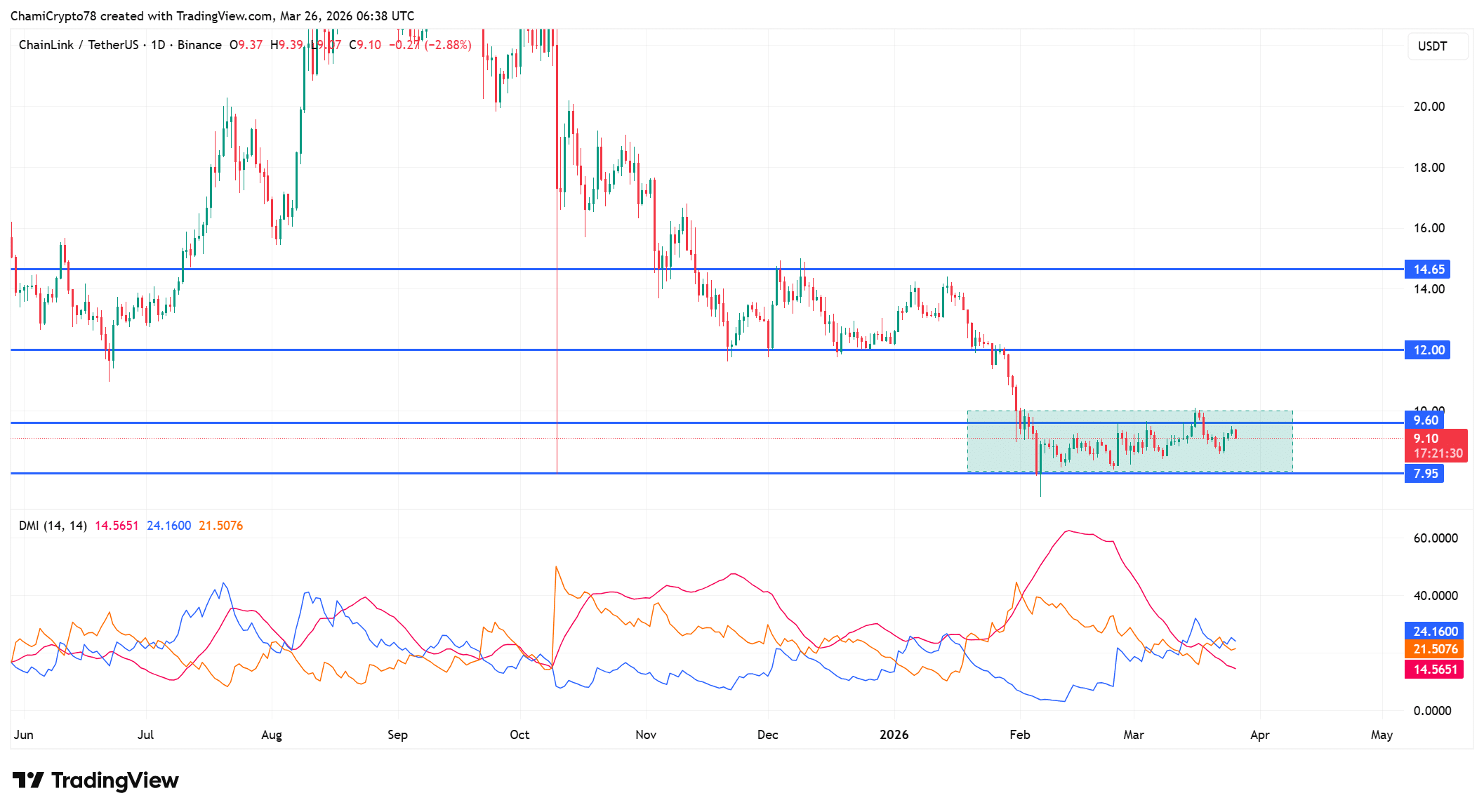
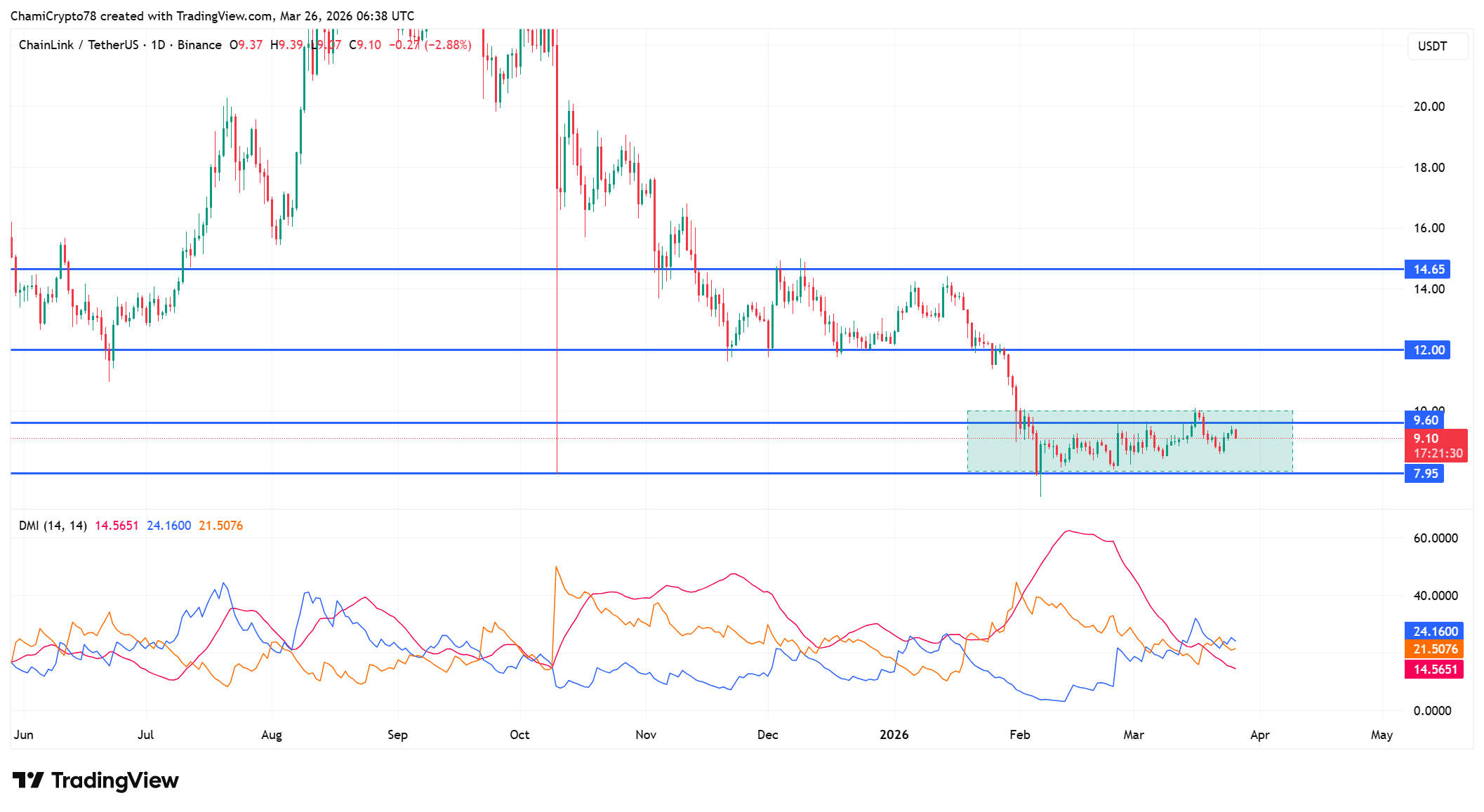
LINK has continued trading within a clearly defined range, with support holding near $7.95 and resistance capping price near $9.60. Price recently rebounded from the lower boundary, reinforcing this zone as a reliable demand area.

However, repeated rejections near $9.60 have prevented any sustained breakout attempt. As consolidation persists, price action has tightened within this range, reflecting reduced volatility and growing compression. This structure typically precedes expansion, especially when price continues respecting both boundaries consistently.

If buyers manage to reclaim $9.60, the price would likely push toward $12.00, where the next major resistance sits. At press time, the DMI structure began reflecting a shift in directional control, with +DI climbing toward 24.16 while -DI has declined closer to 21.50.

This narrowing gap indicates that bearish pressure has weakened compared to previous phases of the downtrend.

However, ADX sat near 14.56, indicating that trend strength remains relatively weak. This combination supports a stabilization phase rather than a confirmed directional breakout.
Source: TradingView

Falling reserves tighten sell-side pressure

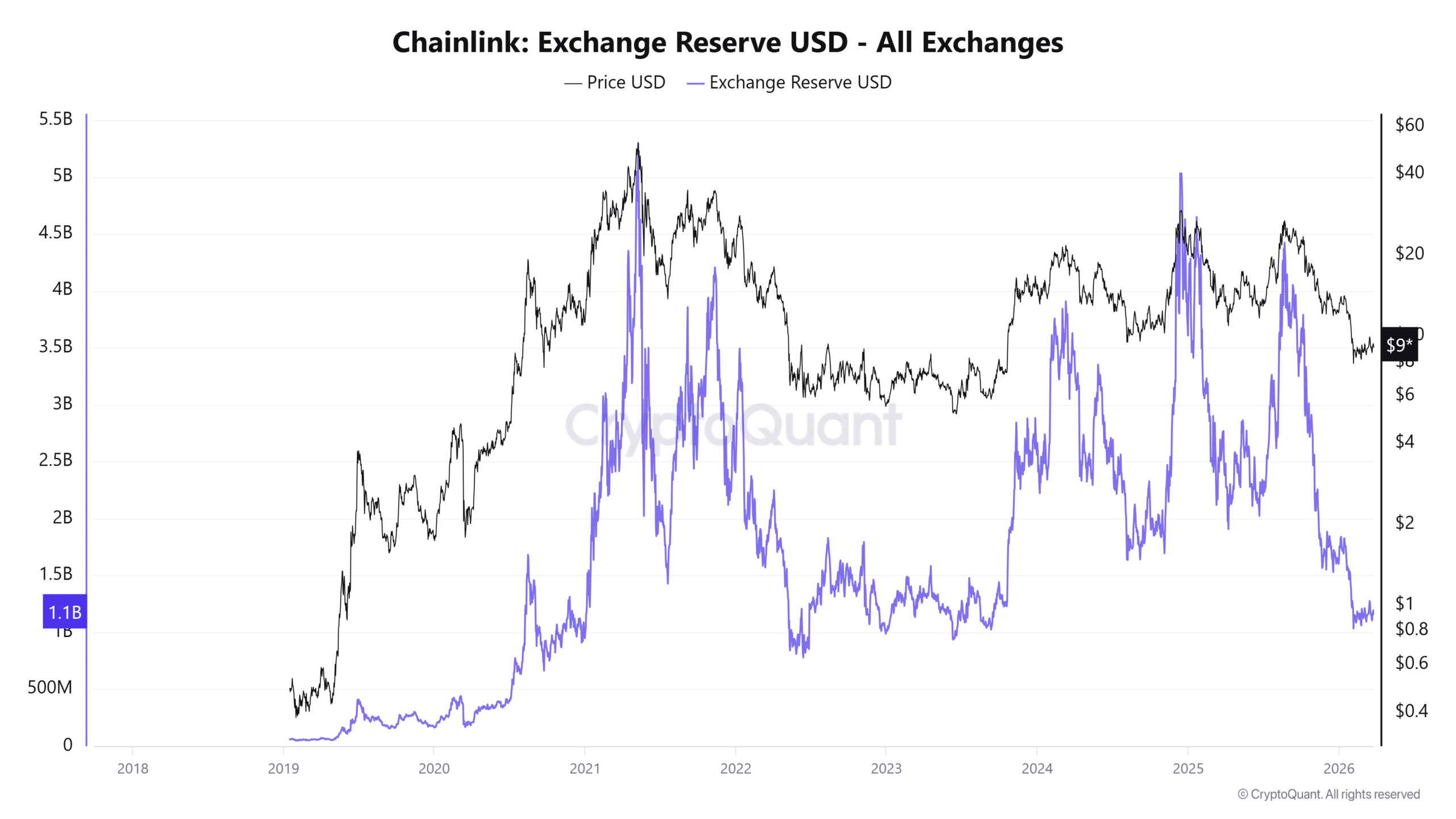
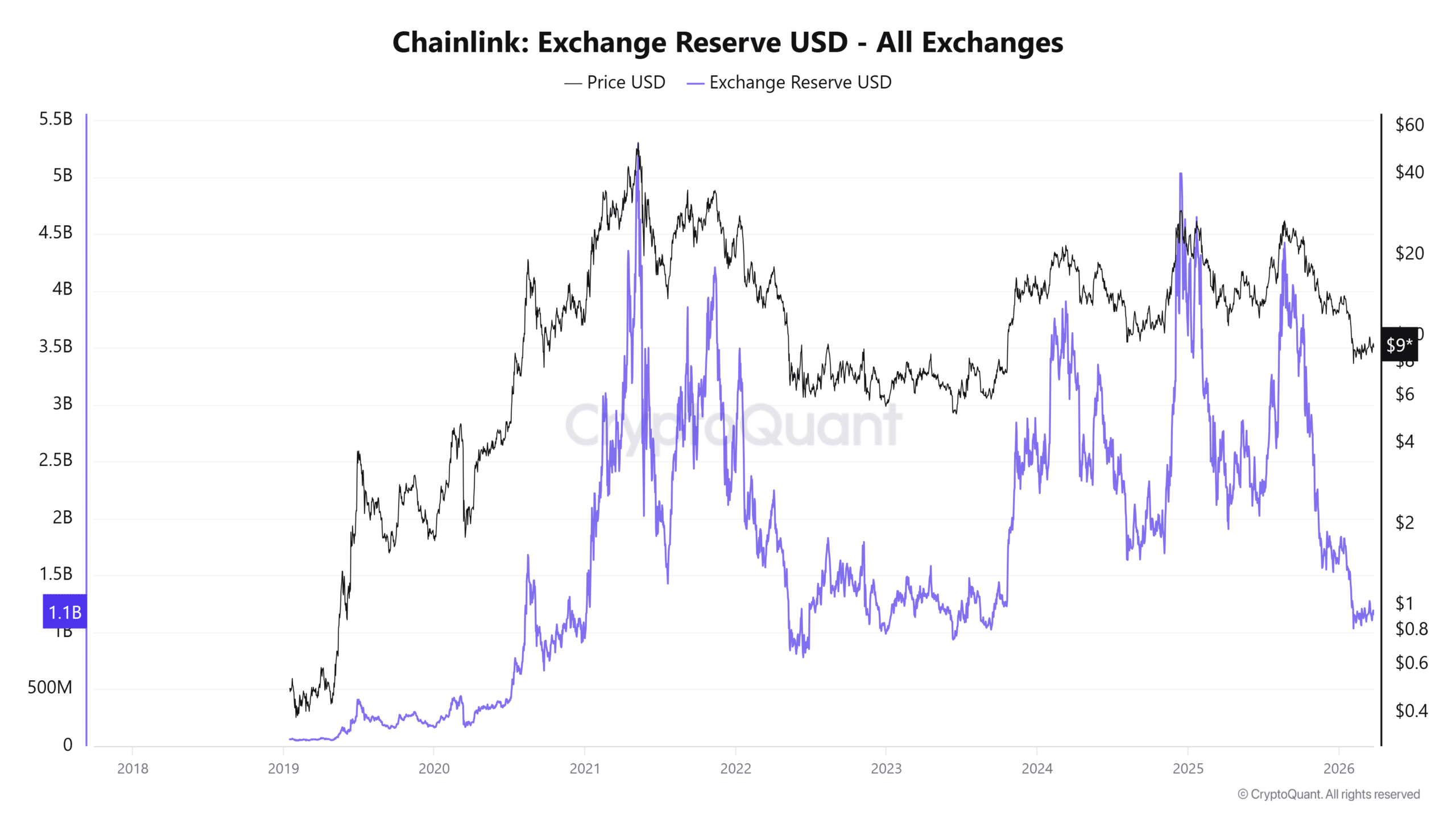
At press time, Exchange Reserves have declined by 2.22%, bringing total holdings to approximately $1.158 billion. This reduction signals that tokens have continued moving away from exchanges, which typically limits immediate sell-side availability.

As supply on trading platforms decreases, the market faces reduced overhead pressure from potential sellers. This aligns closely with the observed rise in large-holder wallets, reinforcing the idea that accumulation has taken place outside exchanges.

As fewer tokens remain accessible for quick liquidation, price tends to stabilize within key zones. This tightening supply structure supports the ongoing consolidation rather than encouraging sharp downside continuation.
Source: CryptoQuant

Chainlink funding stays positive as longs build

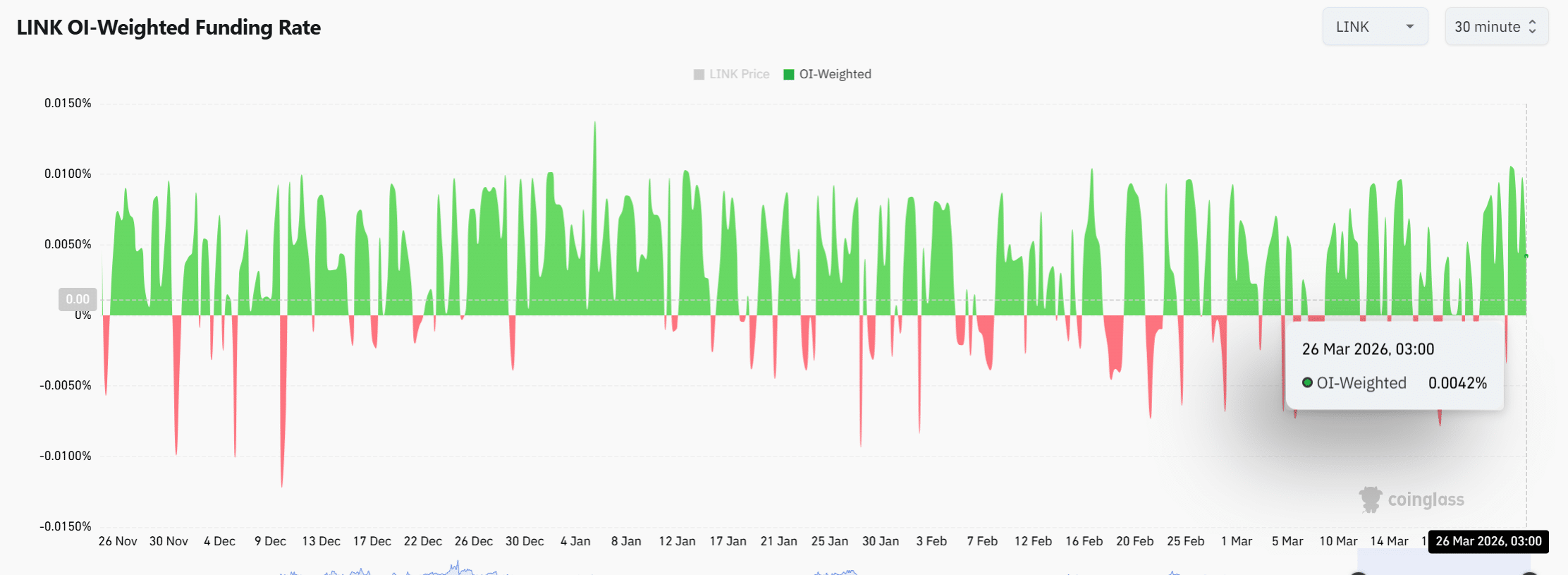
The OI-Weighted Funding Rate has remained positive at 0.0042% as of writing, reflecting a gradual increase in long positioning. This positive bias shows that traders have leaned toward upward expectations without aggressively overcrowding the market.

Unlike extreme spikes, this controlled funding structure suggests steady participation rather than speculative excess. Price has maintained its range despite this long bias, indicating that positioning has not yet forced a breakout. However, sustained positive funding often supports upward pressure over time.

As positioning continues building gradually, it creates a supportive backdrop for a potential move above resistance if demand strengthens further.
Source: CoinGlass

Is a breakout brewing for LINK?

LINK has continued showing strong accumulation beneath resistance while supply tightens and long positioning builds gradually. However, price has remained capped below $9.60, keeping structure compressed.

If buyers reclaim this level, the buildup in positioning and reduced sell pressure would support a move toward $12.00. Until then, consolidation continues to define the trend.


Final Summary

  • Sustained accumulation within tight ranges typically precedes expansion, suggesting LINK could shift once resistance weakens significantly.
  • However, failure to reclaim $9.60 would likely keep the price trapped, delaying any meaningful directional breakout for now.


Criptomoedas em alta

Perguntas relacionadas

QWhat is the current number of large-holder wallets holding over 1,000 LINK, and what does this indicate?

AThere are currently 25,420 wallets holding over 1,000 LINK. This steady increase reflects growing confidence and strategic accumulation by higher-capital participants, suggesting an early-stage accumulation phase before a potential price expansion.

QWhat are the key support and resistance levels for LINK's price mentioned in the article?

AThe key support level for LINK is near $7.95, and the resistance level is capping the price near $9.60. A breakout above $9.60 could push the price toward the next major resistance at $12.00.

QHow have the Chainlink exchange reserves changed, and what does this signify?

AChainlink exchange reserves have declined by 2.22%, bringing total holdings to approximately $1.158 billion. This reduction indicates that tokens are moving away from exchanges, limiting immediate sell-side availability and reducing overhead pressure from potential sellers.

QWhat does the positive OI-Weighted Funding Rate of 0.0042% indicate about trader positioning?

AThe positive OI-Weighted Funding Rate of 0.0042% reflects a gradual increase in long positioning and shows that traders are leaning toward upward expectations without aggressive speculative excess, indicating steady participation.

QWhat are the two possible scenarios for LINK's price movement according to the article's final summary?

AThe two scenarios are: 1) If buyers reclaim the $9.60 resistance level, the buildup in positioning and reduced sell pressure could support a move toward $12.00. 2) If LINK fails to reclaim $9.60, the price would likely remain trapped in consolidation, delaying any meaningful directional breakout.

Leituras Relacionadas

Will MicroStrategy Fall Into a Death Spiral? How Will the Macro Outlook Evolve in the Second Half of the Year?

**Summary:** The discussion centers on recent Bitcoin price declines and the evolving financial strategy of MicroStrategy (MSTR). The core argument is that the primary pressure is not from one-off Bitcoin sales by MSTR, but from the market's new expectation that MSTR may need to engage in *sustained, small-scale* Bitcoin sales to cover cash flow obligations for its growing portfolio of preferred shares and debt instruments (like STRC). This shift is driven by its stated goal of maintaining "bitcoins per share neutrality." The market is now testing whether it can absorb this potential ongoing selling pressure without entering a severe "death spiral" with Bitcoin's price. A resolution may involve MSTR softening its approach to avoid damaging both its stock and Bitcoin. The conversation then explores the parallel rise of AI-related stocks. The guest posits that AI is fundamentally restructuring labor, with "tokens" (representing access to AI models/compute) becoming a new form of capital and a substitute for human execution. This drives corporate efficiency and profits, benefiting upstream hardware providers (semiconductors, data centers), which explains the sustained rally. This represents the early stages of a "machine economy." Regarding crypto exchanges offering US stock trading, this is seen as a natural evolution. With few crypto-native assets generating lasting value, exchanges are pivoting to distribute valuable real-world assets (RWAs). This doesn't necessarily harm crypto's long-term prospects, as blockchain infrastructure may become crucial for future machine-to-machine economies. The analysis concludes that the era of rampant altcoin speculation is likely over, heavily damaged by the liquidity shock of the "1011" event (likely referring to a major market crash). Meme-driven capital has largely migrated to US equities. Looking ahead, macroeconomic uncertainty is rising due to potential large IPOs (e.g., SpaceX) and the US elections. While short-term market corrections are possible, the long-term trends of AI-driven productivity gains and the maturation of blockchain towards real-world utility and institutional adoption remain intact.

marsbitHá 3m

Will MicroStrategy Fall Into a Death Spiral? How Will the Macro Outlook Evolve in the Second Half of the Year?

marsbitHá 3m

Will MicroStrategy Fall into a Death Spiral? What Will the Macro Trend Be in the Second Half of the Year?

The podcast features investor Didier discussing the recent Bitcoin downturn and the evolving strategy of MicroStrategy (MSTR). He argues the core pressure is not macro factors or ETF outflows, but the market pricing in an expectation that MSTR will engage in continuous, small-scale Bitcoin sales to fund its increasing preferred stock and debt obligations under its "bitcoin-per-share neutrality" principle. This creates a structural headwind. However, he is cautiously optimistic a "death spiral" is avoidable without new major shocks, as market support is likely to emerge at a certain price point. Didier then posits that the AI-driven bull market in US stocks (semiconductors, data centers) is fundamentally driven by AI agents and tokens becoming the "new labor force," displacing human roles and boosting corporate margins. This shift toward a machine economy is still in its early stages. He comments on crypto exchanges adding US stock trading, viewing it as a natural move toward valuable real-world assets as truly valuable crypto-native assets remain scarce. For crypto-native traders, he suggests existing strategies (e.g., meme-chasing or value investing) can translate to similar assets in US markets. The discussion notes the severe liquidity damage from the "1011 event" (likely referring to a major market crash) has essentially ended the altcoin cycle, with speculative momentum shifting to the more liquid US stock market. Regarding the macroeconomic outlook for H2 2024, Didier expresses increased caution due to potential market pressure from upcoming mega-IPOs (e.g., SpaceX) and US midterm election risks. Long-term, he remains bullish on AI's productivity gains and its convergence with blockchain/Web3, which he sees maturing into a more institutional, real-asset-focused phase.

链捕手Há 5m

Will MicroStrategy Fall into a Death Spiral? What Will the Macro Trend Be in the Second Half of the Year?

链捕手Há 5m

Dylan Patel: Founder of SemiAnalysis, Praised by Jensen Huang, is a 'Beekeeper' and 'Forum Enthusiast'

Dylan Patel, founder of the independent research firm SemiAnalysis, has an unconventional background. A former beekeeper from rural Georgia, he entered the semiconductor world as a self-taught "forum warrior," discussing chip technology anonymously online from a young age. He launched the SemiAnalysis blog in May 2020, which later transitioned to a paid subscription model. The firm has grown from a one-person operation to a global team of around 60, with a dedicated teardown lab. Its detailed, technically-focused analysis on semiconductor supply chains, AI infrastructure, and products has earned significant industry recognition. Notably, NVIDIA founder Jensen Huang has publicly cited their reports. In a landmark case, a critical 2024 report on AMD's MI300X GPU software stack led to a 90-minute call with AMD CEO Lisa Su, who thanked him for the constructive feedback. SemiAnalysis later acknowledged AMD's improvements. The firm's influence on markets was seen when a report on NVIDIA's Rubin memory configuration was partially shared, affecting memory stock prices. Dylan Patel emphasized the importance of context, contrasting the shared excerpt with the report's actual title. SemiAnalysis, now a multi-faceted consultancy with revenue projected to reach $100 million, is known for its deep technical insights that influence major industry players and investment decisions.

marsbitHá 56m

Dylan Patel: Founder of SemiAnalysis, Praised by Jensen Huang, is a 'Beekeeper' and 'Forum Enthusiast'

marsbitHá 56m

Dylan Patel: SemiAnalysis, Praised by Jensen Huang, is Founded by a 'Beekeeper and Forum Warrior'

Dylan Patel, founder of the independent research firm SemiAnalysis, has an unconventional background. Growing up in rural Georgia, he later worked as a beekeeper in Minnesota. His entry into semiconductors began as a self-taught "forum warrior," engaging anonymously in online tech communities from a young age. In May 2020, he started the SemiAnalysis blog on WordPress, later moving it to Substack as a paid subscription service. The firm has since evolved from a one-person operation into a global company with around 60 employees, featuring a dedicated chip teardown lab. Its revenue, reaching $20 million last year, is projected to surpass $100 million this year. SemiAnalysis is highly regarded in the AI and semiconductor industry for its deep technical analysis. NVIDIA founder Jensen Huang has publicly praised its reports. In a notable instance, a critical report on AMD's MI300X GPU software shortcomings prompted a 90-minute call with CEO Lisa Su, who thanked Patel for the "constructive feedback." A later report acknowledged AMD's subsequent improvements. The firm's analyses have significant market impact. For example, a June report discussing potential memory configuration changes in NVIDIA's next-generation servers was cited as a factor in pressure on memory-related stocks. Patel plans to establish a venture capital firm, having already made personal investments in about 20 startups. SemiAnalysis combines roles as a consultancy, model platform, and tech lab, focusing on the practical bottlenecks in AI infrastructure.

Odaily星球日报Há 1h

Dylan Patel: SemiAnalysis, Praised by Jensen Huang, is Founded by a 'Beekeeper and Forum Warrior'

Odaily星球日报Há 1h

Ethereum Q1 Report: On-chain Activity Hits Record High, Tokenized Assets Lead the Industry

Ethereum Q1 2026 Report: On-chain activity hits record high, tokenized assets lead the industry. In Q1 2026, Ethereum's network experienced a unique divergence: on-chain activity soared while USD-denominated metrics declined. Monthly active users reached 13.2 million, transactions hit 200.4 million, and TPS averaged 25.78, all setting new highs. However, total value locked (TVL) fell 11.0% to $316.2B, DEX volume dropped 24.0% to $134.5B, and ETH's fully diluted market cap fell 30.3% to $290B. A key driver was the Blob Parameter Fork (BPO#2) in January, which increased data capacity and caused a sharp 47.9% drop in layer-1 transaction fees despite higher usage. Etherean's tokenized asset market cap reached $203.4B, up 42.9% year-over-year. While stablecoins ($178.9B) saw a slight dip, tokenized funds ($19.4B, +73.1% YoY), commodities ($4.7B, +325.9% YoY), and stocks ($365.1M) grew strongly. Ethereum dominates cross-chain comparisons, holding 71% of TVL, 79.2% of active loans, 61.8% of stablecoins, and 73% of tokenized funds among top chains. The report highlights a "Jevons Paradox" scenario: network expansion reduces per-transaction costs but unleashes latent demand, driving long-term growth. Ethereum's strategy mirrors Amazon's early focus on scale over profit. Its open, neutral foundation is seen as critical for institutional adoption, as evidenced by growing activity from firms like BlackRock and JPMorgan. The roadmap targets further scalability, aiming for thousands of TPS by 2029 to solidify its role as a global financial settlement layer.

marsbitHá 1h

Ethereum Q1 Report: On-chain Activity Hits Record High, Tokenized Assets Lead the Industry

marsbitHá 1h

Trading

Spot
Futuros

Artigos em Destaque

Como comprar LINK

Bem-vindo à HTX.com!Tornámos a compra de ChainLink (LINK) simples e conveniente.Segue o nosso guia passo a passo para iniciar a tua jornada no mundo das criptos.Passo 1: cria a tua conta HTXUtiliza o teu e-mail ou número de telefone para te inscreveres numa conta gratuita na HTX.Desfruta de um processo de inscrição sem complicações e desbloqueia todas as funcionalidades.Obter a minha contaPasso 2: vai para Comprar Cripto e escolhe o teu método de pagamentoCartão de crédito/débito: usa o teu visa ou mastercard para comprar ChainLink (LINK) instantaneamente.Saldo: usa os fundos da tua conta HTX para transacionar sem problemas.Terceiros: adicionamos métodos de pagamento populares, como Google Pay e Apple Pay, para aumentar a conveniência.P2P: transaciona diretamente com outros utilizadores na HTX.Mercado de balcão (OTC): oferecemos serviços personalizados e taxas de câmbio competitivas para os traders.Passo 3: armazena teu ChainLink (LINK)Depois de comprar o teu ChainLink (LINK), armazena-o na tua conta HTX.Alternativamente, podes enviá-lo para outro lugar através de transferência blockchain ou usá-lo para transacionar outras criptomoedas.Passo 4: transaciona ChainLink (LINK)Transaciona facilmente ChainLink (LINK) no mercado à vista da HTX.Acede simplesmente à tua conta, seleciona o teu par de trading, executa as tuas transações e monitoriza em tempo real.Oferecemos uma experiência de fácil utilização tanto para principiantes como para traders experientes.

899 Visualizações TotaisPublicado em {updateTime}Atualizado em 2026.06.02

Como comprar LINK

Discussões

Bem-vindo à Comunidade HTX. Aqui, pode manter-se informado sobre os mais recentes desenvolvimentos da plataforma e obter acesso a análises profissionais de mercado. As opiniões dos utilizadores sobre o preço de LINK (LINK) são apresentadas abaixo.

活动图片