CFTC pilot opens path for crypto as collateral in derivative markets

cointelegraphPublicado em 2025-12-09Última atualização em 2025-12-09

Resumo

The U.S. Commodity Futures Trading Commission (CFTC) has introduced updated guidance and a pilot program allowing futures commission merchants (FCMs) to accept Bitcoin, Ether, and USDC as collateral in derivatives trading. The initiative aims to integrate cryptocurrencies into regulated markets, enhance customer protection, reduce settlement friction through instant on-chain transfers, and improve risk management. The program includes strict reporting requirements for FCMs and withdraws outdated advisories. Industry leaders from firms like Circle, StarkWare, and Coinbase have praised the move as a significant step toward broader adoption of digital assets and more efficient, automated settlement processes in derivatives markets.

The US Commodity Futures Trading Commission (CFTC) has issued updated guidance for tokenized collateral in derivatives markets, paving the way for a pilot program to test how cryptocurrencies can be used as collateral in derivatives markets.

Collateral in derivatives markets serves as a security deposit, acting as a guarantee to ensure that a trader can cover any potential losses.

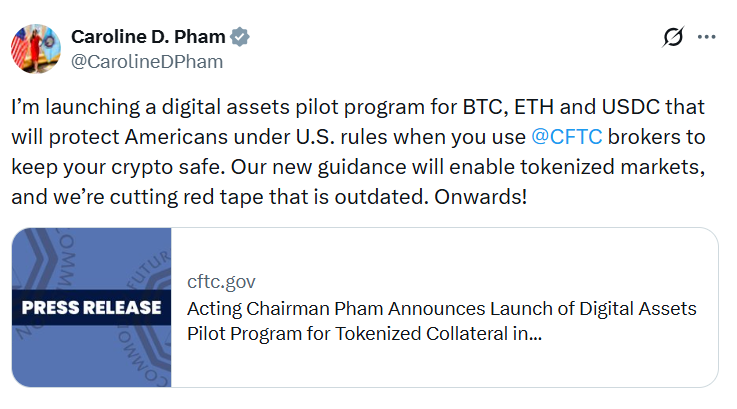
The digital asset pilot, announced by CFTC acting chairman Caroline Pham on Monday, will allow futures commission merchants (FCM) — a company that facilitates futures trades for clients — to accept Bitcoin (BTC), Ether (ETH) and Circle’s stablecoin USDC (USDC) for margin collateral.

The CFTC pilot is another step toward integrating crypto into regulated markets, and Circle CEO Heath Tarbert said it will also protect customers, reduce settlement frictions because tokenized collateral moves instantly onchain, and assist with risk reduction.

Pham said in a statement that the pilot program also “establishes clear guardrails to protect customer assets and provides enhanced CFTC monitoring and reporting.”

As part of the pilot, participating FCMs will be subject to strict reporting criteria, which require weekly reports on total customer holdings and any significant issues that may affect the use of crypto as collateral.
Source: Caroline Pham

Updated CFTC guidance for tokenized assets

The CFTC’s Market Participants Division, Division of Market Oversight, and Division of Clearing and Risk also issued updated guidance on the use of tokenized assets as collateral in the trading of futures and swaps.

The guidance covers tokenized real-world assets, including US Treasury’s money market funds, and topics such as eligible tokenized assets, legal enforceability, segregation, and control arrangements.

Pham said in an X post on Monday that the “guidance provides regulatory clarity and opens the door for more digital assets to be added as collateral by exchanges and brokers, in addition to US Treasurys and money market funds.”

The Market Participants Division also issued a “no-action position” on specific requirements regarding the use of payment stablecoins as customer margin collateral and the holding of certain proprietary payment stablecoins in segregated customer accounts.

A CFTC Staff Advisory that restricted FCMs’ ability to accept crypto as customer collateral, Staff Advisory 20-34, was also withdrawn because it is “outdated and no longer relevant,” in part due to the GENIUS Act.

Crypto execs back CFTC move

Several crypto executives applauded the move by the CFTC.

Katherine Kirkpatrick Bos, the general counsel at blockchain company StarkWare, said the use of “tokenized collateral in the derivatives markets is MASSIVE.”

Related: US regulators dismiss SEC-CFTC merger rumors, move to dispel crypto ‘FUD’

“Atomic settlement, transparency, automation, capital efficiency, savings. Feels abrupt but who recalls the tokenization summit in 2/24, a glimmer of hope in the darkness,” she said.

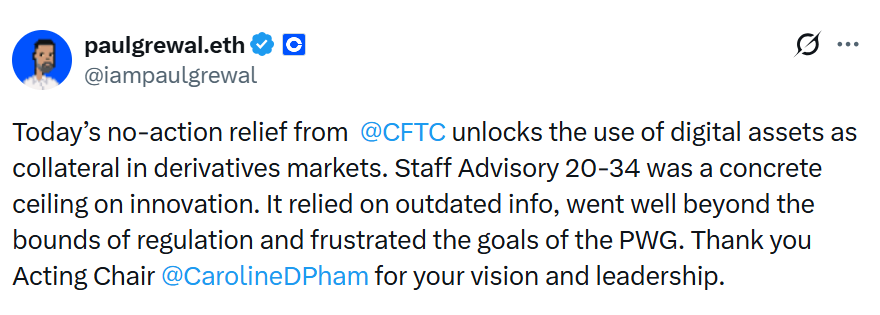
Coinbase chief legal officer Paul Grewal also supported the action, calling Staff Advisory 20-34 a “concrete ceiling on innovation.”

“It relied on outdated info, went well beyond the bounds of regulation and frustrated the goals of the PWG.”
Source: Paul Grewal

Meanwhile, Salman Banaei, the general counsel at layer-1 blockchain, the Plume Network, said it was a “major move” by the CFTC, and another push toward wider adoption.

“This is a step toward the use of onchain infra to automate settlement for the biggest asset class in the world: OTC derivatives, swaps,” he added.

Magazine: XRP’s ‘now or never’ moment, Kalshi taps Solana: Hodler’s Digest, Nov. 30 – Dec. 6

Leituras Relacionadas

Playnance’s $GCOIN Lists on KoinBX Amid Rapid Growth in India

Playnance's native token, $GCOIN, has been listed on the cryptocurrency exchange KoinBX as of June 18. This move aims to enhance accessibility for its rapidly growing community, particularly in India, where the blockchain-powered Web3 iGaming ecosystem has gained significant traction. Over 130 partners in Playnance's "Be the Boss" program have built communities engaging thousands of active players in the region. The "Be the Boss" model allows participants to create and manage their own gaming communities, earning rewards tied to community activity. CEO Pini Peter noted India's high engagement, with community leaders successfully building player networks. One partner, Dr. Nicolas, reported earning over $57,000 through the program in recent months, highlighting both the financial rewards and the opportunity to grow an engaged community. $GCOIN serves as the ecosystem's core utility token, incentivizing participation and aligning the interests of players and community leaders ("Bosses"). The listing on KoinBX is part of Playnance's strategy to expand globally, increasing the token's utility and accessibility by combining community ownership, gamified engagement, and blockchain-based incentives. Founded in 2020, Playnance is a Web3 iGaming infrastructure company focused on creating live, non-custodial, on-chain products to onboard mainstream users. It currently processes approximately one million transactions daily, aiming to simplify the user experience while maintaining full on-chain transparency.

TheNewsCryptoHá 16m

Playnance’s $GCOIN Lists on KoinBX Amid Rapid Growth in India

TheNewsCryptoHá 16m

STRC Hits Historic Low, Saylor's Perpetual Motion Machine Grinds to a Halt

STRC, the perpetual preferred stock issued by MicroStrategy to fund its Bitcoin purchases, hit a historic low of $85.32, a 17% discount to its $100 par value. Designed as a "digital credit engine" to trade stably near par and enable continuous share issuance for buying Bitcoin, its plunge signals a breakdown in this model. Three key factors drove the decline: 1. Bitcoin's price fell over 50% from its peak, trading around $63,000 amid hawkish Fed signals. 2. MicroStrategy's cash reserves were depleted after a $1.5 billion convertible note repayment, slashing the dividend coverage for STRC's 11.5% yield to ~7 months. The company then sold 32 BTC to cover dividends—Michael Saylor's first Bitcoin sale since 2022—damaging the "never sell" narrative. 3. A competing Bitcoin-backed preferred stock, Strive's SATA, offers a higher yield (~13%) and daily dividends, drawing investors away from STRC. The drop triggers a negative cycle: STRC below par halts ATM share issuances, cutting off a key funding source for Bitcoin buys and potentially forcing more BTC sales for dividends, further eroding confidence. While Saylor argues the model is mathematically sound—needing only 2.3% annual Bitcoin growth to sustain itself—the market is testing the resilience of the leveraged Bitcoin treasury strategy in a bear market. The STRC price now reflects rising skepticism about this financial machinery's durability during downturns.

marsbitHá 37m

STRC Hits Historic Low, Saylor's Perpetual Motion Machine Grinds to a Halt

marsbitHá 37m

A Guide to Grayscale’s ‘Bottom Fishing’: Using Cash Flow to Assess Cryptocurrency Value

**Title:** Grayscale's Guide to Bottom-Fishing: Valuing Cryptoassets Using Cash Flows **Summary:** This report by Grayscale Research presents a fundamental valuation framework for cryptocurrency assets, moving beyond pure speculation to analyze those with underlying cash flows. It distinguishes between "commodity-like" assets (e.g., Bitcoin) and "cash-flow" assets, primarily within DeFi. Using the leading decentralized lending protocol Aave as a case study, the analysis applies traditional financial methodologies like Discounted Cash Flow (DCF) and Price-to-Earnings (P/E) multiples. Key findings indicate that AAVE tokens are currently undervalued. Despite recent challenges, the protocol's strong revenue growth, ~50% net profit margin, and diversified treasury support a fundamental valuation range of $80-$100 per token (compared to a ~$75 market price at the time of writing). In a base-case scenario driven by stablecoin adoption and regulatory clarity, the fair value could rise to around $175 within a year. The report emphasizes that protocol success does not automatically translate to token value. It critically examines the "value capture" mechanisms—such as buybacks, burns, and staking rewards—that channel protocol profits to token holders. Furthermore, it addresses the legal and governance complexities of Decentralized Autonomous Organizations (DAOs), noting their difference from traditional corporate equity but highlighting how robust, transparent governance can align protocol economics with holder interests. The conclusion is that the crypto market is maturing, with capital increasingly flowing towards projects with demonstrable fundamentals, real adoption, and disciplined capital allocation, creating opportunities for value-based investors.

marsbitHá 1h

A Guide to Grayscale’s ‘Bottom Fishing’: Using Cash Flow to Assess Cryptocurrency Value

marsbitHá 1h

After semiconductors lead the gains, are funds buying into AI orders or a macroeconomic rebound?

After US-Iran talks led to a temporary ceasefire and framework for reopening the strategic Strait of Hormuz, U.S. stocks rose on June 18, with the Nasdaq gaining 1.9%. The semiconductor and AI hardware sectors outperformed. This rally stemmed primarily from reduced geopolitical risk, which lowered oil prices and inflation expectations, easing discount rate pressure on high-valuation growth stocks like tech. The key question is not whether tech rebounded, but the nature of the rebound. The market appears to be selectively repricing AI infrastructure plays rather than broadly chasing AI narratives. Gains were concentrated in chips, optical interconnects, memory, and domestic manufacturing—segments tied to tangible data center build-outs and capital expenditure. Intel's ~10% surge, fueled by a Trump statement about potential Apple collaboration, exemplifies this mixed dynamic. It reflects policy catalysts and domestic manufacturing sentiment more than confirmed fundamentals. Meanwhile, strong earnings from companies like Astera Labs (revenue up 93% YoY) provided concrete evidence of AI-driven demand in hardware. In essence, the rally represents a risk-premium recalibration. Lower Middle East tensions opened a valuation repair window, and capital flowed first into AI infrastructure segments with visible near-term revenue streams. The sustainability of this move hinges on upcoming Q2 earnings, specifically continued strength in cloud provider capex, AI server orders, and hardware company guidance. Policy hopes alone are insufficient; the cycle needs validation from orders and financials.

marsbitHá 1h

After semiconductors lead the gains, are funds buying into AI orders or a macroeconomic rebound?

marsbitHá 1h

Trading

Spot
Futuros
活动图片