Cardano Founder Says This Midnight Deal Could Bring Billions In TVL

bitcoinistPublicado em 2026-03-26Última atualização em 2026-03-26

Resumo

Cardano founder Charles Hoskinson announced a major partnership between the privacy-focused blockchain Midnight and UK-based Monument Bank, which plans to tokenize up to £250 million in retail deposits. This initial phase could expand into billions in Total Value Locked (TVL) as Monument aims to later offer tokenized investment products and Lombard-style lending. The deal is positioned as a breakthrough for regulated finance on public blockchains, using Midnight’s privacy features to balance transparency with banking confidentiality while operating within existing regulatory frameworks.

Cardano founder Charles Hoskinson says Midnight’s new partnership with Monument Bank could become one of the biggest commercial wins yet for the privacy-focused network, after the UK lender unveiled plans to put retail customer deposits on a public blockchain. In a post on X, the Cardano founder wrote:

“This is one of the largest deals we’ve ever done and could bring hundreds of millions to billions of TVL to the Midnight ecosystem. I’m extremely proud of Fahmi Syed and his team at the Midnight Foundation for the hard work they put into the negotiations with Monument. Midnight is the home of Web 2.5 ventures.”

Why The Cardano So Enthusiastic

Monument, a UK digital bank serving the mass-affluent segment, said it plans to become the first UK bank to tokenize retail customer deposits on a public blockchain, with Midnight providing the underlying network and privacy-preserving architecture.

The first phase is concrete. Monument said it is targeting up to £250 million in tokenized deposits, with each token representing a one-to-one claim on funds held at the bank. Those deposits are intended to remain interest-bearing, redeemable in pounds sterling and protected within the existing regulatory framework, including the Financial Services Compensation Scheme. Monument says it currently serves more than 100,000 clients and has over £7 billion in savings deposits, giving the project a real balance-sheet base rather than a purely experimental starting point.

That setup is central to Midnight’s pitch. The tokenized deposits are not being framed as a new synthetic asset or an offshore wrapper, but as a blockchain mirror of traditional bank deposits. According to the release, transaction data on Midnight will be shielded and visible only to Monument and its customers, an architecture aimed at preserving the confidentiality banks need while still using public-chain rails.

Midnight Foundation President Fahmi Syed used the deal to make a broader point about institutional blockchain adoption. Financial firms, he said, have struggled with the tension between openness and banking-grade confidentiality. Midnight, in his words, is designed to “represent assets on public networks” while protecting “sensitive financial information,” and Monument’s rollout is meant to show that regulated products can move on-chain without stepping outside existing compliance and consumer-protection frameworks.

The longer-term roadmap explains why Hoskinson is talking in terms of billions rather than the initial £250 million. Phase two would expand beyond tokenized deposits into tokenized investment products delivered through the Monument app, including access to private equity, commodity funds and structured products. Phase three would introduce Lombard-style lending, allowing clients to borrow against investments without selling them. Monument also said its technology affiliate aims to extend tokenized-deposit functionality to other institutions through its Banking-as-a-Service platform.

In that sense, Hoskinson’s TVL projection reads less like a claim about day-one inflows and more like a statement about the size of the pipeline if the rollout expands as planned. The hard figure disclosed so far is £250 million in the first phase. But if Monument can move from deposit tokenization into investment products, lending and third-party enablement, Midnight would be competing for balance-sheet-linked activity that is structurally different from mercenary DeFi liquidity.

For Midnight, the partnership is also a live test of its core thesis: that privacy-enhancing infrastructure can make public blockchains usable for regulated finance. If Monument executes beyond the pilot, the deal would give the Cardano-linked network something many crypto projects still lack, a banking use case tied to real deposits, real customers and a product roadmap built to stay inside the guardrails of traditional finance.

At press time, Cardano traded at $0.26.
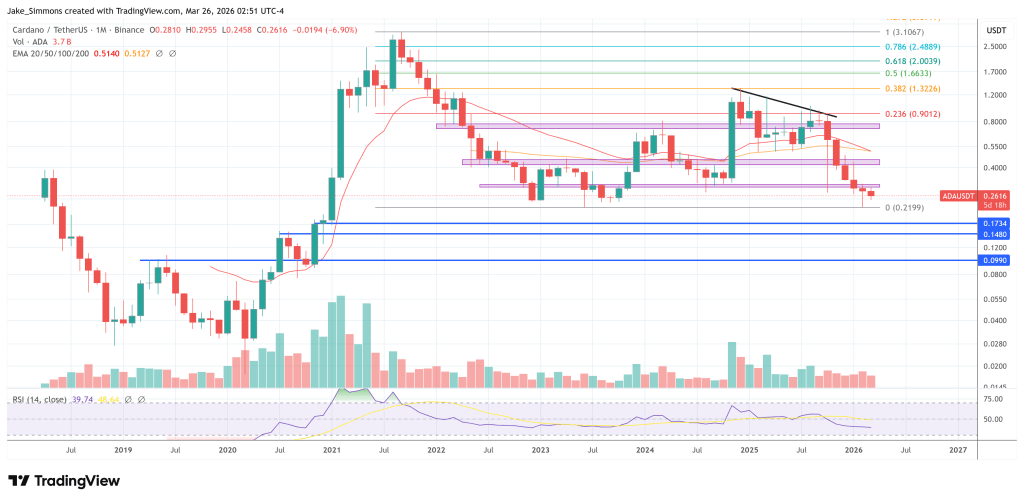
Cardano hovers below key resistance, 1-month chart | Source: ADAUSDT on TradingView.com

Criptomoedas em alta

Perguntas relacionadas

QWhat is the significance of the partnership between Midnight and Monument Bank according to Cardano founder Charles Hoskinson?

ACharles Hoskinson believes this partnership could become one of the largest deals for Midnight, potentially bringing hundreds of millions to billions in Total Value Locked (TVL) to its ecosystem.

QWhat specific service does Monument Bank plan to implement using Midnight's network?

AMonument Bank plans to become the first UK bank to tokenize retail customer deposits on a public blockchain, using Midnight's network and privacy-preserving architecture.

QWhat is the initial target amount for tokenized deposits in the first phase of the project?

AThe initial target for the first phase is up to £250 million in tokenized deposits.

QHow does Midnight's technology address the conflict between openness and confidentiality for financial institutions?

AMidnight is designed to represent assets on public networks while protecting sensitive financial information through its privacy-enhancing infrastructure, allowing transaction data to be shielded and visible only to the bank and its customers.

QWhat are the future phases of the project beyond tokenizing deposits?

APhase two will expand into tokenized investment products like private equity and commodity funds, while phase three will introduce Lombard-style lending, allowing clients to borrow against their investments without selling them.

Leituras Relacionadas

L2 'Recalibration': When L1 Becomes Its Own Rollup, What Is Ethereum's Endgame?

The article discusses the evolving relationship between Ethereum's Layer 1 (L1) and Layer 2 (L2) solutions, moving beyond the initial "L2 for scaling" model. As Ethereum L1 itself scales (increasing Gas Limit, statelessness, zkEVM), the unique value proposition of L2s shifts from merely providing cheap execution to offering differentiated features like application-specific optimization, privacy, and flexible governance. The piece explores three key themes: 1. **L2's New Role:** L2s are transitioning from a pure scaling technology to a spectrum of execution environments with varying degrees of security inheritance from Ethereum L1. 2. **Interoperability as State Trust:** Solving L2 fragmentation is less about cross-chain bridges and more about enabling faster, trust-minimized state verification between environments. This involves initiatives like faster L1 finality, intent-based architectures (Open Intents Framework), and native account abstraction. 3. **Blurring Layers:** With the potential integration of zk-proofs into L1 validation (making L1 akin to its own "Rollup") and the concept of "Native Rollups," the rigid boundary between L1 and L2 may fade. The future could be a unified system with multiple execution domains (for DeFi, gaming, privacy, etc.) sharing a common security, settlement, and state framework. In conclusion, Ethereum's goal is not to abandon L2s or re-centralize everything on L1, but to re-integrate the fragmented user experience—liquidity, accounts, applications—while preserving the scaling benefits of a multi-environment ecosystem. The endgame is a cohesive "one chain" feeling for users, powered by diverse but securely interconnected execution layers.

marsbitHá 40m

L2 'Recalibration': When L1 Becomes Its Own Rollup, What Is Ethereum's Endgame?

marsbitHá 40m

Trading

Spot

Artigos em Destaque

Como comprar ADA

Bem-vindo à HTX.com!Tornámos a compra de Cardano (ADA) simples e conveniente.Segue o nosso guia passo a passo para iniciar a tua jornada no mundo das criptos.Passo 1: cria a tua conta HTXUtiliza o teu e-mail ou número de telefone para te inscreveres numa conta gratuita na HTX.Desfruta de um processo de inscrição sem complicações e desbloqueia todas as funcionalidades.Obter a minha contaPasso 2: vai para Comprar Cripto e escolhe o teu método de pagamentoCartão de crédito/débito: usa o teu visa ou mastercard para comprar Cardano (ADA) instantaneamente.Saldo: usa os fundos da tua conta HTX para transacionar sem problemas.Terceiros: adicionamos métodos de pagamento populares, como Google Pay e Apple Pay, para aumentar a conveniência.P2P: transaciona diretamente com outros utilizadores na HTX.Mercado de balcão (OTC): oferecemos serviços personalizados e taxas de câmbio competitivas para os traders.Passo 3: armazena teu Cardano (ADA)Depois de comprar o teu Cardano (ADA), armazena-o na tua conta HTX.Alternativamente, podes enviá-lo para outro lugar através de transferência blockchain ou usá-lo para transacionar outras criptomoedas.Passo 4: transaciona Cardano (ADA)Transaciona facilmente Cardano (ADA) no mercado à vista da HTX.Acede simplesmente à tua conta, seleciona o teu par de trading, executa as tuas transações e monitoriza em tempo real.Oferecemos uma experiência de fácil utilização tanto para principiantes como para traders experientes.

1.3k Visualizações TotaisPublicado em {updateTime}Atualizado em 2026.06.02

Como comprar ADA

Discussões

Bem-vindo à Comunidade HTX. Aqui, pode manter-se informado sobre os mais recentes desenvolvimentos da plataforma e obter acesso a análises profissionais de mercado. As opiniões dos utilizadores sobre o preço de ADA (ADA) são apresentadas abaixo.

活动图片