Cardano Founder Says This Midnight Deal Could Bring Billions In TVL

bitcoinistPublicado em 2026-03-26Última atualização em 2026-03-26

Resumo

Cardano founder Charles Hoskinson announced a major partnership between the privacy-focused blockchain Midnight and UK-based Monument Bank, which plans to tokenize up to £250 million in retail deposits. This initial phase could expand into billions in Total Value Locked (TVL) as Monument aims to later offer tokenized investment products and Lombard-style lending. The deal is positioned as a breakthrough for regulated finance on public blockchains, using Midnight’s privacy features to balance transparency with banking confidentiality while operating within existing regulatory frameworks.

Cardano founder Charles Hoskinson says Midnight’s new partnership with Monument Bank could become one of the biggest commercial wins yet for the privacy-focused network, after the UK lender unveiled plans to put retail customer deposits on a public blockchain. In a post on X, the Cardano founder wrote:

“This is one of the largest deals we’ve ever done and could bring hundreds of millions to billions of TVL to the Midnight ecosystem. I’m extremely proud of Fahmi Syed and his team at the Midnight Foundation for the hard work they put into the negotiations with Monument. Midnight is the home of Web 2.5 ventures.”

Why The Cardano So Enthusiastic

Monument, a UK digital bank serving the mass-affluent segment, said it plans to become the first UK bank to tokenize retail customer deposits on a public blockchain, with Midnight providing the underlying network and privacy-preserving architecture.

The first phase is concrete. Monument said it is targeting up to £250 million in tokenized deposits, with each token representing a one-to-one claim on funds held at the bank. Those deposits are intended to remain interest-bearing, redeemable in pounds sterling and protected within the existing regulatory framework, including the Financial Services Compensation Scheme. Monument says it currently serves more than 100,000 clients and has over £7 billion in savings deposits, giving the project a real balance-sheet base rather than a purely experimental starting point.

That setup is central to Midnight’s pitch. The tokenized deposits are not being framed as a new synthetic asset or an offshore wrapper, but as a blockchain mirror of traditional bank deposits. According to the release, transaction data on Midnight will be shielded and visible only to Monument and its customers, an architecture aimed at preserving the confidentiality banks need while still using public-chain rails.

Midnight Foundation President Fahmi Syed used the deal to make a broader point about institutional blockchain adoption. Financial firms, he said, have struggled with the tension between openness and banking-grade confidentiality. Midnight, in his words, is designed to “represent assets on public networks” while protecting “sensitive financial information,” and Monument’s rollout is meant to show that regulated products can move on-chain without stepping outside existing compliance and consumer-protection frameworks.

The longer-term roadmap explains why Hoskinson is talking in terms of billions rather than the initial £250 million. Phase two would expand beyond tokenized deposits into tokenized investment products delivered through the Monument app, including access to private equity, commodity funds and structured products. Phase three would introduce Lombard-style lending, allowing clients to borrow against investments without selling them. Monument also said its technology affiliate aims to extend tokenized-deposit functionality to other institutions through its Banking-as-a-Service platform.

In that sense, Hoskinson’s TVL projection reads less like a claim about day-one inflows and more like a statement about the size of the pipeline if the rollout expands as planned. The hard figure disclosed so far is £250 million in the first phase. But if Monument can move from deposit tokenization into investment products, lending and third-party enablement, Midnight would be competing for balance-sheet-linked activity that is structurally different from mercenary DeFi liquidity.

For Midnight, the partnership is also a live test of its core thesis: that privacy-enhancing infrastructure can make public blockchains usable for regulated finance. If Monument executes beyond the pilot, the deal would give the Cardano-linked network something many crypto projects still lack, a banking use case tied to real deposits, real customers and a product roadmap built to stay inside the guardrails of traditional finance.

At press time, Cardano traded at $0.26.
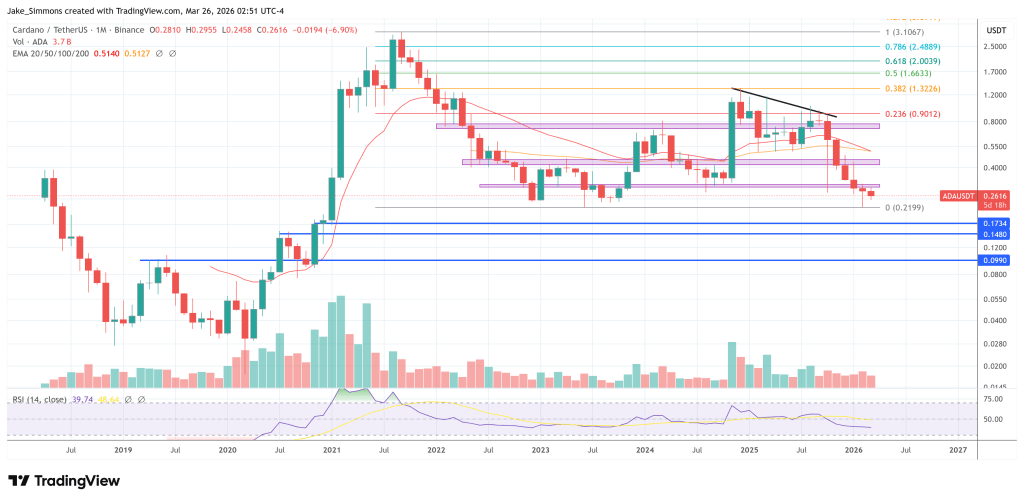
Cardano hovers below key resistance, 1-month chart | Source: ADAUSDT on TradingView.com

Criptomoedas em alta

Perguntas relacionadas

QWhat is the significance of the partnership between Midnight and Monument Bank according to Cardano founder Charles Hoskinson?

ACharles Hoskinson believes this partnership could become one of the largest deals for Midnight, potentially bringing hundreds of millions to billions in Total Value Locked (TVL) to its ecosystem.

QWhat specific service does Monument Bank plan to implement using Midnight's network?

AMonument Bank plans to become the first UK bank to tokenize retail customer deposits on a public blockchain, using Midnight's network and privacy-preserving architecture.

QWhat is the initial target amount for tokenized deposits in the first phase of the project?

AThe initial target for the first phase is up to £250 million in tokenized deposits.

QHow does Midnight's technology address the conflict between openness and confidentiality for financial institutions?

AMidnight is designed to represent assets on public networks while protecting sensitive financial information through its privacy-enhancing infrastructure, allowing transaction data to be shielded and visible only to the bank and its customers.

QWhat are the future phases of the project beyond tokenizing deposits?

APhase two will expand into tokenized investment products like private equity and commodity funds, while phase three will introduce Lombard-style lending, allowing clients to borrow against their investments without selling them.

Leituras Relacionadas

No Sales Team, $20 Million in Revenue: How Did AI Employee Viktor Win Over 30,000 Companies?

The AI employee Viktor, developed by a team with DeepMind background, has achieved $20 million in annual revenue without a traditional sales team, serving over 30,000 companies. Its core innovation lies in positioning itself as a "Tier 3 AI Coworker" capable of "end-to-end execution and delivery of results," moving beyond the "draft and wait for human completion" model of typical AI assistants. Users can simply mention Viktor in Slack or Microsoft Teams using natural language commands, and it autonomously performs tasks like pulling sales data from a CRM, generating reports, or even cross-tool operations like creating board meeting PPTs by aggregating data from six different sources. Key to its growth is a pure Product-Led Growth (PLG) model, eliminating complex implementation cycles and per-seat licensing. Instead, it charges based on task credits or consumption, lowering the trial barrier with a $100 free credit offer and no credit card required. This enabled viral, bottom-up adoption within organizations. Viktor's interaction paradigm removes the barrier of prompt engineering, allowing non-technical employees to delegate complex workflows seamlessly. It also features proactive, automated task execution (e.g., overnight bookkeeping, scheduled reports) based on triggers, effectively embedding AI as an automated "process layer" within business operations. However, its expansion into Microsoft Teams—a platform with 320 million users—highlights challenges. Large enterprises require stringent IT compliance, security reviews (e.g., SOC 2), and governance, potentially hindering the frictionless, user-driven adoption that succeeded in Slack. Additionally, the "black box" nature of its autonomous decision-making raises concerns about operational risks, data integrity, and the need for robust audit logs and permission controls. Balancing efficiency gains with security and trust remains a critical hurdle for Viktor and similar AI agents aiming to become core enterprise infrastructure.

marsbitHá 17m

No Sales Team, $20 Million in Revenue: How Did AI Employee Viktor Win Over 30,000 Companies?

marsbitHá 17m

Manus Buyback Plan Emerges: Chinese Investors Plan to Repurchase Equity with $2 Billion, Path to Hong Kong IPO Becomes Clearer

According to a report by The Information, early Chinese investors of Manus, including Tencent, Sequoia Capital China, and ZhenFund, are planning to repurchase the company from Meta for $2 billion—the same price Meta paid in its acquisition last December. This move is a direct response to the Chinese government's prohibition of the foreign acquisition in April. As part of the repurchase plan, Manus is considering establishing a Sino-foreign joint venture within China. This structure is seen as a way to ensure regulatory compliance for its Chinese investors and to pave the way for a future IPO in Hong Kong. Notably, U.S. investor Benchmark will not participate in the buyback, which will concentrate ownership even more among Chinese capital. Since its acquisition by Meta, Manus's business has grown rapidly, with its annualized revenue run rate reportedly increasing four-to-fivefold to $400-$500 million in roughly six months. This strong growth underpins the investors' willingness to repurchase at the original price. Financially, the forced unwinding of the deal may benefit the early investors, allowing them to regain equity at a cost far below the company's current implied valuation, with the added prospect of an independent future listing. However, specific terms of the repurchase, including funding proportions and the joint venture's equity structure, are still under negotiation. This "repurchase-joint venture-Hong Kong IPO" approach could serve as a reference model for other Chinese AI startups navigating cross-border M&A regulations.

marsbitHá 44m

Manus Buyback Plan Emerges: Chinese Investors Plan to Repurchase Equity with $2 Billion, Path to Hong Kong IPO Becomes Clearer

marsbitHá 44m

STRC Loses Peg by 11%, Can Strategy's Perpetual Motion Machine Keep Running?

The article discusses the significant and concerning depegging of MicroStrategy's (MSTR) preferred stock, STRC. Designed to trade near its $100 target par value, STRC has recently fallen sharply, reaching a low of $83.26 and closing at $88.59, representing an over 11% discount. STRC is a core component of MicroStrategy's financial strategy. As a perpetual preferred stock, it allows the company to raise capital through an "at-the-market" (ATM) issuance program without diluting common shareholders (MSTR). This capital is primarily used to purchase Bitcoin, creating a "capital flywheel": issuing STRC → raising cash → buying BTC → increasing net assets → supporting STRC's value. The flywheel's operation depends on STRC maintaining its $100 price. To enforce this, MicroStrategy employs a dynamic dividend mechanism, recently raising the rate to 11.5% and increasing payout frequency. However, this has failed to halt the depegging, indicating market concerns extend beyond yield. Analysts cite two main reasons. First, technical factors like forced liquidations from leveraged arbitrage trades may have exacerbated the sell-off. Second, and more fundamentally, is waning confidence in MicroStrategy's financial resilience. A JPMorgan report highlighted the company's limited cash relative to its ~$1.7 billion annual dividend obligation, raising liquidity concerns. While MicroStrategy counters that its massive Bitcoin holdings provide decades of coverage, this argument relies on the potential need to sell BTC—a departure from its long-standing "never sell" narrative. The company's recent sale of a small amount of Bitcoin for "testing," despite being framed as minor, has intensified these fears. The persistent depegging threatens to cripple MicroStrategy's primary funding channel. If STRC remains discounted, the company's ability to fund further Bitcoin purchases weakens. Should cash reserves dwindle while financing is constrained, the market may increasingly price in the risk of MicroStrategy becoming a forced seller of Bitcoin to meet obligations. This shift from a major marginal buyer to a potential seller could pose significant downside risk to the broader Bitcoin market.

链捕手Há 53m

STRC Loses Peg by 11%, Can Strategy's Perpetual Motion Machine Keep Running?

链捕手Há 53m

Trading

Spot
Futuros

Artigos em Destaque

Como comprar ADA

Bem-vindo à HTX.com!Tornámos a compra de Cardano (ADA) simples e conveniente.Segue o nosso guia passo a passo para iniciar a tua jornada no mundo das criptos.Passo 1: cria a tua conta HTXUtiliza o teu e-mail ou número de telefone para te inscreveres numa conta gratuita na HTX.Desfruta de um processo de inscrição sem complicações e desbloqueia todas as funcionalidades.Obter a minha contaPasso 2: vai para Comprar Cripto e escolhe o teu método de pagamentoCartão de crédito/débito: usa o teu visa ou mastercard para comprar Cardano (ADA) instantaneamente.Saldo: usa os fundos da tua conta HTX para transacionar sem problemas.Terceiros: adicionamos métodos de pagamento populares, como Google Pay e Apple Pay, para aumentar a conveniência.P2P: transaciona diretamente com outros utilizadores na HTX.Mercado de balcão (OTC): oferecemos serviços personalizados e taxas de câmbio competitivas para os traders.Passo 3: armazena teu Cardano (ADA)Depois de comprar o teu Cardano (ADA), armazena-o na tua conta HTX.Alternativamente, podes enviá-lo para outro lugar através de transferência blockchain ou usá-lo para transacionar outras criptomoedas.Passo 4: transaciona Cardano (ADA)Transaciona facilmente Cardano (ADA) no mercado à vista da HTX.Acede simplesmente à tua conta, seleciona o teu par de trading, executa as tuas transações e monitoriza em tempo real.Oferecemos uma experiência de fácil utilização tanto para principiantes como para traders experientes.

1.3k Visualizações TotaisPublicado em {updateTime}Atualizado em 2026.06.02

Como comprar ADA

Discussões

Bem-vindo à Comunidade HTX. Aqui, pode manter-se informado sobre os mais recentes desenvolvimentos da plataforma e obter acesso a análises profissionais de mercado. As opiniões dos utilizadores sobre o preço de ADA (ADA) são apresentadas abaixo.

活动图片