Cardano Founder Calls For Insider Recusal In Liqwid Governance Dispute

bitcoinistPublicado em 2026-03-16Última atualização em 2026-03-16

Resumo

Cardano founder Charles Hoskinson has intervened in a governance dispute at DeFi protocol Liqwid, urging insiders to recuse themselves from a revote on the distribution of nearly $1 million in NIGHT tokens. The conflict centers on whether the protocol should honor prior public commitments to return all assets deposited in its smart contracts. Hoskinson argued that DAO legitimacy depends on broad participation and trust, not just a vote, especially when insiders could directly benefit from the outcome. He warned that failing to address the perceived breach of trust could severely damage Liqwid's credibility and growth, and recommended a new vote focused solely on whether to honor the original promises.

Cardano founder Charles Hoskinson has weighed in on a governance dispute surrounding Liqwid, arguing that insiders tied to the protocol should step aside from any revote on disputed asset distribution and let token holders decide whether earlier public commitments should be honored. His intervention matters because it cuts to a familiar pressure point in DeFi governance: whether a DAO vote is truly legitimate when founding insiders may be voting on an outcome that benefits them directly.

In a livestream from Wyoming, Hoskinson said he generally avoids involvement in the DeFi layer of the Cardano ecosystem unless there is a broader community mandate. But he said the Liqwid situation had crossed into a more serious issue of trust after October representations that “100% of the assets in the smart contracts” allocated to the protocol would be returned to their “rightful owners.”

The dispute centers on a sizeable pool of Midnight’s NIGHT tokens tied to Liqwid’s ADA market. Public governance materials indicate the allocation totals roughly 18.81 million NIGHT, which at current market prices is worth just under $1 million. That helps explain why the vote has drawn so much attention: the argument is not over a symbolic governance gesture, but over the handling of a seven-figure crypto allocation that users say was supposed to be fully returned.

Cardano Founder Urges Second Liqwid Vote

According to Hoskinson, the team later ran into a governance and legal problem inside the DAO structure itself. “I guess that team did not have, according to the user agreement of their DAO, legal authorization to do so,” he said. “It somehow violated the terms of how they’ve set things up.” Even granting that point, he argued, the more troubling issue was how the matter was then handled.

His proposed fix was straightforward: rerun the vote, but on narrower and cleaner terms. “If you have to go to the DAO for a vote, two things should be done,” Hoskinson said. “First and foremost, those who are insiders should recuse themselves if they’re going to be direct beneficiaries of a governance action of this nature. Second, the question should have been, should we honor our marketing commitments, yes or no?”

That framing goes to the heart of his criticism. In Hoskinson’s telling, users deposited funds into the relevant smart contracts on the understanding that the prior commitments would be respected. “Commitments were already made, people put money into the contracts understanding those terms and conditions and had no reasons to believe that such things would be violated,” he said. “People in a position of trust and people in a position to maintain this type of software, they frankly speaking should be a little bit better.”

Hoskinson repeatedly returned to legitimacy, not just procedure. DAOs, he said, do not derive credibility from the mere existence of a vote. They derive it from broad participation and confidence that the process is not tilted by a small cluster of insiders. “DAOs require legitimacy and the legitimacy comes from participation,” he said. “If the belief is that participation is only controlled by a small group of insiders, there’s no path forward for a DAO to have governance legitimacy.”

His recommendation was for insiders associated with the protocol’s core entities to publicly declare their holdings, recuse themselves, and let holders vote only on whether the October commitments should be honored. If the answer is yes, then the protocol should simply follow through. If the answer is no, then the community could move to a second-stage debate over alternative allocations.

Hoskinson was equally clear about the stakes if that does not happen. He said he has no special powers to reverse the outcome, no control over assets already distributed into smart contracts, and no formal authority over the Cardano ecosystem. But he warned that perception alone could do lasting damage.

“It is my belief that this violation of public trust or at least the perception of it will badly damage the protocol’s ability, Liqwid’s ability to grow and thrive in the future,” he said. “Simply put, if people can’t trust what the core accounts are saying and when votes are taken, people don’t trust those votes, it creates a reality where people will just simply move to other options.”

Overall, if Liqwid wants to restore credibility, he argued, the path is still open. But it runs through disclosure, recusal and a cleaner vote.

At press time, Cardano traded at $0.29.
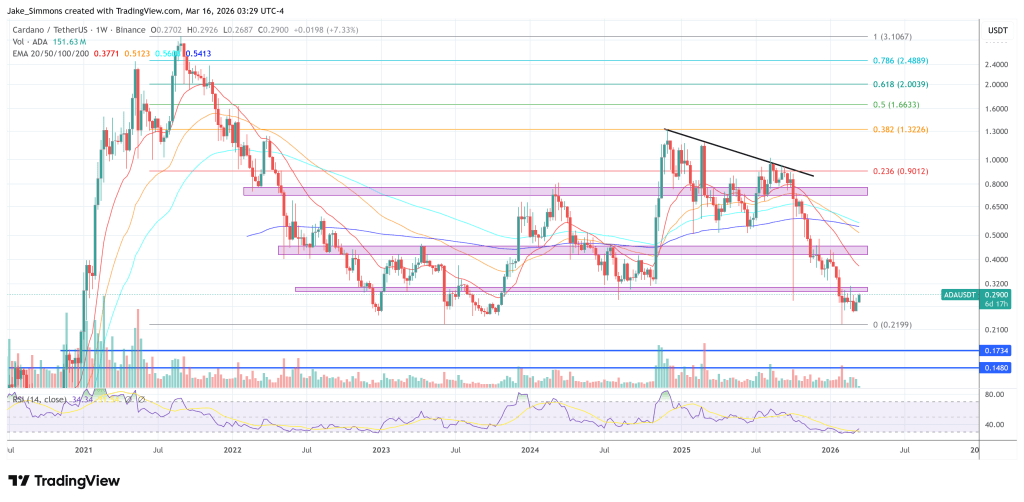
Cardano hovers below key resistance, 1-week chart | Source: ADAUSDT on TradingView.com

Perguntas relacionadas

QWhat is the core issue in the Liqwid governance dispute that Charles Hoskinson is addressing?

AThe core issue is whether insiders tied to the Liqwid protocol should be allowed to vote on a disputed asset distribution that could directly benefit them, and whether a prior public commitment to return 100% of assets in smart contracts to their rightful owners should be honored.

QWhat specific solution did Charles Hoskinson propose to resolve the Liqwid governance dispute?

AHoskinson proposed rerunning the vote with two key changes: first, insiders who are direct beneficiaries should recuse themselves; second, the vote should ask a clear yes or no question on whether the protocol should honor its prior marketing commitments.

QAccording to Hoskinson, what is the source of a DAO's legitimacy in governance?

AHoskinson stated that a DAO's legitimacy comes from broad participation and the confidence that the process is not controlled or tilted by a small group of insiders, not merely from the existence of a vote.

QWhat is the approximate value of the disputed NIGHT token allocation at the center of this controversy?

AThe disputed allocation is roughly 18.81 million NIGHT tokens, which at current market prices is worth just under $1 million.

QWhat potential consequence did Hoskinson warn about if the trust issue in Liqwid governance is not properly addressed?

AHoskinson warned that the violation of public trust, or even the perception of it, would badly damage Liqwid's ability to grow and thrive in the future, as users would lose trust in core accounts and governance votes, leading them to move to other options.

Leituras Relacionadas

From Survival to Accelerated Growth: The Journey of Zcash's Three-Year Rise as Told by the Founder of ZODL

**From Survival to Accelerated Growth: Zcash Founder Details the 3-Year Rise** Three years ago, Zcash (ZEC) was a struggling pioneer in privacy technology, with a price near $30, low shielded supply (11%), and a community mired in governance disputes. Today, ZEC trades around $600, with over 31% of its supply (~$3B) in user-controlled shielded pools. This transformation resulted from breaking key constraints. First, **governance shackles were removed**. The old model guaranteed funding to two entities (ECC and ZF) regardless of performance, creating a monopoly. In 2024, ECC rejected further direct funding, forcing a change. The NU6 upgrade ended direct funding, allocating 8% to community grants and 12% to a protocol-controlled treasury for retroactive rewards, expiring in 2028 unless renewed by overwhelming consensus. The entities also relinquished their trademark-based veto power, freeing community governance. Second, the **product focus shifted** from pure cryptography to user growth. Previously, engineering excelled at privacy tech but failed to attract users. In early 2024, the team (later ZODL) pivoted to building products users wanted, like the Zodl wallet (default privacy, hardware support, cross-asset swaps). This drove shielded supply to grow over 400% in ZEC terms, with 86.5% of recent transactions being shielded, representing real user adoption. Third, the **narrative evolved** from the limiting "privacy coin" label to "unstoppable private money." This clarified Zcash's value proposition: a Bitcoin-like monetary policy with verifiable private payments via advanced cryptography. This structural narrative—protocol (Zcash), asset (ZEC), gateway (Zodl)—enabled broader exchange listings, institutional interest, and ETF filings. Finally, **organizational constraints were broken**. In early 2026, the ECC team left its non-profit structure after disputes over control, forming Zcash Open Development Lab (ZODL). ZODL raised $25M from top VCs (Paradigm, a16z, etc.), gaining the capital and agility of a startup to scale consumer products. Current metrics show strong momentum: social discussion volume for ZEC surged 15,245% in a year, with 81% positive sentiment. The focus is now on enhancing user experience (Zodl wallet), scalability (Tachyon project targeting Visa-level throughput with 25-second blocks), and post-quantum security (quantum-recoverable wallets coming soon). Zcash is positioned to become faster, more usable, scalable, and quantum-resistant.

marsbitHá 9m

From Survival to Accelerated Growth: The Journey of Zcash's Three-Year Rise as Told by the Founder of ZODL

marsbitHá 9m

Five Counterparty Risk Architectures: A Settlement-Layer Methodology for Classifying TradFi Models in Crypto Exchanges

**Summary:** This companion piece reframes the five TradFi-on-crypto exchange architectures, previously classified by "architectural fingerprint," through the lens of counterparty risk. The core question is: whose balance sheet bears the loss first in a stress scenario, and has it historically done so? Each of the five models corresponds to a distinct risk holder with its own documented failure modes. * **Model 1 (Stablecoin-Settled CEX Perpetuals):** Risk is held by the stablecoin issuer (e.g., reserve composition, bank connectivity) and the CEX's own book. History includes Tether's banking disconnections (2017) and reserve misrepresentations (CFTC 2021 Order). * **Model 2 (CFD Brokers):** Risk resides on the broker's balance sheet (B-book model). Regulatory differences (e.g., ESMA's mandatory negative balance protection vs. Mauritius FSC's lack thereof) define loss allocation rules, as seen in the 2015 SNB event (Alpari UK insolvency). * **Model 3 (Off-Chain Custody & Transfer Agent Chain):** Risk lies with the off-chain custodian/platform. User asset recovery depends on Terms of Use and corporate structure, exemplified by the Celsius bankruptcy ruling (2023) where Earn Account assets were deemed property of the estate. * **Model 4 (DEX Perpetual Protocols):** No single balance sheet bears risk. Loss absorption relies on a protocol's insurance fund and Auto-Deleveraging (ADL) mechanism, as demonstrated in the GMX V1 (2022) and dYdX v3 YFI (2023) incidents. * **Model 5 (Regulated CCP - DCM-DCO-FCM):** The most institutionalized model concentrates risk in the Central Counterparty (CCP). However, history shows CCPs can employ non-standard tools under extreme stress, such as mass trade cancellation (LME Nickel, 2022) or enabling negative price settlements (CME WTI, 2020). The report argues that regulatory choices and counterparty risk structures are co-extensive, not in an upstream-downstream relationship. It concludes with five separate observation checklists (not predictions) for monitoring the structural vulnerabilities of each risk model.

marsbitHá 26m

Five Counterparty Risk Architectures: A Settlement-Layer Methodology for Classifying TradFi Models in Crypto Exchanges

marsbitHá 26m

Trading

Spot
Futuros

Artigos em Destaque

Como comprar ADA

Bem-vindo à HTX.com!Tornámos a compra de Cardano (ADA) simples e conveniente.Segue o nosso guia passo a passo para iniciar a tua jornada no mundo das criptos.Passo 1: cria a tua conta HTXUtiliza o teu e-mail ou número de telefone para te inscreveres numa conta gratuita na HTX.Desfruta de um processo de inscrição sem complicações e desbloqueia todas as funcionalidades.Obter a minha contaPasso 2: vai para Comprar Cripto e escolhe o teu método de pagamentoCartão de crédito/débito: usa o teu visa ou mastercard para comprar Cardano (ADA) instantaneamente.Saldo: usa os fundos da tua conta HTX para transacionar sem problemas.Terceiros: adicionamos métodos de pagamento populares, como Google Pay e Apple Pay, para aumentar a conveniência.P2P: transaciona diretamente com outros utilizadores na HTX.Mercado de balcão (OTC): oferecemos serviços personalizados e taxas de câmbio competitivas para os traders.Passo 3: armazena teu Cardano (ADA)Depois de comprar o teu Cardano (ADA), armazena-o na tua conta HTX.Alternativamente, podes enviá-lo para outro lugar através de transferência blockchain ou usá-lo para transacionar outras criptomoedas.Passo 4: transaciona Cardano (ADA)Transaciona facilmente Cardano (ADA) no mercado à vista da HTX.Acede simplesmente à tua conta, seleciona o teu par de trading, executa as tuas transações e monitoriza em tempo real.Oferecemos uma experiência de fácil utilização tanto para principiantes como para traders experientes.

1.2k Visualizações TotaisPublicado em {updateTime}Atualizado em 2025.03.21

Como comprar ADA

Discussões

Bem-vindo à Comunidade HTX. Aqui, pode manter-se informado sobre os mais recentes desenvolvimentos da plataforma e obter acesso a análises profissionais de mercado. As opiniões dos utilizadores sobre o preço de ADA (ADA) são apresentadas abaixo.

活动图片













