Cardano Foundation Advances Decentralized Governance With New ADA Delegations To 11 Community DReps

bitcoinistPublicado em 2026-01-22Última atualização em 2026-01-22

Resumo

Cardano Foundation has significantly advanced its decentralization efforts by delegating over 220 million ADA to 11 community Delegated Representatives (DReps). This move strengthens on-chain governance and broadens community participation in decision-making. Additionally, the Foundation self-delegated 171 million ADA to actively engage in governance rather than auto-abstaining. Currently, 36.9% of circulating ADA is delegated to DReps, reflecting growing trust in Cardano’s community-driven model. A recent governance vote saw 67.8% of participants (representing 3.77 billion ADA) supporting the network’s direction, signaling strong community confidence in its future.

Cardano and its vibrant ecosystem are becoming more decentralized as several moves are consistently being made to improve the leading blockchain network. One of these efforts is clearly indicated by the steady expansion of ADA delegation to multiple community DReps across the sector.

More Cardano Delegation To DReps

In a bold and exciting move, the Cardano Foundation has taken another step forward toward deeper and robust decentralization. The Foundation’s goal for deeper decentralization is being carried by expanding its ADA delegation to about 11 community DReps, which strengthens on-chain governance and community participation.

The recent delegation activity was disclosed on Cexplorer, the biggest and most featured OG blockchain explorer, via the social media platform X. The action is in line with Cardano’s changing governance structure, where elected representatives hold a growing amount of decision-making authority instead of fundamental entities.
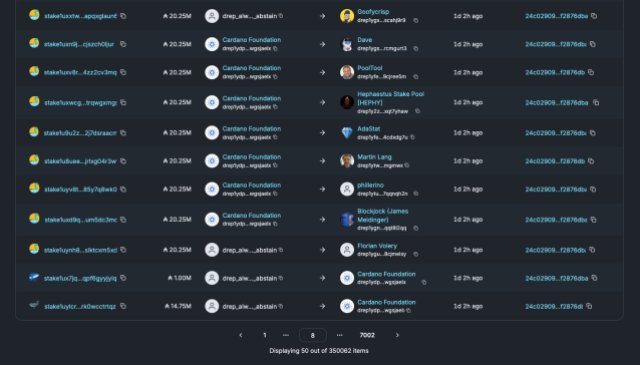
ADA delegations to 11 communities | Source: Chart from Cexplorer on X

As reported by the popular explorer, the Cardano Foundation has delegated over 220 million ADA to the 11 community DReps. By expanding its ADA delegation, the foundation is reaffirming its dedication to openness, diversity, and long-term network resilience, thereby making Cardano more decentralized.

These are the most crucial pillars in the move as the network persistently shifts toward a full community-driven ecosystem. According to the explorer, the Foundation has also self-delegated about 171 million ADA, moving it from an auto-abstain in order for all funds to actively participate in governance.

Delegation Operations Snags A Notable Supply

Following the move, the amount of ADA that has been utilized for delegation activity has increased sharply. A massive wave of ADA delegation signals a growing acceptance of on-chain governance across the broader Cardano ecosystem.

Cexplorer reported that the number has seen steady growth over the past several months. Current data shows that over 36.9% of circulating ADA has been delegated to Cardano DReps, which reflects mounting conviction in the network’s model.

Furthermore, it is a sign that more participants are willing to play a crucial role in shaping the blockchain’s future. Thus, decision-making power is shifting from concentrated entities to community voices as more holders pledge their tokens to designated representatives.

When compared to the stake pool, the explorer data shows that roughly 56% of ADA in circulation is delegated to the area. In the meantime, for delegators to be able to take out their staking rewards, they are expected to delegate to a DRep.

After a recent voting operation, Cardano’s future direction is now quite clear. Over 700 community members and 200 DReps participated in the voting process to decide where the ecosystem should be by 2030.

At the end, 67.80%, representing over 3.77 billion ADA, voted yes to the proposal that the network is moving in the right direction. Meanwhile, the rest, representing 491 million ADA, voted No to the proposal.

ADA trading at $0.36 on the 1D chart | Source: ADAUSDT on Tradingview.com

Criptomoedas em alta

Perguntas relacionadas

QWhat is the Cardano Foundation's recent move to advance decentralized governance?

AThe Cardano Foundation has expanded its ADA delegation to 11 community DReps, delegating over 220 million ADA to strengthen on-chain governance and community participation.

QHow much ADA has been delegated to DReps in total according to current data?

ACurrent data shows that over 36.9% of circulating ADA has been delegated to Cardano DReps.

QWhat percentage of ADA in circulation is delegated to stake pools compared to DReps?

ARoughly 56% of circulating ADA is delegated to stake pools, while 36.9% is delegated to DReps.

QWhat was the outcome of the recent voting operation regarding Cardano's future direction?

A67.80% of voters, representing over 3.77 billion ADA, voted 'Yes' that the network is moving in the right direction, while 491 million ADA voted 'No'.

QHow did the Cardano Foundation adjust its own ADA holdings for governance participation?

AThe Foundation self-delegated about 171 million ADA, moving it from an auto-abstain to ensure all funds actively participate in governance.

Leituras Relacionadas

Global Stock Market's Storm Center: South Korea's Stock Market De-leveraging Is Largely Complete

Storm's Eye: South Korean Market De-leveraging Nears Completion The recent sharp correction in South Korean equities, with the KOSPI index dropping 32% from its June high, has been a key trigger for global tech stock volatility. The core driver was not a fundamental shift but a forced de-leveraging process within the market's unique structure, which is now largely complete. Two main leverage channels amplified the sell-off: 1. **Leveraged ETFs:** Their size, proportionally four times larger than in the U.S., peaked near $50 billion. Their mandatory daily rebalancing mechanism created a vicious cycle of "price drop → forced selling → further drop." Approximately 75% of this excess has been unwound, shrinking to $26 billion, with regulatory curbs now blocking new inflows. 2. **Hedge Fund Leverage:** Using swaps to magnify exposure, hedge funds saw their net long positioning fall by over 50% from peak levels. The most intense phase of this institutional de-leveraging is over. In contrast, **retail margin debt** poses minimal systemic risk. At 0.5% of market cap, it is far lower than in the U.S. or China, lacks automatic triggers, and is concentrated in smaller stocks. The conclusion: the high-leverage structures most prone to "chain-reaction selling" have been substantially cleared. The market is transitioning from a liquidity-driven crash to one priced more on fundamentals. The article argues that the AI trend—centered on Korean memory chips—remains intact. This episode represents a painful but necessary clearing of crowded trades, not the end of the AI revolution. For investors, the key question is conviction in the long-term AI direction; if the trend is real, current volatility is a cost of entry, not a terminal risk.

链捕手Há 53m

Global Stock Market's Storm Center: South Korea's Stock Market De-leveraging Is Largely Complete

链捕手Há 53m

The Eternal Fragments of Money: Third-Party Payment Has No First Principle

"The Enduring Fragments of Money: Third-Party Payments Lack a First Principle" Stripe is reportedly attempting to acquire PayPal, marking a significant shift reminiscent of PayPal's merger with the original X.com 30 years ago. The article analyzes Stripe's strategic challenges and the broader payments industry landscape. Despite its initial success with a developer-friendly API model, Stripe missed its optimal IPO window during the pandemic and has since seen its valuation decline. Its attempts to expand through acquisitions and new ventures, particularly in stablecoins (like its OUSD project) and Agent-focused payments (ACP/MPP protocols), have faced headwinds. The author argues that the payment industry remains highly fragmented and is ultimately an adjunct to the traditional banking system. This structure limits the potential for any single player, including Stripe, to achieve complete dominance. While stablecoins and the future rise of autonomous Agent economies present potential growth avenues, they are not yet mainstream and still require integration with the existing financial system. For now, Agent-based transactions are largely used for speculative "volume boosting" rather than substantive business applications. Stripe's current move to acquire PayPal is seen as an attempt to bolster its weak consumer-facing (C-side) business after its stablecoin-focused strategies faltered. Meanwhile, PayPal is described as structurally outdated, unable to revive itself through new products like Venmo or PYUSD. The future of payments may lie not in payments themselves but in value-added services like more efficient settlement networks. The author suggests that companies like Stripe and Circle, which are building their own blockchains (Tempo, Arc) and stablecoins, are positioning themselves to eventually profit from high-efficiency settlement systems. These new networks could potentially bypass some traditional banking layers. In conclusion, the article posits that third-party payment is a perpetually fragmented battlefield where scale alone cannot ensure victory. Players must find new models, focusing on efficiency to compete with the entrenched banking system. Stripe's acquisition of PayPal represents a bet on this uncertain future.

链捕手Há 1h

The Eternal Fragments of Money: Third-Party Payment Has No First Principle

链捕手Há 1h

Trading

Spot

Artigos em Destaque

Como comprar ADA

Bem-vindo à HTX.com!Tornámos a compra de Cardano (ADA) simples e conveniente.Segue o nosso guia passo a passo para iniciar a tua jornada no mundo das criptos.Passo 1: cria a tua conta HTXUtiliza o teu e-mail ou número de telefone para te inscreveres numa conta gratuita na HTX.Desfruta de um processo de inscrição sem complicações e desbloqueia todas as funcionalidades.Obter a minha contaPasso 2: vai para Comprar Cripto e escolhe o teu método de pagamentoCartão de crédito/débito: usa o teu visa ou mastercard para comprar Cardano (ADA) instantaneamente.Saldo: usa os fundos da tua conta HTX para transacionar sem problemas.Terceiros: adicionamos métodos de pagamento populares, como Google Pay e Apple Pay, para aumentar a conveniência.P2P: transaciona diretamente com outros utilizadores na HTX.Mercado de balcão (OTC): oferecemos serviços personalizados e taxas de câmbio competitivas para os traders.Passo 3: armazena teu Cardano (ADA)Depois de comprar o teu Cardano (ADA), armazena-o na tua conta HTX.Alternativamente, podes enviá-lo para outro lugar através de transferência blockchain ou usá-lo para transacionar outras criptomoedas.Passo 4: transaciona Cardano (ADA)Transaciona facilmente Cardano (ADA) no mercado à vista da HTX.Acede simplesmente à tua conta, seleciona o teu par de trading, executa as tuas transações e monitoriza em tempo real.Oferecemos uma experiência de fácil utilização tanto para principiantes como para traders experientes.

1.3k Visualizações TotaisPublicado em {updateTime}Atualizado em 2026.06.02

Como comprar ADA

Discussões

Bem-vindo à Comunidade HTX. Aqui, pode manter-se informado sobre os mais recentes desenvolvimentos da plataforma e obter acesso a análises profissionais de mercado. As opiniões dos utilizadores sobre o preço de ADA (ADA) são apresentadas abaixo.

活动图片