Source: Phoenix News
Canadian Prime Minister Mark Carney delivered a strongly-worded speech at the World Economic Forum in Davos, Switzerland, on Tuesday, making the significant assertion: "The old order will not return." He stated that the long-standing U.S.-led, rules-based international order has ended, and middle powers like Canada must shift their strategies to avoid becoming victims of further coercion by powerful forces.
Carney did not directly name U.S. President Trump but referred to "American hegemony," noting that major powers are using economic integration as a "weapon." He called on middle powers to stop "pretending the rules still work" and to strive for genuine strategic autonomy through collective action.
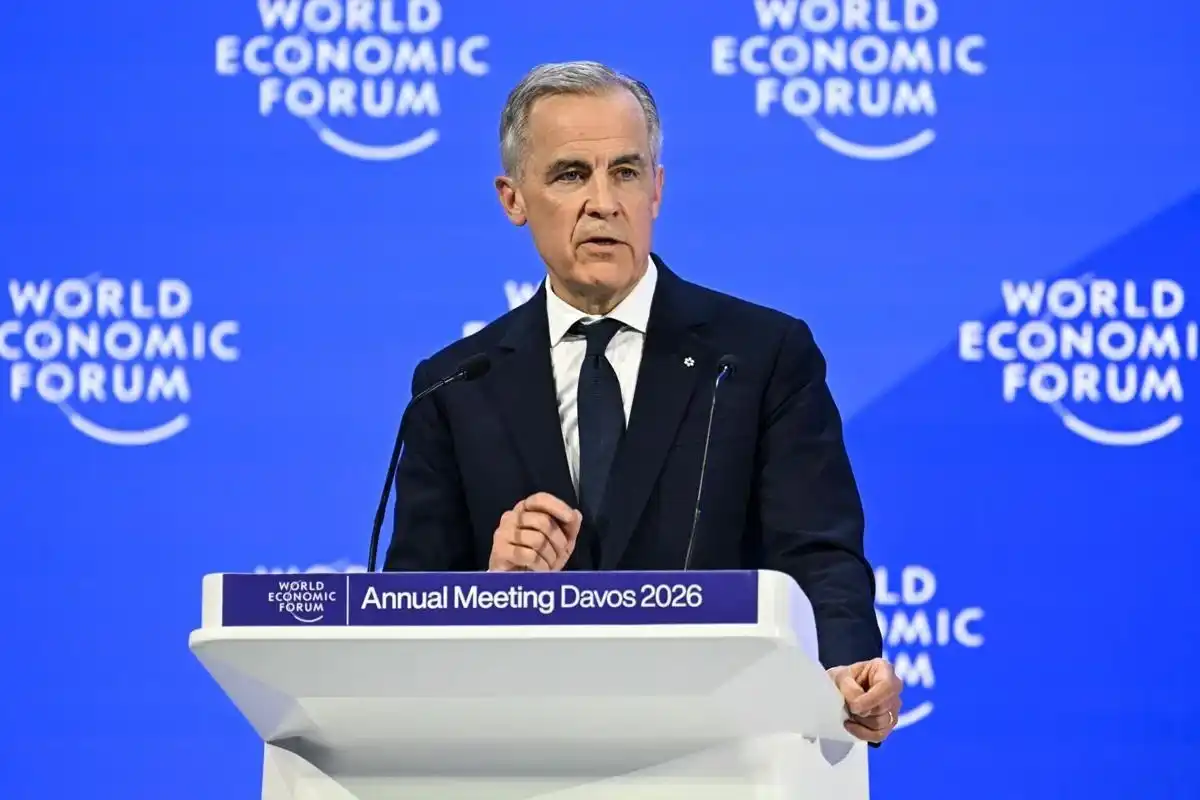
Below is a compilation by Phoenix News "World Affairs" (abridged):
We seem to be reminded daily: we are living in an era of great power competition—the so-called "rules-based order" is fading, the strong can do as they please, and the weak must endure the consequences they have to bear.
Thucydides' adage is presented as an inevitable reality, as if it were the re-emergence of the natural logic of international relations. Faced with this logic, countries often tend to go with the flow, accommodate each other, avoid trouble, and hope that compliance will buy security.
But that is not the case. So, what are our choices?
In 1978, Czech politician Václav Havel wrote an essay about a greengrocer.
Every morning, the shop owner would place a sign in his window with a symbolic slogan. He did not believe in the message. But he still displayed it to avoid trouble, show compliance, and keep the peace. And because every shopkeeper on every street did the same, the system persisted—not just through force, but through ordinary people participating in rituals they privately knew were false.
Havel called this state "living a lie." The system's strength came not from its truthfulness, but from everyone's willingness to pretend it was true. And its fragility lay precisely in this: if even one person stopped performing, if that greengrocer took the sign out of the window, the illusion would begin to crumble.
Friends, it is time for businesses and countries to take these signs down.
For decades, countries like Canada have thrived under what we call the "rules-based international order." We joined these institutions, praised their principles, and benefited from their predictability. Because of this, we were able to pursue value-based foreign policies under their protection.
We also knew that this story of an international rules-based order was, to some extent, a fiction: the most powerful nations would exempt themselves when convenient, trade rules were enforced asymmetrically, and the application of international law depended on the identity of the accused or the victim.
This fiction was once useful. Particularly, American hegemony helped provide public goods—open sea lanes, a stable financial system, collective security, and an institutional framework for dispute resolution.
So, we put the sign in the window. We participated in these rituals and largely avoided pointing out the gap between rhetoric and reality.
But that bargain is no longer working.
Let me be blunt: we are in a rupture, not a transition.
Over the past two decades, successive crises in finance, public health, energy, and geopolitics have exposed the risks of highly global integration. More recently, major powers have begun to turn economic integration into a weapon, using tariffs as leverage, financial infrastructure as a tool of coercion, and supply chains as vulnerabilities to be exploited.
When integration itself becomes the source of your vulnerability, you can no longer live in the lie of "mutual benefit and win-win."
The multilateral institutions on which middle powers rely—the WTO, the UN, the climate conference mechanism, and the entire institutional architecture of collective problem-solving—are under threat. As a result, many countries have reached the same conclusion: they must develop greater strategic autonomy in energy, food, critical minerals, finance, and supply chains. This impulse is understandable.
A country that cannot feed itself, power itself, or defend itself has very limited choices. When the rules no longer protect you, you must protect yourself.
But we must be clear-eyed about where this path leads. A world of fortresses will be poorer, more fragile, and less sustainable.
There is also the fact: if major powers abandon even the pretense of rules and values, pursuing only unconstrained power and interest, then the gains from transactional diplomacy will become increasingly difficult to replicate.
Hegemonic powers cannot constantly monetize relationships. Allies will hedge against uncertainty through diversification, buying "insurance," and increasing options to rebuild sovereignty—a sovereignty once built on rules will increasingly depend on the ability to withstand pressure.
Everyone here understands that this is classic risk management. Risk management has a cost, but the cost of strategic autonomy and sovereignty can be shared. Collective investment in resilience is much cheaper than each building their own fortress. Common standards can reduce fragmentation, and complementarity creates positive-sum effects.
For middle powers like Canada, the question is not whether to adapt to this new reality—we must adapt.
The question is, will we merely build higher walls, or can we be more ambitious?
Canada was among the first to hear this alarm, which prompted us to fundamentally adjust our strategic posture. Canadians understand that our old comfortable assumptions—that geography and alliance membership automatically brought prosperity and security—are no longer valid. Our new path is based on what Finnish President Stubb calls "value-based realism."
In other words, we adhere to principles while acting pragmatically. In principle, we firmly defend fundamental values, sovereignty, territorial integrity, adherence to the prohibition of the use of force unless in accordance with the UN Charter, and respect for human rights.
Pragmatically, we also recognize that progress is often gradual, interests diverge, and not all partners share all our values.
Therefore, we engage with the world broadly and strategically, with clear eyes. We proactively face the world as it is, rather than waiting for the ideal world to arrive.
We are calibrating relationships so their depth reflects our values, while maximizing our influence in today's fluid and risky world through broad engagement.
We no longer rely solely on the strength of our values, but also on the value of strength itself.
We are building that strength at home. Since this government took office, we have cut personal income taxes, capital gains taxes, and taxes on business investment; eliminated all federal-level interprovincial trade barriers; and accelerated investments totaling one trillion dollars in energy, AI, critical minerals, new trade corridors, and other areas. We plan to double defense spending by the end of this decade and are advancing this process with the goal of strengthening domestic industry. At the same time, we are rapidly advancing external diversification.
We have reached a comprehensive strategic partnership with the EU, including joining the European defense procurement mechanism SAFE, and have signed 12 trade and security agreements across four continents in six months.
In the past few days, we have reached new strategic partnerships with China and Qatar, and are negotiating free trade agreements with India, ASEAN, Thailand, the Philippines, and Mercosur.
We are also doing something else: to address global issues, we are promoting "variable geometry," meaning forming different coalitions on different issues based on shared values and interests. On Ukraine, we are one of the core members of the "coalition of the willing" and one of the largest per capita contributors to defense and security.
On Arctic sovereignty, we stand firmly with Greenland and Denmark, fully supporting their unique right to determine Greenland's future.
Our commitment to NATO Article 5 is unwavering, so we are working with NATO allies, including the "Nordic-Baltic Eight," to enhance security on the alliance's northern and western flanks, including Canada's unprecedented investments in over-the-horizon radar, submarines, aircraft, and ground forces—ice-capable troops.
Canada firmly opposes tariffs related to the Greenland issue and calls for targeted dialogue to achieve our shared security and prosperity goals in the Arctic.
In multilateral trade, we are promoting bridges between the CPTPP and the EU to create a new trade bloc covering 1.5 billion people, with critical minerals at its core.
We are building a "buyers' club" based on the G7 to help the world break free from dependence on highly concentrated supplies. In AI, we are working with like-minded democracies to ensure we are not ultimately forced to choose between a hegemonic power and hyper-scale platforms.
This is not naive multilateralism, nor mere reliance on existing institutions, but building viable coalitions with partners who share enough common ground on specific issues. In some cases, this will include the vast majority of the world's countries. The goal is to build a dense network of connections in trade, investment, culture, and other areas to address future challenges and opportunities.
Our view is that middle powers must act together because if we are not at the table, we will be on the menu.
Let me also say that major powers still have the ability to go it alone for now. They have market size, military capability, and leverage, which middle powers lack. But when we negotiate bilaterally only with hegemonic powers, we negotiate from a position of weakness, accepting what we are given, and competing with each other to see who is more compliant.
This is not sovereignty; it is performing sovereignty while accepting subordination.
In a world of great power competition, countries caught in the middle have a choice: compete with each other for favor, or unite to carve out a third path with real influence. We should not let the rise of hard power blind us to the strength of legitimacy, integrity, and rules—which remain powerful if we choose to wield them together.
This brings me back to Havel. What does "living in truth" mean for middle powers?
First, it means facing reality. Stop pretending the "rules-based international order" still works as advertised, and instead be honest: this is a system of intensifying great power competition where the strongest use economic integration to coerce and pursue self-interest.
It means acting consistently, applying the same standards to allies and adversaries. When middle powers criticize economic coercion from one direction but remain silent about another, we are still hanging the sign in the window.
It means building what we claim to believe in, not waiting for the old order to return. It means creating institutions and agreements that actually function as described, reducing the leverage that makes coercion possible.
It means building a strong domestic economy—this should be the top priority of every government.
And international diversification is not just economic prudence; it is the material basis for an honest foreign policy. A country can only take principled stands if it reduces its vulnerability to retaliation.
So, Canada. Canada has what the world needs. We are an energy superpower, with vast reserves of critical minerals, one of the world's most highly educated populations, and our pension funds are among the largest and most sophisticated global investors. In other words, we have capital and talent. We also have a government with significant fiscal capacity and the ability to act decisively, and values that many countries aspire to.
Canada is a well-functioning pluralistic society. Our public space is noisy, diverse, and free. Canadians remain committed to sustainable development. We are a stable and reliable partner in an extremely unstable world, a partner that values and cultivates relationships for the long term.
And one more thing: we understand what is happening and are determined to act accordingly. We understand that this rupture requires not just adaptation, but honesty about the real world.
We are taking the sign out of the window.
We know the old order will not return, and we should not mourn it. Nostalgia is not a strategy. But we believe that from this rupture, a larger, better, stronger, and more just order can be built. This is the task of middle powers—those who stand to lose the most in a fortress world and gain the most from genuine cooperation.
The strong have their power. But we also have our own power: the ability to stop pretending, face reality, build strength at home, and act together collectively.
This is the path Canada has chosen. We walk it openly and confidently, and we welcome any country willing to join us.
Thank you very much.




















