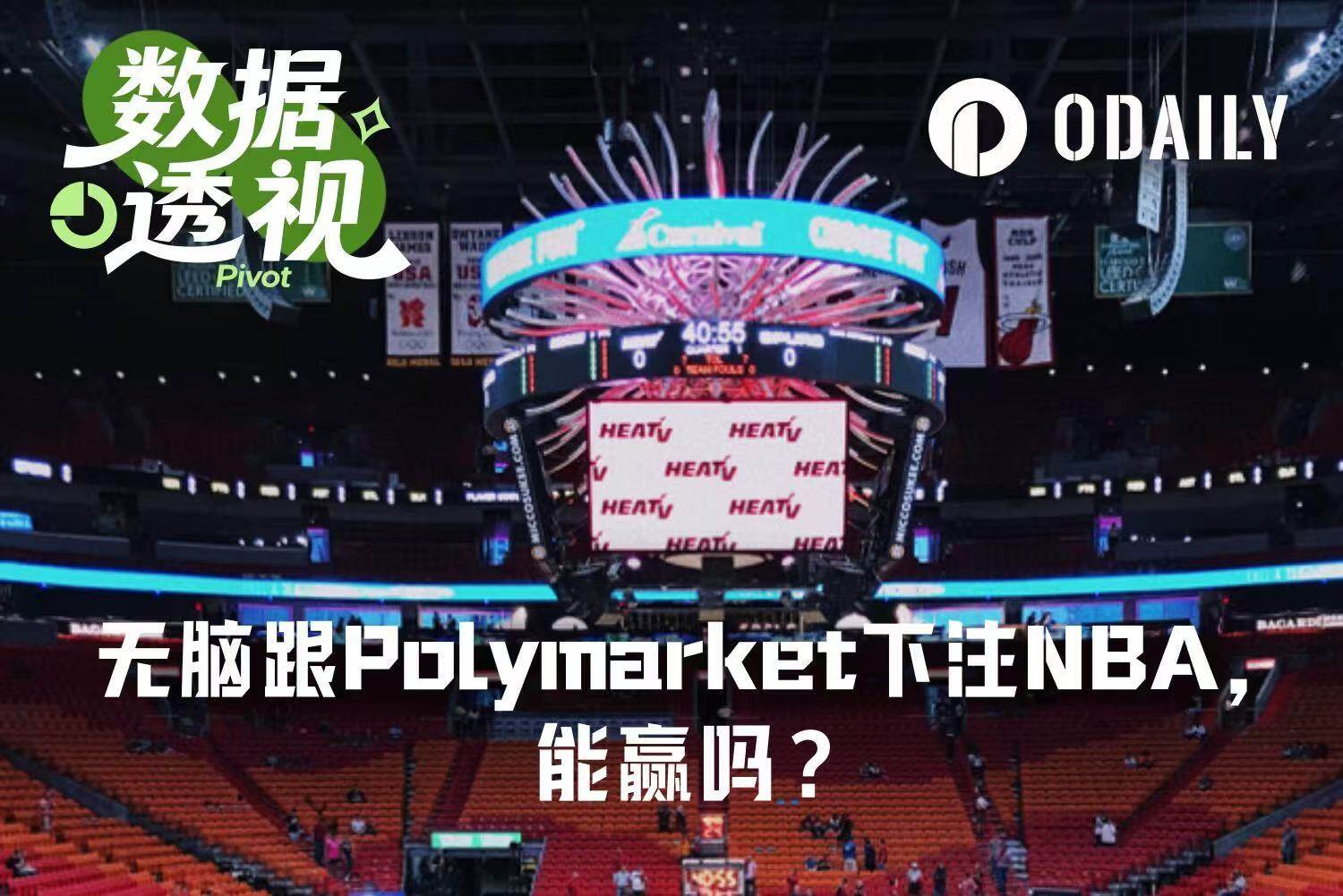
Can You Make a Steady Profit by Blindly Following Polymarket's Pre-Game Win Probability to Bet on NBA Games?

Odaily星球日报Publicado em 2026-04-17Última atualização em 2026-04-17

Resumo

**Can You Consistently Profit by Blindly Following Pre-Game Win Probabilities on Polymarket for NBA Games?** A backtest of the entire NBA 2025-26 regular season (1,096 games) was conducted to test the strategy of always betting $100 on the team with the higher pre-game win probability on Polymarket. The results show that this strategy is not profitable. The total amount wagered was $109,600, with a return of $107,545.20, resulting in a net loss of $2,054 and a Return on Investment (ROI) of -1.87%. This indicates that the market is highly efficient, and pre-game probabilities are accurately priced, leaving no simple arbitrage opportunity. In fact, blindly following the market would have been slightly less profitable than betting against it. However, a deeper analysis by team revealed significant differences. Certain teams consistently outperformed market expectations when they were favored to win: * Portland Trail Blazers (POR): 19% ROI * Philadelphia 76ers (PHI): 14% ROI * San Antonio Spurs (SAS): 12% ROI * Los Angeles Lakers (LAL): 11% ROI * Charlotte Hornets (CHA): 9% ROI In contrast, the market was highly efficient for the top-performing teams, offering minimal returns (e.g., Boston Celtics ROI: 4%, Denver Nuggets ROI: -5%). Results for the weakest teams were too inconsistent due to small sample sizes. The key finding is that team-specific factors, rather than the probability percentage itself, drive potential value, making a one-size-fits-all strategy ineffec...

Trading NBA games on Polymarket, perhaps you, like many others, have had this experience: before the game, you see one team with a significantly higher win probability than their opponent, only for them to collapse in the fourth quarter and get swept away by a scoring run (like the recent Hornets and Heat game—I lost so much on that bet it made me question my life).

Since everyone says Polymarket is a "truth machine," does that mean I can easily make money by blindly buying the team with the higher pre-game win probability?

To test this hypothesis, I backtested the 1,096 regular-season games of the NBA 2025-26 season. The data revealed the truth—

Blindly following the market won't make you money, but it won't lose you much either; the pre-game probabilities are fully priced in.

Blindly Buying the Market Favorite is a Guaranteed Loss

The backtesting strategy was very simple:

  • Used the average probability from 3 minutes before the game as a benchmark
  • Traded $100 on each game
  • Always bought the side with the "higher win probability"

Results:

  • Total amount wagered: $109,600. Total amount returned: $107,545.20. Net loss: $2,054.
  • ROI: -1.87%

This shows that Polymarket's prices are quite efficient; the market has fully priced in the teams' win probabilities, leaving no "arbitrage" opportunity.

The difference in ROI likely comes from other dimensions like transaction costs and emotional premiums. If you insist on "buying blindly," you might as well bet against the market—you could even make a 1.87% profit.

The Real Value: Not All Teams Are Created Equal

The above backtest was for the entire set of a thousand games. I then broke it down from multiple angles to try and find parts that break free from the market's gravity:

  • By week: Random walk
  • By probability: Still a random walk. That is, betting on pre-game win probabilities of 50%, 60%, 70%, or 80% showed no difference in returns.
  • By team: Here, clear differences emerged.

Some teams simply live up to the market's trust—

When the market thinks they will win, they are more likely to actually win.

  • POR (Trail Blazers): ROI 19%
  • PHI (76ers): ROI 14%
  • SAS (Spurs): ROI 12%
  • LAL (Lakers): ROI 11%
  • CHA (Hornets): ROI 9%

Why is there such a difference for these teams? As the author previously had little understanding of NBA teams themselves, an initial hypothesis was formed:

Are they the strongest or the weakest teams, thus having high expectation consistency?

But upon verification, this was not the case. Except for SAS (Spurs), the other four teams were only ranked in the middle to slightly above average positions.

So what about the teams with the best records? The market has already fully priced them in. Blindly buying them yields an average ROI of only 2.16%; the pre-game betting odds contain no水分 (water/hidden value).

  • DET (Pistons): ROI 1%
  • BOS (Celtics): ROI 4%
  • NYK (Knicks): ROI 3%
  • OKC (Thunder): ROI -2%
  • DEN (Nuggets): ROI -5%

What about the weakest teams?

Here, there is extreme divergence instead. These teams are almost never favored by the market. For example, the Nets (BKN) were only favored (win probability >50%) in 7 games, won 5 of them, resulting in a high ROI of 21%; while the Pacers (IND) were favored in 8 games, won 4, but had an ROI of -20%. The sample size is too small to serve as a trading reference.

This means, theoretically (only theoretically!), POR (Trail Blazers), PHI (76ers), SAS (Spurs), LAL (Lakers), and CHA (Hornets) are the range defined by the existing data for following.


Perguntas relacionadas

QAccording to the article, can you consistently make a profit by blindly following the pre-game win probability on Polymarket for NBA games?

ANo, the article's backtest of the 2025-26 NBA season showed that blindly buying the team with the higher pre-game win probability resulted in an overall loss of 1.87%, indicating the market is efficiently priced.

QWhat was the return on investment (ROI) for the simple strategy of always buying the 'higher win rate' team before each game?

AThe ROI for the strategy was -1.87%, meaning a loss of $2,054 on a total investment of $109,600 across 1,096 games.

QWhich specific NBA teams, according to the data, provided a positive ROI when their pre-game win probability was high?

AThe teams with a positive ROI were POR (Trail Blazers) at 19%, PHI (76ers) at 14%, SAS (Spurs) at 12%, LAL (Lakers) at 11%, and CHA (Hornets) at 9%.

QDid the ROI vary significantly when the strategy was applied to the strongest teams in the league?

ANo, the ROI for the strongest teams was very low, averaging only 2.16%, indicating the market had already efficiently priced their high pre-game win probabilities.

QWhat conclusion does the article draw about the overall efficiency of the Polymarket for NBA games?

AThe article concludes that the Polymarket is a 'truth machine' and its prices are quite efficient, as the market has fully priced in team win probabilities, leaving no simple arbitrage opportunity for a blind-follow strategy.

Leituras Relacionadas

20 Billion Valuation, Alibaba and Tencent Competing to Invest, Whose Money Will Liang Wenfeng Take?

DeepSeek, an AI startup founded by Liang Wenfeng, is reportedly in talks with Alibaba and Tencent for an external funding round that could value the company at over $20 billion. This marks a significant shift, as DeepSeek had previously relied solely on funding from its parent company,幻方量化 (Huanfang Quantitative), and had resisted external investment. The potential valuation would place DeepSeek among the top-tier AI model companies in China, comparable to competitors like MoonDark (valued at ~$18 billion) and ahead of recently listed firms like MiniMax and Zhipu. The funding—which could range from $600 million (for a 3% stake) to $2 billion (for 10%)—is seen as a move to secure resources for model development, retain talent, and support infrastructure needs, particularly as competition in inference models and AI agents intensifies. Both Alibaba and Tencent are eager to invest, not only for financial returns but also to integrate DeepSeek into their broader AI ecosystems. However, DeepSeek’s leadership is cautious about maintaining independence and may prefer financial investors over strategic ones to avoid being locked into a specific tech ecosystem. Alternative options, such as state-backed funds, offer longer-term capital and policy support but may come with slower decision-making and potential constraints on global expansion. With competing AI firms accelerating their IPO plans, DeepSeek’s window for securing optimal terms may be narrowing. The final decision will reflect a trade-off between capital, resources, and strategic independence.

marsbitHá 1h

20 Billion Valuation, Alibaba and Tencent Competing to Invest, Whose Money Will Liang Wenfeng Take?

marsbitHá 1h

After Losing 97% of Its Market Value, iQiyi Attempts to Use AI to Forcefully Extend Its Lifespan

After losing 97% of its market value since its 2018 peak, iQiyi is aggressively pivoting to AI in a desperate attempt to survive. At its 2026 World Conference, CEO Gong Yu announced an "AI Artist Library" with over 100 virtual performers and a new AIGC platform, "NaDou Pro," promising faster production and lower costs. This shift comes as the company faces severe financial distress: its market cap sits near delisting thresholds at $1.36 billion, with significant losses, declining membership revenue, and depleted cash flow. The AI strategy has sparked controversy. Top actors have issued legal threats against unauthorized digital replicas, while in Hengdian, over 134,000 background actors are seeing their already scarce job opportunities vanish as AI replaces them for background roles. iQiyi's move represents a fundamental shift from being a high-cost content buyer to a landlord" to becoming a "platform capitalist" that transfers production risk to creators. This contrasts with competitors like Douyin (TikTok's Chinese counterpart), which is investing heavily in *real* actor-led short dramas, betting that authentic human connection retains users better than AI-generated content. The article draws a parallel to the 1920s transition to "talkies," which made cinema musicians obsolete but ultimately enriched the art form. In contrast, iQiyi's AI drive is framed not as an artistic evolution but as a cost-cutting measure that could degrade storytelling, replacing genuine human emotion with algorithmically calculated stimulation and potentially numbing audiences' capacity for empathy. The core question remains: can a company focused solely on financial survival preserve the art of storytelling?

marsbitHá 1h

After Losing 97% of Its Market Value, iQiyi Attempts to Use AI to Forcefully Extend Its Lifespan

marsbitHá 1h

Trading

Spot
Futuros
活动图片