Nice, nice.
DeepSeek's official version is still on the way, and the unofficial "Best Harness" has already made a grand entrance! (Might as well outdo everyone.jpg)
The project is called "Pi", an open-source programming Agent that has pulled in about 86,000 Stars on GitHub.
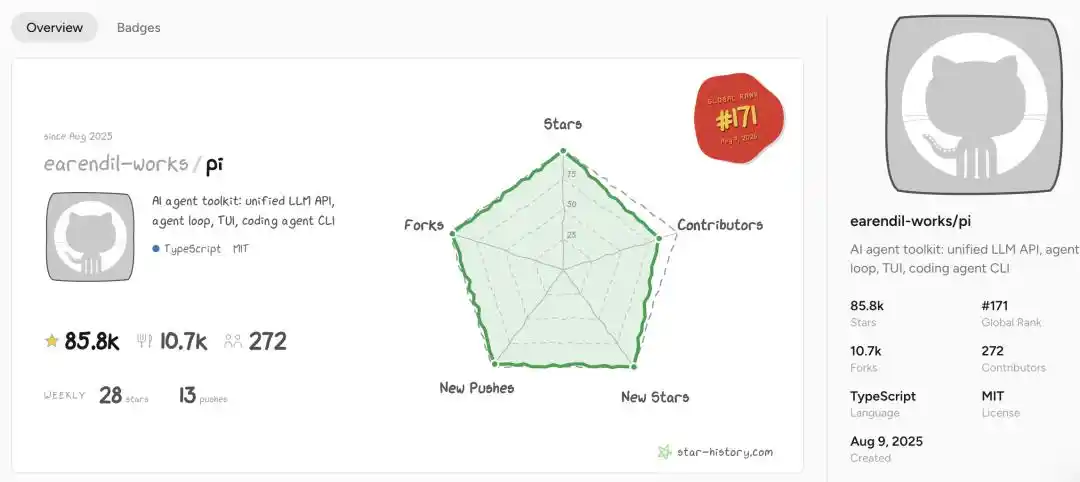
The main reason the project is so hot is simply because this thing is so Efficient...
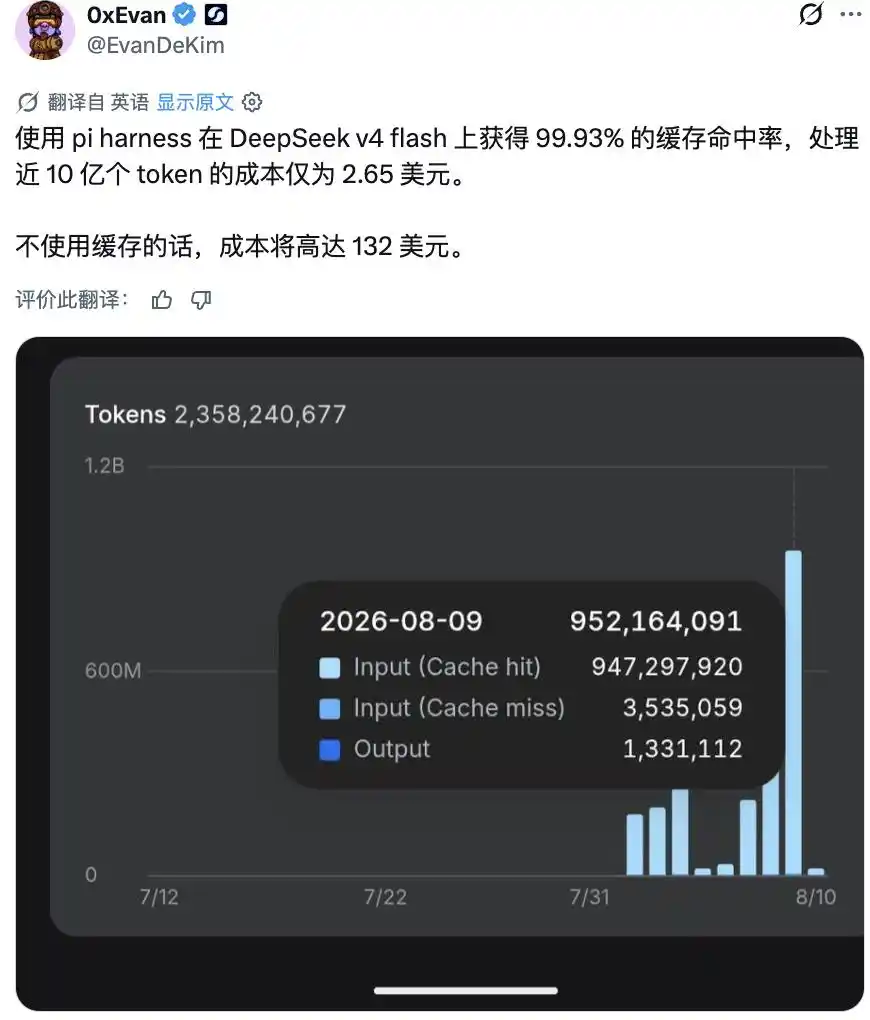
Look at this developer, Evan Kim. After he connected DeepSeek to Pi, approximately 99.93% of input tokens were successfully cache hits.
In other words, the cache miss rate is only 0.07%, meaning the vast majority of repeated context doesn't need to be recomputed???
What's more, the Composio team recently conducted a horizontal test of 8 mainstream Agent Harnesses, directly running DeepSeek V4 Flash on real tasks.
The results came out a bit dramatic—
Pi had the lowest average cost per successful task, only about $0.028.
Claude Code: How did you just make my price 7 times Pi's!!!

DeepSeek: My tokens are already sold this cheap.
Pi and other cost-saving projects: It's fine, we can make users buy even fewer of them, ha.
Four Tools Paired with DeepSeek, Cache Miss Rate Drops to 0.07%
Before talking about Pi, let's briefly discuss what a Harness actually is.
We all know that large models themselves are more like thinking brains—
To get them to actually work in a code repository, they need to be equipped with eyes, hands, and workflows.
For example, who reads files, how to call the terminal, how to run tests after modifying code—these engineering systems surrounding the model are collectively called a Harness.
Because of this, the same model with a different Harness can have vastly different practical performance and invocation costs!!
And the "Pi" created by developer Mario Zechner does exactly this—building such a programming workstation for large models.

After scanning the project, I can briefly summarize that Pi's approach is quite Direct—
That is, this thing, from the very beginning, never intended to cram "all features" into its core...
Specifically, by default, Pi only gives the model four tools—read file, write file, modify file, and execute command.
If users need planning mode, sub-agents, MCP, Git checkpoints, or permission controls, they can then install them one by one via extensions and Skills~
Emm... It's probably like delivering a bare apartment with basic utilities; Pi is responsible for building the four walls, and whether it's eventually decorated into a studio, a gaming room, or a three-bedroom apartment depends entirely on the user's own tinkering??

What a coincidence, this perfectly aligns with DeepSeek's needs...
As is well known, DeepSeek's reasoning and programming capabilities are quite strong, but its tool calling, context management, and reasoning content playback have their own interface rules.
This leads to problems when we directly plug it into a general Harness designed around OpenAI or Claude, such as tool format incompatibility, errors in reasoning content playback, and cache invalidation.
So, while DeepSeek's official product is still on the way, Pi took the initiative to adapt first—
In April this year, Pi added native Provider support for DeepSeek while also fixing 400 errors in V4 session playback.
It retains the reasoning_content as required by DeepSeek's interface and maps Pi's internal reasoning intensity to the thinking levels supported by DeepSeek.
Truly·customized by the community.
But! What really made Pi and DeepSeek click instantly was "Caching".
After all, a Coding Agent, with each step it executes, has to resend the system prompt, tool definitions, historical conversation, and code to the model, which leads to—
The longer the model works on a task, the longer the request grows, and most of this content, DeepSeek has already seen...
This is where automatic prefix caching comes in handy.
It can temporarily remember the already computed beginning of a request. In the next invocation, as long as the system prompt, tool definitions, and historical conversation remain consistent, this large chunk of content can be reused directly, and the model only needs to process the newly added information at the end.
And "Cache Hit Rate" measures exactly what percentage of tokens in this input successfully reused previous computation results.
The higher the hit rate, the fewer tokens need recomputation, and naturally, the lower the invocation cost.
But the trouble hides here too; adding a timestamp to the prompt, changing the order of tools—the cache might immediately forget and start computing from scratch.
However, Pi's advantage is that it's Simple Enough: Few default tools, session content continuously appends forward, rarely going back to tinker with previous content.
This way, when DeepSeek checks the log, the hundreds of pages it has already seen can be skipped directly, only processing the few newly added pages at the end, drastically lowering the cache miss rate~
And indeed, netizen Evan Kim came forward to verify—
After connecting DeepSeek to Pi, the cache miss rate dropped to 0.03%, corresponding to a cache hit rate of about 99.97%.

Do the math: processing 1 billion tokens would cost only around $19, whereas without using the cache, the cost would be over $900...
Additionally, the Composio team recently conducted a horizontal test of 8 mainstream Agent Harnesses, directly running DeepSeek V4 Flash on real tasks.
The results came out somewhat dramatic, The same DeepSeek, with a different Harness, can have a cost difference of up to 7 times???

At a glance, indeed Pi Agent has the lowest "average cost" per successful task, needing only about $0.028.
Following behind are Deep Agents, Hermes Agent, OpenCode, Codex, Oh My Pi, and Prime Agent, respectively.
Let's look at A-clan's precious Claude Code, the undisputed "Most Expensive Contestant"—
Completing one successful task costs an average of about $0.195, yes, nearly 7 times that of Pi... (The sky is falling)
Of course, this number doesn't mean Claude Code lacks capability; after all, it is itself a complete engineering system built around the Claude model.
It's just that when the underlying model is switched to DeepSeek, the workflows optimized for the Claude ecosystem don't fully benefit from DeepSeek's low cost and high cache efficiency.
The model is still the same DeepSeek; Pi just makes it read much less of the content it has already seen.
Pi: Quietly waiting for the official Harness to surpass me, ha.
Official Harness Team Already Assembled, Targeting Claude Code Directly
Of course, no matter how suitable Pi is for DeepSeek, it's currently still a third-party solution.
After all, DeepSeek itself has decided to step into the ring and build its own Harness, and it's probably not far from launch? (I guess)
Back in May this year, DeepSeek senior researcher Chen Deli confirmed that the company is internally forming an Agent Harness team, summarizing its goal in a very straightforward statement—
Build a DeepSeek Code Harness from scratch, benchmarked against Claude Code.
Then, over the past few months, job postings for Harness Product Managers and R&D Engineers have been popping up everywhere on the official website, like:

Then, at the end of July, the team lead for DeepSeek's Agent Harness team, ACM gold medalist Cui Tianyi, was still recruiting developers for related projects online.
It's almost coming to fruition.

Putting these clues together, DeepSeek's path is gradually becoming clear.
V4 is responsible for strengthening underlying reasoning, programming, and Agent capabilities; the official Harness is responsible for connecting the model to terminals, code repositories, and toolchains; context management and test feedback can send real user failure cases back to the model team.
Of course, to be honest, after the official product launches, Pi won't lose its place because of it.
DeepSeek Harness focuses on out-of-the-box usability and deeper synergy with its own models.
Pi leaves the workstation for users to modify themselves, more suitable for developers who like to control tools, customize workflows, and swap models at any time.
After all, Pi never tied itself exclusively to DeepSeek from the start...
Claude, OpenAI, Gemini, Kimi, MiniMax are all supported. Use DeepSeek today to save tokens, switch to another model tomorrow for special tasks—users can switch Providers anytime.
Emm... This also means that DeepSeek's official Harness, besides facing a bunch of Claude Code-style products, also has to contend with open workstations like Pi that developers have already adapted quite comfortably. (doge)
So now, the pressure officially shifts to the official version—
Your own Harness for DeepSeek, surely it can't be less knowledgeable about saving tokens than a third-party one, right??? (doge)
Reference Links:
[1]https://x.com/composio/status/2086814488162972027?s=20
[2]https://github.com/earendil-works/pi
This article is from WeChat Official Account "QbitAI", Author: Meng Yao