BTC Rebound Remains Corrective, HYPE's Main Uptrend Initiates | Invited Analysis

Odaily星球日报Publicado em 2026-03-16Última atualização em 2026-03-16

Resumo

This market analysis provides a technical overview of Bitcoin (BTC) and HYPE, highlighting a continued bearish trend for BTC and a developing bullish wave for HYPE. **Market Overview:** The crypto market remained in a consolidation phase. Bitcoin experienced a rebound from recent lows but is still characterized as a weak, range-bound bounce within an ongoing medium-term bearish trend. The overall structure and trading volume suggest the primary downward trend remains intact. **HYPE Analysis (Bullish):** HYPE is identified as being in Wave III of a bullish impulse pattern, considered its main upward trend. * **Wave Structure:** Wave I peaked on Feb 3rd (+87.73%), followed by a Wave II decline until Feb 24th (-33.35%). The current Wave III began on Feb 24th and has already surpassed the Wave I high, confirming its validity with a maximum gain of 51.76% so far. * **Short-Term Trade:** A successful long position was executed with 1x leverage, yielding an 18.44% profit based on quant model entries/exits and wave analysis. * **Outlook:** The primary III wave trend is ongoing. Price action is currently building a consolidation structure on lower timeframes; a breakout from this range is key for the continuation of the upward move. **Bitcoin Analysis (Bearish):** BTC's activity is framed within a larger corrective pattern. * **Market Structure:** The bounce from the February 6th low (~$60,000) is interpreted as a C-2 wave retracement within a larger C wave correction. A su...

Last week, the cryptocurrency market continued its sideways movement. Bitcoin experienced a phased rebound after its previous rapid decline, but from the perspective of overall structure and trading volume, the current market is still in a weak range-bound consolidation phase, with the medium-term trend not fundamentally changed yet.

In such a market environment, we continue to strictly execute our strategies according to the established trading system: on one hand, persistently tracking the evolution of HYPE's Wave III main advancing structure; on the other hand, conducting short-term spread trading and medium-term trend position management around BTC's range-bound pattern.

This week's report will provide a systematic review and analysis of last week's market structure, trade execution, and potential market evolution paths this week, along with corresponding trading strategy references.

Trading Report Core Summary:

• In-depth Deconstruction of HYPE's Multi-Timeframe Structure: Weekly Tracking. (See Part 1)

• HYPE Short-term Trade Performance: HYPE completed one short-term long trade (1x leverage) last week, successfully realizing a gain of approximately 18.44%. (See Table 1)

• BTC Strategy Execution (Short-term) Performance: Bitcoin followed the既定 short-term strategy last week, completing one short-term short trade (1x leverage), successfully realizing a gain of approximately 2.01%. (See Table 2)

• BTC Strategy Execution (Medium-term) Performance: Bitcoin followed the既定 medium-term strategy last week, continuing to hold the short position established at around $89,000 (1x leverage). As of last week's close (approx. $72,831), the profit is about 18.17%, with a maximum profit of about 32.58% during the period.

• Core View (Short-term) Validation: Bitcoin continued its weak range-bound consolidation last week. The current price action is in line with expectations.

• BTC Price Outlook and Medium-/Short-term Operation Strategies for This Week.

I. HYPE: Structure Analysis & Short-term Trade Review

1. Continuous Tracking of HYPE Market Dynamics and Investment Opportunities

• Feb 23 Weekly Review: First indicated HYPE might be entering an investment window, noting the price was in a Wave II correction phase, and anticipated the potential initiation of a Wave III main advance thereafter.

• Mar 3 Weekly Review: Determined the low of $25.60 on Feb 24 might be the starting point of Wave III, confirming the trend reversal level.

• Mar 9 Weekly Review: Noted the price had effectively broken through multiple moving average resistance on the daily chart, subsequently entered a retracement and consolidation phase, which is a process of momentum accumulation, expecting a rapid rise after its completion.

2. Overview of HYPE Daily Chart Structure: (Based on price action since Jan 21)

• Wave I (Impulse Wave): From the Jan 21 low of $20.46 to the Feb 3 high of $38.41, lasting 14 days, with a maximum gain of 87.73%.

• Wave II (Corrective Wave): From the Feb 3 high of $38.41 to the Feb 24 low of $25.60, lasting 20 days, with a maximum decline of 33.35%.

• Wave III (Main Advance Wave): From the Feb 24 low of $25.60 to present, and made a new high of $38.85 on Mar 14, successfully breaking the Wave I peak of $38.41, confirming the Wave III行情. As of now, the wave has lasted 20 days, with a maximum gain of 51.76%. The main advancing trend is continuing.

3. HYPE Hourly Sub-structure: (Based on price action since Mar 8)

HYPE_60min K-line Chart
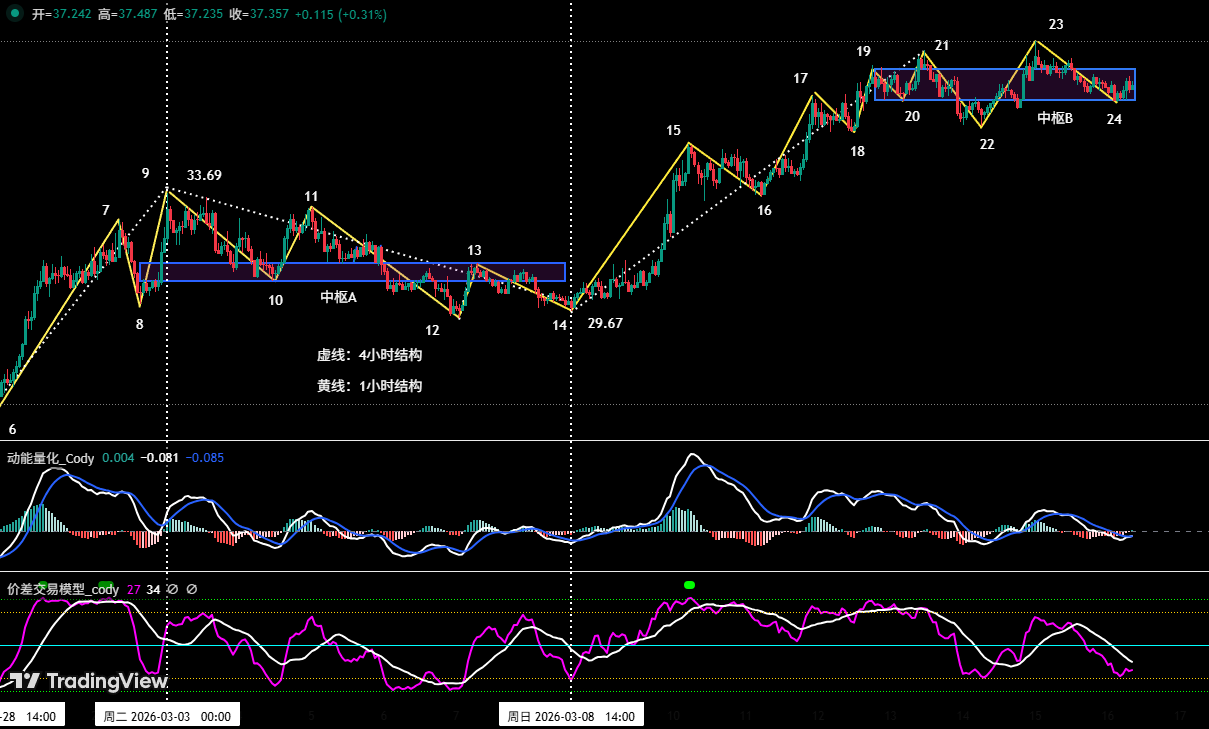
Figure 1

• HYPE Hourly Structure Review (03.02~03.08): In the Mar 9 weekly review, we considered the hourly adjustment starting Mar 2 could be divided into 5 segments: 9-10, 10-11, 11-12, 12-13, 13-14. Analysis showed a clear bottom divergence signal comparing the entry segment (9-10) and the exit segment (13-14). Therefore, we judged the high probability that the adjustment ended at endpoint 14 (approx. $29.67).

• The rise initiated from the Mar 8 low (endpoint 14) can internally be divided into a 10-segment structure from endpoint 14 to 24. These 10 segments (i.e., 14-15, 15-16, 16-17, 17-18, 18-19, 19-20, 20-21, 21-22, 22-23, 23-24) constitute an upward impulse wave. As of the time of analysis, this rising structure is still continuing.

• Central Pivot Construction: Within the latest 10-segment structure, segments 19-20, 20-21, 21-22, 22-23, 23-24 are constructing an ascending central pivot structure.

4. This Week's Core View: The current price action is within the Wave III trend. After the central pivot construction is complete, the key for subsequent movement is to observe whether the price can effectively break free from the gravitational pull of this pivot. High probability of range-bound consolidation this week.

5. HYPE Short-term Trade Review (1x Leverage): (03.09~03.15)

Last week, based on trading signals from our self-built spread trading model and momentum量化 model, combined with the anticipation of the Wave III main advance, we completed one short-term (long) operation, successfully profiting 18.44%.

Table 1

Entry Decision (See Fig. 2): This entry decision integrated triple validation from trend, structure, and量化 signals: First, judged the hourly adjustment structure had ended at endpoint 14 (~$29.67). Then, the price effectively broke above the suppression of the previous platform's upper rail (~$31.33). Simultaneously, based on bottom resonance signals from the spread量化 model and momentum量化 model, we opened a 30% long position at $31.40.

Exit Decision: Based on top resonance signals from the spread量化 model and momentum量化 model, and the price approaching the Wave I peak near $38.41, we closed the position near $37.19.

Trade Summary: This operation successfully captured the Wave III rise opportunity, profiting approximately 18.44%.

HYPE_60min K-line Chart
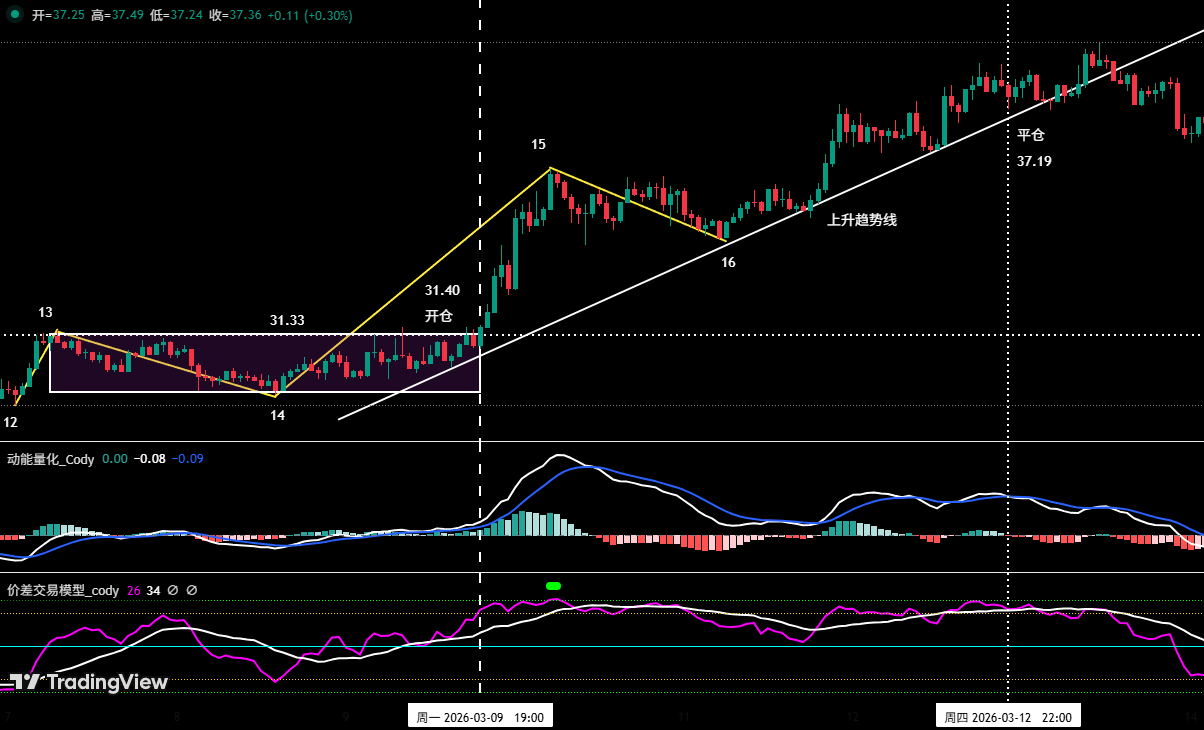
Figure 2 (Short-term Trade Illustration)

II. Bitcoin: Structure Analysis & Long/Short-term Trade Review

1. Short-term Strategy Review: (See Table 2)

Strictly following trading signals from our self-built spread trading model and momentum量化 model, combined with market outlook, we completed one short-term (short) operation last week, gaining 2.01%.

1. Bitcoin Short-term Trade Details Summary: (Leverage*1x)

Table 2

2. Short-term Trade Review: (See Fig. 3)

• Entry: The price encountered resistance near $74,500 on the bounce. Simultaneously, the spread trading model triggered a strong top warning signal (green dot in chart), and both models showed shorting resonance signals, so we established a short-term 30% short position at $72,496.

• Exit: Fell to near $70,500, and the spread trading model triggered a bottom warning signal (red dot in chart), so we closed the entire position near $71,039.

Bitcoin 30min K-line Chart: (Momentum量化 Model + Spread Trading Model)
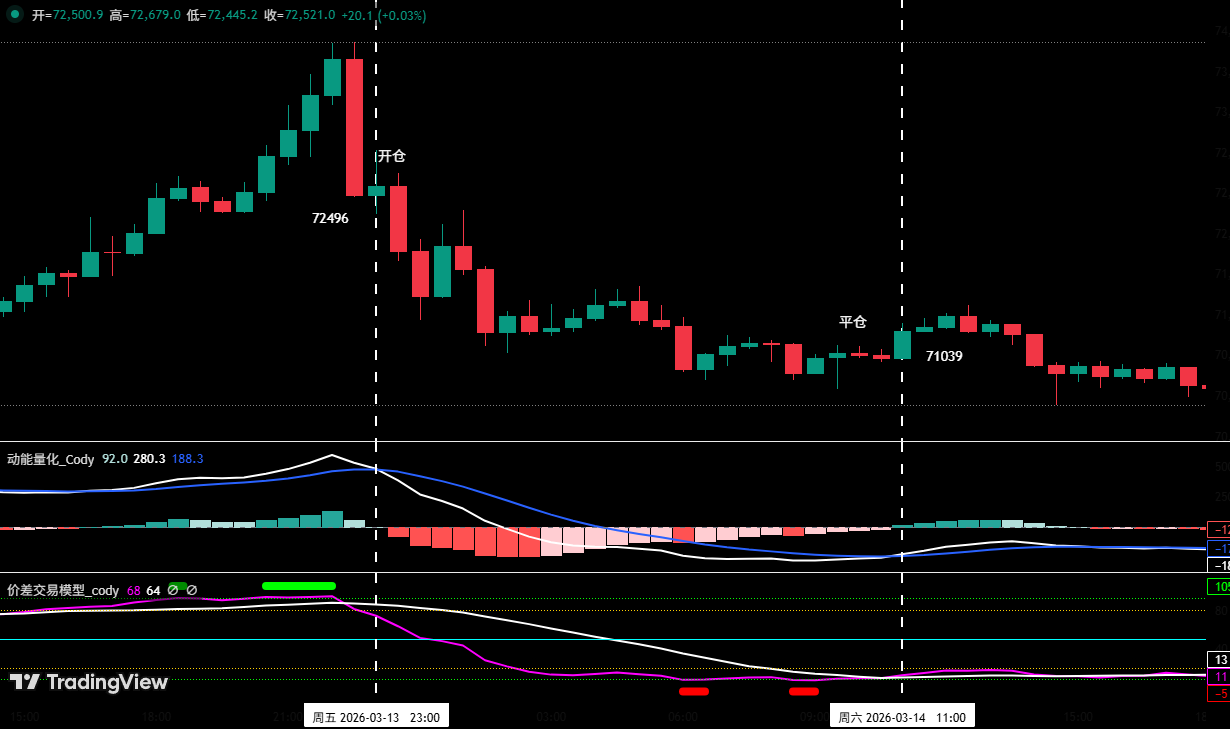
Figure 3 (Short-term Trade Illustration)

2. Medium-term Strategy Review:

Medium-term Strategy: Continue holding the 60% short position established near $89,000 (Jan 28). As of last week's post-market (closing ~$72,831), the profit is approximately 18.17%.

III. Bitcoin: Weekly, Daily Technical Indicator Analysis

Combining market movement, the author conducts a deep analysis of multiple Bitcoin technical indicators from multi-model and multi-dimensional perspectives based on a self-built trading system.

1. Analysis from the Weekly chart level, as shown in (Fig. 4):

Bitcoin Weekly K-line Chart: (Momentum量化 Model + Sentiment量化 Model)
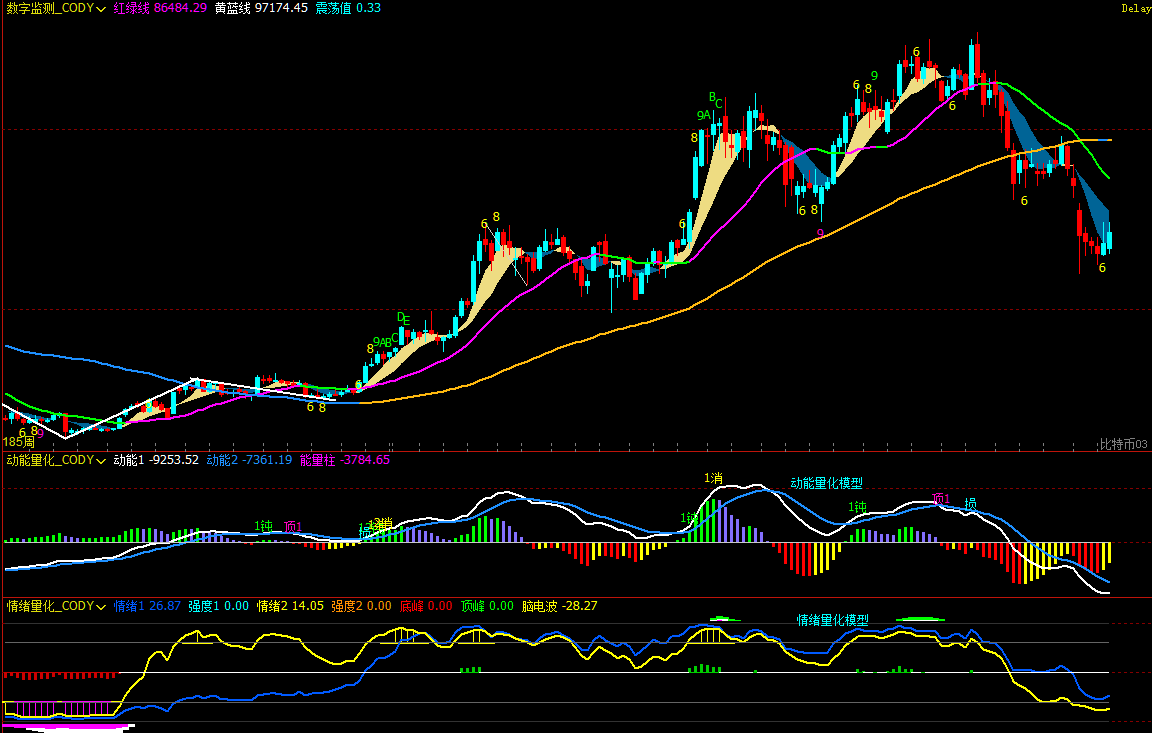
Figure 4

• Momentum量化 Model: Technical indicators show the momentum line declining同步, with the white momentum line showing signs of flattening; negative energy柱 gradually shortening, no divergence signal appeared.

• Sentiment量化 Model: Blue sentiment line value 26, strength zero; Yellow sentiment line value 13, strength zero, peak value is 0.

• Digital Monitoring Model: Moving averages show a bearish排列, last week closed with a large阳线, gain ~10.39%, price stood above the 7-week MA for the first time; bottom digital monitoring signal not present.

Comprehensive Analysis: From the data of the three models above, last week's market rebound was significant, with concentrated release of bullish momentum, multiple technical indicators repaired, oversold conditions eased. However, we believe the weekly chart bearish trend for Bitcoin has not reversed yet. Last week's large阳线 needs further observation to confirm its sustainability.

2. Analysis from the Daily chart level: As shown in (Fig. 5)

Bitcoin Daily K-line Chart: (Momentum量化 Model + Sentiment量化 Model)
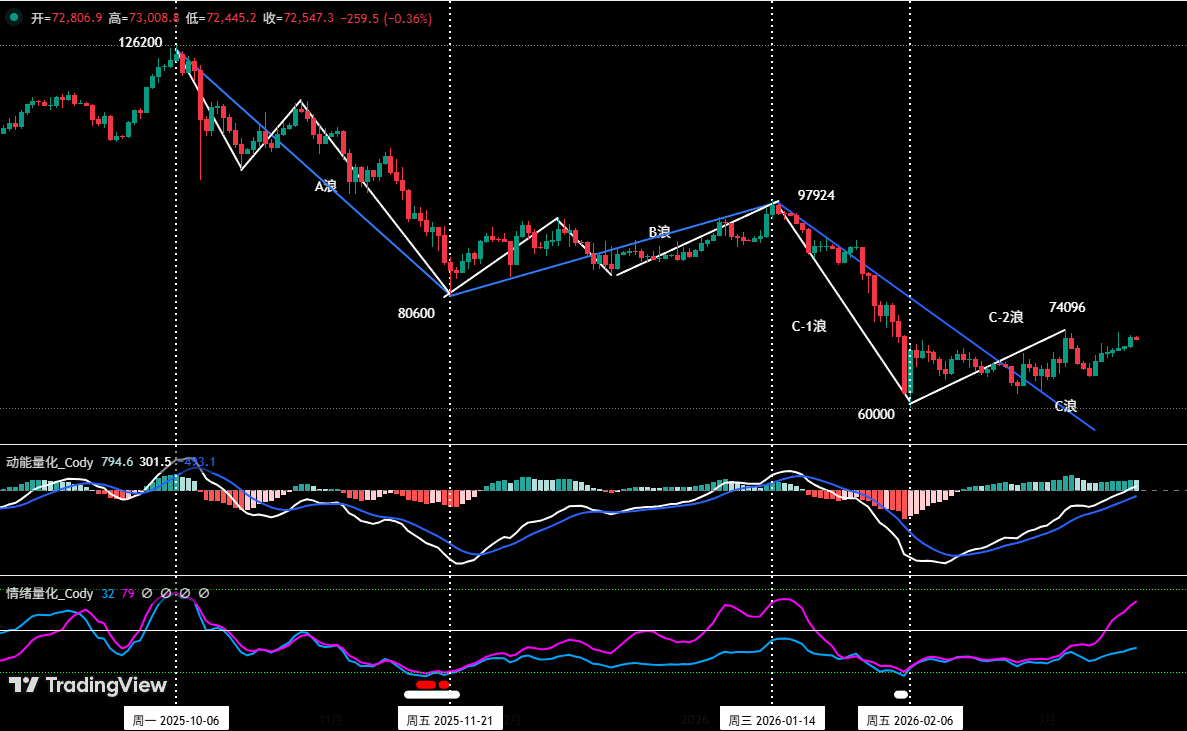
Figure 5

• Momentum量化 Model: Last week's overall showed a "震荡上行" (oscillating rise) pattern. Momentum line rose同步 below the zero axis, with the white momentum line crossing above the zero axis for the first time; positive energy柱 gradually strengthened, but weakly.

• Sentiment量化 Model: At last week's daily close, blue sentiment line value 31, strength zero; purple sentiment line value 75, strength zero, purple line rose significantly.

Comprehensive Analysis: Combining momentum量化 and sentiment量化 model analysis, we believe: Although last week's daily chart closed with 7 consecutive阳K线, showing strong short-term rebound momentum, the daily trading volume did not放大同步, the overall movement still belongs to the category of an oversold rebound, not yet breaking out of the range-bound pattern. The daily bearish trend continues. Subsequent focus should be on the battle between bulls and bears around the key demarcation line (zero axis).

IV. This Week's Market Prediction: (03.16~03.22)

1. Bitcoin Ascending Pivot Construction (Based on post-Feb 6 low price action): (Updated Weekly)

Bitcoin 4-hour K-line Chart
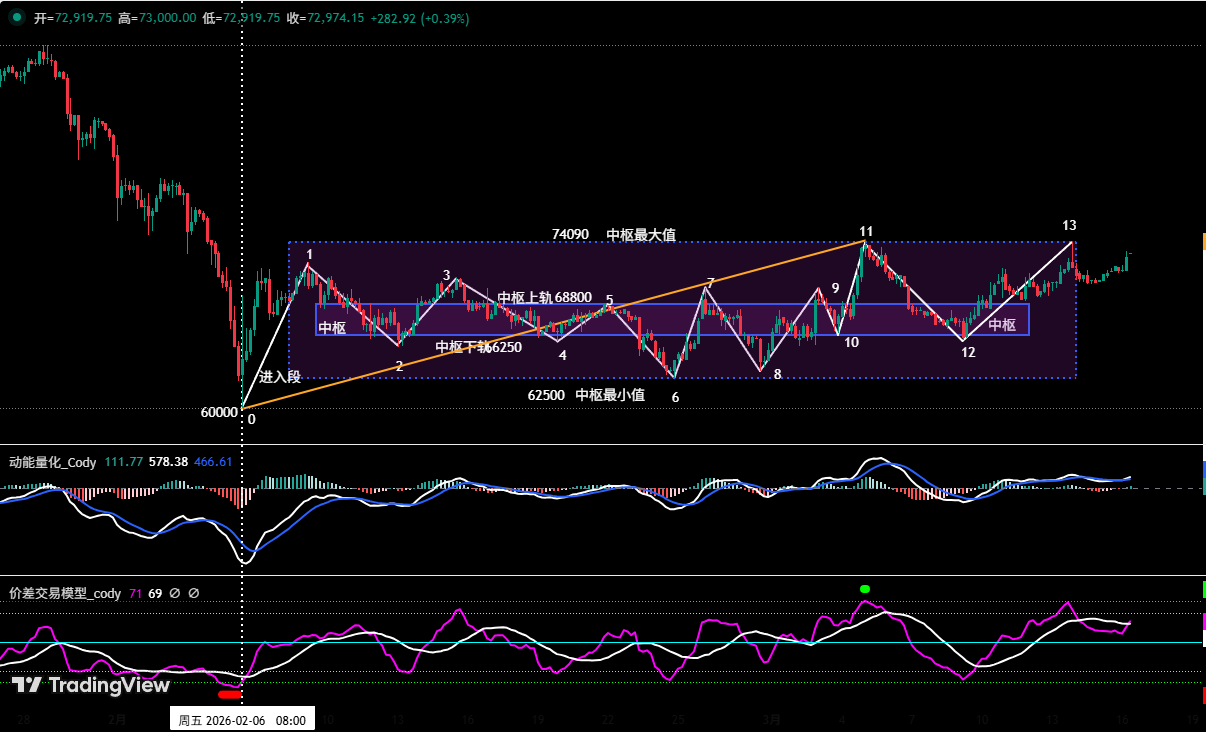
Figure 6

Using Bitcoin 4-hour as the analysis周期:

• Pivot Construction: (Fig. 6) shows: Last week mainly ran segment 12-13 structure. Currently, the ascending pivot is under construction. Its highest resistance level moved up to near $74,090, lowest support near $62,500; pivot upper rail ~$68,800, pivot lower rail ~$66,250.

2. C-2 Wave Rebound End Judgment:

• Maintain the previous core framework: The rising行情 initiated from the Feb 6 low (~$60,000) is, in nature, a C-2 wave oversold rebound within a large-degree C wave correction, to be followed by a C-3 wave corrective行情.

• Basis for C-2 Rebound End: If the price effectively breaks below the pivot lower rail support near $66,250 during adjustment, and subsequent pullback fails to reclaim this level, it constitutes a third-type selling point in Chan theory. This signal indicates strong selling momentum, likely破坏 the rebound structure, significantly increasing the possibility that the C-2 wave rebound has ended.

3. This Week's Core View: Maintain $62,500~$74,500 range-bound consolidation pattern, observe bull-bear struggle near range edges; Special attention: Price action after effectively breaking below the pivot lower rail (~$66,250). Strategically, firmly execute the principle of "reduce positions (longs) on rallies, control risk".

4. Core Resistance Levels:

• First Resistance Zone: Near $74,500 (Near previous important low)

• Second Resistance Zone: $79,500~$80,600 area (Near Nov 2025 low)

5. Core Support Levels:

• First Support: Near $65,000 (Previous important support area)

• Second Support: $60,000~$62,500 area (Feb 6 low area)

• Third Support: Near $57,400

V. This Week's Operation Strategy (Excluding Sudden News Impact): (03.16~03.22)

1. Medium-term Strategy: (See Fig. 7)

Bitcoin Daily K-line Chart: (Position Monitoring Model)
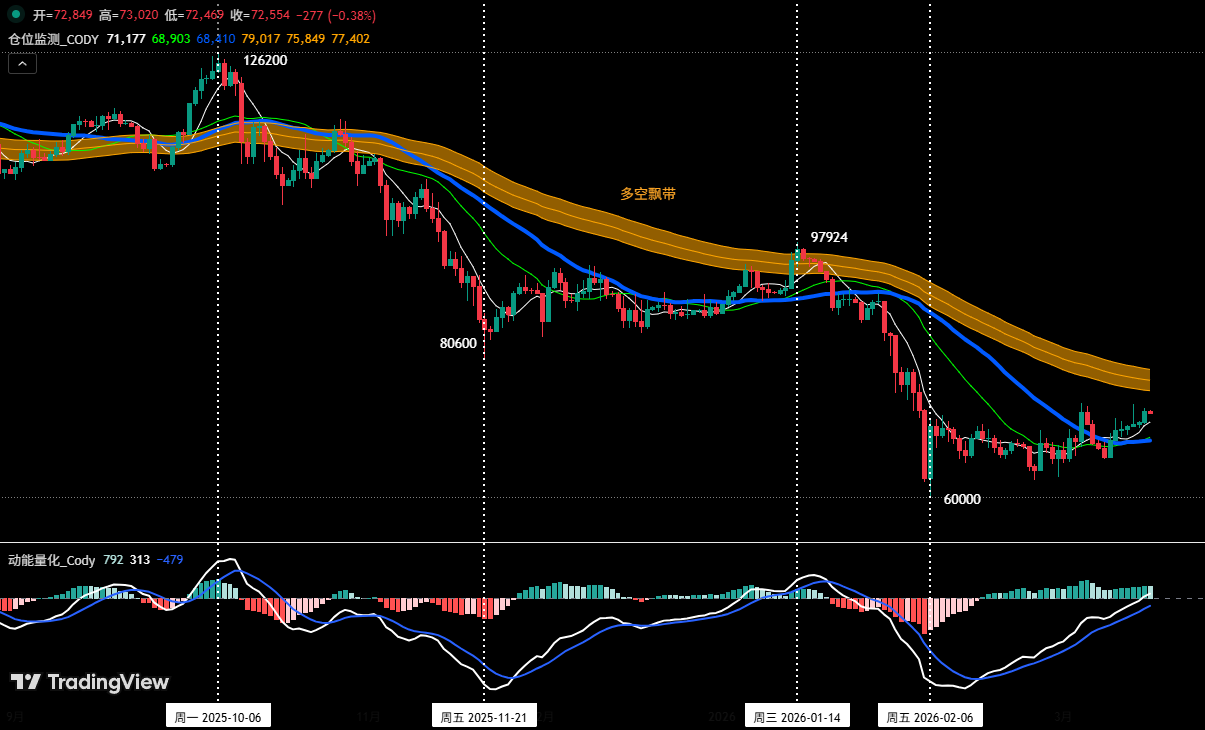
Figure 7

Position Monitoring Model: Currently price is below the Bull-Bear Ribbon (yellow), so continue holding the 60% short position established at $89,000 (Jan 28).

• If price反弹 effectively breaks above $74,500, reduce medium-term position to 40%.

• If price反弹 effectively breaks above and stabilizes above the Bull-Bear Ribbon, clear all medium-term positions.

2. Short-term Strategy: Utilize 30% position, set stop-loss, look for "spread" opportunities based on support and resistance levels. (Use 30min/60min as operation周期).

3. As the medium-term market direction is bearish, to dynamically respond to complex market changes and signals from our self-built trading model, we propose two short-term operation plans A/B:

• Plan A: Sell on rallies encountering resistance.

• Entry: When price持续反弹至 near $74,500 triggers resistance signals combined with model top signals, establish a 30% short position.

• Risk Control: Initial short stop-loss set above $76,000.

• Exit: When falling to important support levels combined with model signals, gradually close position to take profit.

• Plan B: Follow-through breakout short.

• Entry: When price effectively breaks below the pivot lower rail $66,250, then pulls back to this level but fails to hold, combined with model top signals,顺势 establish a 30% short position.

• Risk Control: Initial short stop-loss set above $67,500.

• Exit: When falling to support levels combined with model signals, gradually close position to take profit.

VI. Special Notes:

1. At entry: Immediately set initial stop-loss.

2. When profit reaches 1%: Move stop-loss to entry cost (breakeven point), ensuring principal safety.

3. When profit reaches 2%: Move stop-loss to the 1% profit level.

4. Continuous Tracking: Thereafter, for every additional 1% profit, move stop-loss同步 by 1%, dynamically protecting and locking in profits.

Financial markets change rapidly. All market analysis and trading strategies require dynamic adjustment. All views, analytical models, and operation strategies involved in this article are derived from personal technical analysis, intended solely for personal trading log purposes, and do not constitute any investment advice or operational basis. The market involves risks, investment requires caution. Do not make decisions based on this.


Perguntas relacionadas

QWhat is the overall market condition for Bitcoin according to the analysis?

AThe analysis states that Bitcoin is currently in a weak range-bound consolidation phase, with the overall structure and volume indicating that the medium-term trend has not fundamentally changed. The recent rebound is considered a technical correction within a bearish trend.

QWhat is the current wave count and status for HYPE as described in the report?

AHYPE is currently in its Wave III (main upward wave) of its Elliott Wave structure. It started from the low of $25.60 on February 24th, recently broke through the Wave I high of $38.41, and is showing a continuation of the main upward trend.

QWhat was the result of the short-term HYPE trade executed last week?

AA short-term long position on HYPE was executed with 1x leverage, resulting in a successful profit of approximately 18.44%.

QWhat are the key support and resistance levels identified for Bitcoin's price action this week?

AKey resistance levels are identified at $74,500 (near a previous important low) and the $79,500-$80,600 zone (near the November 2025 low). Key support levels are at $65,000, the $60,000-$62,500 zone (near the February 6th low), and $57,400.

QWhat is the core medium-term strategy for Bitcoin, and under what conditions would the position be reduced or closed?

AThe core medium-term strategy is to continue holding the 60% short position established near $89,000. This position would be reduced to 40% if the price effectively breaks above $74,500, and would be fully closed if the price breaks above and stabilizes above the multi-empty ribbon indicator.

Leituras Relacionadas

In-Depth Report on the On-Chain Lending Market: When Off-Chain Credit Meets On-Chain Liquidation

The on-chain lending market has evolved from a peripheral DeFi niche into core financial infrastructure. As of early 2026, total value locked (TVL) in on-chain lending protocols has reached $64.3 billion, accounting for 53.54% of total DeFi TVL, making it the largest and most mature vertical within decentralized finance. Aave dominates the sector with approximately $32.9 billion in TVL, commanding nearly half of the market—a leadership position that is unlikely to be challenged in the foreseeable future. However, the path of on-chain lending forward is not without risk. Liquidation cascades, credit defaults, and cross-chain vulnerabilities remain systemic threats hanging over the industry. At the same time, a deeper structural transformation is underway: on-chain lending is shifting from a “leverage tool for crypto-native users” to a “compliant gateway for institutional capital”. The scale of RWA (Real World Asset) lending has surpassed $18.5 billion, with U.S. Treasuries and government securities increasingly serving as core collateral. Institutional capital inflows are reshaping both the user base and risk appetite of the sector. This report systematically analyzes the evolution of on-chain lending definitions, competitive dynamics, core risks, and future trends, providing a comprehensive industry outlook for investors and trade practitioners. Key findings suggest that the “one dominant player with several strong challengers” structure will persist in the short term, while fixed-rate lending, compliant collateral, and institutional credit underwriting will define the next phase of competition. For investors focused on DeFi infrastructure, three key opportunity tracks stand out, namely, the Aave ecosystem (Morpho, Spark), RWA lending protocols (Ondo, Maple) and fixed-rate innovation (Notional, Pendle).

HTX LearnHá 36m

In-Depth Report on the On-Chain Lending Market: When Off-Chain Credit Meets On-Chain Liquidation

HTX LearnHá 36m

Fu Peng's First Public Speech in 2026: What Exactly Are Crypto Assets? Why Did I Join the Crypto Asset Industry?

Fu Peng, a renowned macroeconomist and now Chief Economist at New火 Group, delivered his first public speech of 2026 at the Hong Kong Web3 Festival. He explained his perspective on crypto assets and why he joined the industry, framing it within the context of macroeconomic trends and financial evolution. Fu emphasized that crypto assets are transitioning from an early, belief-driven phase to a mature, institutionally integrated asset class. He drew parallels to the 1970s-80s, when technological advances (like computing) revolutionized traditional finance, leading to the rise of FICC (Fixed Income, Currencies, and Commodities). Similarly, current advancements in AI, data, and blockchain are reshaping finance, with crypto assets becoming part of a new "FICC + C" (C for Crypto) framework. He noted that institutional capital, including traditional hedge funds, avoided early crypto due to its speculative nature but are now engaging as regulatory clarity emerges (e.g., stablecoin laws, CFTC classifying crypto as a commodity). Fu predicted that 2025-2026 marks a turning point where crypto becomes a standardized, financially viable asset for diversified portfolios, akin to commodities or derivatives in traditional finance. Fu defined Bitcoin not as "digital gold" in a simplistic sense but as a value-preserving, financially tradable asset. He highlighted that crypto's future lies in regulated, institutional adoption, moving away from retail-dominated trading. His entry into crypto signals this maturation, where traditional finance integrates crypto into mainstream asset management.

marsbitHá 1h

Fu Peng's First Public Speech in 2026: What Exactly Are Crypto Assets? Why Did I Join the Crypto Asset Industry?

marsbitHá 1h

Justin Sun Sues Trump Family: What $75 Million Bought Was Only a Blacklist

Justin Sun, founder of Tron, has filed a lawsuit in federal court against World Liberty Financial (WLF), alleging he was made the "primary target of a fraudulent scheme" after investing $75 million. Sun claims the investment secured him an advisor title and WLFI tokens, which were later frozen by WLF, causing "hundreds of millions in losses." The dispute began in late 2024 when Sun's investment helped revive WLF's struggling token sale, which ultimately raised $550 million. Shortly after, the SEC dropped its lawsuit against Sun following Donald Trump's inauguration. However, relations soured when Sun refused WLF's demands for additional funding. In August 2025, WLF added a "blacklist" function to its smart contract, allowing it to unilaterally freeze tokens. Sun's holdings, worth approximately $107 million, were frozen, and he was threatened with token destruction. The lawsuit highlights WLF's structure, which directs 75% of token sale profits to the Trump family, who had earned $1 billion by December 2025. WLF's CEO is Zach Witkoff, son of U.S. Middle East envoy Steve Witkoff. The project faces scrutiny for opaque operations, including a controversial loan arrangement on the Dolomite platform, co-founded by a WLF advisor. Despite Sun's history with the SEC, the case underscores centralization risks within DeFi, as WLF controls governance and holds powers to freeze assets arbitrarily. Sun's tokens remain frozen as legal proceedings begin.

marsbitHá 1h

Justin Sun Sues Trump Family: What $75 Million Bought Was Only a Blacklist

marsbitHá 1h

Trading

Spot
Futuros

Artigos em Destaque

O que é $S$

Compreender o SPERO: Uma Visão Abrangente Introdução ao SPERO À medida que o panorama da inovação continua a evoluir, o surgimento de tecnologias web3 e projetos de criptomoeda desempenha um papel fundamental na formação do futuro digital. Um projeto que tem atraído atenção neste campo dinâmico é o SPERO, denotado como SPERO,$$s$. Este artigo tem como objetivo reunir e apresentar informações detalhadas sobre o SPERO, para ajudar entusiastas e investidores a compreender as suas bases, objetivos e inovações nos domínios web3 e cripto. O que é o SPERO,$$s$? O SPERO,$$s$ é um projeto único dentro do espaço cripto que procura aproveitar os princípios da descentralização e da tecnologia blockchain para criar um ecossistema que promove o envolvimento, a utilidade e a inclusão financeira. O projeto é concebido para facilitar interações peer-to-peer de novas maneiras, proporcionando aos utilizadores soluções e serviços financeiros inovadores. No seu núcleo, o SPERO,$$s$ visa capacitar indivíduos ao fornecer ferramentas e plataformas que melhoram a experiência do utilizador no espaço das criptomoedas. Isso inclui a possibilidade de métodos de transação mais flexíveis, a promoção de iniciativas impulsionadas pela comunidade e a criação de caminhos para oportunidades financeiras através de aplicações descentralizadas (dApps). A visão subjacente do SPERO,$$s$ gira em torno da inclusão, visando fechar lacunas dentro das finanças tradicionais enquanto aproveita os benefícios da tecnologia blockchain. Quem é o Criador do SPERO,$$s$? A identidade do criador do SPERO,$$s$ permanece algo obscura, uma vez que existem recursos publicamente disponíveis limitados que fornecem informações detalhadas sobre o(s) seu(s) fundador(es). Esta falta de transparência pode resultar do compromisso do projeto com a descentralização—uma ética que muitos projetos web3 partilham, priorizando contribuições coletivas em vez de reconhecimento individual. Ao centrar as discussões em torno da comunidade e dos seus objetivos coletivos, o SPERO,$$s$ incorpora a essência do empoderamento sem destacar indivíduos específicos. Assim, compreender a ética e a missão do SPERO é mais importante do que identificar um criador singular. Quem são os Investidores do SPERO,$$s$? O SPERO,$$s$ é apoiado por uma diversidade de investidores que vão desde capitalistas de risco a investidores-anjo dedicados a promover a inovação no setor cripto. O foco desses investidores geralmente alinha-se com a missão do SPERO—priorizando projetos que prometem avanço tecnológico social, inclusão financeira e governança descentralizada. Essas fundações de investidores estão tipicamente interessadas em projetos que não apenas oferecem produtos inovadores, mas que também contribuem positivamente para a comunidade blockchain e os seus ecossistemas. O apoio desses investidores reforça o SPERO,$$s$ como um concorrente notável no domínio em rápida evolução dos projetos cripto. Como Funciona o SPERO,$$s$? O SPERO,$$s$ emprega uma estrutura multifacetada que o distingue de projetos de criptomoeda convencionais. Aqui estão algumas das características-chave que sublinham a sua singularidade e inovação: Governança Descentralizada: O SPERO,$$s$ integra modelos de governança descentralizada, capacitando os utilizadores a participar ativamente nos processos de tomada de decisão sobre o futuro do projeto. Esta abordagem promove um sentido de propriedade e responsabilidade entre os membros da comunidade. Utilidade do Token: O SPERO,$$s$ utiliza o seu próprio token de criptomoeda, concebido para servir várias funções dentro do ecossistema. Esses tokens permitem transações, recompensas e a facilitação de serviços oferecidos na plataforma, melhorando o envolvimento e a utilidade gerais. Arquitetura em Camadas: A arquitetura técnica do SPERO,$$s$ suporta modularidade e escalabilidade, permitindo a integração contínua de funcionalidades e aplicações adicionais à medida que o projeto evolui. Esta adaptabilidade é fundamental para manter a relevância no panorama cripto em constante mudança. Envolvimento da Comunidade: O projeto enfatiza iniciativas impulsionadas pela comunidade, empregando mecanismos que incentivam a colaboração e o feedback. Ao nutrir uma comunidade forte, o SPERO,$$s$ pode melhor atender às necessidades dos utilizadores e adaptar-se às tendências do mercado. Foco na Inclusão: Ao oferecer taxas de transação baixas e interfaces amigáveis, o SPERO,$$s$ visa atrair uma base de utilizadores diversificada, incluindo indivíduos que anteriormente podem não ter participado no espaço cripto. Este compromisso com a inclusão alinha-se com a sua missão abrangente de empoderamento através da acessibilidade. Cronologia do SPERO,$$s$ Compreender a história de um projeto fornece insights cruciais sobre a sua trajetória de desenvolvimento e marcos. Abaixo está uma cronologia sugerida que mapeia eventos significativos na evolução do SPERO,$$s$: Fase de Conceituação e Ideação: As ideias iniciais que formam a base do SPERO,$$s$ foram concebidas, alinhando-se de perto com os princípios de descentralização e foco na comunidade dentro da indústria blockchain. Lançamento do Whitepaper do Projeto: Após a fase conceitual, um whitepaper abrangente detalhando a visão, os objetivos e a infraestrutura tecnológica do SPERO,$$s$ foi lançado para atrair o interesse e o feedback da comunidade. Construção da Comunidade e Primeiros Envolvimentos: Esforços ativos de divulgação foram feitos para construir uma comunidade de primeiros adotantes e investidores potenciais, facilitando discussões em torno dos objetivos do projeto e angariando apoio. Evento de Geração de Tokens: O SPERO,$$s$ realizou um evento de geração de tokens (TGE) para distribuir os seus tokens nativos a apoiantes iniciais e estabelecer liquidez inicial dentro do ecossistema. Lançamento da dApp Inicial: A primeira aplicação descentralizada (dApp) associada ao SPERO,$$s$ foi lançada, permitindo que os utilizadores interagissem com as funcionalidades principais da plataforma. Desenvolvimento Contínuo e Parcerias: Atualizações e melhorias contínuas nas ofertas do projeto, incluindo parcerias estratégicas com outros players no espaço blockchain, moldaram o SPERO,$$s$ em um jogador competitivo e em evolução no mercado cripto. Conclusão O SPERO,$$s$ é um testemunho do potencial do web3 e das criptomoedas para revolucionar os sistemas financeiros e capacitar indivíduos. Com um compromisso com a governança descentralizada, o envolvimento da comunidade e funcionalidades inovadoras, abre caminho para um panorama financeiro mais inclusivo. Como em qualquer investimento no espaço cripto em rápida evolução, potenciais investidores e utilizadores são incentivados a pesquisar minuciosamente e a envolver-se de forma ponderada com os desenvolvimentos em curso dentro do SPERO,$$s$. O projeto demonstra o espírito inovador da indústria cripto, convidando a uma exploração mais aprofundada das suas inúmeras possibilidades. Embora a jornada do SPERO,$$s$ ainda esteja a desenrolar-se, os seus princípios fundamentais podem, de facto, influenciar o futuro de como interagimos com a tecnologia, as finanças e uns com os outros em ecossistemas digitais interconectados.

69 Visualizações TotaisPublicado em {updateTime}Atualizado em 2024.12.17

O que é $S$

O que é AGENT S

Agent S: O Futuro da Interação Autónoma no Web3 Introdução No panorama em constante evolução do Web3 e das criptomoedas, as inovações estão constantemente a redefinir a forma como os indivíduos interagem com plataformas digitais. Um projeto pioneiro, o Agent S, promete revolucionar a interação humano-computador através do seu framework aberto e agente. Ao abrir caminho para interações autónomas, o Agent S visa simplificar tarefas complexas, oferecendo aplicações transformadoras em inteligência artificial (IA). Esta exploração detalhada irá aprofundar-se nas complexidades do projeto, nas suas características únicas e nas implicações para o domínio das criptomoedas. O que é o Agent S? O Agent S é um framework aberto e agente, especificamente concebido para abordar três desafios fundamentais na automação de tarefas computacionais: Aquisição de Conhecimento Específico de Domínio: O framework aprende inteligentemente a partir de várias fontes de conhecimento externas e experiências internas. Esta abordagem dupla capacita-o a construir um rico repositório de conhecimento específico de domínio, melhorando o seu desempenho na execução de tarefas. Planeamento ao Longo de Longos Horizontes de Tarefas: O Agent S emprega planeamento hierárquico aumentado por experiência, uma abordagem estratégica que facilita a decomposição e execução eficientes de tarefas intrincadas. Esta característica melhora significativamente a sua capacidade de gerir múltiplas subtarefas de forma eficiente e eficaz. Gestão de Interfaces Dinâmicas e Não Uniformes: O projeto introduz a Interface Agente-Computador (ACI), uma solução inovadora que melhora a interação entre agentes e utilizadores. Utilizando Modelos de Linguagem Multimodais de Grande Escala (MLLMs), o Agent S pode navegar e manipular diversas interfaces gráficas de utilizador de forma fluida. Através destas características pioneiras, o Agent S fornece um framework robusto que aborda as complexidades envolvidas na automação da interação humana com máquinas, preparando o terreno para uma infinidade de aplicações em IA e além. Quem é o Criador do Agent S? Embora o conceito de Agent S seja fundamentalmente inovador, informações específicas sobre o seu criador permanecem elusivas. O criador é atualmente desconhecido, o que destaca ou o estágio nascente do projeto ou a escolha estratégica de manter os membros fundadores em anonimato. Independentemente da anonimidade, o foco permanece nas capacidades e no potencial do framework. Quem são os Investidores do Agent S? Como o Agent S é relativamente novo no ecossistema criptográfico, informações detalhadas sobre os seus investidores e financiadores não estão explicitamente documentadas. A falta de informações disponíveis publicamente sobre as fundações de investimento ou organizações que apoiam o projeto levanta questões sobre a sua estrutura de financiamento e roteiro de desenvolvimento. Compreender o apoio é crucial para avaliar a sustentabilidade do projeto e o seu impacto potencial no mercado. Como Funciona o Agent S? No núcleo do Agent S reside uma tecnologia de ponta que lhe permite funcionar eficazmente em diversos ambientes. O seu modelo operacional é construído em torno de várias características-chave: Interação Humano-Computador Semelhante: O framework oferece planeamento avançado em IA, esforçando-se para tornar as interações com computadores mais intuitivas. Ao imitar o comportamento humano na execução de tarefas, promete elevar as experiências dos utilizadores. Memória Narrativa: Utilizada para aproveitar experiências de alto nível, o Agent S utiliza memória narrativa para acompanhar os históricos de tarefas, melhorando assim os seus processos de tomada de decisão. Memória Episódica: Esta característica fornece aos utilizadores orientações passo a passo, permitindo que o framework ofereça suporte contextual à medida que as tarefas se desenrolam. Suporte para OpenACI: Com a capacidade de funcionar localmente, o Agent S permite que os utilizadores mantenham o controlo sobre as suas interações e fluxos de trabalho, alinhando-se com a ética descentralizada do Web3. Fácil Integração com APIs Externas: A sua versatilidade e compatibilidade com várias plataformas de IA garantem que o Agent S possa integrar-se perfeitamente em ecossistemas tecnológicos existentes, tornando-o uma escolha apelativa para desenvolvedores e organizações. Estas funcionalidades contribuem coletivamente para a posição única do Agent S no espaço cripto, à medida que automatiza tarefas complexas e em múltiplos passos com mínima intervenção humana. À medida que o projeto evolui, as suas potenciais aplicações no Web3 podem redefinir a forma como as interações digitais se desenrolam. Cronologia do Agent S O desenvolvimento e os marcos do Agent S podem ser encapsulados numa cronologia que destaca os seus eventos significativos: 27 de Setembro de 2024: O conceito de Agent S foi lançado num artigo de pesquisa abrangente intitulado “Um Framework Agente Aberto que Usa Computadores como um Humano”, mostrando a base para o projeto. 10 de Outubro de 2024: O artigo de pesquisa foi disponibilizado publicamente no arXiv, oferecendo uma exploração aprofundada do framework e da sua avaliação de desempenho com base no benchmark OSWorld. 12 de Outubro de 2024: Uma apresentação em vídeo foi lançada, proporcionando uma visão visual das capacidades e características do Agent S, envolvendo ainda mais potenciais utilizadores e investidores. Estes marcos na cronologia não apenas ilustram o progresso do Agent S, mas também indicam o seu compromisso com a transparência e o envolvimento da comunidade. Pontos-Chave Sobre o Agent S À medida que o framework Agent S continua a evoluir, várias características-chave destacam-se, sublinhando a sua natureza inovadora e potencial: Framework Inovador: Concebido para proporcionar um uso intuitivo de computadores semelhante à interação humana, o Agent S traz uma abordagem nova à automação de tarefas. Interação Autónoma: A capacidade de interagir autonomamente com computadores através de GUI significa um avanço em direção a soluções computacionais mais inteligentes e eficientes. Automação de Tarefas Complexas: Com a sua metodologia robusta, pode automatizar tarefas complexas e em múltiplos passos, tornando os processos mais rápidos e menos propensos a erros. Melhoria Contínua: Os mecanismos de aprendizagem permitem que o Agent S melhore a partir de experiências passadas, aprimorando continuamente o seu desempenho e eficácia. Versatilidade: A sua adaptabilidade em diferentes ambientes operacionais, como OSWorld e WindowsAgentArena, garante que pode servir uma ampla gama de aplicações. À medida que o Agent S se posiciona no panorama do Web3 e das criptomoedas, o seu potencial para melhorar as capacidades de interação e automatizar processos significa um avanço significativo nas tecnologias de IA. Através do seu framework inovador, o Agent S exemplifica o futuro das interações digitais, prometendo uma experiência mais fluida e eficiente para os utilizadores em diversas indústrias. Conclusão O Agent S representa um ousado avanço na união da IA e do Web3, com a capacidade de redefinir a forma como interagimos com a tecnologia. Embora ainda esteja nas suas fases iniciais, as possibilidades para a sua aplicação são vastas e cativantes. Através do seu framework abrangente que aborda desafios críticos, o Agent S visa trazer interações autónomas para o primeiro plano da experiência digital. À medida que avançamos mais profundamente nos domínios das criptomoedas e da descentralização, projetos como o Agent S desempenharão, sem dúvida, um papel crucial na formação do futuro da tecnologia e da colaboração humano-computador.

529 Visualizações TotaisPublicado em {updateTime}Atualizado em 2025.01.14

O que é AGENT S

Como comprar S

Bem-vindo à HTX.com!Tornámos a compra de Sonic (S) simples e conveniente.Segue o nosso guia passo a passo para iniciar a tua jornada no mundo das criptos.Passo 1: cria a tua conta HTXUtiliza o teu e-mail ou número de telefone para te inscreveres numa conta gratuita na HTX.Desfruta de um processo de inscrição sem complicações e desbloqueia todas as funcionalidades.Obter a minha contaPasso 2: vai para Comprar Cripto e escolhe o teu método de pagamentoCartão de crédito/débito: usa o teu visa ou mastercard para comprar Sonic (S) instantaneamente.Saldo: usa os fundos da tua conta HTX para transacionar sem problemas.Terceiros: adicionamos métodos de pagamento populares, como Google Pay e Apple Pay, para aumentar a conveniência.P2P: transaciona diretamente com outros utilizadores na HTX.Mercado de balcão (OTC): oferecemos serviços personalizados e taxas de câmbio competitivas para os traders.Passo 3: armazena teu Sonic (S)Depois de comprar o teu Sonic (S), armazena-o na tua conta HTX.Alternativamente, podes enviá-lo para outro lugar através de transferência blockchain ou usá-lo para transacionar outras criptomoedas.Passo 4: transaciona Sonic (S)Transaciona facilmente Sonic (S) no mercado à vista da HTX.Acede simplesmente à tua conta, seleciona o teu par de trading, executa as tuas transações e monitoriza em tempo real.Oferecemos uma experiência de fácil utilização tanto para principiantes como para traders experientes.

984 Visualizações TotaisPublicado em {updateTime}Atualizado em 2025.03.21

Como comprar S

Discussões

Bem-vindo à Comunidade HTX. Aqui, pode manter-se informado sobre os mais recentes desenvolvimentos da plataforma e obter acesso a análises profissionais de mercado. As opiniões dos utilizadores sobre o preço de S (S) são apresentadas abaixo.

活动图片