British Money Laundering Case: Chinese Tycoon Spends $100 Million on WLFI Tokens, $75 Million Flows into Trump Family Entities

marsbitPublicado em 2026-08-11Última atualização em 2026-08-11

Resumo

NYT investigation reveals that the biggest single public investment of $100 million into the Trump-linked crypto project World Liberty Financial (WLFI) came from Guren "Bobby" Zhou, a businessman under a UK money laundering probe. The June 2025 purchase, made via the UAE-registered fund Aqua 1, resulted in up to $75 million flowing to the Trump family entity DT Marks DEFI LLC per WLFI's revenue-sharing model. Blockchain analysis traced the $100 million purchase through two wallets linked to Zhou-controlled entities. UK authorities confirmed the ongoing investigation into Zhou as of July 2026; he has not been formally charged. Zhou has a history of failed business ventures, including a bankrupt retail firm and a nearly worthless crypto token. Compliance experts flagged multiple "red flags," including Zhou's background and the transaction's size, noting the heightened scrutiny required for deals involving politically exposed persons like the Trump family. The report follows congressional scrutiny over other major foreign investments into WLFI, including a $500 million commitment from an Abu Dhabi fund. WLFI stated it complies with all laws but did not comment on whether it knew the source of Zhou's funds.

Author: Claude, Deep Chao TechFlow

Deep Chao Introduction: The New York Times disclosed on August 10 that the $100 million governance token purchase order received by the Trump family crypto project World Liberty Financial (WLFI) came from a buyer linked to British money laundering suspect Guren "Bobby" Zhou. The transaction was completed in June 2025 through the UAE-registered fund Aqua 1. Under WLFI's revenue-sharing structure, up to $75 million flowed into the entity DT Marks DEFI LLC, controlled by Trump and his three sons. As of late July 2026, the British authorities' money laundering investigation into Zhou remains ongoing, and Zhou has not been formally charged.

A New York Times investigation published on the 10th has placed the Trump family crypto project World Liberty Financial (WLFI) in the spotlight. The report identifies that the funds for WLFI's largest-ever publicly disclosed token purchase, $100 million, originated from businessman Guren "Bobby" Zhou, who is under investigation for money laundering by British authorities. The transaction, completed in June 2025 through the UAE-registered fund Aqua 1, made Zhou the single largest publicly known investor in WLFI with his purchase of $100 million worth of WLFI governance tokens.

Guren Zhou, commonly known as Bobby Zhou, was arrested in the UK in March 2021 on suspicion of money laundering. British officials confirmed to The New York Times that as of late July 2026, the investigation remains active. Zhou himself has not been formally charged, and he did not respond to requests for comment on the report.

Two Wallets Purchased in Batches, On-Chain Path Points to Same Controller

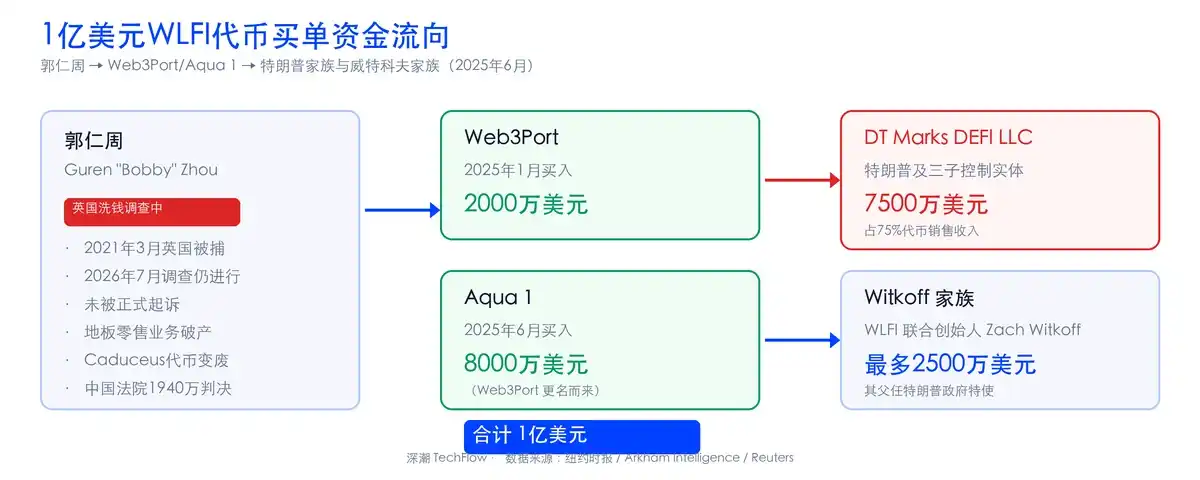
This is not Zhou's first involvement with WLFI. Blockchain analytics firm Arkham Intelligence tracked on-chain records showing the $100 million purchase was completed in two parts: in January 2025, a wallet controlled by Web3Port purchased $20 million worth of WLFI; in June 2025, another wallet believed to be controlled by Aqua 1 purchased $80 million worth, totaling $100 million.

The link between Web3Port and Aqua 1 was established by The New York Times after reviewing corporate filings. A Web3Port entity registered in the British Virgin Islands later changed its name to Aqua 1 GP Limited. Approximately two weeks after this name change, Aqua 1 announced the $100 million WLFI purchase order. Aqua 1 had previously publicly denied any connection to Web3Port but did not specify which part of the reporting was inaccurate. Web3Port had earlier announced a $10 million investment in WLFI shortly after Trump's inauguration in January 2025.

$75 Million Diverted to Trump Family Entity

Under WLFI's revenue-sharing arrangement, up to $75 million from the $100 million purchase—or 75% of the token sale proceeds—flowed to DT Marks DEFI LLC, an entity controlled by Trump and his three sons. The transaction also benefited the family of WLFI co-founder Zach Witkoff, whose father, Steve Witkoff, currently serves as an envoy for the Trump administration.

Trump's latest financial disclosure shows he received over $65.6 million from the sale of WLF Holdco equity and $236.25 million from WLFI token sale distributions. Eric Trump had met with Guren Zhou in Dubai to discuss this investment, which Zhou later described as "participating in the Trump family's crypto project."
Guren Zhou's String of Failures: Flooring Retailer Bankruptcy, Crypto Tokens Turned Worthless

The source of Zhou's funds remains unclear, and The New York Times stated it could not confirm the ultimate origin of the $100 million. The report detailed Zhou's past business ventures in the UK, all of which ended in failure.

Zhou once operated a UK flooring retailer that entered administration without repaying approximately $5 million owed to his father's company. He subsequently moved into the crypto space, launching the Caduceus project, which raised about $7.6 million but whose tokens became nearly worthless by 2024. Caduceus had claimed support from China Merchants Securities UK and the Bin Zayed Group, founded by a member of the Abu Dhabi royal family. Both institutions told The New York Times that these claims were "unauthorized and substantively false."

In 2024, Zhou relocated from London to Abu Dhabi and became associated with Web3Port and later Aqua 1, propelling these entities into the ranks of WLFI's major token buyers. Chinese courts have also issued civil judgments against Zhou totaling approximately 19.4 million yuan (about $2.4 million) for unpaid loans.

Compliance Expert Flags Red Flags, Retired NATO General Refuses Dialogue

Patrick Prinz, COO of crypto crime investigation firm Recoveris, told The New York Times that Zhou's profile should have triggered anti-money laundering (AML) documentation requirements before WLFI accepted the funds. He listed red flags including Zhou's multiple business failures, his ability to suddenly access large sums of money, the transaction size, and the ongoing investigation, stating that the combination of these four factors reached the threshold for AML reporting.

International AML rules classify Trump and his family as "Politically Exposed Persons" (PEPs). Prinz noted that this status should trigger the highest level of scrutiny within the financial system.

Zhou used the WLFI investment as a credential, displaying photos of Trump and his sons in meetings in Dubai and Abu Dhabi, and touting Aqua 1 as the "largest investor with provable credibility" in WLFI. Retired Supreme Allied Commander Europe of NATO, Wesley Clark, told The New York Times that his team conducted a background check on Zhou after being approached by his representatives for an event and subsequently withdrew from dialogue. Clark's team informed Zhou's representatives: "We're not talking to you."

Congressional Scrutiny Escalates, $500 Million Abu Dhabi Investment Already Under Senatorial Scrutiny

Aqua 1 is not the only WLFI overseas funding source drawing scrutiny. In June 2026, five Democratic senators sent a letter to Republican committee leaders requesting a hearing on the $500 million investment in WLFI by Abu Dhabi investment company Aryam Investment 1. Aryam is backed by UAE National Security Advisor Sheikh Tahnoon bin Zayed Al Nahyan.

In the letter, the senators cited a Wall Street Journal report questioning whether the investment involved potential conflicts between foreign financial interests and the Trump administration. White House spokeswoman Anna Kelly reiterated that Trump has no conflicts of interest. WLFI spokesman David Wachsman stated that the company complies with all applicable laws and maintains a compliance program that "meets or exceeds industry standards." He declined to say whether WLFI knew the source of Zhou's funds.

Following the NYT report, the WLFI token was quoted at $0.05295, largely flat on the day, but its 24-hour trading volume jumped 57%. Regarding court cases, criminal proceedings against two of Zhou's employees are scheduled for trial in 2028, with one defendant having pleaded guilty.

Perguntas relacionadas

QWho is identified as the buyer behind the $100 million purchase of WLFI tokens, and what is his legal status according to the article?

AThe buyer is identified as Guren 'Bobby' Zhou, a Chinese businessman. According to the article, he is a suspect under investigation for money laundering by British authorities as of late July 2026, but he has not been formally charged.

QHow much of the $100 million from the WLFI token purchase is structured to flow to an entity controlled by Donald Trump and his three sons?

AAccording to WLFI's revenue-sharing structure, up to $75 million (75%) of the $100 million token purchase is directed to the entity DT Marks DEFI LLC, which is controlled by Donald Trump and his three sons.

QWhat are the two wallet entities involved in the $100 million WLFI purchase, and what evidence links them together?

AThe two wallet entities are Web3Port and Aqua 1. The article cites a corporate filing showing that a British Virgin Islands entity owned by Web3Port later changed its name to Aqua 1 GP Limited. This name change occurred roughly two weeks before Aqua 1 announced its $100 million WLFI purchase, establishing a link between them.

QAccording to the compliance expert cited, what four 'red flags' should have triggered anti-money laundering checks regarding Guren Zhou's investment?

APatrick Prinz, COO of Recoveris, listed four red flags: 1) Zhou's history of multiple business failures, 2) his sudden ability to access large sums of money, 3) the size of the transaction, and 4) the fact that he was under an active investigation. The combination of these factors should have triggered enhanced due diligence.

QWhat other major foreign investment in WLFI has drawn scrutiny from U.S. lawmakers, and who is behind it?

AA $500 million investment from the Abu Dhabi-based firm Aryam Investment 1 has drawn scrutiny. The investment is backed by Sheikh Tahnoon bin Zayed Al Nahyan, the United Arab Emirates' national security adviser. Five Democratic senators have requested a hearing regarding this investment.

Leituras Relacionadas

Podcast Notes | VanEck Digital Asset Research Head: Current AI Infrastructure Rally Not a Bubble; Crypto Market Quiet Due to Institutional Disappointment in L1s

In this podcast, VanEck's Head of Digital Asset Research Matthew Sigel discusses the current market dynamics. He argues the ongoing AI infrastructure boom is not a bubble, contrasting it with the 19th-century railroad mania. Unlike railroads funded by speculative land grants and government bonds, today's AI data centers are backed by long-term private contracts and significant customer prepayments, making the investment cycle more sustainable. Sigel notes a recent market shift: companies with high capital expenditures (capex) were rewarded in early 2024 but are now being punished. Cryptocurrencies, categorized as software assets, have suffered alongside the broader software sector. His NODE ETF has outperformed Bitcoin by nearly 100 percentage points over 15 months, largely by betting on Bitcoin miners transitioning into AI data centers. He highlights the value of miners' key assets—power and land—and their new ability to fund growth through debt instead of diluting shareholders. Regarding the crypto market's weakness, Sigel points to institutional disappointment with major Layer-1 (L1) blockchains like Ethereum and Solana. Post-election rallies lacked breakout applications, and regulated entities are increasingly building their own private, permissioned chains (e.g., by Circle, Stripe, Wells Fargo), diluting the "winner-takes-all" potential of public L1s. He believes a regulatory catalyst like the CLARITY Act, which would enforce disclosure standards, could trigger a significant relief rally for some tokens, but remains cautious until then. He also views proposals by ETH, Solana, and NEAR to reduce token inflation as a positive, necessary adjustment for the maturing sector.

marsbitHá 7m

Podcast Notes | VanEck Digital Asset Research Head: Current AI Infrastructure Rally Not a Bubble; Crypto Market Quiet Due to Institutional Disappointment in L1s

marsbitHá 7m

Shenzhen Competing for 'Tsinghua Faction' Talent

Shenzhen is actively attracting Tsinghua University-affiliated technology ventures, as highlighted during the "X-Day" Xili Lake Roadshow held in Nanshan. The event featured six startup projects from Tsinghua alumni, spanning semiconductors, AI, materials, and healthcare. The showcased companies include: Zhichen Semiconductor, developing edge AI chips; Guangsu Evolution, creating AI-powered home security systems; Qingli Technology, commercializing "self-superlubricating" technology; Shu Yu Technology, offering an AI Agent for analog chip design; Heyi Intelligent Control, providing AI-driven building management systems; and Shengshengyi, applying AI to assisted reproductive medicine. These ventures represent a trend of deep-tech innovation closely linked to academic research. The roadshow series, initiated a year ago, underscores a strategic shift in Shenzhen's investment landscape. Venture capital is moving earlier into the innovation cycle, seeking projects directly from laboratories and research papers. Tsinghua University serves as a key source for such early-stage, technology-intensive startups. Over the past two years, Tsinghua alumni projects have accounted for nearly 30% of the approximately 280 billion RMB in early-stage deep-tech funding in Shenzhen. The "X-Day" platform has facilitated significant growth. To date, its 19 roadshows have connected companies with investors thousands of times, leading to over 3.3 billion RMB in equity financing for 58 firms. Past participants like Kuaiwei Intelligent (recently valued over 10 billion RMB after a Series B round) and Lingcifang (securing four funding rounds in 18 months) exemplify the successful trajectory from this ecosystem. The activity underscores Shenzhen's, particularly Nanshan District's, role in bridging academic research from institutions like Tsinghua with industrial application and venture capital.

marsbitHá 8m

Shenzhen Competing for 'Tsinghua Faction' Talent

marsbitHá 8m

Trading

Spot
活动图片