BP Price Soars 300% in 2 Weeks: What Is Backpack Betting On?

Foresight NewsPublicado em 2026-06-15Última atualização em 2026-06-15

Resumo

"BP, the native token of the Backpack exchange, surged over 300% in two weeks to $0.475, driven by the launch of its new regulated stock brokerage and asset tokenization arm, Backpack Securities. The platform enables users to trade U.S. stocks and tokenize them on Solana, with the SpaceX tokenized stock (SPCX) generating significant on-chain volume. This expansion into bridging traditional finance with DeFi aligns with the RWA narrative. BP's unique tokenomics, where 25% was airdropped at TGE with zero allocation to the team, and a staking mechanism allowing conversion to equity upon a company IPO, underpins its value proposition. Over 66% of the circulating supply is currently staked."


Author: Ma He, Foresight News


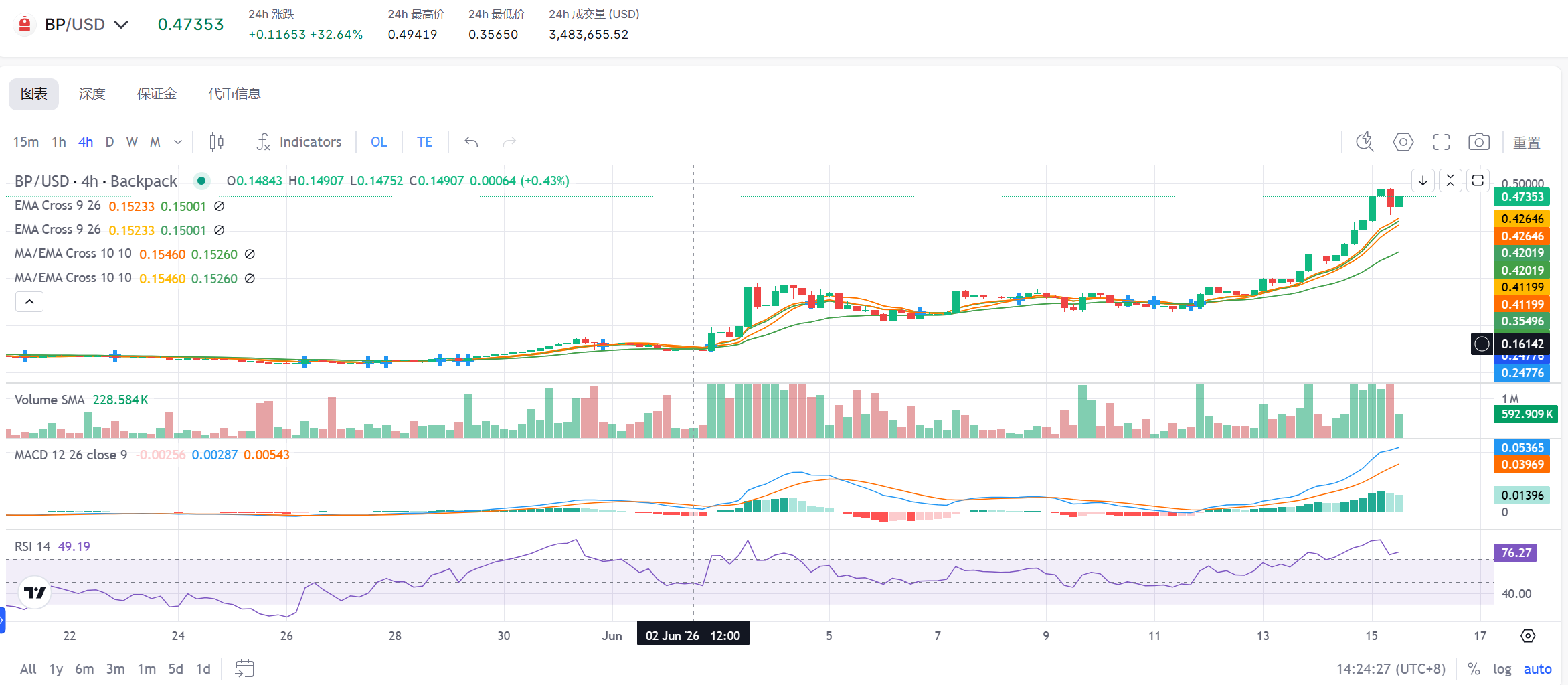
On June 15, the exchange token of Backpack, BP, surged over 30% again within 24 hours, currently quoted at $0.475, with a market cap of $118.48 million and an FDV of $473.94 million. BP has skyrocketed significantly from around $0.16 in early June this year, peaking above $0.48.


The immediate driving force behind this rally comes from the platform's latest breakthrough in traditional U.S. stock brokerage and asset tokenization services.


Entering U.S. Stock Brokerage and Tokenization Business


In March 2026, BP completed its TGE on Solana, with a total supply of 1 billion tokens and an initial circulating supply of 250 million. After listing, the price briefly hit a high before quickly retracing, with a single-day maximum drop exceeding 40%, filling the market with profit-taking pressure. For several weeks thereafter, the price consolidated at lower levels until the turn-around in early June.


On June 2, Backpack announced the launch of the Backpack Securities platform, which will offer regulated U.S. stock brokerage services while also supporting the tokenization of traditional stocks for circulation on the blockchain, enabling seamless conversion between traditional securities and on-chain assets. The brokerage services are planned for a gradual rollout in June, with initial tokenized products launched on the Solana ecosystem through a partnership with Sunrise. BP surged over 80% in a single day, rapidly climbing from the $0.14-0.15 range to around $0.27, with its market cap approaching $70 million at one point.


On June 12, the same day SpaceX listed on NASDAQ, its tokenized product SPCX went live on Solana. BP subsequently rose approximately 27% within the next 24 hours, reaching above $0.347. This token is pegged 1:1 to real SpaceX shares, supports 24/7 on-chain trading, and can be redeemed to a traditional securities account via Backpack's brokerage account, achieving interoperability between on-chain and off-chain assets. On its first day, the product generated approximately $35-38 million in on-chain trading volume across DEXs like Jupiter and Raydium. According to the latest official data, the total on-chain trading volume for SPCX exceeded $86 million.
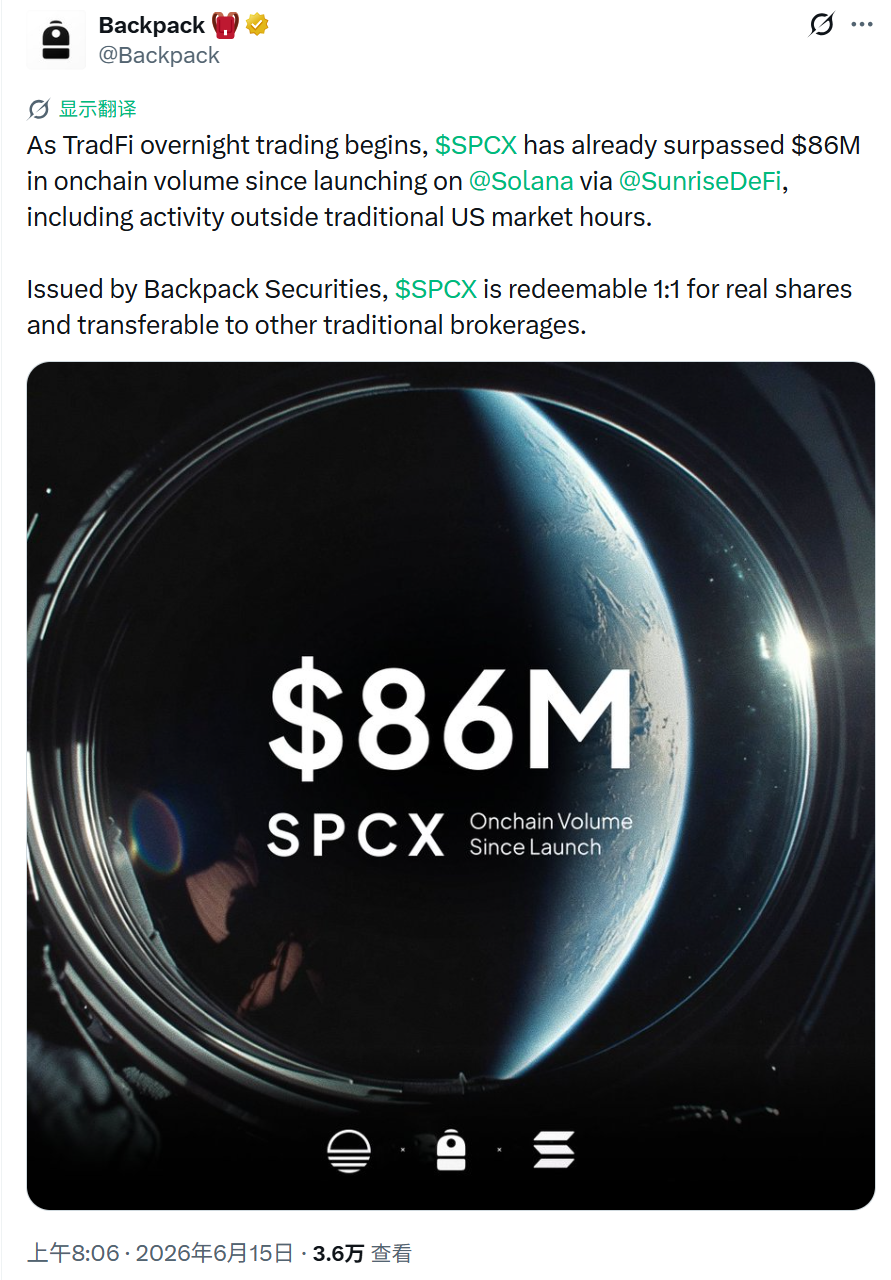


Backpack is building a bridge between traditional U.S. stocks and Solana DeFi. Users can not only trade crypto assets on the platform but also access real stocks through the same account, and tokenize some of those assets for on-chain use, trading, or composability. This path aligns well with the current RWA narrative and has also provided the BP token with clearer use cases and demand support.
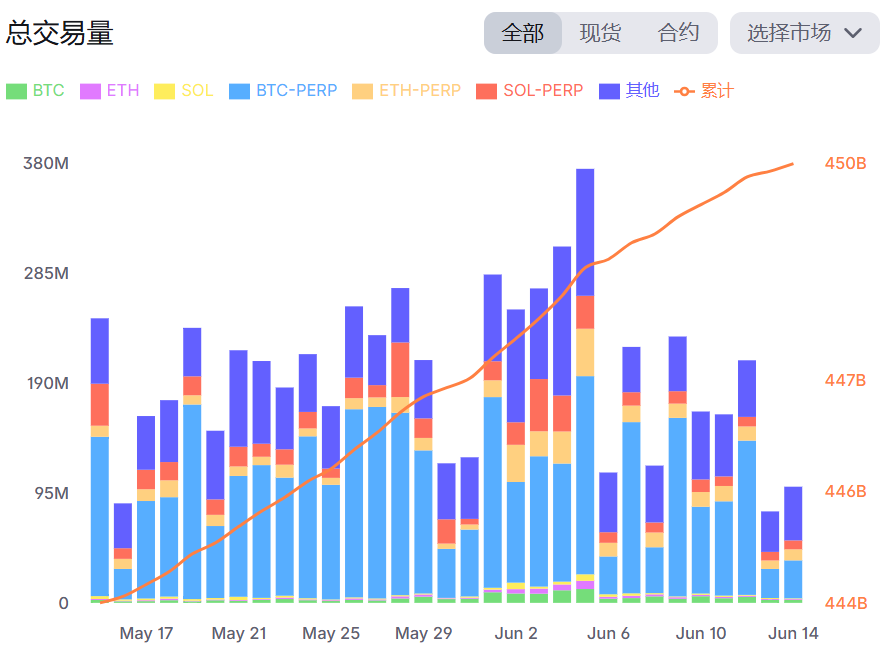


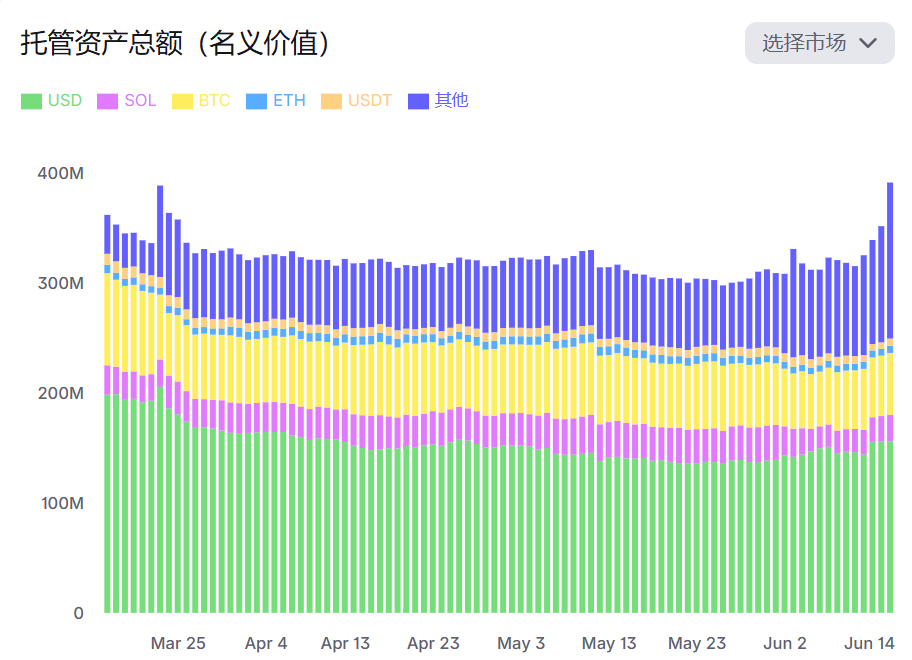
BP's rise this round stems more from the substantial expansion of the platform's business rather than short-term hype. Currently, its official website shows that Backpack's Total Custodied Assets (nominal value) has rebounded to $390 million.

Team Receives Zero Tokens Unless the Company Goes Public


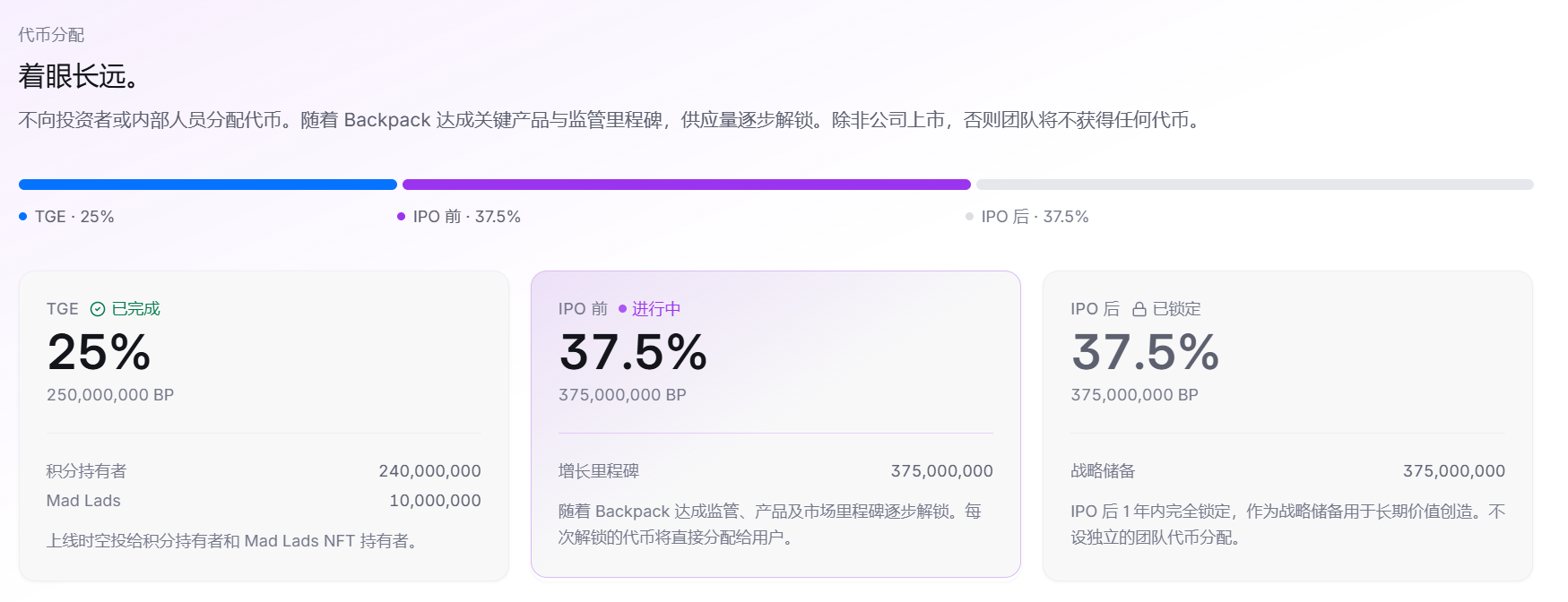
Supporting the development of the above business is the BP token and its unique economic structure launched by Backpack as early as March. The total supply of 1 billion tokens is divided into three phases: The TGE phase allocates 25% (250 million tokens) entirely to community users via airdrop, with approximately 240 million given to Points Program participants and 10 million to Mad Lads NFT holders. At launch, the team, founders, and investors received zero token allocation; The Pre-IPO phase allocates 37.5%, tied to growth triggers like regulatory milestones and product launches, and continues distribution to users upon unlocking; The Post-IPO phase allocates 37.5% to the company treasury, locked for at least one year post-IPO, with the team benefiting only through equity, not directly from tokens.


The most notable mechanism is the equity conversion design: Users staking BP for at least 1 year gain the right to convert their tokens into company equity upon an IPO or acquisition, with the base unlock bonus increasing with holding time up to the 4th year.


Additionally, staking grants benefits such as tiered trading fee discounts, extra yield on USD collateral, free wire transfers, and priority access to the Backpack Card. Currently, about 66% (approximately 165 million tokens) of the circulating supply is staked.


Although the airdrop process was technically smooth, it sparked community discussion. Supporters argued that the "no insider TGE allocation" model was quite radical, and the points system genuinely rewarded trading and ecosystem participation; criticism centered on the relatively strict Sybil filtering mechanism, which led to some long-term users having their points invalidated and receiving less than expected, as well as noticeable profit-taking during the post-listing price correction. CEO Armani Ferrante publicly denied allegations related to team OTC selling.


These controversies affected market sentiment in the short term, but as real products like Backpack Securities land, the focus is gradually shifting from distribution details to the platform's long-term growth and the token's actual utility. Against the backdrop of the platform's expansion into U.S. stock brokerage and tokenization services, the long-term alignment value of BP's staking and equity mechanisms is being re-examined.


Perguntas relacionadas

QWhat is the primary driver behind the recent surge in Backpack Exchange's BP token price?

AThe primary driver behind the recent surge in BP token price is the platform's expansion into traditional U.S. stock brokerage and asset tokenization services, particularly the launch of Backpack Securities and the tokenization of SpaceX shares (SPCX).

QWhat key feature of the BP token's economic structure aims to align long-term user and platform interests?

AA key feature is the equity conversion design: users who stake BP for at least one year gain the right to convert their tokens into company equity during an IPO or acquisition, with the conversion bonus increasing up to the fourth year of staking.

QWhat was a significant immediate market reaction following the launch of the tokenized SpaceX (SPCX) product?

AA significant immediate market reaction was that BP's price rose approximately 27% within 24 hours after the SPCX tokenized product launched on Solana on June 12, coinciding with SpaceX's Nasdaq IPO.

QAccording to the article, what portion of the initially circulating BP token supply was allocated to the team, founders, and investors at TGE (Token Generation Event)?

AAccording to the article, 0% of the BP tokens were allocated to the team, founders, and investors at the TGE. The entire initial circulating supply of 250 million tokens (25% of total supply) was airdropped to the community.

QWhat is the total supply of BP tokens and what percentage is designated for the 'Post-IPO' stage to be held in the company treasury?

AThe total supply of BP tokens is 1 billion. 37.5% of the total supply is designated for the 'Post-IPO' stage and will enter the company treasury, locked for at least one year after an IPO.

Leituras Relacionadas

Blockchain Has Finally Started to Sail into the Mainstream After 18 Years

Blockchain Finds Its True Path After 18 Years: Becoming the Financial Backbone for AI Agents and Autonomy This analysis explores a pivotal shift in the blockchain and crypto investment landscape, driven by the dominance of AI. Major venture capital firms, including Variant, Paradigm, Haun Ventures, and YZi Labs, are moving beyond pure "crypto" investment theses. They are expanding their focus to AI, robotics, and frontier tech, signaling that blockchain is no longer seen as a standalone sector but as an underlying infrastructure layer. The core argument is that blockchain's killer application may not be user-facing apps, but rather providing the economic rails for the coming wave of AI agents, autonomous robots, and automated systems. Key capabilities like self-custody wallets, programmable stablecoins for micropayments, on-chain identity, and verifiable smart contracts are positioned as essential for a future where machines conduct economic activity. The recent $1.4 billion investment by Tether (via its venture arm) in German robotics company NEURA Robotics exemplifies this, aiming to embed Tether's wallet tools directly into robots for autonomous transactions. While many "AI + Crypto" projects remain superficial, the article concludes that true value lies where crypto is a necessary component—enabling machine-to-machine payments, agent autonomy, verifiable data provenance, and open financial settlement for the AI era. For crypto venture capital, this convergence with AI represents both an adaptation to shifting capital flows and a potential path to unlocking the large-scale, non-speculative utility the industry has long sought.

marsbitHá 4m

Blockchain Has Finally Started to Sail into the Mainstream After 18 Years

marsbitHá 4m

Blockchain has finally begun sailing toward the main channel after 18 years

After 18 years of development, blockchain technology is beginning to move from a specialized niche into mainstream adoption, according to a recent industry analysis. The shift is reflected in the changing strategies of major crypto venture capital firms, which are expanding their focus beyond pure "digital ownership" towards broader themes like "autonomy." The report highlights that leading VC firms like Variant, Paradigm, Haun Ventures, and YZi Labs are broadening their investment mandates to include not only crypto but also artificial intelligence (AI), robotics, biotech, and other frontier technologies. This reflects a recognition that the isolated "crypto investment" narrative is losing appeal to limited partners (LPs) as capital and attention increasingly flow toward AI and other high-growth tech sectors. A key emerging thesis is that blockchain's most significant future application may not be as a consumer-facing product, but as the underlying economic and settlement infrastructure for the AI era. As AI agents and autonomous systems become more prevalent, they will require programmable, global, and low-cost payment networks (like stablecoins), verifiable digital identities, and secure wallets to manage transactions and assets on behalf of users. The investment by stablecoin issuer Tether into robotics company NEURA, with plans to integrate its wallet technology, is cited as a prime example of this convergence. However, the article cautions that simply labeling projects as "AI + Crypto" is insufficient. True value lies in integrations where blockchain technology is essential—such as enabling machine-to-machine micropayments, verifiable data provenance for AI, or transparent governance for autonomous organizations—rather than being a superficial marketing add-on. In conclusion, while AI currently dominates the tech narrative and capital flows, it may ultimately create the real-world, high-frequency demand that the crypto industry has long sought. For crypto VCs and projects, the path forward is to position blockchain not as a competing sector, but as a critical foundational layer powering autonomy and economic activity in an AI-driven future.

链捕手Há 10m

Blockchain has finally begun sailing toward the main channel after 18 years

链捕手Há 10m

Y Combinator Co-founder: How to Make a Billion Dollars?

The Y Combinator co-founder argues that becoming a billionaire by founding a successful startup is not only possible but demonstrably achievable without unfair or unethical practices. He disputes a politician's claim to the contrary, using the example of a founder whose company grew at 93% monthly solely through creating a product users loved and recommended. The core mechanism is exponential growth. A conservative 15% monthly growth rate compounds to a 4384x increase over five years, which can easily lead to billion-dollar valuations and founder wealth. The process depends on two key variables: the growth rate and the duration it can be sustained. A high growth rate stems from a great product that users naturally promote, while a long duration requires a large enough market. For aspiring founders, especially young ones, the simplest path is to build something they and their friends genuinely need. Young people's current needs often predict future mass-market trends. He advises against actively "searching" for ideas, as this tends to filter out unconventional but promising ones. Instead, inspiration should come from working on interesting projects with friends, as many iconic companies (e.g., Apple, Facebook) started this way. Ultimately, building a massively valuable startup is not about exploitation but empathy: deeply understanding a user group and building a product that significantly improves their lives. This, powered by exponential growth in a large market, is the legitimate path to immense wealth creation.

Foresight NewsHá 13m

Y Combinator Co-founder: How to Make a Billion Dollars?

Foresight NewsHá 13m

The 800V Voltage Standard Championed by Nvidia: Which Infrastructure Providers Stand to Benefit?

NVIDIA is actively promoting the 800VDC architecture as a key direction for its next-generation AI factories and high-power racks, particularly for the upcoming Rubin and Kyber platforms. The primary driver is the rapidly increasing power density of AI racks, with designs like GB200/GB300 NVL72 reaching 120-140kW and future systems potentially hitting 180-220kW. At such high power levels, traditional low-voltage power delivery becomes inefficient due to massive current, leading to significant copper use, cable bulk, heat, and power loss. The 800VDC standard aims to increase efficiency by transmitting power at higher voltage and lower current to the rack before stepping it down locally for GPUs. NVIDIA claims this can improve efficiency by up to 5%, reduce total cost of ownership (TCO) by up to 30%, and cut copper usage by approximately 45%. This shift redefines infrastructure roles, pushing power engineering to the forefront alongside GPU performance. Key beneficiaries and ecosystem partners highlighted include: 1. **Power Infrastructure Providers:** Companies like Vertiv, Schneider Electric, Delta Electronics (台达电), and Korean firms LS Electric and HD Hyundai Electric are involved in designing next-gen AI factory power distribution, rack power supplies, and backup systems. 2. **Power Semiconductors:** Suppliers of SiC/GaN devices, such as Infineon and STMicroelectronics, are better suited for high-voltage, high-efficiency conversion in this new architecture. 3. **Connectivity & Structure:** The focus shifts to high-reliability components like busbars, high-voltage connectors, and advanced PCBs that meet stricter insulation and safety requirements. 4. **Liquid Cooling & Rack ODM:** As power and heat density rise, liquid cooling becomes critical. Full-rack system integrators (e.g., Dell, Wiwynn, Wistron) must now demonstrate robust pre-delivery testing capabilities, including burn-in testing under full load, requiring significant power and cooling infrastructure in their factories. The transition is not immediate for all data centers but is targeted at high-density AI factories. NVIDIA’s 800VDC ecosystem is in a preparatory phase, with full-scale production expected to align with the 2027 launch of Kyber rack-scale systems. The investment thesis revolves around which companies can demonstrate proven product integration, customer validation, and reliable delivery of complete, high-power AI rack systems, making power, cooling, and testing capabilities new critical variables in the AI infrastructure value chain alongside GPUs.

marsbitHá 33m

The 800V Voltage Standard Championed by Nvidia: Which Infrastructure Providers Stand to Benefit?

marsbitHá 33m

Did 'Unlimited Minting' Actually Happen? Zcash Founder Responds to Four Major Market Concerns

The Orchard shielding pool in the privacy cryptocurrency Zcash was recently found to have contained a critical counterfeiting vulnerability that existed for four years. This discovery caused significant market panic and a sharp drop in the price of ZEC, though it has since recovered partially. Zcash founder Zooko Wilcox addressed four key questions raised by the vulnerability. First, while it's unknown if the bug was exploited, he believes it likely was not, citing advanced, targeted discovery methods, a rapid response to freeze the pool, and the typical "smash-and-grab" nature of past crypto exploits. Second, he states that if no exploitation occurred, all legitimate user funds in Orchard are recoverable. However, cautious users moving funds should be aware of privacy trade-offs and other risks involved in transferring to transparent or Sapling pools. Third, users currently cannot independently verify that the total ZEC supply hasn't been inflated due to this bug. However, the proposed "Ironwood" network upgrade will restore this ability by permanently sealing the Orchard pool. This will prevent any counterfeit funds from circulating and allow anyone running a node to cryptographically verify that the supply cap has not been breached. Finally, regarding other undiscovered vulnerabilities, Wilcox notes that intensive ongoing audits by multiple teams, including using advanced AI-assisted tools, have so far found no other counterfeiting bugs. This provides increased, though not absolute, confidence. In conclusion, while assessments suggest the bug was likely unused and funds are safe, the core issue was the loss of user-verifiable supply integrity. The Ironwood upgrade is presented as the solution, aiming to restore trust by allowing users to independently verify Zcash's supply security without relying on third-party assurances.

marsbitHá 34m

Did 'Unlimited Minting' Actually Happen? Zcash Founder Responds to Four Major Market Concerns

marsbitHá 34m

Trading

Spot
Futuros
活动图片