Probability of Fed Rate Hike Surges After Warsh Issues 'Hawkish' Warning

cryptonews.ruPublicado em 2026-07-30Última atualização em 2026-07-30

Resumo

The probability of a Fed rate hike has surged following hawkish comments from Chairman Kevin Warsh. At its latest meeting, the Federal Open Market Committee voted 9-3 to hold rates steady. Warsh emphasized the committee's singular commitment to 2% inflation, signaling no softening of its stance. Markets reacted by pricing in a higher chance of a September hike. The CME FedWatch Tool now sees a 61.4% probability of a 25-basis-point increase. Prediction markets from Kalshi and Polymarket show similar odds. Warsh highlighted two key developments since the last meeting: a significant rise in Treasury yields, which tightens financial conditions, and persistent business investment in AI, which complicates the inflation outlook by boosting demand for expensive infrastructure. Stock markets initially sold off sharply post-announcement but partially recovered the next day, led by tech. Bitcoin traded in a narrow range above $64,000. The next FOMC decision is on September 16, with incoming data on inflation, employment, and consumer spending set to be crucial. Warsh concluded that policy is shifting away from predictable signals toward a more data-dependent approach.

The Federal Open Market Committee voted 9-3 to keep the target range unchanged. Federal Reserve Chairman Kevin Warsh addressed the dissent during the post-meeting press conference, making clear the Committee aims to reinforce its commitment to price stability, not soften its stance.

"There is no soft inflation target, there is no soft implicit target — not at least while this Committee is at the helm," Warsh told reporters. The Fed Chair added:

"There is only one target, and it is 2 percent."

Markets Price in September Rate Hike

Rate expectations shifted almost immediately after the meeting: traders on the three largest exchanges now lean toward a hike occurring in September. This reaction follows a familiar pattern. When the Fed makes a 'hawkish' hold decision rather than a 'dovish' pause, markets often spend more time reevaluating the next meeting than reacting to the current one.

The CME Fedwatch Tool now prices a 61.4% chance of a 25 basis point hike, which would raise the target range to 3.75%–4.00% on September 16; a month ago, that probability was 50.6%. Expectations for a larger 50 basis point hike have vanished entirely, down from 25% a week prior to 0.0%, while the probability of a rate cut is zero.
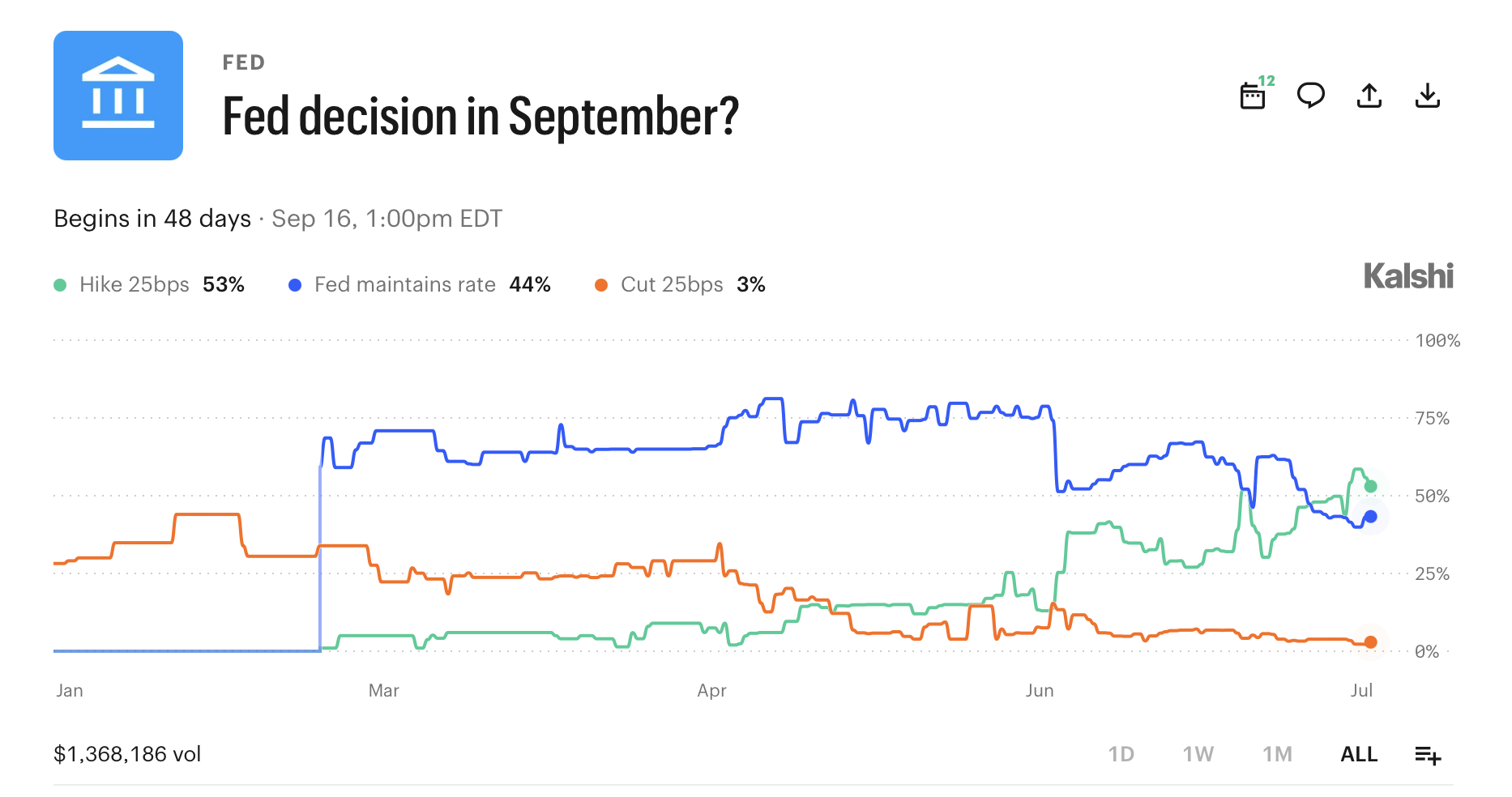
Kalshi market data on the Fed's interest rate decision for September, recorded on July 30, 2026.

Prediction markets paint a similar picture. Traders on Kalshi price a 53% chance of a 25 basis point hike versus 44% for holding rates steady, with trading volume exceeding $1.36 million. On Polymarket, where trading volume surpassed $8 million, betting participants price a 52% chance of a hike compared to 46% for maintaining the current rate.

While each platform arrives at these conclusions differently, all three are reacting to the same signals: inflation hasn't cooled enough to satisfy policymakers, and Warsh's remarks leave little doubt that the Committee remains focused on restoring credibility, not preparing markets for policy easing.

Warsh Highlights Treasury Yields, AI Spending

Warsh began by highlighting two developments that stood out particularly over the 42 days since the Committee's last meeting.

The first was the shift in Treasury yields. Sharp rises in both nominal and real yields tend to tighten financial conditions even before the Fed changes rates, making it an important signal policymakers watch closely. The U.S. central bank chief described the increase as "among the most significant in the past two decades" and partly attributed it to the Fed stepping back from detailed forward guidance, telling reporters markets were "learning to play ball, not umpire."

The second factor concerned business investment. Spending related to artificial intelligence (AI) is becoming harder to separate from broader capital expenditure trends, as large-scale infrastructure projects simultaneously impact manufacturing, semiconductors, power demand, and construction. Warsh noted that investment in AI equipment and software has risen almost 20% over the past four quarters, supporting industrial output but also complicating the inflation picture as these same expenditures boost demand for costly equipment and infrastructure.

Warsh said the Committee devoted much of its meeting to discussing four practical questions: how five years of above-target inflation should influence today's monetary policy decisions; how various economic shocks affect employment and growth; whether AI-driven capital expenditures represent temporary price pressure or a broader inflation risk; and to what extent monetary policy easing is still provided by the Fed's balance sheet, separate from interest rate policy.

Stocks Recover, Bitcoin Stabilizes

On Wednesday, markets parsed the Fed statement, then shifted direction the following day. This sequence is typical following major policy announcements, especially when investors first react to headlines before reassessing the overall tone of the press conference.

Wednesday's sell-off marked the Dow Jones Industrial Average's sharpest one-day drop in roughly 15 months, with the index falling about 2.2%. The S&P 500 declined about 1.5%, and the Nasdaq Composite dropped about 1.7%. During Wednesday's session, the U.S. stock market shed $1.2 trillion in value.

By midday Thursday, buyers returned to the market. The Dow Jones recovered about 0.6%, trading near 51,900. The S&P 500 gained roughly 1% to 1.2%, and the Nasdaq rose 1.5%–2.4% on the back of better-than-expected results from Microsoft's Azure cloud segment. Meta shares lagged amid tempered forecasts, and rising long-term Treasury yields — with 30-year bonds nearing multi-year highs — continued to cap overall optimism.

Bitcoin traded in a relatively narrow range throughout the session, holding above $64,000 with a slight upward bias. Price action remained orderly despite 24-hour trading volume exceeding $20 billion, suggesting market participants preferred to await additional macroeconomic data rather than take aggressive positions immediately following the Fed meeting. Such consolidation often follows a sharp move, especially after Bitcoin pulled back from highs near $66,000 in early July.

What Comes Next

The next Fed monetary policy decision will occur on September 16, giving officials roughly seven weeks to study additional inflation, employment, and consumer spending data before voting again. Historically, when the Committee is split, incoming economic reports carry even greater weight, as they can rapidly shift internal consensus.

Concluding, Warsh emphasized the Committee is moving away from predictable policy signals and toward decisions more driven by incoming data and internal debates regarding inflation, supply-side pressures, and AI-related investment.

For investors, the gap between the Fed's official decision and market expectations will remain the dominant theme heading into September. If inflation remains stubbornly high and long-term bond yields stay elevated, a quarter-percentage-point hike will no longer be a surprise. Instead, it will be the next step in a policy course markets have already begun to price in.

end-content

Perguntas relacionadas

QWhat was the outcome of the Federal Open Market Committee's vote on interest rates?

AThe Federal Open Market Committee voted 9 to 3 to keep the target range for the federal funds rate unchanged.

QAccording to market data from CME Fedwatch, what is the probability of a 25-basis-point rate hike in September?

AAccording to the CME Fedwatch Tool, the probability of a 25-basis-point rate hike in September is now 61.4%.

QWhat two events did Fed Chairman Kevin Warsh highlight as significant since the last Committee meeting?

AFed Chairman Kevin Warsh highlighted two significant events: a major shift in Treasury yields, which he called one of the most significant in two decades, and the difficulty of separating business investments related to artificial intelligence (AI) from broader capital expenditure trends.

QHow did major US stock indices perform on the day following the Fed's policy announcement?

AOn the day following the announcement, the Dow Jones Industrial Average recovered roughly 0.6%, the S&P 500 gained approximately 1% to 1.2%, and the Nasdaq Composite rose between 1.5% and 2.4%.

QWhat is the next date for a Federal Reserve monetary policy decision, and what will officials focus on before then?

AThe next Federal Reserve monetary policy decision is scheduled for September 16. Officials will use the roughly seven weeks to study additional data on inflation, employment, and consumer spending before the next vote.

Leituras Relacionadas

The Turning Point of the AI Bull Market: Leverage Blow-ups, Overcapacity in Compute, Why This Macro Analyst is Fully Bearish

AI Bull Market Reaches Inflection Point: Analyst Turns Bearish Due to Leverage, Chinese Competition, and Overcapacity Fidenza Macro analyst Geo Chen explains his decision to sell all AI semiconductor and infrastructure holdings in June, offering a comprehensive bearish thesis. He argues the AI-driven bull market has peaked, citing several key factors. First, unsustainable buying pressure: a massive influx of "low-quality" capital from Korean retail investors using highly leveraged ETFs on stocks like SK Hynix created a parabolic, fragile rally. Recent liquidations have wiped out billions and impacted over a million accounts, removing a key market driver. Second, a competitive threat: the rapid rise of powerful, cost-effective open-source AI models from China, such as MoonShot AI's Kimi K3 and Alibaba's Qwen 3.8, is commoditizing intelligence. This undermines the pricing power and high-valuation financing prospects of closed-source leaders like OpenAI and Anthropic, potentially creating a "single point of failure" for the ecosystem. Third, an impending capacity glut: while AI compute and components are currently in shortage, Chen warns this is typical of a cycle top. Massive, committed capex from cloud providers will likely lead to a supply overhang within 1-2 years. Data shows token spending has already peaked and declined since June, while bond spreads for data center companies are widening, signaling rising credit risk. Chen also highlights broader macro headwinds: the protracted Iran conflict acts as a persistent stagflationary force, and the Federal Reserve under Chair Kevin Warsh is losing credibility in its inflation fight. Long-term Treasury yields breaking above 5.2% present a new challenge for equities. In summary, Chen believes the convergence of speculative excesses, competitive disruption, looming overcapacity, and adverse macroeconomic conditions marks a significant turning point for the AI investment theme.

marsbitHá 15m

The Turning Point of the AI Bull Market: Leverage Blow-ups, Overcapacity in Compute, Why This Macro Analyst is Fully Bearish

marsbitHá 15m

Saeed Al-Marri: How Tokenization Unlocks New Opportunities for Shipping Funds

Said Al-Marri: How Tokenization Opens New Opportunities for Shipping Funds For centuries, commercial shipping has been a capital-intensive asset class limited to institutional funds and shipping dynasties. Said bin Saleh Al-Marri, CEO of Ethra Invest and Ethra Ship, aims to break down these barriers by combining Real World Asset (RWA) tokenization with conservative private equity principles. This bridges decentralized finance (DeFi) with the physical realities of global trade. Tokenization allows fractional ownership of ships on a blockchain, giving smaller investors access to previously inaccessible markets. However, Al-Marri warns it is not a regulatory loophole or a cure for asset illiquidity. The core physical risks are isolated in Special Purpose Vehicles (SPVs) for qualified investors. While tokenization enhances transparency and ownership record-keeping, Al-Marri stresses that a liquid secondary market depends on transparent asset valuation and must not interfere with ship operations managed by professionals. Regarding legal enforcement, smart contracts cannot physically seize a ship. Legal recourse still relies on traditional maritime courts, ship mortgages, and flag state laws, with blockchain records needing to mirror legal ownership in the SPV perfectly. Beyond ownership, the industry faces administrative hurdles like paper-based bills of lading. Al-Marri argues the bottleneck is legal and operational standardization, not technology. He advocates for a hybrid model combining digital trade documents and programmable settlements with support from regulated financial institutions, rather than a full crypto replacement for tools like Letters of Credit. A major challenge is decarbonizing the global fleet by 2050. Transitioning to green fuels requires massive upfront investment. Al-Marri emphasizes a conservative, holistic approach to underwriting these projects, evaluating technology, fuel availability, safety, and resale value. Investments must be justified under conservative forecasts, not just optimistic ones. By combining pragmatic risk management with digital infrastructure, leaders like Al-Marri show that the evolution of maritime finance is about mobilizing capital to build a modernized and sustainable global fleet, not just putting ships on a blockchain.

cryptonews.ruHá 30m

Saeed Al-Marri: How Tokenization Unlocks New Opportunities for Shipping Funds

cryptonews.ruHá 30m

Trading

Spot
活动图片