Black Whale Emerges, DeepSeek's Second Half Begins

marsbitPublicado em 2026-08-13Última atualização em 2026-08-13

Resumo

DeepSeek has unveiled its V4 Pro model and officially launched DeepSeek Harness, a developer-preview agent framework released as open-source under the MIT license. The article highlights that while model capabilities set the upper limit, the execution system (or "Harness") significantly determines real-world task success rates and cost efficiency, as demonstrated by tests where the same DeepSeek V4-Flash model performed differently across various harnesses. DeepSeek Harness is built on a "Everything is a plugin" philosophy using the Cordis system, allowing developers to modularly replace or extend core components like the model, tools, and UI without modifying the core code. It emphasizes full traceability with an append-only session log and is designed for stable, long-running tasks. Notably, it supports integration with nearly 40 external LLMs, including Kimi, OpenAI, and Anthropic, positioning itself not as a fixed agent but as a customizable platform. The release signals a strategic shift for DeepSeek from merely selling computational tokens (inference) to delivering actionable results (task completion). However, the v0.1 Harness faces challenges, including competing with established players like Claude Code, building a robust plugin ecosystem, and adapting to a potential "pay-for-result" business model. The article concludes that while both V4 Pro and Harness are early-stage with gaps to top models, DeepSeek's consistent direction is to make advanced AI capabilities af...

DeepSeek's Most Promising Project Takes the Stage, Everything is a Plugin. Harness isn't trying to imitate anyone, but to give the power of definition to the open-source community.

On the evening of August 13th, DeepSeek finally broke its silence, releasing two important pieces of information. First, the official version of DeepSeek V4 Pro was released, and simultaneously updated on the APP, web version, and API. Users can use the brand new V4 Pro official model by selecting "Expert Mode" via the APP or web interface; the API model name remains unchanged.

Second, the " DeepSeek Harness Team," with its black whale avatar, made its first post, announcing the official launch of the Harness Developer Preview version, open-sourced under the MIT license.

As previously teased, the V4 Pro official version and the self-developed Harness made a simultaneous debut. Since we have already focused on introducing V4 Pro before, this article will focus on analyzing why DeepSeek Harness is noteworthy.

And after today, whether DeepSeek will transform from a model company into a harder-to-define company.

01

The Same Model, A Different Shell Makes It Seem Like a Different Person

To understand why Harness is important, one must first grasp a counterintuitive fact: in the Agent era, what determines whether an AI can get work done is not just the model.

On August 6th and 11th, the agent tool company Composio conducted two experimental tests attempting to prove the value of Harness. Researchers connected the same DeepSeek V4-Flash model to eight different Harnesses—the execution systems wrapped around the model—and had them complete thirty multi-step tasks respectively. These tasks weren't simple Q&A; they required the Agent to access real applications like Gmail, Google Calendar, GitHub, Slack, call tools, and change application states. Each task was allowed to run for up to fifteen minutes, and success required passing all checks.
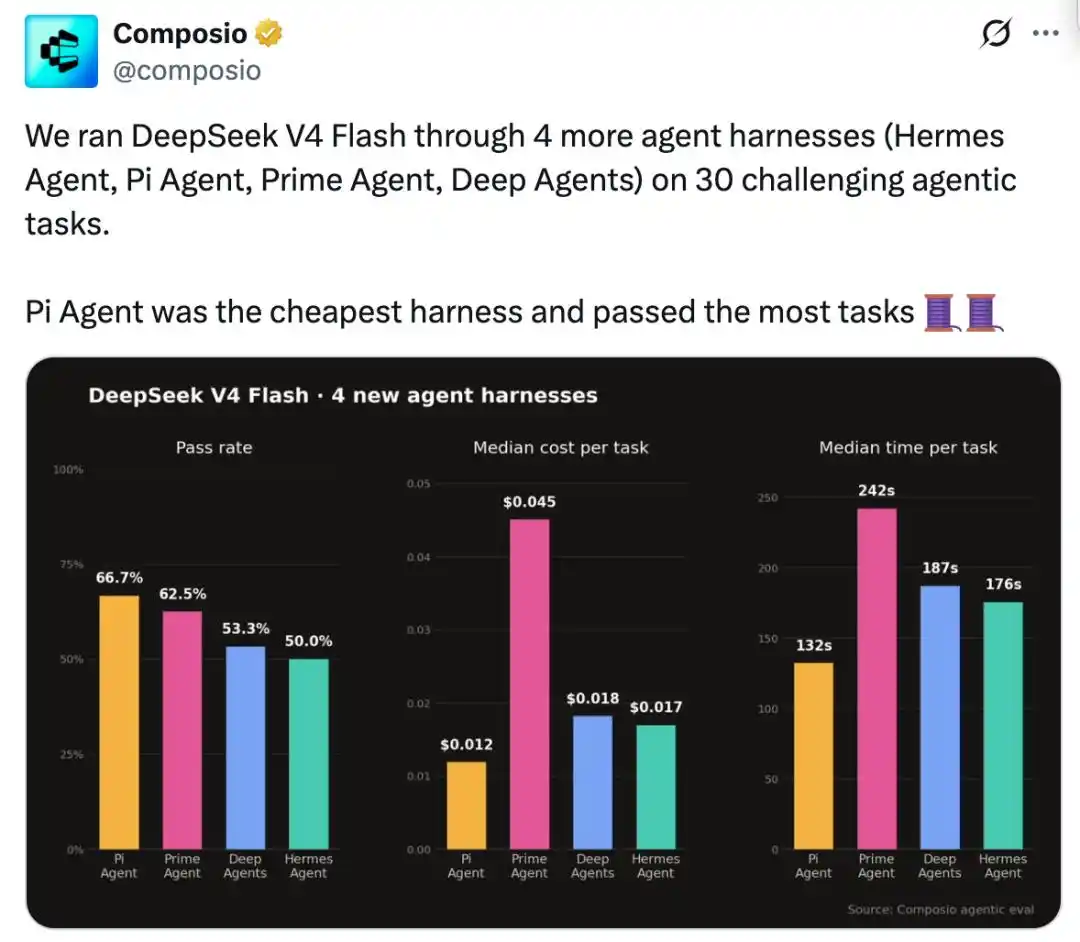
The gap was significant. The best performer, Pi Agent, passed twenty tasks; the worst, OpenCode, passed only fourteen. Out of 240 total runs across eight Harnesses, only 129 succeeded. Among the thirty tasks, only six were completed by all Harnesses. In terms of cost, for similarly completing sixteen tasks, the estimated cost per successful task for Claude Code, Codex, and DeepAgents was approximately $0.195, $0.081, and $0.045 respectively. For the same model, the difference was more than fourfold.
This means that the model sets the upper limit of capability, while the Harness determines how much of that ceiling is ultimately realized and at what cost. Throughout a long-running task, the execution system must constantly make judgments: what to keep and what to discard in the context, when to call which tool, whether to retry or change course when a tool fails, whether to trust the model's completion signal or verify it again. If any step is mishandled, even if the model has the right idea, it could fail at the last moment when actually modifying files or submitting code.

It's worth noting that this is one of the very few projects that DeepSeek opened for early closed beta since its rise to fame.

Several developers received Harness beta access before the official release. Some testers discovered that having the same V4-Flash model complete the same game within DeepSeek Harness, Reasonix, and Codex produced drastically different outcomes. This shows that when the model is identical, the tools, prompts, context organization, and execution strategies provided by the execution system can significantly alter the final product.

This is precisely why DeepSeek values its self-developed Harness. Internally, DeepSeek has believed that Agents need to solve the problem of continuous learning, ultimately enabling AI to accelerate AI R&D. Looking down this path, Harness is not just an add-on programming tool, but a workbench for models to enter real development tasks.

Furthermore, a company that built its foundation on low cost and model capability would find itself in a precarious position if task delivery, failure feedback, and developer interfaces remained long-term dependencies on others' systems. Even with a price advantage, it wouldn't control how many tokens a task ultimately burns, how many retries are needed, or when a task is truly considered complete.

02

Everything is a Plugin, DeepSeek Isn't a Replacement for Anyone

What exactly is Harness? The most convenient description in the market is " DeepSeek version of Claude Code." But those who have used the beta version generally find this label inaccurate.

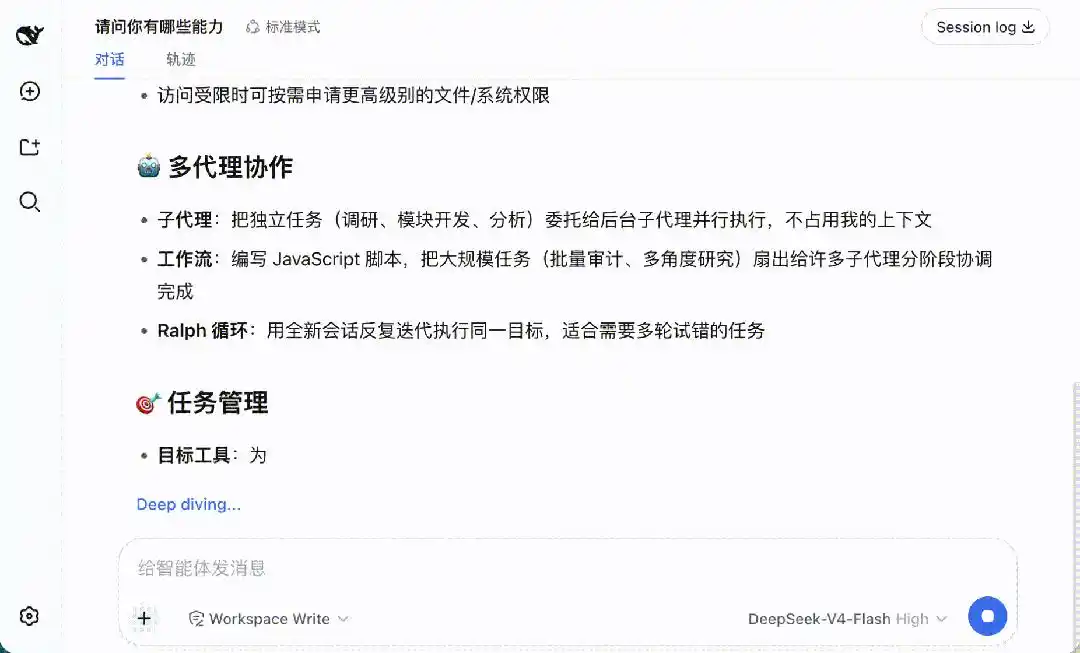
According to DeepSeek 's official documentation, the core design philosophy of Harness is "Everything is a plugin." It is built on the Cordis plugin system. Models, tools, skills, sessions, sandboxes, storage, loops, schedulers, UI—all Agent capabilities are composed of plugins. Developers can select, replace, or extend any capability through configuration without modifying the Harness source code.
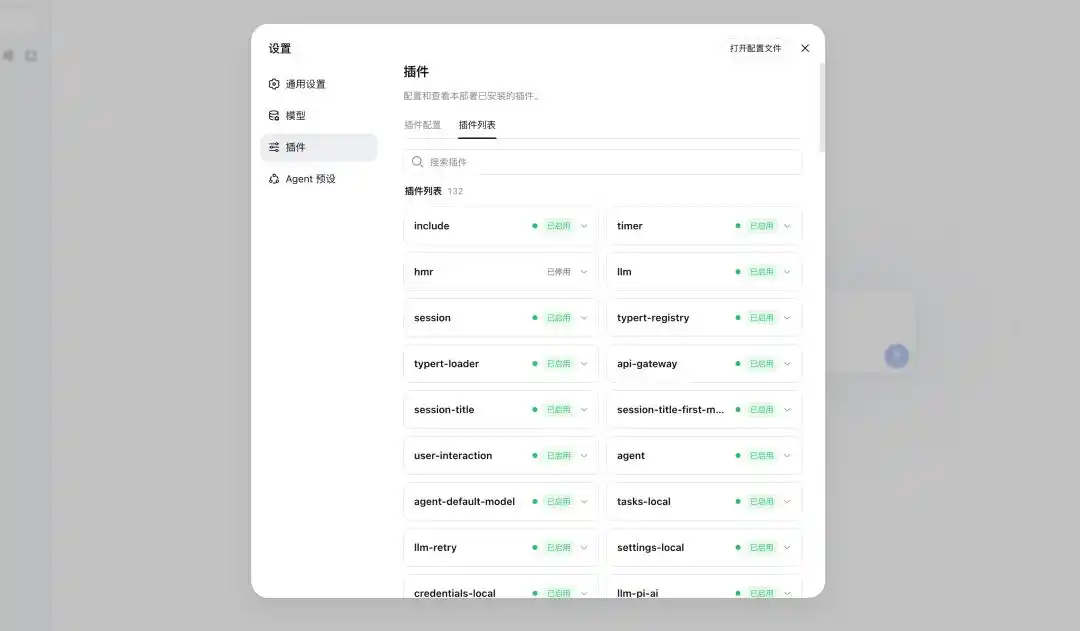
This is on a different scale from the usual understanding of plugins. VS Code plugins add features to the editor; Codex plugins add tools to the Agent. Harness plugins can replace the Agent's brain, toolbox, rules, even its entire interface.

According to multiple sources involved in the beta test, developers went wild with plugin-making during the beta period. "People aren't properly testing the beta anymore; they're running off to write plugins." Hundreds of plugins emerged within just a few days—some completely overhauled the work interface, while others implemented "cross-session long-term memory with background self-evolution" using pure plugins, enabling the model to periodically review its work records and compress temporary experiences into lasting knowledge.

Some also commented that open-source community governance might be another challenge DeepSeek will face next.

Another crucial design aspect is traceability. Harness uses an append-only session log. Everything the model sees—system prompts, chain-of-thought, tool calls and results, sub-Agent scheduling, every context injection—is fully recorded. Context compression does not delete the original history; it only changes what the model subsequently sees through replacement events. Developers can trace by source in the Trajectory view, supporting recovery, forking, retrieval, and replay. The official documentation summarizes this principle as "If the model saw it, it's recorded."

This reflects a typical systems engineering mindset. According to reports, DeepSeek Harness team leader Cui Tianyi graduated from Zhejiang University's Computer Science Department, worked at the quantitative trading firm Jane Street for nine years, and joined DeepSeek in March 2026, with Harness officially starting internal development in May. The core moat of high-frequency trading systems has never been about smarter strategies, but stable execution in extremely complex environments, exception handling, comprehensive log traceability, and controllable risk—exactly the missing piece for moving AI Agents from demos to production. One beta developer described its performance in long tasks as "steady as an old dog": tasks are automatically saved when interrupted, ready to resume next time without starting over.

It's worth noting that Harness hasn't confined itself within DeepSeek models' walled garden. It natively supports connecting to nearly 40 major models including Kimi , OpenAI, Anthropic, and Google. Perhaps others tend to build a ready-made Agent, but DeepSeek Harness is more like a set of components, allowing developers to decide for themselves what the Agent should be like and how it should work.

Of course, the official team remains clear-headed. The announcement states that, as an early preview version, "there are still many details to be improved and refined, and core plugins and basic APIs will also undergo rapid iteration." In fact, one of the media outlets involved in the beta, ifanr, marveled that it was hard to imagine the famously fast DeepSeek taking over half an hour to run a programming task. The v0.1 version number also indicates that this black whale has just surfaced, far from swimming freely.

03

From Selling Tokens to Delivering Results, the Ambition of the Black Whale

The emergence of Harness coincides with a shift in the entire AI industry.

Over the past few years, competition among large model companies has focused on parameter scale and benchmark scores. But entering 2026, the core capabilities of leading models have rapidly converged, gaps in single-turn QA have narrowed, while price wars have intensified. The ceiling for the pure token-selling business model has become clearly visible. The industry is gradually realizing that the core value of the AI industry lies not in model output, but in real-world application—with the same token consumption, idle chat yields minimal value, while fixing a bug or completing a feature development can create several times the commercial value.

DeepSeek 's new release signifies a move from selling compute power to delivering results. In the old model, customers paid based on token usage, regardless of whether the model actually solved the problem. In the new model, the anchor point for payment shifts from how much compute was consumed to what task was accomplished.

This DeepSeek Harness release is also highly praised by developers for another reason. DeepSeek does not define the Agent itself. Instead, it leverages the diffusion power of the open-source community to promote a Harness-based approach. This is a grander, yet more difficult, path.

Furthermore, Harness faces a mature market already validated by Claude Code and Codex, with the latter backed by the model iterations and commercial resources of Anthropic and OpenAI, holding a first-mover advantage. After open-sourcing, questions remain unanswered: whether the plugin ecosystem can spontaneously flourish, whether developers are willing to entrust production environments to a v0.1 version, and whether the domestic market's payment habits can support the new logic of "pay-per-result." DeepSeek itself has stated that core plugins and APIs will continue to evolve rapidly, meaning early adopters may bear the cost of interface changes.

On August 13th, releases happened on both sides of the Pacific. Elon Musk took the stage for Grok 4.6, calling it "intelligent, fast, and highly cost-effective" ; DeepSeek said nothing, just kept pushing updates.

Between the clamor and the silence lies a divergence of two business philosophies.

We want to call this DeepSeek 's "most promising project in history," not because it's the strongest today. V4 Pro still has gaps with SOTA models, Harness is only a v0.1 developer preview, market reaction to recent price adjustments needs observation, and ecosystem building is a long journey. Potential is potential precisely because it is not yet realized.

But if we stretch the timeline, from R1 to V4, from models to Harness, DeepSeek has taken each step in the same direction: compressing cutting-edge capabilities into affordable costs, then connecting affordable capabilities to implementable systems.

The black whale has surfaced. As for how far it can swim—that lies in a future belonging to the open-source community.

This article is from the WeChat public account "Phoenix Network Technology," author: Dale, editor: Dong Yuqing

Criptomoedas em alta

Perguntas relacionadas

QAccording to the article, what is the key finding of Composio's experiments comparing different Agent execution systems (Harnesses) using the same DeepSeek model?

AThe key finding was that the choice of execution system significantly impacts the performance and cost of the same AI model. The experiments showed up to a fourfold difference in the cost per successful task completion when the same DeepSeek V4-Flash model was paired with different Harnesses.

QWhat is the core design philosophy of DeepSeek's newly released Harness system?

AThe core design philosophy is "Everything is a plugin." Harness is built on the Cordis plugin system, meaning all Agent capabilities—models, tools, skills, sessions, UI, etc.—are composed of interchangeable plugins, allowing developers to customize the system without modifying the core source code.

QWhy does the article suggest Harness is not simply a 'DeepSeek version of Claude Code'?

ABecause Harness is fundamentally a modular system of plugins where developers can define and configure the Agent's functionality, behavior, and interface. It's designed to be a flexible, foundational framework for building various Agents, not a single, pre-defined tool for coding tasks.

QWhat shift in the AI industry's business model does the article associate with the release of DeepSeek Harness?

AThe article associates it with a shift from selling computational power (tokens) to delivering results. The value proposition is moving from charging for model output volume to charging based on the completion and value of specific tasks (like bug fixes or feature development).

QWhat is the significance of the 'append-only' session log and 'Trajectory view' in the Harness system, according to the article?

AThe 'append-only' log ensures complete traceability and reproducibility. Every system prompt, chain-of-thought, tool call, and context injection is permanently recorded. The 'Trajectory view' allows developers to trace, restore, fork, and replay any step, providing crucial control and debugging capabilities for complex, long-running AI tasks.

Leituras Relacionadas

After Tokenized U.S. Treasury Bonds, Tokenized Stocks Are Becoming the New Battleground for RWA

**Tokenized Stocks Emerge as the New RWA Battleground** Following the initial surge of tokenized U.S. Treasuries, the tokenized stock market is rapidly expanding in both scale and quality. Unlike the currently stagnating treasury tokenization market, tokenized stock offerings are seeing significant growth and attracting major players from traditional finance, fintech, crypto exchanges, and native Web3 platforms. The U.S. SEC has outlined a framework for tokenized securities, which applies to stocks: **Issuer-Sponsored Tokenized Securities** (direct tokenization by the issuer, inheriting all shareholder rights but with strict compliance, e.g., Securitize); **Custodial Tokenized Securities** (tokenization of custodied interests, e.g., DTCC, Ondo's recent IVV/MU tokens); **Linked Securities** (tokenized debt notes backed by the stock, offering price exposure and greater on-chain utility, e.g., Ondo, xStocks, Robinhood's new Stock Tokens); and **Security-Based Swaps** (tokenized derivatives contracts, e.g., Robinhood's earlier Classic Stock Tokens). Key platforms are pursuing different strategies: * **Securitize** leads with an issuer-sponsored model, ensuring full rights but limiting on-chain interactions via its compliance-enforcing DS Protocol. * **Ondo** and **xStocks** use the linked security structure for broad accessibility on CEXs and DeFi, though this fragments liquidity and excludes U.S. users. * **Robinhood** recently launched linked security-based Stock Tokens, leveraging its user base and new Robinhood Chain. * Traditional infrastructure giants like **DTCC**, the **NYSE**, and **Nasdaq** are actively developing pilots and platforms for tokenized settlement and trading. * **Coinbase** has announced plans for tokenized stocks, likely using a structure that offers on-chain utility while excluding U.S. customers. Despite different approaches, all players are converging on tokenized stocks as the next major catalyst for the RWA sector. The evolving regulatory landscape and market adoption will shape this competitive new battlefield.

marsbitHá 47m

After Tokenized U.S. Treasury Bonds, Tokenized Stocks Are Becoming the New Battleground for RWA

marsbitHá 47m

Nvidia Faces Collective Selling by Funds: What Are Private Equity Firms Sniffing Out?

Several prominent Chinese private equity funds, including Gaoyi Asset and Dantoo's Orient Harbor, made significant portfolio adjustments in Q2 2024, as revealed in their latest SEC 13F filings. The most notable move was a collective retreat from AI chip leader NVIDIA, with Gaoyi reducing its stake by over 70%, Jilin Asset selling out completely, and Orient Harbor trimming its holdings. This shift does not signal a loss of faith in the AI trend, but rather a change in investment focus from "expectation-driven" to "realization-driven" valuation. Capital is flowing from crowded, high-valuation names towards segments with clearer profitability visibility and better risk-reward profiles. The funds' new major conviction is Taiwan Semiconductor Manufacturing Company (TSMC), which Gaoyi built into its top holding. The thesis centers on TSMC's role as a critical bottleneck in the AI supply chain due to its dominance in advanced semiconductor manufacturing and, crucially, advanced CoWoS packaging capacity. As demand for AI chips explodes, TSMC's "must-pass" foundry services grant it significant pricing power, suggesting a potential migration of profits from chip designers to manufacturers. Simultaneously, both Gaoyi and Orient Harbor substantially increased positions in memory chip companies like Micron and SanDisk. The investment logic here is twofold: a cyclical recovery in the memory market combined with a new, structural growth driver from AI. High Bandwidth Memory (HBM), essential for AI processor performance, is supply-constrained and its production diverts capacity from standard DRAM and NAND, creating a broad-based pricing tailwind for the memory sector. The collective reduction in NVIDIA reflects a view that its massive prior gains have compressed its future upside potential ("lowered赔率"). The market now demands flawless execution and faces new risks like rising costs from TSMC and HBM suppliers, as well as competition from cloud companies' custom chips. The funds' reallocation highlights a broader thematic: as the AI boom matures, investment opportunities and excess profits are shifting along the supply chain—from design to the physical constraints of manufacturing and memory. The next phase of AI investing may be defined by pricing power derived from tangible bottlenecks like advanced packaging and HBM capacity.

marsbitHá 1h

Nvidia Faces Collective Selling by Funds: What Are Private Equity Firms Sniffing Out?

marsbitHá 1h

Reverse Turing Test: This 'Pure Handcrafted Large Model' Is Driving Netizens Crazy

An art project called ChatTJB, humorously billed as a "next-generation, single-operator Large Language Experience" (LLE), gained viral attention in San Francisco. Promoted via a billboard, its website mimicked a genuine AI service with a chat interface, documentation, and even a "Pro" subscription. The twist? It was entirely manual. A single person, named Tucker, personally read, thought about, and typed replies to thousands of user queries using his thumbs, even hand-drawing images. He coined terms like "human-powered reasoning layer" to describe this process, highlighting its inherent human limitations: speed depended on his alertness, capacity was strictly one conversation at a time, and errors were traceable to a specific individual. The project's popularity overwhelmed Tucker, forcing a pause on new users and leading to plans for a community version with volunteer "AIs" (Average Individuals). While initially a source of amusement, Tucker noted that some users began sharing genuine personal concerns, valuing the knowledge that a real person was attentively listening and responding. The project satirizes AI hype while underscoring the irreplaceable value of human connection and attention in an age of automated, scalable interactions. A similar platform, "Your AI Slop Bores Me," was mentioned, where users either submit requests or role-play as the "AI" to fulfill others' text or drawing prompts, further emphasizing the human element behind the interface. The core message: sometimes, knowing there's a real person on the other end is what truly matters.

marsbitHá 1h

Reverse Turing Test: This 'Pure Handcrafted Large Model' Is Driving Netizens Crazy

marsbitHá 1h

Overnight, GPT-5.6 Sol Was Accelerated 14x by OpenAI

OpenAI, in collaboration with chipmaker Cerebras, has unveiled a limited preview of an "Ultrafast Mode" for its flagship GPT-5.6 Sol model. This new service tier reportedly achieves output speeds of up to 750 tokens per second—a 14x increase over the standard mode's baseline of ~53 tokens/s—without any loss in quality. Key to this acceleration is Cerebras's wafer-scale architecture (WSE-3), which houses model parameters entirely in on-chip SRAM to eliminate the memory bandwidth bottlenecks typical of traditional GPU clusters. In benchmark testing on the challenging "Humanity's Last Exam" (HLE), GPT-5.6 Sol in Ultrafast Mode answered all 2500 questions in 11 hours and 11 minutes, compared to over 78 hours for a competitor model, while maintaining similar accuracy. The speed boost also translated to a 5.6x faster end-to-end performance on the GDP-Val benchmark for economically valuable knowledge work. OpenAI highlights several potential applications for such rapid inference, including real-time event response and reliability analysis, dynamic financial research and security, complex customer support, interactive shopping assistance, and accelerated research and experimentation workflows that enable multiple iterative cycles within a single workday. This advancement may allow users to deploy the highest-tier models for tasks previously requiring slower secondary models, significantly compressing multi-step agent workflows from hours to minutes.

marsbitHá 1h

Overnight, GPT-5.6 Sol Was Accelerated 14x by OpenAI

marsbitHá 1h

Trading

Spot

Artigos em Destaque

O que é $S$

Compreender o SPERO: Uma Visão Abrangente Introdução ao SPERO À medida que o panorama da inovação continua a evoluir, o surgimento de tecnologias web3 e projetos de criptomoeda desempenha um papel fundamental na formação do futuro digital. Um projeto que tem atraído atenção neste campo dinâmico é o SPERO, denotado como SPERO,$$s$. Este artigo tem como objetivo reunir e apresentar informações detalhadas sobre o SPERO, para ajudar entusiastas e investidores a compreender as suas bases, objetivos e inovações nos domínios web3 e cripto. O que é o SPERO,$$s$? O SPERO,$$s$ é um projeto único dentro do espaço cripto que procura aproveitar os princípios da descentralização e da tecnologia blockchain para criar um ecossistema que promove o envolvimento, a utilidade e a inclusão financeira. O projeto é concebido para facilitar interações peer-to-peer de novas maneiras, proporcionando aos utilizadores soluções e serviços financeiros inovadores. No seu núcleo, o SPERO,$$s$ visa capacitar indivíduos ao fornecer ferramentas e plataformas que melhoram a experiência do utilizador no espaço das criptomoedas. Isso inclui a possibilidade de métodos de transação mais flexíveis, a promoção de iniciativas impulsionadas pela comunidade e a criação de caminhos para oportunidades financeiras através de aplicações descentralizadas (dApps). A visão subjacente do SPERO,$$s$ gira em torno da inclusão, visando fechar lacunas dentro das finanças tradicionais enquanto aproveita os benefícios da tecnologia blockchain. Quem é o Criador do SPERO,$$s$? A identidade do criador do SPERO,$$s$ permanece algo obscura, uma vez que existem recursos publicamente disponíveis limitados que fornecem informações detalhadas sobre o(s) seu(s) fundador(es). Esta falta de transparência pode resultar do compromisso do projeto com a descentralização—uma ética que muitos projetos web3 partilham, priorizando contribuições coletivas em vez de reconhecimento individual. Ao centrar as discussões em torno da comunidade e dos seus objetivos coletivos, o SPERO,$$s$ incorpora a essência do empoderamento sem destacar indivíduos específicos. Assim, compreender a ética e a missão do SPERO é mais importante do que identificar um criador singular. Quem são os Investidores do SPERO,$$s$? O SPERO,$$s$ é apoiado por uma diversidade de investidores que vão desde capitalistas de risco a investidores-anjo dedicados a promover a inovação no setor cripto. O foco desses investidores geralmente alinha-se com a missão do SPERO—priorizando projetos que prometem avanço tecnológico social, inclusão financeira e governança descentralizada. Essas fundações de investidores estão tipicamente interessadas em projetos que não apenas oferecem produtos inovadores, mas que também contribuem positivamente para a comunidade blockchain e os seus ecossistemas. O apoio desses investidores reforça o SPERO,$$s$ como um concorrente notável no domínio em rápida evolução dos projetos cripto. Como Funciona o SPERO,$$s$? O SPERO,$$s$ emprega uma estrutura multifacetada que o distingue de projetos de criptomoeda convencionais. Aqui estão algumas das características-chave que sublinham a sua singularidade e inovação: Governança Descentralizada: O SPERO,$$s$ integra modelos de governança descentralizada, capacitando os utilizadores a participar ativamente nos processos de tomada de decisão sobre o futuro do projeto. Esta abordagem promove um sentido de propriedade e responsabilidade entre os membros da comunidade. Utilidade do Token: O SPERO,$$s$ utiliza o seu próprio token de criptomoeda, concebido para servir várias funções dentro do ecossistema. Esses tokens permitem transações, recompensas e a facilitação de serviços oferecidos na plataforma, melhorando o envolvimento e a utilidade gerais. Arquitetura em Camadas: A arquitetura técnica do SPERO,$$s$ suporta modularidade e escalabilidade, permitindo a integração contínua de funcionalidades e aplicações adicionais à medida que o projeto evolui. Esta adaptabilidade é fundamental para manter a relevância no panorama cripto em constante mudança. Envolvimento da Comunidade: O projeto enfatiza iniciativas impulsionadas pela comunidade, empregando mecanismos que incentivam a colaboração e o feedback. Ao nutrir uma comunidade forte, o SPERO,$$s$ pode melhor atender às necessidades dos utilizadores e adaptar-se às tendências do mercado. Foco na Inclusão: Ao oferecer taxas de transação baixas e interfaces amigáveis, o SPERO,$$s$ visa atrair uma base de utilizadores diversificada, incluindo indivíduos que anteriormente podem não ter participado no espaço cripto. Este compromisso com a inclusão alinha-se com a sua missão abrangente de empoderamento através da acessibilidade. Cronologia do SPERO,$$s$ Compreender a história de um projeto fornece insights cruciais sobre a sua trajetória de desenvolvimento e marcos. Abaixo está uma cronologia sugerida que mapeia eventos significativos na evolução do SPERO,$$s$: Fase de Conceituação e Ideação: As ideias iniciais que formam a base do SPERO,$$s$ foram concebidas, alinhando-se de perto com os princípios de descentralização e foco na comunidade dentro da indústria blockchain. Lançamento do Whitepaper do Projeto: Após a fase conceitual, um whitepaper abrangente detalhando a visão, os objetivos e a infraestrutura tecnológica do SPERO,$$s$ foi lançado para atrair o interesse e o feedback da comunidade. Construção da Comunidade e Primeiros Envolvimentos: Esforços ativos de divulgação foram feitos para construir uma comunidade de primeiros adotantes e investidores potenciais, facilitando discussões em torno dos objetivos do projeto e angariando apoio. Evento de Geração de Tokens: O SPERO,$$s$ realizou um evento de geração de tokens (TGE) para distribuir os seus tokens nativos a apoiantes iniciais e estabelecer liquidez inicial dentro do ecossistema. Lançamento da dApp Inicial: A primeira aplicação descentralizada (dApp) associada ao SPERO,$$s$ foi lançada, permitindo que os utilizadores interagissem com as funcionalidades principais da plataforma. Desenvolvimento Contínuo e Parcerias: Atualizações e melhorias contínuas nas ofertas do projeto, incluindo parcerias estratégicas com outros players no espaço blockchain, moldaram o SPERO,$$s$ em um jogador competitivo e em evolução no mercado cripto. Conclusão O SPERO,$$s$ é um testemunho do potencial do web3 e das criptomoedas para revolucionar os sistemas financeiros e capacitar indivíduos. Com um compromisso com a governança descentralizada, o envolvimento da comunidade e funcionalidades inovadoras, abre caminho para um panorama financeiro mais inclusivo. Como em qualquer investimento no espaço cripto em rápida evolução, potenciais investidores e utilizadores são incentivados a pesquisar minuciosamente e a envolver-se de forma ponderada com os desenvolvimentos em curso dentro do SPERO,$$s$. O projeto demonstra o espírito inovador da indústria cripto, convidando a uma exploração mais aprofundada das suas inúmeras possibilidades. Embora a jornada do SPERO,$$s$ ainda esteja a desenrolar-se, os seus princípios fundamentais podem, de facto, influenciar o futuro de como interagimos com a tecnologia, as finanças e uns com os outros em ecossistemas digitais interconectados.

344 Visualizações TotaisPublicado em {updateTime}Atualizado em 2024.12.17

O que é $S$

O que é AGENT S

Agent S: O Futuro da Interação Autónoma no Web3 Introdução No panorama em constante evolução do Web3 e das criptomoedas, as inovações estão constantemente a redefinir a forma como os indivíduos interagem com plataformas digitais. Um projeto pioneiro, o Agent S, promete revolucionar a interação humano-computador através do seu framework aberto e agente. Ao abrir caminho para interações autónomas, o Agent S visa simplificar tarefas complexas, oferecendo aplicações transformadoras em inteligência artificial (IA). Esta exploração detalhada irá aprofundar-se nas complexidades do projeto, nas suas características únicas e nas implicações para o domínio das criptomoedas. O que é o Agent S? O Agent S é um framework aberto e agente, especificamente concebido para abordar três desafios fundamentais na automação de tarefas computacionais: Aquisição de Conhecimento Específico de Domínio: O framework aprende inteligentemente a partir de várias fontes de conhecimento externas e experiências internas. Esta abordagem dupla capacita-o a construir um rico repositório de conhecimento específico de domínio, melhorando o seu desempenho na execução de tarefas. Planeamento ao Longo de Longos Horizontes de Tarefas: O Agent S emprega planeamento hierárquico aumentado por experiência, uma abordagem estratégica que facilita a decomposição e execução eficientes de tarefas intrincadas. Esta característica melhora significativamente a sua capacidade de gerir múltiplas subtarefas de forma eficiente e eficaz. Gestão de Interfaces Dinâmicas e Não Uniformes: O projeto introduz a Interface Agente-Computador (ACI), uma solução inovadora que melhora a interação entre agentes e utilizadores. Utilizando Modelos de Linguagem Multimodais de Grande Escala (MLLMs), o Agent S pode navegar e manipular diversas interfaces gráficas de utilizador de forma fluida. Através destas características pioneiras, o Agent S fornece um framework robusto que aborda as complexidades envolvidas na automação da interação humana com máquinas, preparando o terreno para uma infinidade de aplicações em IA e além. Quem é o Criador do Agent S? Embora o conceito de Agent S seja fundamentalmente inovador, informações específicas sobre o seu criador permanecem elusivas. O criador é atualmente desconhecido, o que destaca ou o estágio nascente do projeto ou a escolha estratégica de manter os membros fundadores em anonimato. Independentemente da anonimidade, o foco permanece nas capacidades e no potencial do framework. Quem são os Investidores do Agent S? Como o Agent S é relativamente novo no ecossistema criptográfico, informações detalhadas sobre os seus investidores e financiadores não estão explicitamente documentadas. A falta de informações disponíveis publicamente sobre as fundações de investimento ou organizações que apoiam o projeto levanta questões sobre a sua estrutura de financiamento e roteiro de desenvolvimento. Compreender o apoio é crucial para avaliar a sustentabilidade do projeto e o seu impacto potencial no mercado. Como Funciona o Agent S? No núcleo do Agent S reside uma tecnologia de ponta que lhe permite funcionar eficazmente em diversos ambientes. O seu modelo operacional é construído em torno de várias características-chave: Interação Humano-Computador Semelhante: O framework oferece planeamento avançado em IA, esforçando-se para tornar as interações com computadores mais intuitivas. Ao imitar o comportamento humano na execução de tarefas, promete elevar as experiências dos utilizadores. Memória Narrativa: Utilizada para aproveitar experiências de alto nível, o Agent S utiliza memória narrativa para acompanhar os históricos de tarefas, melhorando assim os seus processos de tomada de decisão. Memória Episódica: Esta característica fornece aos utilizadores orientações passo a passo, permitindo que o framework ofereça suporte contextual à medida que as tarefas se desenrolam. Suporte para OpenACI: Com a capacidade de funcionar localmente, o Agent S permite que os utilizadores mantenham o controlo sobre as suas interações e fluxos de trabalho, alinhando-se com a ética descentralizada do Web3. Fácil Integração com APIs Externas: A sua versatilidade e compatibilidade com várias plataformas de IA garantem que o Agent S possa integrar-se perfeitamente em ecossistemas tecnológicos existentes, tornando-o uma escolha apelativa para desenvolvedores e organizações. Estas funcionalidades contribuem coletivamente para a posição única do Agent S no espaço cripto, à medida que automatiza tarefas complexas e em múltiplos passos com mínima intervenção humana. À medida que o projeto evolui, as suas potenciais aplicações no Web3 podem redefinir a forma como as interações digitais se desenrolam. Cronologia do Agent S O desenvolvimento e os marcos do Agent S podem ser encapsulados numa cronologia que destaca os seus eventos significativos: 27 de Setembro de 2024: O conceito de Agent S foi lançado num artigo de pesquisa abrangente intitulado “Um Framework Agente Aberto que Usa Computadores como um Humano”, mostrando a base para o projeto. 10 de Outubro de 2024: O artigo de pesquisa foi disponibilizado publicamente no arXiv, oferecendo uma exploração aprofundada do framework e da sua avaliação de desempenho com base no benchmark OSWorld. 12 de Outubro de 2024: Uma apresentação em vídeo foi lançada, proporcionando uma visão visual das capacidades e características do Agent S, envolvendo ainda mais potenciais utilizadores e investidores. Estes marcos na cronologia não apenas ilustram o progresso do Agent S, mas também indicam o seu compromisso com a transparência e o envolvimento da comunidade. Pontos-Chave Sobre o Agent S À medida que o framework Agent S continua a evoluir, várias características-chave destacam-se, sublinhando a sua natureza inovadora e potencial: Framework Inovador: Concebido para proporcionar um uso intuitivo de computadores semelhante à interação humana, o Agent S traz uma abordagem nova à automação de tarefas. Interação Autónoma: A capacidade de interagir autonomamente com computadores através de GUI significa um avanço em direção a soluções computacionais mais inteligentes e eficientes. Automação de Tarefas Complexas: Com a sua metodologia robusta, pode automatizar tarefas complexas e em múltiplos passos, tornando os processos mais rápidos e menos propensos a erros. Melhoria Contínua: Os mecanismos de aprendizagem permitem que o Agent S melhore a partir de experiências passadas, aprimorando continuamente o seu desempenho e eficácia. Versatilidade: A sua adaptabilidade em diferentes ambientes operacionais, como OSWorld e WindowsAgentArena, garante que pode servir uma ampla gama de aplicações. À medida que o Agent S se posiciona no panorama do Web3 e das criptomoedas, o seu potencial para melhorar as capacidades de interação e automatizar processos significa um avanço significativo nas tecnologias de IA. Através do seu framework inovador, o Agent S exemplifica o futuro das interações digitais, prometendo uma experiência mais fluida e eficiente para os utilizadores em diversas indústrias. Conclusão O Agent S representa um ousado avanço na união da IA e do Web3, com a capacidade de redefinir a forma como interagimos com a tecnologia. Embora ainda esteja nas suas fases iniciais, as possibilidades para a sua aplicação são vastas e cativantes. Através do seu framework abrangente que aborda desafios críticos, o Agent S visa trazer interações autónomas para o primeiro plano da experiência digital. À medida que avançamos mais profundamente nos domínios das criptomoedas e da descentralização, projetos como o Agent S desempenharão, sem dúvida, um papel crucial na formação do futuro da tecnologia e da colaboração humano-computador.

940 Visualizações TotaisPublicado em {updateTime}Atualizado em 2025.01.14

O que é AGENT S

Como comprar S

Bem-vindo à HTX.com!Tornámos a compra de Sonic (S) simples e conveniente.Segue o nosso guia passo a passo para iniciar a tua jornada no mundo das criptos.Passo 1: cria a tua conta HTXUtiliza o teu e-mail ou número de telefone para te inscreveres numa conta gratuita na HTX.Desfruta de um processo de inscrição sem complicações e desbloqueia todas as funcionalidades.Obter a minha contaPasso 2: vai para Comprar Cripto e escolhe o teu método de pagamentoCartão de crédito/débito: usa o teu visa ou mastercard para comprar Sonic (S) instantaneamente.Saldo: usa os fundos da tua conta HTX para transacionar sem problemas.Terceiros: adicionamos métodos de pagamento populares, como Google Pay e Apple Pay, para aumentar a conveniência.P2P: transaciona diretamente com outros utilizadores na HTX.Mercado de balcão (OTC): oferecemos serviços personalizados e taxas de câmbio competitivas para os traders.Passo 3: armazena teu Sonic (S)Depois de comprar o teu Sonic (S), armazena-o na tua conta HTX.Alternativamente, podes enviá-lo para outro lugar através de transferência blockchain ou usá-lo para transacionar outras criptomoedas.Passo 4: transaciona Sonic (S)Transaciona facilmente Sonic (S) no mercado à vista da HTX.Acede simplesmente à tua conta, seleciona o teu par de trading, executa as tuas transações e monitoriza em tempo real.Oferecemos uma experiência de fácil utilização tanto para principiantes como para traders experientes.

1.7k Visualizações TotaisPublicado em {updateTime}Atualizado em 2026.06.02

Como comprar S

Discussões

Bem-vindo à Comunidade HTX. Aqui, pode manter-se informado sobre os mais recentes desenvolvimentos da plataforma e obter acesso a análises profissionais de mercado. As opiniões dos utilizadores sobre o preço de S (S) são apresentadas abaixo.

活动图片