Bitcoin's Key Channel Broken? History Won't Simply Repeat Itself | Invited Analysis

marsbitPublicado em 2026-01-26Última atualização em 2026-01-26

Resumo

This analysis by Odaily's guest market analyst Cody examines Bitcoin's recent price action and potential future trajectories. The key technical focus is the breach of Bitcoin's critical rising channel support, which had been acting as a "lifeline" for the market since the November 21, 2025, low of $80,600. The report compares the current market structure to the 2021 cycle, noting a similar three-wave corrective pattern (A-B-C) but cautioning that history does not simply repeat itself. The recent break below the $94,500-$95,000 support zone confirmed a return to a wider consolidation range between $84,000 and $94,500. Key scenarios are outlined: * If the price fails to reclaim the rising channel's support, a bearish C-wave could drive the price down towards key support levels at $84,000, $80,600 (the B-wave starting point), and potentially $75,200. * A recovery above the channel support could lead to a retest of the $94,500 resistance and the 21-week moving average, though this would require supportive macro conditions. The analyst details a successful short-term trade from the previous week, which yielded a 3.76% return using a quant model-based strategy. Current market structure is assessed as bearish on weekly and daily timeframes, with the daily momentum indicator dipping below zero. The upcoming week's strategy involves monitoring the confirmed break of the channel support. Operational plans include potential short positions (with a 60% allocation for mid-term and...

Odaily's Invited Market Analyst Cody, Master of Financial Statistics from Columbia University, USA, focused on quantitative trading of US stocks during university and gradually expanded to digital assets such as Bitcoin. He has built a systematic quantitative trading model and risk control system through practical experience; possesses keen data insight into market fluctuations and is committed to continuous深耕 in the professional trading field, pursuing steady returns; will deeply analyze changes in BTC technology, macroeconomics, capital flows, etc., weekly, review and display practical strategies, and preview major upcoming events for reference.
Core Summary of Trading Weekly Report:

In the previous article, we compared the BTC trend structure of 2021 and 2025, judging that history might repeat itself (BTC would continue to adjust), which received a lot of feedback, and some analysts had different views. Below, based on this week's updates, we provide a detailed analysis of the current market trend characteristics and future focus points. Welcome everyone to discuss together.

• Strategy (Short-term) Execution Effectiveness Verification: Last week's trading strictly followed the established strategy, completing one short-term operation (1x leverage), successfully achieving a return of 3.76%. (Detailed explanation see Figure 1)

• Core View (Short-term) Verification: At the beginning of last week, the price quickly fell below the core range of $94,500~$95,000, returning to the original震荡 range of $84,000~$94,500, and continued to move towards the lower轨 of the range. It is particularly emphasized that the lowest point of the price last week恰好 fell on the $86,000 support level we previously indicated. Overall, last week's market trend and the performance of key support levels were precisely verified by the market.

The following will详细回顾 the行情预判, strategy execution, and specific trading process.

一、Learning from History, Need a Dialectical View of the Current Market (See Figure 3)

By comparing the weekly-level adjustments after two historical highs of BTC, we observed that the adjustment starting in October 2025 and the adjustment in November 2021 share惊人相似 structural规律. Currently, the market is at a critical technical decision point.

1、Key Technical Position: Gain and Loss of the Rising Channel Lower轨

The rebound starting from the low of $80,600 on November 21, 2025, has formed a clear rising channel. The lower轨 of this channel has become the "lifeline" determining the short-term trend.

2、Two Possible Paths for Bitcoin's Later Trend:

• If it steadies itself back above the channel lower轨, the B-wave rebound行情 is expected to continue. The next step will first test the pressure near $94,500, then challenge the key resistance level of the 21-week moving average. The realization of this path requires the配合 of macro factors, particularly a shift towards宽松 in Fed policy expectations.

• If it effectively breaks below the channel lower轨 and the model momentum line (daily) breaks below the zero axis, it宣告 the daily level has returned to a bear market. This means the B-wave rebound行情 starting on November 21, 2025, may have ended, and the C-wave adjustment will further continue, significantly increasing the possibility of the price falling below $80,600.

3、Three-stage Adjustment Structure Analysis: Based on the premise of the price effectively breaking the channel lower轨

The current adjustment starting from October 2025 presents a typical three-stage structure:

A-wave adjustment: $126,200 (2025-10-06) to $80,600 (2025-11-21), lasting 46 days, a drop of 36%.

B-wave rebound: $80,600 (2025-11-21) to $97,924 (2026-01-14), lasting 54 days, a rise of 21.5%, this stage belongs to technical repair.

C-wave adjustment: $97,924 (January 14) to present. Currently in this stage of operation, the gain and loss of the channel lower轨 will become the key basis for judging the strength of the C-stage adjustment.

4、C-wave Adjustment Target Prediction:

$80,600, this is the B-wave starting point. If this point is effectively broken, the A-B-C three-wave adjustment structure starting from $126,200 tends to be complete.

$75,200, this price is both the 50% Fibonacci retracement level of the A-wave decline and coincides with the adjustment low of April 2025, forming an important historical support area.

"History repeats itself, but does not simply repeat" is the most profound dialectic of financial markets. It requires investors to both respect historical laws and to discern the particularity of the current market. Therefore, all rational market predictions are probabilistic outlooks obtained after comprehensive fundamental and technical structure analysis, not deterministic prophecies. Their ultimate purpose is not to accurately predict the future, but to formulate more resilient coping strategies.

二、Bitcoin Last Week's Market Review: (01.19~01.25)

1、Last Week's Short-term Operation Review: As shown in (Figure 1)

1、Transaction Details Summary: (No leverage)

We strictly followed the trading signals issued by our self-built spread trading model and momentum quantitative model, combined with the预判 of market trends, and completed one short-term operation. This transaction profited 3.76%.

Specific transaction details and review are as follows:

Bitcoin 30-minute K-line chart: (Momentum Quantitative Model + Spread Trading Model)
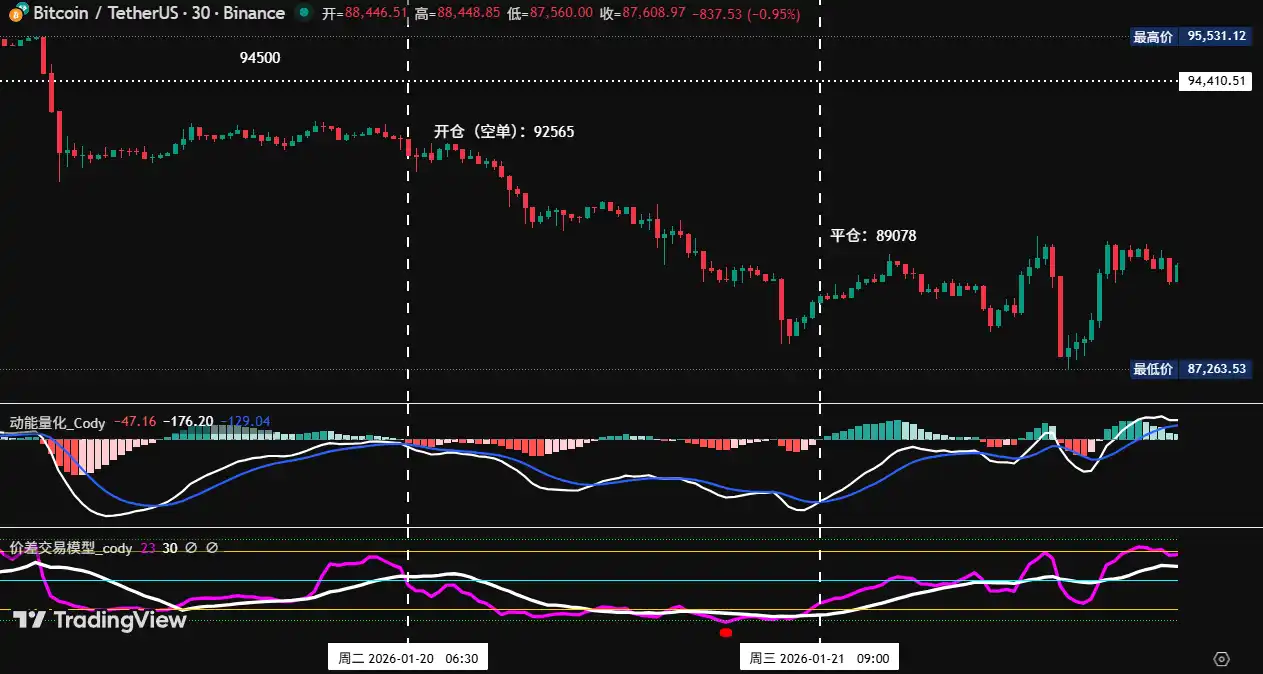
Figure 1

2、Short-term Trading Review:

• First transaction (Profit 3.76%): This operation executed Plan B (Effectively break below the key area to go short) strategy: When the price fell below the $94,500~$95,000 area and反弹无力,同时 the spread trading model and momentum model共振 triggered a top signal,叠加 the two momentum lines formed a dead cross below (near) the zero axis, constituting a triple bearish signal. Based on this, we established a 30% short position at $92,565. Subsequently, the market trend adjusted as expected. When the price fell to an important support level, the spread model率先 issued a触底预警 signal (red dot), followed by the momentum quantitative model and spread trading model共振 again generating a bottom signal. Based on this, we平仓 all positions at $89,078, achieving the expected profit target.

2、Last Week's Trend Prejudgment and Operation Strategy Review:

1、Last week clearly提示: Focus on the gain and loss of the $94,500~$95,000 area. If effectively broken, it will maintain震荡 within the $84,000~$94,500 range.

2、Core point review: Pressure level at $94,500~$95,000 area; First support at $89,500~$91,000 area, Second support at $86,000~$86,500.

2、Operation Strategy Review:

• Mid-line strategy: Empty position.

• Short-term strategy: Because the price effectively broke below the $94,500~$95,000 area, execute operation according to Plan B (see below):

• Open position: If反弹 to this area confirms the break is effective, a 30% short position can be established.

• Risk control: Initial stop loss for short orders set about 1.5% above the cost price(i.e., 1.015*cost price).

• Close position: When it探至 $86,500附近并结合 model signals, can gradually清仓获利了结.

三、Bitcoin Trend Structure: Daily Level Maintains Bearish Pattern

Combining market operation, the author conducts a deep analysis of Bitcoin's trend structure from multiple models and dimensions based on a self-built trading system.

Bitcoin Weekly K-line chart: (Momentum Quantitative Model+Sentiment Quantitative Model)
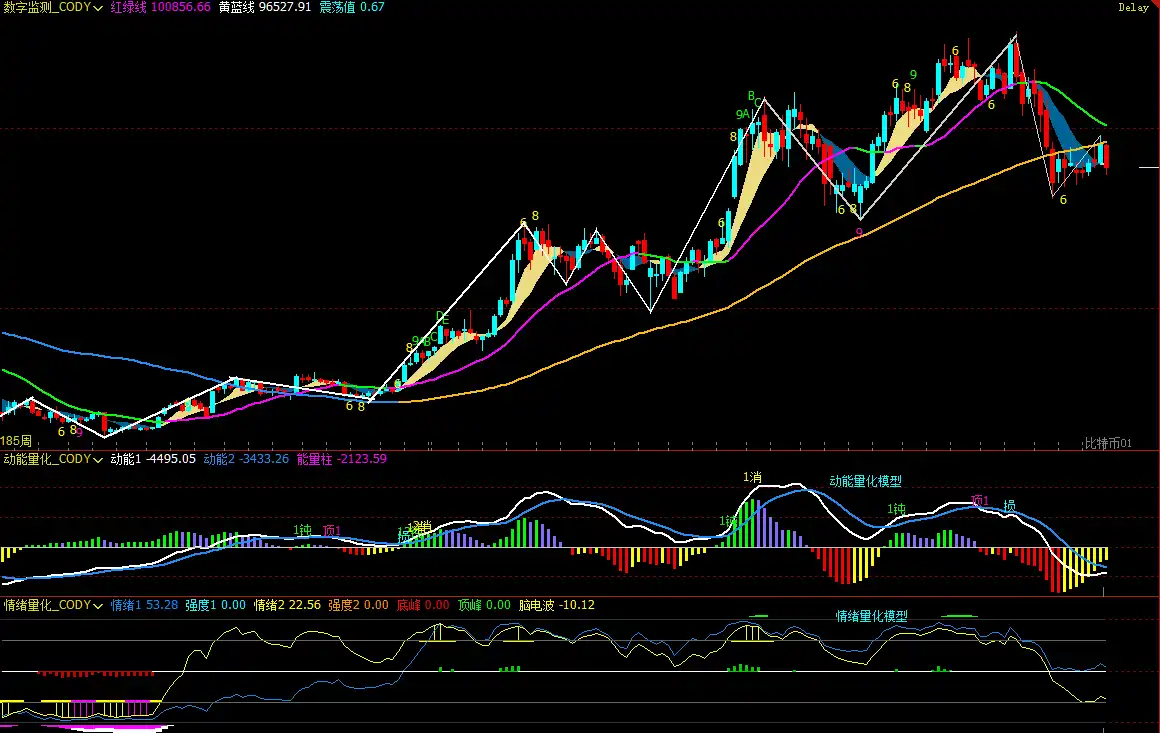
Figure 2

1、As shown in (Figure 2), analysis from the weekly chart:

Momentum Quantitative Model: Technical indicators show that shorting momentum was released last week, the two momentum lines showed signs of opening, the negative energy column change was not obvious, pay attention to the bears' next performance.

Momentum Quantitative Model Predicts: Price decline index: High

Sentiment Quantitative Model: Blue sentiment line value 53.28, strength zero; Yellow sentiment line value 22.56, strength zero, peak value is 0.

Sentiment Quantitative Model Predicts: Price pressure and support index: Neutral

Digital Monitoring Model: The price has been below the bull-bear (yellow-blue line)分界线 for 10 weeks, the price has fallen again, the price is far from the分界线.

Digital Monitoring Model Predicts: Monitoring (top/bottom) digital signals have not appeared; Weekly K-line closed with a large阴线, decline about 7.55%; The recent three-week K-lines form a "strong top分型" bearish pattern.

The above data predicts: Bitcoin weekly bearish trend, beware of震荡下跌 risk.

Bitcoin Daily K-line chart: (Momentum Quantitative Model+Sentiment Quantitative Model)
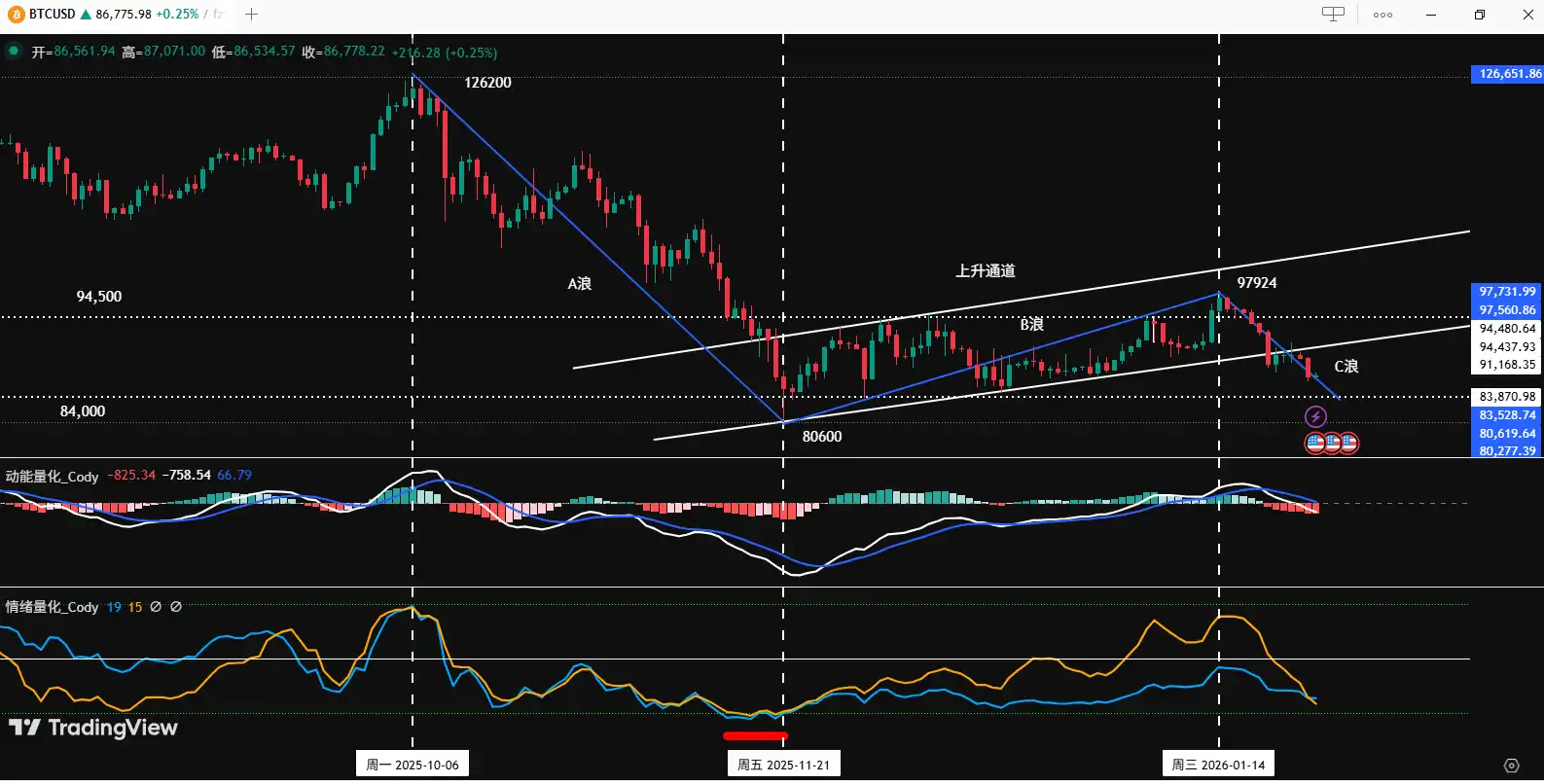
Figure 3

2、As shown in (Figure 3), analysis from the daily chart:

Momentum Quantitative Model: Last week overall presented a "decline-震荡-decline" pattern. After Sunday's盘后, Momentum Line 1 has fallen below the zero axis, Line 2 is about to fall below the zero axis; Negative energy column is gradually放大.

Momentum Quantitative Model Predicts: Daily shorting momentum is being released, pay attention to the gain and loss of the zero axis.

Sentiment Quantitative Model: After last week's daily close, blue sentiment line value 19, strength zero; yellow sentiment line value 20, strength zero.

Sentiment Quantitative Model Predicts: Pressure and support index: Neutral

The above data提示: The daily level initially shows a bearish pattern,有效性 still待确认, pay attention to the bull-bear battle for the zero axis.

四、This Week's Market Prediction: (01.26~02.01)

1、This Week's Core View: Pay attention to the effective confirmation after breaking the rising channel lower轨.

• If the price effectively breaks below the lower轨, the price will accelerate adjustment, target first look at the lower edge of the original震荡 box near $84,000.

• If the price effectively stabilizes, it will maintain震荡 within the rising channel, but the height is limited.

2、Core Pressure Levels:

• First pressure area: $88,500~$91,200 area (previous震荡中枢)

• Second pressure area: $94,500~$95,000 area (previous震荡中枢)

• Important pressure area: Near the 21-week moving average

3、Core Support Levels:

• First support level: $86,000~$86,500 area (previous筹码密集成交区)

• Second support level: Near $84,000 (previous box lower edge)

• Important support level: Near $80,000~$80,600 (near last November's low)

五、This Week's Operation Strategy (Excluding Sudden News Impact): (01.26~02.01)

1、Mid-line strategy: If it effectively breaks below the rising channel lower轨, can choose to establish a 60% short position.

2、Short-term strategy: Use 30% of the position, set stop loss points, based on support and pressure levels, look for "spread" opportunities. (Use 30 minutes as the operation cycle).

3、In operation, focus on the gain and loss of the rising channel lower轨. To dynamically respond to market evolution and combine real-time model signals, we have formulated A/B two sets of short-term operation plans:

Plan A: If the price falls below the rising channel lower轨:

• Open position: After effective break and combined with model top signal, can establish a 30% short position.

• Risk control: Initial stop loss for short orders set about 1.5% above the cost price(i.e., 1.015*cost price).

• Close position: When falling to near important support levels and combined with model signals, can gradually清仓获利了结.

Plan B: If the price stabilizes back above the rising channel lower轨: (Sell on resistance)

• Open position: When反弹 to important pressure levels or the channel upper轨 shows受阻信号, and combined with model top signal, can establish a 30% short position.

• Risk control: Initial stop loss for short orders set about 1.5% above the cost price(i.e., 1.015*cost price).

• Close position: When falling to the channel lower轨 or support levels, and combined with model signals, can gradually清仓获利了结.

六、Special Tips:​​

1、When opening a position: Immediately set the initial stop loss level.

2、When profit reaches 1%: Move the stop loss to the opening cost price (break-even point), ensuring principal safety.

3、When profit reaches 2%​​: Move the stop loss to the position of 1% profit.

4、Continuous tracking: Thereafter, for every additional 1% profit, the stop loss level moves同步 1%, dynamically protecting and locking in profits.


Perguntas relacionadas

QWhat is the key technical level that determines the short-term trend of Bitcoin according to the analyst?

AThe key technical level is the lower rail of the ascending channel formed since the low of $80,600 on November 21, 2025. Its hold or break will determine if the B-wave rally continues or if a C-wave decline begins.

QWhat are the two possible paths for Bitcoin's price movement outlined in the analysis?

AThe two paths are: 1. If the price stabilizes above the ascending channel's lower rail, the B-wave rally could continue, targeting resistance near $94,500 and then the 21-week moving average. 2. If it effectively breaks below the channel's lower rail and the daily momentum line breaks below the zero axis, it would signal a return to a daily bear market, likely starting a C-wave decline with targets at $80,600 or even $75,200.

QWhat was the result of the short-term trade executed last week?

AA short-term trade was executed with 1x leverage, resulting in a successful profit of 3.76%.

QWhat is the significance of the $80,600 price level in the current market structure analysis?

AThe $80,600 level is the starting point of the B-wave rally. If this level is effectively broken, it would complete the A-B-C three-wave correction structure that began from the high of $126,200.

QWhat trading strategy is recommended for the current week if the price breaks below the ascending channel's lower rail?

AIf the price effectively breaks below the ascending channel's lower rail, the strategy is to opportunistically establish a 60% short position for medium-term, and use 30% of capital for short-term 'spread' opportunities based on support and resistance levels, using a 30-minute operating cycle with strict stop-loss rules.

Leituras Relacionadas

How Many Tokens Away Is Yang Zhilin from the 'Moon Chasing the Light'?

The article explores the intense competition between two leading Chinese AI companies, DeepSeek and Kimi (Moon Dark Side), and the mounting pressure on Yang Zhilin, the founder of Kimi. While DeepSeek re-emerged after 15 months of silence with its powerful V4 model—boasting 1.6 trillion parameters and low-cost, long-context capabilities—Kimi has been focusing on long-context processing and multi-agent systems with its K2.6 model. Yang faces a threefold challenge: technological rivalry, commercialization pressure, and investor expectations. Despite Kimi’s high valuation (reaching $18 billion), its revenue heavily relies on a single product with low paid conversion rates, while DeepSeek’s strategic silence and open-source influence have strengthened its market position and valuation prospects, now targeting over $20 billion. Both companies reflect broader trends in China’s AI ecosystem: Kimi aims for global influence through open-source contributions and agent-based advancements, while DeepSeek prioritizes foundational innovation and hardware independence, notably shifting to Huawei’s chips. Their competition is seen as vital for China’s AI progress, with the gap between top Chinese and U.S. models narrowing to just 2.7% on the Elo rating scale. Ultimately, the article argues that this rivalry, though anxiety-inducing for leaders like Zhilin, is essential for driving innovation and solidifying China’s role in the global AI landscape.

marsbitHá 2h

How Many Tokens Away Is Yang Zhilin from the 'Moon Chasing the Light'?

marsbitHá 2h

TechFlow Intelligence Bureau: ChatGPT Helps Amateur Mathematician Crack 60-Year-Old Problem, CFTC Sues New York Regulator Over Coinbase and Gemini

An amateur mathematician, with the assistance of ChatGPT, has solved a combinatorial mathematics puzzle originally proposed by Hungarian mathematician Paul Erdős in the 1960s. This marks another milestone in AI-aided mathematical research, demonstrating the evolving capabilities of large language models in formal reasoning. In other AI developments, OpenAI introduced a new privacy filter tool for enterprise API usage, automatically screening sensitive data. Meanwhile, the Qwen3.6-27B model achieved 100 tokens per second on a single RTX 5090 GPU using quantization, significantly lowering the cost barrier for local AI deployment. In crypto and Web3, the U.S. CFTC sued New York’s financial regulator, challenging its oversight of Coinbase and Gemini—a first-of-its-kind federal-state regulatory clash. Following a vulnerability, KelpDAO and major DeFi protocols established a recovery fund. Tether froze $344 million in assets linked to Iran’s central bank upon U.S. Treasury request, highlighting the centralized control risks in stablecoins. Separately, Litecoin underwent a 3-hour chain reorganization to undo a privacy-layer exploit. In the U.S., former President Trump invoked the Defense Production Act to address power grid bottlenecks affecting AI data centers and dismissed the entire National Science Board, raising concerns over research independence. A retail trader gained 250% on a $600k Intel options bet amid AI-related speculation. Xiaomi announced its first performance electric vehicle, targeting rivals like Tesla. Meanwhile, iPhone users reported devices automatically reinstalling a hidden app daily, suspected to be MDM-related. A Chinese securities report noted that A-share institutional crowding has reached its second-longest streak since 2007, signaling high valuations and potential style rotation. The day’s developments reflect a dual narrative: AI is enabling unprecedented individual breakthroughs, while centralized power structures—whether governmental or corporate—are becoming more assertive, underscoring that decentralization is as much a political-economic challenge as a technical one.

marsbitHá 3h

TechFlow Intelligence Bureau: ChatGPT Helps Amateur Mathematician Crack 60-Year-Old Problem, CFTC Sues New York Regulator Over Coinbase and Gemini

marsbitHá 3h

Trading

Spot
Futuros

Artigos em Destaque

O que é $S$

Compreender o SPERO: Uma Visão Abrangente Introdução ao SPERO À medida que o panorama da inovação continua a evoluir, o surgimento de tecnologias web3 e projetos de criptomoeda desempenha um papel fundamental na formação do futuro digital. Um projeto que tem atraído atenção neste campo dinâmico é o SPERO, denotado como SPERO,$$s$. Este artigo tem como objetivo reunir e apresentar informações detalhadas sobre o SPERO, para ajudar entusiastas e investidores a compreender as suas bases, objetivos e inovações nos domínios web3 e cripto. O que é o SPERO,$$s$? O SPERO,$$s$ é um projeto único dentro do espaço cripto que procura aproveitar os princípios da descentralização e da tecnologia blockchain para criar um ecossistema que promove o envolvimento, a utilidade e a inclusão financeira. O projeto é concebido para facilitar interações peer-to-peer de novas maneiras, proporcionando aos utilizadores soluções e serviços financeiros inovadores. No seu núcleo, o SPERO,$$s$ visa capacitar indivíduos ao fornecer ferramentas e plataformas que melhoram a experiência do utilizador no espaço das criptomoedas. Isso inclui a possibilidade de métodos de transação mais flexíveis, a promoção de iniciativas impulsionadas pela comunidade e a criação de caminhos para oportunidades financeiras através de aplicações descentralizadas (dApps). A visão subjacente do SPERO,$$s$ gira em torno da inclusão, visando fechar lacunas dentro das finanças tradicionais enquanto aproveita os benefícios da tecnologia blockchain. Quem é o Criador do SPERO,$$s$? A identidade do criador do SPERO,$$s$ permanece algo obscura, uma vez que existem recursos publicamente disponíveis limitados que fornecem informações detalhadas sobre o(s) seu(s) fundador(es). Esta falta de transparência pode resultar do compromisso do projeto com a descentralização—uma ética que muitos projetos web3 partilham, priorizando contribuições coletivas em vez de reconhecimento individual. Ao centrar as discussões em torno da comunidade e dos seus objetivos coletivos, o SPERO,$$s$ incorpora a essência do empoderamento sem destacar indivíduos específicos. Assim, compreender a ética e a missão do SPERO é mais importante do que identificar um criador singular. Quem são os Investidores do SPERO,$$s$? O SPERO,$$s$ é apoiado por uma diversidade de investidores que vão desde capitalistas de risco a investidores-anjo dedicados a promover a inovação no setor cripto. O foco desses investidores geralmente alinha-se com a missão do SPERO—priorizando projetos que prometem avanço tecnológico social, inclusão financeira e governança descentralizada. Essas fundações de investidores estão tipicamente interessadas em projetos que não apenas oferecem produtos inovadores, mas que também contribuem positivamente para a comunidade blockchain e os seus ecossistemas. O apoio desses investidores reforça o SPERO,$$s$ como um concorrente notável no domínio em rápida evolução dos projetos cripto. Como Funciona o SPERO,$$s$? O SPERO,$$s$ emprega uma estrutura multifacetada que o distingue de projetos de criptomoeda convencionais. Aqui estão algumas das características-chave que sublinham a sua singularidade e inovação: Governança Descentralizada: O SPERO,$$s$ integra modelos de governança descentralizada, capacitando os utilizadores a participar ativamente nos processos de tomada de decisão sobre o futuro do projeto. Esta abordagem promove um sentido de propriedade e responsabilidade entre os membros da comunidade. Utilidade do Token: O SPERO,$$s$ utiliza o seu próprio token de criptomoeda, concebido para servir várias funções dentro do ecossistema. Esses tokens permitem transações, recompensas e a facilitação de serviços oferecidos na plataforma, melhorando o envolvimento e a utilidade gerais. Arquitetura em Camadas: A arquitetura técnica do SPERO,$$s$ suporta modularidade e escalabilidade, permitindo a integração contínua de funcionalidades e aplicações adicionais à medida que o projeto evolui. Esta adaptabilidade é fundamental para manter a relevância no panorama cripto em constante mudança. Envolvimento da Comunidade: O projeto enfatiza iniciativas impulsionadas pela comunidade, empregando mecanismos que incentivam a colaboração e o feedback. Ao nutrir uma comunidade forte, o SPERO,$$s$ pode melhor atender às necessidades dos utilizadores e adaptar-se às tendências do mercado. Foco na Inclusão: Ao oferecer taxas de transação baixas e interfaces amigáveis, o SPERO,$$s$ visa atrair uma base de utilizadores diversificada, incluindo indivíduos que anteriormente podem não ter participado no espaço cripto. Este compromisso com a inclusão alinha-se com a sua missão abrangente de empoderamento através da acessibilidade. Cronologia do SPERO,$$s$ Compreender a história de um projeto fornece insights cruciais sobre a sua trajetória de desenvolvimento e marcos. Abaixo está uma cronologia sugerida que mapeia eventos significativos na evolução do SPERO,$$s$: Fase de Conceituação e Ideação: As ideias iniciais que formam a base do SPERO,$$s$ foram concebidas, alinhando-se de perto com os princípios de descentralização e foco na comunidade dentro da indústria blockchain. Lançamento do Whitepaper do Projeto: Após a fase conceitual, um whitepaper abrangente detalhando a visão, os objetivos e a infraestrutura tecnológica do SPERO,$$s$ foi lançado para atrair o interesse e o feedback da comunidade. Construção da Comunidade e Primeiros Envolvimentos: Esforços ativos de divulgação foram feitos para construir uma comunidade de primeiros adotantes e investidores potenciais, facilitando discussões em torno dos objetivos do projeto e angariando apoio. Evento de Geração de Tokens: O SPERO,$$s$ realizou um evento de geração de tokens (TGE) para distribuir os seus tokens nativos a apoiantes iniciais e estabelecer liquidez inicial dentro do ecossistema. Lançamento da dApp Inicial: A primeira aplicação descentralizada (dApp) associada ao SPERO,$$s$ foi lançada, permitindo que os utilizadores interagissem com as funcionalidades principais da plataforma. Desenvolvimento Contínuo e Parcerias: Atualizações e melhorias contínuas nas ofertas do projeto, incluindo parcerias estratégicas com outros players no espaço blockchain, moldaram o SPERO,$$s$ em um jogador competitivo e em evolução no mercado cripto. Conclusão O SPERO,$$s$ é um testemunho do potencial do web3 e das criptomoedas para revolucionar os sistemas financeiros e capacitar indivíduos. Com um compromisso com a governança descentralizada, o envolvimento da comunidade e funcionalidades inovadoras, abre caminho para um panorama financeiro mais inclusivo. Como em qualquer investimento no espaço cripto em rápida evolução, potenciais investidores e utilizadores são incentivados a pesquisar minuciosamente e a envolver-se de forma ponderada com os desenvolvimentos em curso dentro do SPERO,$$s$. O projeto demonstra o espírito inovador da indústria cripto, convidando a uma exploração mais aprofundada das suas inúmeras possibilidades. Embora a jornada do SPERO,$$s$ ainda esteja a desenrolar-se, os seus princípios fundamentais podem, de facto, influenciar o futuro de como interagimos com a tecnologia, as finanças e uns com os outros em ecossistemas digitais interconectados.

69 Visualizações TotaisPublicado em {updateTime}Atualizado em 2024.12.17

O que é $S$

O que é AGENT S

Agent S: O Futuro da Interação Autónoma no Web3 Introdução No panorama em constante evolução do Web3 e das criptomoedas, as inovações estão constantemente a redefinir a forma como os indivíduos interagem com plataformas digitais. Um projeto pioneiro, o Agent S, promete revolucionar a interação humano-computador através do seu framework aberto e agente. Ao abrir caminho para interações autónomas, o Agent S visa simplificar tarefas complexas, oferecendo aplicações transformadoras em inteligência artificial (IA). Esta exploração detalhada irá aprofundar-se nas complexidades do projeto, nas suas características únicas e nas implicações para o domínio das criptomoedas. O que é o Agent S? O Agent S é um framework aberto e agente, especificamente concebido para abordar três desafios fundamentais na automação de tarefas computacionais: Aquisição de Conhecimento Específico de Domínio: O framework aprende inteligentemente a partir de várias fontes de conhecimento externas e experiências internas. Esta abordagem dupla capacita-o a construir um rico repositório de conhecimento específico de domínio, melhorando o seu desempenho na execução de tarefas. Planeamento ao Longo de Longos Horizontes de Tarefas: O Agent S emprega planeamento hierárquico aumentado por experiência, uma abordagem estratégica que facilita a decomposição e execução eficientes de tarefas intrincadas. Esta característica melhora significativamente a sua capacidade de gerir múltiplas subtarefas de forma eficiente e eficaz. Gestão de Interfaces Dinâmicas e Não Uniformes: O projeto introduz a Interface Agente-Computador (ACI), uma solução inovadora que melhora a interação entre agentes e utilizadores. Utilizando Modelos de Linguagem Multimodais de Grande Escala (MLLMs), o Agent S pode navegar e manipular diversas interfaces gráficas de utilizador de forma fluida. Através destas características pioneiras, o Agent S fornece um framework robusto que aborda as complexidades envolvidas na automação da interação humana com máquinas, preparando o terreno para uma infinidade de aplicações em IA e além. Quem é o Criador do Agent S? Embora o conceito de Agent S seja fundamentalmente inovador, informações específicas sobre o seu criador permanecem elusivas. O criador é atualmente desconhecido, o que destaca ou o estágio nascente do projeto ou a escolha estratégica de manter os membros fundadores em anonimato. Independentemente da anonimidade, o foco permanece nas capacidades e no potencial do framework. Quem são os Investidores do Agent S? Como o Agent S é relativamente novo no ecossistema criptográfico, informações detalhadas sobre os seus investidores e financiadores não estão explicitamente documentadas. A falta de informações disponíveis publicamente sobre as fundações de investimento ou organizações que apoiam o projeto levanta questões sobre a sua estrutura de financiamento e roteiro de desenvolvimento. Compreender o apoio é crucial para avaliar a sustentabilidade do projeto e o seu impacto potencial no mercado. Como Funciona o Agent S? No núcleo do Agent S reside uma tecnologia de ponta que lhe permite funcionar eficazmente em diversos ambientes. O seu modelo operacional é construído em torno de várias características-chave: Interação Humano-Computador Semelhante: O framework oferece planeamento avançado em IA, esforçando-se para tornar as interações com computadores mais intuitivas. Ao imitar o comportamento humano na execução de tarefas, promete elevar as experiências dos utilizadores. Memória Narrativa: Utilizada para aproveitar experiências de alto nível, o Agent S utiliza memória narrativa para acompanhar os históricos de tarefas, melhorando assim os seus processos de tomada de decisão. Memória Episódica: Esta característica fornece aos utilizadores orientações passo a passo, permitindo que o framework ofereça suporte contextual à medida que as tarefas se desenrolam. Suporte para OpenACI: Com a capacidade de funcionar localmente, o Agent S permite que os utilizadores mantenham o controlo sobre as suas interações e fluxos de trabalho, alinhando-se com a ética descentralizada do Web3. Fácil Integração com APIs Externas: A sua versatilidade e compatibilidade com várias plataformas de IA garantem que o Agent S possa integrar-se perfeitamente em ecossistemas tecnológicos existentes, tornando-o uma escolha apelativa para desenvolvedores e organizações. Estas funcionalidades contribuem coletivamente para a posição única do Agent S no espaço cripto, à medida que automatiza tarefas complexas e em múltiplos passos com mínima intervenção humana. À medida que o projeto evolui, as suas potenciais aplicações no Web3 podem redefinir a forma como as interações digitais se desenrolam. Cronologia do Agent S O desenvolvimento e os marcos do Agent S podem ser encapsulados numa cronologia que destaca os seus eventos significativos: 27 de Setembro de 2024: O conceito de Agent S foi lançado num artigo de pesquisa abrangente intitulado “Um Framework Agente Aberto que Usa Computadores como um Humano”, mostrando a base para o projeto. 10 de Outubro de 2024: O artigo de pesquisa foi disponibilizado publicamente no arXiv, oferecendo uma exploração aprofundada do framework e da sua avaliação de desempenho com base no benchmark OSWorld. 12 de Outubro de 2024: Uma apresentação em vídeo foi lançada, proporcionando uma visão visual das capacidades e características do Agent S, envolvendo ainda mais potenciais utilizadores e investidores. Estes marcos na cronologia não apenas ilustram o progresso do Agent S, mas também indicam o seu compromisso com a transparência e o envolvimento da comunidade. Pontos-Chave Sobre o Agent S À medida que o framework Agent S continua a evoluir, várias características-chave destacam-se, sublinhando a sua natureza inovadora e potencial: Framework Inovador: Concebido para proporcionar um uso intuitivo de computadores semelhante à interação humana, o Agent S traz uma abordagem nova à automação de tarefas. Interação Autónoma: A capacidade de interagir autonomamente com computadores através de GUI significa um avanço em direção a soluções computacionais mais inteligentes e eficientes. Automação de Tarefas Complexas: Com a sua metodologia robusta, pode automatizar tarefas complexas e em múltiplos passos, tornando os processos mais rápidos e menos propensos a erros. Melhoria Contínua: Os mecanismos de aprendizagem permitem que o Agent S melhore a partir de experiências passadas, aprimorando continuamente o seu desempenho e eficácia. Versatilidade: A sua adaptabilidade em diferentes ambientes operacionais, como OSWorld e WindowsAgentArena, garante que pode servir uma ampla gama de aplicações. À medida que o Agent S se posiciona no panorama do Web3 e das criptomoedas, o seu potencial para melhorar as capacidades de interação e automatizar processos significa um avanço significativo nas tecnologias de IA. Através do seu framework inovador, o Agent S exemplifica o futuro das interações digitais, prometendo uma experiência mais fluida e eficiente para os utilizadores em diversas indústrias. Conclusão O Agent S representa um ousado avanço na união da IA e do Web3, com a capacidade de redefinir a forma como interagimos com a tecnologia. Embora ainda esteja nas suas fases iniciais, as possibilidades para a sua aplicação são vastas e cativantes. Através do seu framework abrangente que aborda desafios críticos, o Agent S visa trazer interações autónomas para o primeiro plano da experiência digital. À medida que avançamos mais profundamente nos domínios das criptomoedas e da descentralização, projetos como o Agent S desempenharão, sem dúvida, um papel crucial na formação do futuro da tecnologia e da colaboração humano-computador.

533 Visualizações TotaisPublicado em {updateTime}Atualizado em 2025.01.14

O que é AGENT S

Como comprar S

Bem-vindo à HTX.com!Tornámos a compra de Sonic (S) simples e conveniente.Segue o nosso guia passo a passo para iniciar a tua jornada no mundo das criptos.Passo 1: cria a tua conta HTXUtiliza o teu e-mail ou número de telefone para te inscreveres numa conta gratuita na HTX.Desfruta de um processo de inscrição sem complicações e desbloqueia todas as funcionalidades.Obter a minha contaPasso 2: vai para Comprar Cripto e escolhe o teu método de pagamentoCartão de crédito/débito: usa o teu visa ou mastercard para comprar Sonic (S) instantaneamente.Saldo: usa os fundos da tua conta HTX para transacionar sem problemas.Terceiros: adicionamos métodos de pagamento populares, como Google Pay e Apple Pay, para aumentar a conveniência.P2P: transaciona diretamente com outros utilizadores na HTX.Mercado de balcão (OTC): oferecemos serviços personalizados e taxas de câmbio competitivas para os traders.Passo 3: armazena teu Sonic (S)Depois de comprar o teu Sonic (S), armazena-o na tua conta HTX.Alternativamente, podes enviá-lo para outro lugar através de transferência blockchain ou usá-lo para transacionar outras criptomoedas.Passo 4: transaciona Sonic (S)Transaciona facilmente Sonic (S) no mercado à vista da HTX.Acede simplesmente à tua conta, seleciona o teu par de trading, executa as tuas transações e monitoriza em tempo real.Oferecemos uma experiência de fácil utilização tanto para principiantes como para traders experientes.

1.0k Visualizações TotaisPublicado em {updateTime}Atualizado em 2025.03.21

Como comprar S

Discussões

Bem-vindo à Comunidade HTX. Aqui, pode manter-se informado sobre os mais recentes desenvolvimentos da plataforma e obter acesso a análises profissionais de mercado. As opiniões dos utilizadores sobre o preço de S (S) são apresentadas abaixo.

活动图片













